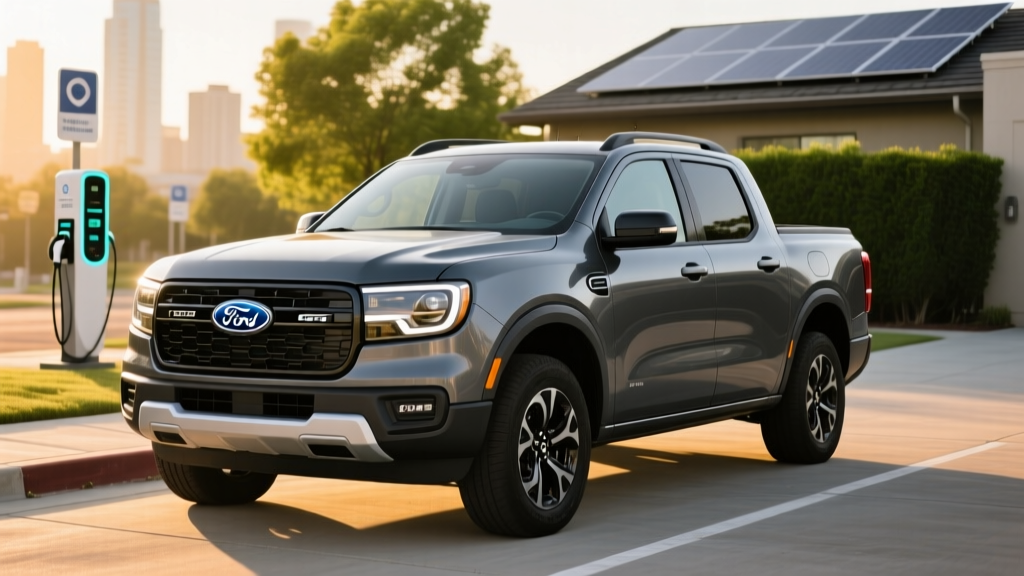
The compact truck segment has only one true hybrid option, and it wears a Blue Oval. The 2025 Ford Maverick Hybrid pairs a 2.5-liter Atkinson-cycle four-cylinder with an electric motor for a combined 194 horsepower—and for 2025, Ford finally added all-wheel drive to the hybrid powertrain, a move buyers have demanded since the truck's 2022 debut. But does adding AWD compromise the Maverick Hybrid's headline fuel economy? We dug into the EPA numbers, real-world driving data, and ownership economics to find out.
2025 Ford Maverick Hybrid AWD: EPA MPG Ratings
The addition of all-wheel drive to the hybrid lineup for 2025 splits the Maverick's fuel economy story into two chapters. The front-wheel-drive hybrid remains the efficiency champion, while the AWD variant trades a few MPG for year-round traction.
| Drivetrain | City MPG | Highway MPG | Combined MPG | Estimated Range |
|---|---|---|---|---|
| FWD Hybrid | 42 | 33 | 38 | ~507 mi (13.5-gal tank) |
| AWD Hybrid | 40 | 34 | 37 | ~499 mi (13.5-gal tank) |
| AWD 2.0L EcoBoost (gas) | 22 | 29 | 25 | ~337 mi (13.5-gal tank) |
According to fueleconomy.gov, the AWD Hybrid loses just 1 MPG combined versus the FWD version—a remarkably small penalty for gaining a second driven axle. The city-heavy advantage (40 city vs. 34 highway) reflects how the hybrid system recovers energy during stop-and-go driving, using the electric motor extensively at low speeds.
HEV vs. PHEV vs. EV: Where the Maverick Hybrid Fits
The Maverick Hybrid is a conventional hybrid electric vehicle (HEV), not a plug-in hybrid. This is a critical distinction that confuses many shoppers.
Conventional Hybrid (HEV)
- No plug required. The battery charges via regenerative braking and the gas engine.
- Small battery (~1.1 kWh usable in the Maverick).
- Electric motor assists the engine; cannot drive on electric power alone for meaningful distances.
- Best for: Drivers who want better MPG without changing habits or needing charging access.
Plug-In Hybrid (PHEV)
- Plugs in to charge. Larger battery (typically 12-25 kWh).
- 20-40 miles of electric-only range before the gas engine kicks in.
- Requires home or workplace charging to maximize value.
- Best for: Drivers with short commutes and reliable charging access who still want gas-engine range for road trips.
Ford does not offer the Maverick as a PHEV or a battery-electric vehicle (BEV). If you need a plug-in compact truck, the closest competitor is the Ford F-150 Lightning (full BEV) or the Hyundai Santa Cruz (gas-only, no hybrid). The Maverick Hybrid occupies a unique niche: it's the only compact truck you can buy that sips fuel like a midsize sedan without ever needing a charging cable.
Powertrain Deep Dive: What Makes the Maverick Hybrid Tick
| Specification | Detail |
|---|---|
| Engine | 2.5L Atkinson-cycle inline-4 |
| Engine Output | 162 hp / 155 lb-ft torque |
| Electric Motor | Permanent-magnet synchronous, integrated in transaxle |
| Motor Output | 131 hp / 176 lb-ft torque |
| Combined System Output | 194 hp |
| Transmission | eCVT (planetary gearset, no fixed gears) |
| AWD System | Rear electric motor (eAWD), no mechanical driveshaft |
| Hybrid Battery | ~1.1 kWh, lithium-ion (NMC chemistry) |
| 0-60 mph | ~7.8 seconds (est.) |
| Max Towing | 2,000 lbs (hybrid); 4,000 lbs with 2.0L EcoBoost + 4K Tow pkg |
| Payload | ~1,500 lbs |
The Maverick's eAWD system is worth highlighting. Unlike traditional AWD setups that use a mechanical driveshaft from the transmission to the rear axle, Ford uses a separate rear-mounted electric motor that engages the rear wheels only when slip is detected or when extra traction is needed. This eliminates parasitic drivetrain loss during normal cruising, which is why the AWD Hybrid's MPG penalty is so small.
The eCVT transmission isn't a belt-and-cone CVT like you'd find in some competitors. It's a planetary gearset that seamlessly blends engine and motor power. The result is smooth, linear acceleration without the "rubber band" effect that gives traditional CVTs a bad reputation. That said, the 194-hp combined output means this is not a quick truck—it's adequate for merging and passing but won't win any drag races.
Pricing, Trims, and Tax Credit Eligibility
The 2025 Maverick Hybrid is available across multiple trims, with AWD offered on most of them. Pricing reflects Ford's strategy of making the hybrid powertrain accessible rather than premium.
| Trim | AWD Hybrid MSRP (est.) | Key Features |
|---|---|---|
| XL | ~$28,990 | 8" touchscreen, Ford Co-Pilot360, 4-bed tie-downs |
| XLT | ~$30,490 | Alloy wheels, keyless entry, cruise control |
| Lariat | ~$34,490 | Leatherette seats, power driver seat, ambient lighting |
| Lobo (performance-styled) | Not available with hybrid | EcoBoost only |
| Tremor (off-road) | ~$38,990 | Off-road suspension, skid plates, tow hooks |
Battery Warranty, Reliability, and Long-Term Costs
Hybrid battery longevity remains one of the top concerns for buyers considering their first electrified vehicle. Here's what the data shows for the Maverick Hybrid.
- Hybrid Battery: 8 years / 100,000 miles (whichever comes first). Covers defects and capacity loss below a defined threshold.
- Hybrid System Components: 8 years / 100,000 miles (inverter, electric motor, eCVT).
- Powertrain (engine): 5 years / 60,000 miles.
- Bumper-to-Bumper: 3 years / 36,000 miles.
Ford's hybrid battery warranty aligns with the industry standard set by Toyota and Hyundai. In practice, modern lithium-ion hybrid batteries experience minimal degradation because they operate in a narrow state-of-charge window (typically 40-60%), never fully charging or fully depleting. This is vastly different from a BEV battery that cycles through 10-90% daily.
Real-world reliability data is still maturing for the Maverick Hybrid (introduced for the 2022 model year), but Ford's 2.5L hybrid powertrain has been in production since 2020 in the Escape Hybrid and has proven robust. Toyota's decades of hybrid taxi fleet data—covering millions of miles on similar nickel-metal-hydride and lithium-ion packs—suggests hybrid batteries routinely last 150,000-200,000+ miles before significant capacity loss.
If a hybrid battery does need replacement out of warranty, expect a cost in the range of $2,000-$4,000 for a refurbished or new pack, plus labor. This is substantially less than a BEV battery replacement ($8,000-$20,000+) because the Maverick's hybrid battery is roughly 1.1 kWh—about 1/70th the size of a typical EV battery.
Who Should Choose the Maverick Hybrid (And Who Shouldn't)
Choose the Maverick Hybrid AWD If:
- You commute in stop-and-go traffic and want 40 MPG city
- You need a truck bed occasionally but drive a car-sized vehicle daily
- You live in a region with rain or snow but don't need hardcore off-road capability
- You don't have access to home or workplace EV charging
- You want low fuel costs without changing any habits (no plugging in)
- Your towing needs stay under 2,000 pounds
Look Elsewhere If:
- You regularly tow more than 2,000 lbs (get the 2.0L EcoBoost with 4K Tow package)
- You need serious off-road capability (consider the Maverick Tremor with EcoBoost, or a Tacoma TRD)
- You want a plug-in vehicle to access HOV lanes or qualify for the $7,500 federal tax credit
- You want EV-only daily commuting (consider a PHEV like the RAV4 Prime or a full BEV)
- You need a full-size truck bed or 7,000+ lb towing (F-150 Lightning or F-150 PowerBoost Hybrid)
Ownership Economics: Maverick Hybrid vs. EcoBoost vs. Gas Competitors
The financial case for the Maverick Hybrid rests on its fuel-cost advantage over the gas-only EcoBoost and competitors like the Hyundai Santa Cruz and Chevrolet Colorado.
| Vehicle | Combined MPG | Annual Fuel Cost | 5-Year Fuel Cost |
|---|---|---|---|
| Maverick Hybrid AWD | 37 | $1,378 | $6,892 |
| Maverick AWD 2.0L EcoBoost | 25 | $2,040 | $10,200 |
| Hyundai Santa Cruz AWD (turbo) | 22 | $2,318 | $11,591 |
| Chevrolet Colorado AWD (turbo) | 21 | $2,429 | $12,143 |
Over five years, the Maverick Hybrid AWD saves approximately $3,308 in fuel versus the EcoBoost AWD and $4,700+ versus turbocharged competitors. The hybrid powertrain adds roughly $1,000-$1,500 to the MSRP versus the equivalent EcoBoost trim (depending on configuration), meaning the fuel savings pay back the price premium in approximately 2-3 years for a typical driver.
Insurance costs for the Maverick Hybrid are competitive with the gas model—typically within 3-5% according to aggregated quote data. Maintenance costs are lower than the EcoBoost: the hybrid system has no additional service intervals, and regenerative braking extends brake pad life significantly (many hybrid owners report 80,000+ miles on original pads).
Frequently Asked Questions
How many MPG does the 2025 Ford Maverick Hybrid AWD actually get?
The EPA rates the AWD Hybrid at 40 city / 34 highway / 37 combined MPG. Real-world mixed driving typically yields 35-38 MPG, with city-heavy routes sometimes exceeding the EPA city rating. Highway-only driving at 75+ mph and cold weather can reduce observed fuel economy to 32-34 MPG combined.
Does the Maverick Hybrid need to be plugged in?
No. The Maverick Hybrid is a conventional hybrid (HEV), not a plug-in hybrid (PHEV). Its small 1.1 kWh battery charges automatically through regenerative braking and the gasoline engine. You fuel it like any other gas vehicle—just less often.
Does the 2025 Maverick Hybrid qualify for any federal tax credit?
No. The IRS §30D clean vehicle credit applies only to plug-in vehicles (PHEVs and BEVs). The Maverick Hybrid, as a conventional HEV, does not qualify for the up-to-$7,500 federal credit. Check your state and local utility for possible hybrid incentives, which vary by jurisdiction.
How long will the Maverick Hybrid battery last, and what does replacement cost?
Ford warranties the hybrid battery for 8 years / 100,000 miles. Based on industry data from similar hybrid systems, these batteries commonly last 150,000-200,000+ miles. Out-of-warranty replacement runs approximately $2,000-$4,000 for the battery pack—far less than a full EV battery replacement.
Is the AWD system always engaged?
No. The Maverick's eAWD system uses a rear electric motor that activates only when front-wheel slip is detected or additional traction is needed (acceleration from stop, wet/icy roads). During steady-state cruising, the truck operates in front-wheel drive to maximize fuel efficiency.
Can I tow with the Maverick Hybrid AWD?
Yes, but with limits. The Maverick Hybrid is rated for 2,000 pounds of towing capacity—enough for a small utility trailer, a pair of dirt bikes, or a light popup camper. If you need 4,000 pounds of towing, you'll need the 2.0L EcoBoost engine with the optional 4K Tow package (not available with the hybrid).