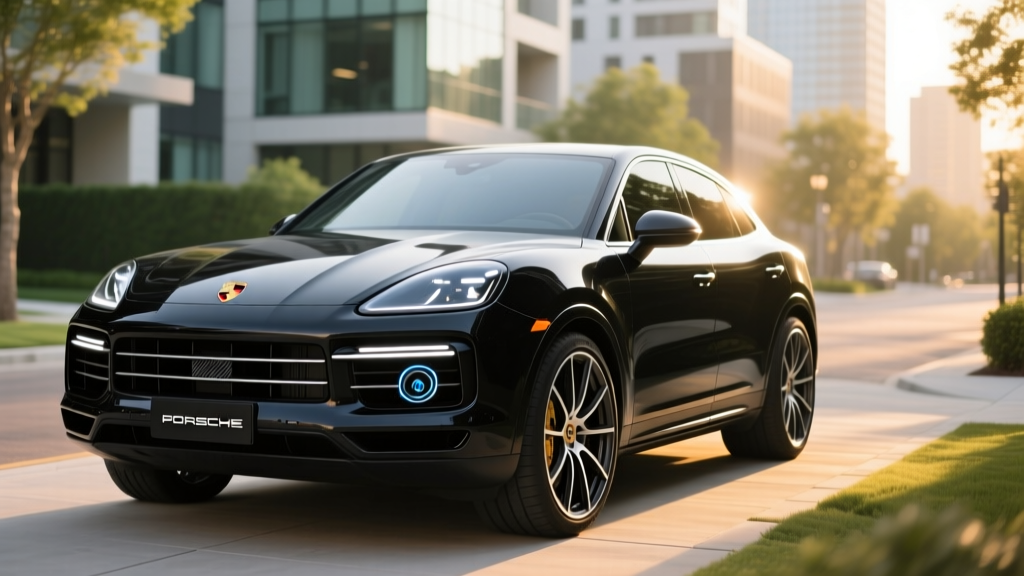
The Porsche Cayenne has long been the benchmark for performance SUVs, but the 2026 Cayenne Turbo E-Hybrid asks a provocative question: can a 5,700-pound luxury haulier deliver supercar acceleration and silent, zero-tailpipe-emission school runs? As Porsche's most powerful production SUV ever, the Turbo E-Hybrid pairs a twin-turbo V8 with a substantially uprated electric motor and a 25.9 kWh battery to produce 729 horsepower. This guide breaks down the real-world efficiency, electric-only range, charging logistics, and ownership math that Porsche's marketing brochures tend to gloss over.
HEV vs PHEV: Where the Cayenne Turbo E-Hybrid Fits
Before diving into specs, it's worth clarifying terminology because Porsche's naming can confuse first-time hybrid buyers:
Conventional Hybrid (HEV): A small battery (typically 1–2 kWh) recharges via regenerative braking and the engine. You never plug it in. Examples: Toyota RAV4 Hybrid, Honda CR-V Hybrid. Fuel savings come from electric assist at low speeds.
Plug-in Hybrid (PHEV): A much larger battery (15–30+ kWh) that you do plug in, enabling 20–50 miles of pure electric driving before the gas engine takes over. The Cayenne Turbo E-Hybrid is a PHEV.
Battery Electric (BEV): No gas engine at all. The Taycan is Porsche's BEV counterpart in the performance space.
The Cayenne Turbo E-Hybrid is strictly a PHEV — there is no conventional HEV variant in the current Cayenne lineup. If you don't plan to plug in regularly, you're paying a premium for battery weight you won't benefit from.
Powertrain and Performance: 729 HP Explained
The Turbo E-Hybrid's powertrain is a thorough rework of the standard E-Hybrid setup. Here's how the numbers stack up:
| Specification | Figure |
|---|---|
| Engine | 4.0L twin-turbo V8 (591 hp) |
| Electric motor (integrated in transmission) | 174 hp / 339 lb-ft |
| Combined system output | 729 hp / 664 lb-ft |
| 0–60 mph | 3.5 seconds (manufacturer) |
| Top track speed | 183 mph |
| Transmission | 8-speed Tiptronic automatic |
| Drivetrain | All-wheel drive (AWD) |
| Battery (gross / usable) | 25.9 kWh gross (~21–22 kWh usable) |
| Battery chemistry | NMC lithium-ion |
| Curb weight | ~5,700 lb |
The electric motor now sits between the engine and transmission and can propel the Cayenne on its own at speeds up to 84 mph — meaning most suburban and highway commuting can happen in pure electric mode if the battery is charged. Porsche's E-Priority mode defaults to electric drive whenever possible, only waking the V8 under hard acceleration or when battery charge is depleted.
Electric-Only Range and Total Range
EPA-estimated electric range: ~30 miles (WLTP is higher at ~44 mi, but EPA testing is more conservative and reflects real-world US driving).
Real-world expectation: Plan on 22–28 miles of usable electric range in mixed driving. Cold weather (below 40°F) and sustained highway speeds above 70 mph can reduce this to 18–22 miles. In warm city driving with regen braking, 30+ miles is achievable.
Total combined range (gas + electric): Approximately 440–470 miles on a full tank and full charge, based on the 19.8-gallon fuel tank and combined MPGe once the battery is depleted.
Thirty miles of electric range sounds modest next to a BEV, but for a PHEV it's meaningful: the average American drives ~29 miles per day according to FHWA data. Owners with home charging and short commutes may go weeks without the V8 firing up.
MPG, MPGe, and Real-World Efficiency
PHEV efficiency is reported two ways, and conflating them is a common mistake:
| Mode | City | Highway | Combined |
|---|---|---|---|
| Charge-depleting (EV + gas, first ~30 mi) | ~46 MPGe combined (EPA estimate) | ||
| Charge-sustaining (battery depleted, gas only) | ~17 MPG | ~22 MPG | ~19 MPG |
Real-world MPG vs EPA: Once the battery is empty, expect roughly 17–20 MPG combined in normal driving. This is a heavy, powerful V8 SUV — efficiency when running on gasoline alone is closer to a BMW X5 M than a Prius. However, if you plug in nightly and drive under 30 miles daily, your effective gasoline consumption could drop to near zero for months at a time.
According to fueleconomy.gov, PHEV owners who charge regularly report fuel consumption 40–60% lower than the charge-sustaining figure suggests. The flip side: skip the plug and you're hauling 5,700 pounds with a thirsty V8 and dead battery weight.
Charging: Levels, Times, and the DC Fast-Charging Question
The Cayenne Turbo E-Hybrid uses a J1772/CCS1 inlet for AC charging. Here's what to expect at each charging level:
| Level | Power | 0–100% Time | Notes |
|---|---|---|---|
| Level 1 (120V household) | ~1.4 kW | ~17 hours | Emergency/top-up only |
| Level 2 (240V home/public) | Up to 11 kW (onboard charger) | ~2.5 hours (0–100%) | Recommended daily charging method |
| DC Fast Charging | Not available | N/A | Cayenne PHEVs do not support DCFC |
Critical note: The Cayenne Turbo E-Hybrid cannot DC fast charge. This is a deliberate Porsche engineering choice — the 25.9 kWh battery is small enough that AC Level 2 charging refills it in roughly 2.5 hours, which covers overnight and workplace scenarios. If you need road-trip fast charging, a BEV like the Taycan (which charges at up to 270 kW DC) is the better tool.
For home charging, Porsche recommends a Level 2 wallbox on a dedicated 48-amp/60-amp circuit. Installation typically runs $800–$2,500 depending on panel proximity and local permitting, on top of $500–$1,200 for the charger itself. The optional Porsche Mobile Charger Connect includes a NEMA 14-50 plug for a simpler (if slower) setup.
Pricing, Trims, and Tax Credit Eligibility
The Cayenne Turbo E-Hybrid sits at the top of the Cayenne lineup. Pricing for the 2026 model year (estimated based on current trajectory):
- Cayenne Turbo E-Hybrid (SUV): ~$151,000 MSRP (base, before options and destination)
- Cayenne Turbo E-Hybrid Coupé: ~$156,000 MSRP
Options (ceramic brakes, Sport Chrono, premium leather, rear-axle steering) can push the as-tested price well past $175,000.
Federal Tax Credit (§30D) — The Bad News
Under current IRS §30D rules, the Cayenne Turbo E-Hybrid does not qualify for the $7,500 federal EV tax credit. Multiple disqualifying factors apply:
- MSRP cap: §30D limits SUVs to a $80,000 MSRP ceiling. The Turbo E-Hybrid starts above $150,000.
- Buyer income cap: Even if MSRP qualified, AGI limits ($150k single / $300k joint) would exclude most buyers in this price bracket.
- Critical minerals & battery sourcing: Porsche's battery supply chain has not met the escalating domestic-content thresholds for 2026.
Source: IRS §30D guidance. Some states offer separate PHEV rebates (California's CVRP, for example, has its own income and MSRP limits that also likely exclude this vehicle). Always consult a tax professional for your specific situation.
Battery Warranty, Lifespan, and Replacement Cost
Porsche PHEV battery warranty: 8 years / 100,000 miles (whichever comes first), covering defects and capacity loss below a specified threshold (typically 70% of original capacity).
Expected battery lifespan: NMC chemistry in a thermally managed pack like the Cayenne's should retain 80–90% capacity at 10 years with normal use. Porsche's liquid-cooled battery system mitigates the heat degradation that plagued early PHEVs.
Out-of-warranty replacement cost: Based on comparable Porsche and VW Group PHEV battery pricing, expect $12,000–$18,000 for a full high-voltage battery replacement if needed beyond warranty coverage. Individual module replacement (if supported) could be substantially less.
The 8-year/100,000-mile hybrid battery warranty is federally mandated minimum for emissions-related components, and Porsche matches this standard. In practice, well-maintained PHEV batteries from VW Group vehicles have shown strong longevity — the Panamera E-Hybrid (which shares architecture) has demonstrated less than 10% degradation over 6 years in owner-reported data.
Who Should Buy the Cayenne Turbo E-Hybrid?
Choose the Cayenne Turbo E-Hybrid if:
- You want supercar-level acceleration (3.5s 0–60) in a practical SUV
- You have home or workplace Level 2 charging and a commute under 30 miles
- You value silent electric driving around town but need 400+ mile total range for road trips
- Tax credits aren't a factor in your purchase decision at this price point
Choose a full BEV (Taycan, Model X, iX) instead if:
- You want zero gasoline maintenance (no oil, no V8 service intervals)
- Your daily drive exceeds 30 miles and you'd rather not manage gas + charging
- DC fast charging for road trips matters to you
Choose a conventional HEV or less expensive PHEV if:
- Fuel economy is your primary goal, not performance
- You lack regular plug-in access — the Turbo E-Hybrid's efficiency penalty without charging is significant
Pros
- 729 hp / 3.5s 0–60 in a luxury SUV — among the fastest production crossovers
- ~30 miles of real electric commuting range covers most daily driving
- Porsche build quality, chassis dynamics, and braking performance
- No range anxiety — V8 takes over seamlessly when battery depletes
- Quiet electric mode transforms the character of school runs and city driving
Cons
- $151,000+ MSRP; no federal tax credit eligibility
- ~19 MPG on gas alone when battery is depleted — thirsty for daily errands beyond EV range
- No DC fast charging — road trips rely entirely on the gas tank
- 5,700 lb curb weight affects handling vs lighter Cayenne trims
- Level 2 charge time of ~2.5 hours means midday top-ups are impractical
Reliability and Ownership Considerations
Porsche's hybrid systems have proven more reliable than early industry efforts, and the Cayenne E-Hybrid architecture has been in production since 2019 with iterative updates. Common ownership considerations:
- Maintenance: The V8 still requires regular oil changes, spark plugs, and transmission service. Budget $1,500–$3,000 annually for scheduled maintenance, more if you track the vehicle.
- Brake wear: Regenerative braking significantly extends pad life — many PHEV owners report 60,000+ miles on original brake pads.
- Insurance: Expect premiums 15–25% higher than a base Cayenne, reflecting the vehicle's value, performance, and repair complexity. Get quotes before purchase.
- Depreciation: High-end PHEVs have historically depreciated faster than their BEV or gas counterparts in the first 3 years, though Porsche's brand strength helps. Plan for 40–55% value loss over 5 years.
Frequently Asked Questions
How many MPG does the Cayenne Turbo E-Hybrid get?
Once the battery is depleted, expect approximately 17 city / 22 highway / 19 combined MPG on gasoline alone. With regular plug-in charging and short commutes, effective fuel consumption can be dramatically lower — some owners report going weeks between fill-ups.
How far can it go on electric only?
The EPA estimates ~30 miles of electric-only range. Real-world results vary: 22–28 miles in typical mixed driving, up to 30+ in warm city conditions, and as low as 18–22 miles in cold weather or sustained highway driving above 70 mph.
Does the Cayenne Turbo E-Hybrid qualify for a tax credit?
No. The 2026 Cayenne Turbo E-Hybrid does not qualify for the $7,500 federal §30D clean vehicle credit due to its MSRP exceeding the $80,000 SUV cap, buyer income limitations, and battery-sourcing requirements. State-level incentives are unlikely to apply at this price point either.
Is this hybrid reliable, and what does battery replacement cost?
Porsche's PHEV system has a solid reliability track record since 2019. The high-voltage battery is warrantied for 8 years / 100,000 miles. Out-of-warranty replacement is estimated at $12,000–$18,000, though most packs are expected to last the life of the vehicle with normal use.
Hybrid vs PHEV vs EV — which Cayenne should I choose?
The Cayenne lineup currently offers only PHEV electrification (no conventional HEV). If you want full electric, look at the Taycan. If you want Cayenne utility with electric commuting and no range anxiety, the E-Hybrid variants (including the Turbo E-Hybrid) are the answer. If you never plan to plug in, a standard gas Cayenne will cost less and perform similarly once the PHEV battery is dead weight.
Can I DC fast charge the Cayenne Turbo E-Hybrid?
No. The Cayenne PHEV supports only AC charging — Level 1 (120V) and Level 2 (240V). A full 0–100% charge on Level 2 takes approximately 2.5 hours. This is adequate for overnight home charging but means no rapid top-ups on road trips.
What's the difference between the Cayenne Turbo E-Hybrid and the standard E-Hybrid?
The standard Cayenne E-Hybrid produces ~463 hp from a turbocharged V6 and electric motor, with similar electric range but a significantly lower starting price (~$95,000). The Turbo E-Hybrid's V8, 729 hp, and performance hardware justify a $55,000+ premium only if maximum acceleration and exclusivity are priorities.
Sources: Porsche AG official specifications, fueleconomy.gov, IRS §30D clean vehicle credit guidance. Specifications reflect announced/estimated 2026 model-year data and are subject to change. Consult Porsche.com for final EPA certifications and a tax professional for credit eligibility.