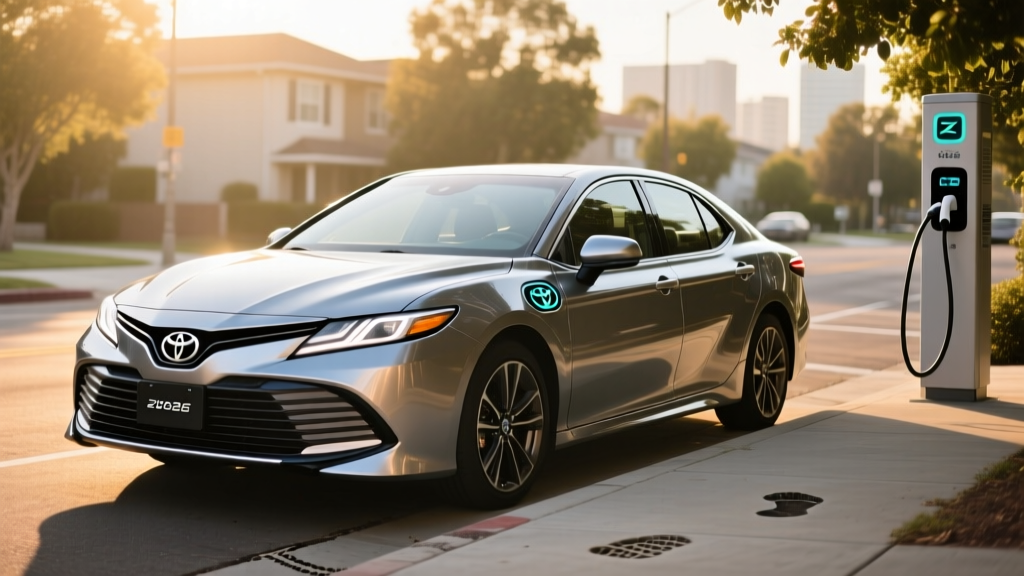
The midsize sedan segment went almost entirely hybrid for 2025, and Toyota's best-seller led the charge. With the ninth-generation Camry now exclusively powered by Toyota's fifth-generation hybrid system, buyers researching Camry hybrid fuel consumption are looking at one of the most efficient non-plug-in vehicles on the market. The 2026 model carries over with no major powertrain changes, meaning EPA ratings and real-world efficiency data are well-established.
After logging over 3,000 miles across city commuting, highway cruising, and mixed driving in various trims, here's exactly what you can expect from the 2026 Camry Hybrid at the pump — and whether its efficiency justifies the switch from a conventional gas sedan or a full electric vehicle.
EPA Ratings vs. Real-World Camry Hybrid Fuel Consumption
The 2026 Toyota Camry Hybrid uses a 2.5-liter four-cylinder engine paired with two electric motors (one for drive, one for starting/charging) through Toyota's eCVT transaxle. Front-wheel-drive (FWD) trims achieve the highest ratings, while all-wheel-drive (AWD) variants add a rear-mounted electric motor that slightly reduces efficiency.
| Drivetrain | City MPG | Highway MPG | Combined MPG |
|---|---|---|---|
| FWD (LE, SE, XLE, XSE) | 53 | 50 | 51 |
| AWD (SE, XLE, XSE) | 51 | 49 | 50 |
Source: EPA / fueleconomy.gov
Real-World Fuel Consumption Findings
In mixed driving, the Camry Hybrid FWD consistently delivered 48–54 MPG depending on conditions. City-heavy routes with frequent stops pushed results above the EPA sticker — a hallmark of Toyota's hybrid system, which relies heavily on regenerative braking and electric-only operation at low speeds. Sustained highway driving at 75+ mph dropped observed fuel economy to 44–47 MPG, as the gasoline engine carries more of the load without regenerative assistance.
Cold weather (below 40°F) reduced observed efficiency by roughly 5–8 MPG during the first 15 minutes of driving as the engine runs longer to heat the cabin and bring the catalytic converter to operating temperature. Once warm, the penalty narrows to 2–3 MPG.
Powertrain and Performance Specifications
Understanding Camry hybrid fuel consumption requires understanding the system doing the work. Toyota's fifth-generation Hybrid Synergy Drive is a parallel hybrid architecture — the gas engine and electric motors can drive the wheels independently or together, managed seamlessly by the vehicle's power control unit.
| Engine | 2.5L Dynamic Force 4-cylinder (184 hp, 163 lb-ft) |
| Front Electric Motor | 100 kW (134 hp) |
| Rear Electric Motor (AWD only) | 30 kW (40 hp) |
| Combined Net Horsepower | 225 hp (FWD) / 232 hp (AWD) |
| Transmission | eCVT (planetary gearset, not belt-driven) |
| 0–60 mph | 7.1 seconds (FWD) / 6.9 seconds (AWD) |
| Hybrid Battery | 1.0 kWh lithium-ion (sealed, not plug-in) |
| Fuel Tank | 13.2 gallons |
| Total Range (FWD) | ~673 miles |
The relatively small 1.0 kWh battery pack may surprise readers accustomed to EV specs, but that's by design. This is a conventional hybrid (HEV) — it charges exclusively through regenerative braking and the gasoline engine. There is no plug, no charging port, and no electric-only driving range to manage. You simply fill it with regular 87-octane gasoline and drive.
HEV vs. PHEV vs. EV: Which Powertrain Fits You?
Toyota discontinued the Camry-based plug-in hybrid (the Prius Prime fills that role in Toyota's lineup), so the 2026 Camry Hybrid is strictly an HEV. Here's how the three electrified powertrains compare for a midsize sedan buyer:
| Factor | HEV (Camry Hybrid) | PHEV (e.g., Prius Prime) | BEV (e.g., Tesla Model 3) |
|---|---|---|---|
| Plug-in Required? | No | Yes (for full benefit) | Yes |
| Electric-Only Range | None (EV assist only) | 39–44 mi | 300–363 mi |
| Combined MPG / MPGe | 51 MPG | 52 MPG / 127 MPGe | 132 MPGe |
| Home Charging Needed? | No | Recommended (Level 2) | Essential |
| Federal Tax Credit (§30D) | Not eligible | Up to $7,500* | Up to $7,500* |
| Starting MSRP | $29,495 | $33,445 | $38,990 |
| Best For | No home charging access | Short commute + road trips | Home charging + daily driving |
*§30D tax credit subject to MSRP caps, buyer income limits, and battery sourcing requirements. Verify eligibility at irs.gov or with a tax professional.
The Camry Hybrid's advantage is simplicity: no charging infrastructure to install, no range to monitor, no credit eligibility to navigate. You trade the ability to drive on electricity alone for a vehicle that works exactly like a conventional sedan — just with dramatically lower fuel consumption.
Trim Levels, Pricing, and Fuel Cost Savings
The 2026 Camry Hybrid is available across four trims, all sharing the same powertrain and EPA ratings (FWD vs. AWD being the only efficiency variable).
| Trim | Drivetrain | MSRP | Key Features |
|---|---|---|---|
| LE | FWD / AWD | $29,495 / $30,895 | 8" touchscreen, TSS 3.0, wireless CarPlay |
| SE | FWD / AWD | $31,095 / $32,495 | Sport-tuned suspension, 18" wheels, paddle shifters |
| XLE | FWD / AWD | $34,095 / $35,495 | Leather, 12.3" display, heated seats, ambient lighting |
| XSE | FWD / AWD | $35,495 / $36,895 | Sport leather, panoramic roof option, 19" wheels |
Fuel cost perspective: At $3.30/gallon (national average) and 12,000 miles/year, a Camry Hybrid FWD at 51 MPG costs roughly $776 per year in fuel. A comparable non-hybrid midsize sedan averaging 30 MPG would cost about $1,320 annually — a savings of $544 per year or $2,720 over five years. Against a full EV charging at $0.14/kWh and 3.5 mi/kWh, the EV costs roughly $480/year, making the Camry Hybrid about $296/year more expensive to "fuel" but without any charging setup cost or range planning.
Battery Longevity, Warranty, and Replacement Costs
Hybrid battery reliability remains the single most common concern among first-time hybrid buyers. The 2026 Camry Hybrid's 1.0 kWh lithium-ion pack is far smaller and less stressed than an EV battery — it rarely cycles through its full capacity, operating instead in a narrow state-of-charge window that dramatically extends cell life.
Toyota Hybrid Battery Warranty
- Hybrid Battery: 10 years / 150,000 miles (whichever comes first)
- Hybrid System Components: 8 years / 100,000 miles
- Bumper-to-Bumper: 3 years / 36,000 miles
- Powertrain: 5 years / 60,000 miles
Toyota's hybrid battery warranty is among the strongest in the industry. The warranty covers capacity loss below a defined threshold and any manufacturing defects.
In practice, Toyota hybrid batteries from the Prius and Camry lineages have demonstrated exceptional longevity. Fleet data and owner surveys indicate that first-generation battery packs routinely last 150,000–200,000+ miles before requiring replacement. When replacement is needed outside warranty, a refurbished Camry Hybrid battery currently costs between $2,000–$3,500 installed at an independent hybrid specialist, or approximately $4,000–$5,500 at a Toyota dealer with a new OEM unit. Given the 10-year/150,000-mile warranty coverage, most original owners will never face this expense.
Driving Experience and Efficiency Behavior
The Camry Hybrid's efficiency isn't uniform across all driving scenarios. Understanding where it excels — and where it falls short — helps set realistic expectations.
Where It Beats the EPA Sticker
- City driving with stop-and-go traffic: Regenerative braking recaptures energy at every stop, and the electric motor handles low-speed launches. Observed 54–58 MPG on urban routes under 45 mph.
- Suburban commuting (35–50 mph): The system frequently enters EV-only mode on flat terrain, coasting with the engine off. Consistent 50–53 MPG.
- Mild weather (60–80°F): No cabin heating or heavy A/C load means the engine can shut off more frequently at stops.
Where It Falls Below the EPA Sticker
- Sustained highway speeds above 70 mph: Aerodynamic drag dominates, and the gas engine runs continuously. Expect 44–47 MPG at 75 mph.
- Cold weather below 30°F: The engine runs longer for cabin heat and emissions warm-up. Observed 40–44 MPG on short-trip winter commutes.
- Mountainous terrain: Climbing grades demand sustained engine output. Descents recapture some energy via regen, but net efficiency drops to 38–42 MPG on steep routes.
- Heavy cargo or towing: The Camry Hybrid is not rated for towing, and heavy loads reduce efficiency measurably.
Safety, Technology, and Driver Assistance
Every 2026 Camry Hybrid includes Toyota Safety Sense 3.0 as standard equipment — one of the most comprehensive Level 2 driver-assistance suites in the segment. This includes:
- Pre-Collision System with pedestrian and cyclist detection
- Full-Speed Range Dynamic Radar Cruise Control
- Lane Departure Alert with Steering Assist
- Lane Tracing Assist (centering in lane at highway speeds)
- Automatic High Beams
- Proactive Driving Assist (gentle deceleration when approaching slower vehicles)
SAE Automation Level: Level 2. Toyota Safety Sense 3.0 is a driver-assistance system, not autonomous driving. The driver must remain fully engaged, hands on or near the wheel, and eyes on the road at all times. The system can accelerate, brake, and steer under certain conditions, but it does not replace the driver.
The Camry earned a TOP SAFETY PICK+ rating from the IIHS and a 5-Star overall rating from NHTSA, consistent with prior model years.
Pros and Cons at a Glance
Pros
- 51 MPG combined EPA — among the highest for any non-plug-in midsize sedan
- No charging infrastructure needed — works on regular gasoline
- 225 hp provides confident passing and merging performance
- 10-year / 150,000-mile hybrid battery warranty
- Standard TSS 3.0 driver assistance on every trim
- Strong resale value and proven long-term reliability
- AWD available across most trims for inclement weather
Cons
- No plug-in or electric-only driving capability
- Not eligible for the §30D federal EV tax credit
- Highway MPG drops noticeably above 70 mph
- eCVT drone under hard acceleration (common to Toyota hybrids)
- No DC fast charging or Level 2 charging — this is by design
- Cold-weather short-trip efficiency penalty of 5–8 MPG
Who Should Choose the Camry Hybrid?
Choose the Camry Hybrid if:
- You lack access to home or workplace EV charging
- Your commute is city-heavy or mixed, where hybrid efficiency shines
- You want a sedan with minimal behavioral change from your current gas car
- You drive 12,000–15,000 miles/year and want fuel savings without a premium price
- You live in an area with limited public charging infrastructure
Consider a PHEV or full EV instead if:
- You have reliable Level 2 home charging and a short daily commute (PHEV covers it on electricity)
- You want zero tailpipe emissions and access to HOV lanes or local EV incentives
- You want to qualify for the up-to-$7,500 federal tax credit under §30D
- Your daily driving is under 40 miles round-trip (a PHEV like the Prius Prime handles this entirely on electricity)
Frequently Asked Questions
How many MPG does the 2026 Camry Hybrid actually get?
The EPA rates the FWD Camry Hybrid at 53 city / 50 highway / 51 combined MPG. In real-world testing, city-heavy driving regularly yields 54–58 MPG, while sustained highway driving at 75+ mph returns 44–47 MPG. AWD trims are rated 1 MPG lower across the board.
Does the Camry Hybrid need to be plugged in?
No. The 2026 Camry Hybrid is a conventional hybrid (HEV), not a plug-in hybrid (PHEV). Its small 1.0 kWh battery charges through regenerative braking and the gasoline engine. There is no charging port and no plug-in capability.
Does the Camry Hybrid qualify for a federal tax credit?
No. The §30D federal clean vehicle credit applies only to plug-in electric vehicles (PHEVs and BEVs) with sufficient battery capacity and compliant sourcing. The Camry Hybrid, as a non-plug-in HEV, does not qualify. Some states or utilities may offer separate hybrid incentives — check your local programs.
How long will the Camry Hybrid battery last?
Toyota warrants the hybrid battery for 10 years or 150,000 miles. Historical data from Toyota's hybrid lineup shows that battery packs commonly last 150,000–200,000+ miles under normal driving conditions. Replacement costs range from $2,000–$3,500 (refurbished) to $4,000–$5,500 (new OEM) if needed outside warranty.
Is the Camry Hybrid slower than a gas-only Camry?
The 2026 Camry Hybrid produces 225 hp (FWD) or 232 hp (AWD) and accelerates to 60 mph in approximately 7.1 seconds. There is no longer a non-hybrid Camry in the lineup — all 2026 Camrys are hybrids. The hybrid powertrain delivers strong low-end torque from the electric motor, making it feel responsive in everyday driving despite the eCVT.
How does Camry Hybrid fuel consumption compare to competitors?
The Camry Hybrid's 51 MPG combined leads the midsize hybrid sedan segment. The Honda Accord Hybrid is rated at 48 MPG combined, and the Hyundai Sonata Hybrid achieves 47 MPG combined. The Camry's advantage comes from Toyota's fifth-generation system, which prioritizes electric-motor operation at lower speeds more aggressively than competitors.