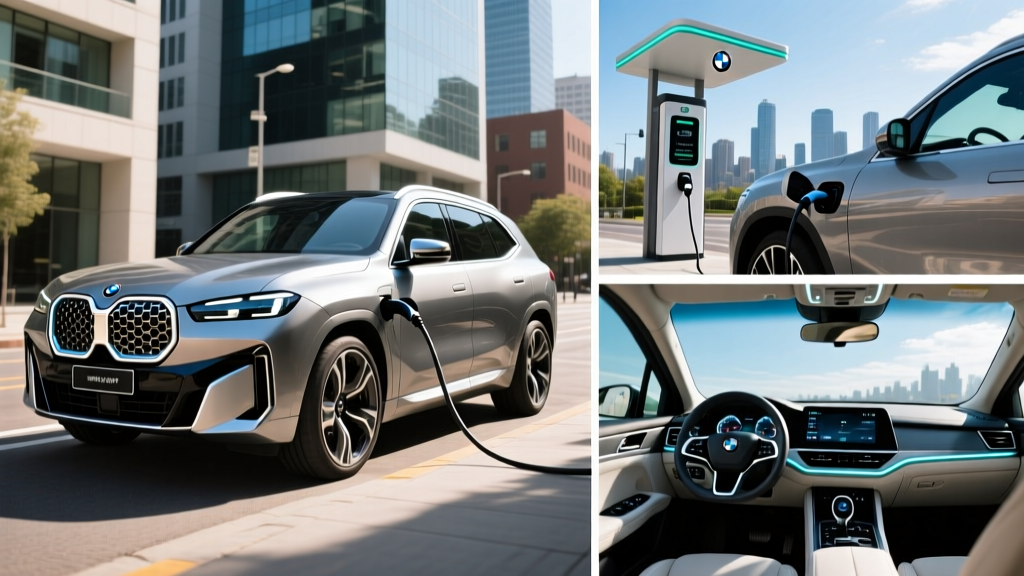
The BMW XM is not a rational purchase. It is a 6,000-pound, twin-turbo V8 luxury SUV that also happens to plug into a wall. As BMW's first standalone M division vehicle since the legendary M1, the XM exists at the intersection of excess and electrification. But for buyers drawn to its audacity, the plug-in hybrid powertrain raises practical questions: How much electric-only range do you actually get? What does real-world fuel economy look like? And does the PHEV system genuinely reduce running costs, or is it just a regulatory fig leaf?
We've broken down every spec that matters for the 2026 BMW XM lineup — the standard XM xDrive50 and the ferocious XM Label — so you can decide whether this hybrid super-SUV fits your garage and your budget.
BMW XM Powertrain: Twin-Turbo V8 Meets Electric Motor
The BMW XM is exclusively a plug-in hybrid electric vehicle (PHEV). There is no conventional hybrid (HEV) version and no gas-only variant. BMW pairs a 4.4-liter twin-turbocharged V8 engine with an electric motor integrated into the eight-speed M Steptronic transmission. The system draws energy from a lithium-ion battery pack mounted beneath the floor.
| Specification | XM xDrive50 | XM Label |
|---|---|---|
| Engine | 4.4L Twin-Turbo V8 | 4.4L Twin-Turbo V8 (S68T) |
| Engine Output | 483 hp / 516 lb-ft | 577 hp / 553 lb-ft |
| Electric Motor | 194 hp / 207 lb-ft | 194 hp / 207 lb-ft |
| Combined System Output | 644 hp / 590 lb-ft | 738 hp / 738 lb-ft |
| Transmission | 8-speed M Steptronic | 8-speed M Steptronic |
| Drivetrain | M xDrive AWD | M xDrive AWD |
| 0–60 mph | 4.1 seconds | 3.7 seconds |
| Top Speed | 155 mph (168 w/ M Driver's Pkg) | 180 mph |
The electric motor provides instant torque fill at low RPMs while the V8 builds boost, eliminating the lag typical of large twin-turbo engines. In Electric mode, the XM drives the rear wheels through the motor alone. Engage the V8 and the full all-wheel-drive system comes online.
EPA Fuel Economy and MPGe: What the Sticker Says
Because the XM is a PHEV, the EPA rates it in two ways: MPGe (miles per gallon equivalent) when operating on combined electric and gasoline power with a full battery, and standard MPG once the battery is depleted and the V8 runs solo.
| Metric | XM xDrive50 | XM Label |
|---|---|---|
| Combined MPGe (electric + gas) | 46 MPGe | 44 MPGe |
| Combined MPG (gas only, battery depleted) | 17 MPG | 16 MPG |
| City MPG (gas only) | 14 MPG | 13 MPG |
| Highway MPG (gas only) | 20 MPG | 19 MPG |
Those gas-only numbers deserve context. Once the battery is depleted, you're hauling nearly 6,000 pounds with a high-output V8 — 17 MPG combined is thirsty by any measure, but it's comparable to other performance SUVs in this weight and power class, such as the Lamborghini Urus or Mercedes-AMG G63.
Electric-Only Range and Battery Specs
The XM's high-voltage battery has a gross capacity of 25.7 kWh, with approximately 19.2 kWh usable. BMW uses a generous buffer to protect long-term battery health — a smart engineering choice, but one that reduces the headline range figure.
| Specification | Detail |
|---|---|
| Battery Gross Capacity | 25.7 kWh |
| Battery Usable Capacity | ~19.2 kWh |
| Battery Chemistry | NMC (Nickel Manganese Cobalt) |
| EPA Electric Range | 30–31 miles |
| Max AC Charging (Level 2) | 7.4 kW |
| Level 2 Charge Time (0–100%) | ~3.25 hours |
| DC Fast Charging | Not available |
| Level 1 (120V) Charge Time | ~12+ hours |
The absence of DC fast charging is notable. BMW limits the XM to Level 2 AC charging at 7.4 kW. For daily use this is perfectly adequate — plug in at home overnight and you'll wake up with a full battery every morning. But on road trips, you cannot top up the battery at a DC fast-charging station during a rest stop. Once those 30 electric miles are used, the V8 takes over until you can plug in again.
Real-World MPG: What Owners Actually See
The XM's real-world fuel economy depends entirely on your driving pattern and charging discipline. This is true of every PHEV, but the XM's extremes make the variance especially dramatic.
Best-case scenario: If your daily commute is under 30 miles round-trip and you charge every night, you may go weeks without burning gasoline. Your effective "MPG" is essentially infinite for daily driving, with the V8 reserved for longer weekend trips.
Worst-case scenario: If you never plug in and drive the XM as a conventional performance SUV, expect 14–17 MPG combined, with city driving dipping to 12–13 MPG. This is the reality for PHEV owners without reliable home or workplace charging access.
Highway road trip: At sustained 75 mph with a depleted battery, owners report 18–20 MPG — slightly better than the EPA highway figure thanks to steady-state cruising, but still thirsty. The XM's aerodynamic profile and 5,960-pound curb weight work against it.
For comparison, a conventional three-row luxury SUV like the BMW X7 xDrive40i achieves about 22 MPG combined. The XM sacrifices roughly 5 MPG combined (gas-only mode) in exchange for 644+ horsepower and 30 miles of electric range.
HEV vs PHEV vs EV: Which Powertrain Fits You?
The BMW XM is only available as a PHEV, but understanding where it sits among electrified options helps clarify whether it's the right choice.
| Factor | Conventional Hybrid (HEV) | Plug-In Hybrid (PHEV) | Battery Electric (BEV) |
|---|---|---|---|
| Plug in to charge? | No — regenerative braking only | Yes — but can drive on gas alone | Yes — electricity only |
| Electric-only range | None (electric assist only) | 20–50 miles typical | 200–400+ miles |
| Gas engine | Yes — primary power source | Yes — kicks in when battery depletes | No |
| Home charging needed? | No | Recommended for full benefit | Essential |
| Tailpipe emissions (local) | Reduced vs gas | Zero in EV mode; gas when depleted | Zero |
| Best for | No charging access; want better MPG | Short commutes + occasional long trips | Daily drivers w/ home charging |
| Example | Toyota RAV4 Hybrid | BMW XM | BMW iX |
The XM makes sense if you want supercar-rivaling performance with the option of silent, zero-emission commuting — and you're not ready to rely solely on charging infrastructure for long trips. If you drive more than 40 miles daily and have home charging, a full EV like the BMW iX M60 (324-mile range, 610 hp) might serve you better with lower running costs and no gasoline dependency.
Pricing, Trims, and Tax Credit Eligibility
| Trim | Starting MSRP | Est. After Options / Destination |
|---|---|---|
| XM xDrive50 | $159,995 | $165,000–$180,000+ |
| XM Label | $185,995 | $195,000–$210,000+ |
State-level incentives vary. Some states offer rebates or HOV lane access for PHEVs regardless of price, while others mirror federal caps. Check your state's energy or DMV website for current programs.
Battery Warranty, Reliability, and Replacement Cost
BMW's PHEV systems have been in production since the i8 in 2014 and the X5 xDrive45e before that. The M-specific variant in the XM uses a more powerful motor and higher-output battery, but the fundamental architecture is proven. The large buffer (roughly 6.5 kWh reserved at the top and bottom of the pack) reduces stress on individual cells, which should support long-term durability.
Battery replacement cost: If the high-voltage battery requires full replacement out of warranty, expect a parts-and-labor cost in the range of $12,000–$18,000. However, module-level repairs (replacing individual cell groups rather than the entire pack) can reduce this to $3,000–$6,000 depending on the failure. Given the 70% retention warranty and conservative buffer management, full pack replacement within the first decade of ownership is uncommon.
Overall vehicle reliability is difficult to project for a low-volume, first-generation M performance SUV. BMW's broader brand reliability has improved in recent years, and the S68 V8 engine family is shared with the X7 M60i and 7 Series. The main risk factors are the complexity of the combined powertrain and the XM's low production volume, which may affect parts availability.
Who Should Buy the BMW XM Hybrid?
Pros
- 644–738 hp with instant electric torque fill
- 30 miles of silent, zero-emission commuting
- No range anxiety — V8 covers any distance
- Distinctive, polarizing design that stands out
- Luxurious interior with premium materials
- Proven PHEV architecture with 8-year battery warranty
Cons
- 14–17 MPG on gas alone — expensive to fuel
- No DC fast charging capability
- Does not qualify for the $7,500 federal tax credit
- Nearly 6,000 lbs — heavy even for a performance SUV
- Limited electric range vs PHEV competitors
- Depreciation risk on a $160K+ niche vehicle
Decision Framework
Choose the BMW XM if: You want a statement performance SUV with 600+ hp, value the ability to commute silently on electric power, have reliable home charging, and budget isn't the primary constraint. You accept 15 MPG on road trips as the cost of 738 hp.
Look elsewhere if: Fuel economy is a priority (consider the BMW X5 xDrive50e PHEV at ~$68K with 38 miles EV range and 22 MPG gas-only). If you want full electric, the BMW iX M60 delivers 610 hp and 324 miles of range with zero gasoline. If you want a more practical M SUV, the X5 M or X6 M offer similar performance without the PHEV premium — though at similar fuel consumption.
Frequently Asked Questions
How many MPG does the BMW XM hybrid get?
The EPA rates the BMW XM xDrive50 at 46 MPGe combined (electric + gas) and 17 MPG combined once the battery is depleted (14 city / 20 highway). The XM Label rates at 44 MPGe and 16 MPG combined gas-only. Real-world gas-only MPG typically falls between 14–20 depending on driving style and conditions.
How far can the BMW XM go on electric only?
The EPA rates the XM at 30–31 miles of electric-only range. Real-world range is typically 25–28 miles in mixed driving, dropping to 20–23 miles at sustained highway speeds or in cold weather below 40°F.
Does the BMW XM qualify for any tax credit?
No. The BMW XM's MSRP of $159,995+ far exceeds the IRS §30D SUV cap of $80,000. It does not qualify for the federal $7,500 clean vehicle credit. Some state-level incentives may apply — check your state's energy office for details.
Can the BMW XM charge at a DC fast charger?
No. The BMW XM only supports AC charging: Level 2 at up to 7.4 kW (about 3.25 hours for a full charge) or Level 1 at 120V (12+ hours). There is no DC fast charging capability. This is common among PHEVs, which have smaller batteries that don't justify the cost and weight of DC fast-charging hardware.
Is the BMW XM reliable, and what does a battery replacement cost?
BMW's PHEV powertrain technology is mature, having been used across multiple models since 2014. The high-voltage battery carries an 8-year/80,000-mile warranty with a 70% capacity retention guarantee. Out-of-warranty full battery replacement is estimated at $12,000–$18,000, though module-level repairs are significantly cheaper. Long-term reliability data specific to the XM is still limited given its 2023 launch.
Should I get the XM xDrive50 or the XM Label?
The xDrive50 delivers 644 hp and a 4.1-second 0–60 for $159,995 — already supercar territory. The Label adds 94 hp (738 total), drops 0–60 to 3.7 seconds, and includes unique chassis tuning and aesthetic upgrades for $185,995. Unless you plan to track the vehicle or simply must have the most powerful BMW ever built, the xDrive50 provides the complete experience at a $26,000 discount.