BMW X7 Plug-In Hybrid: Quick Verdict
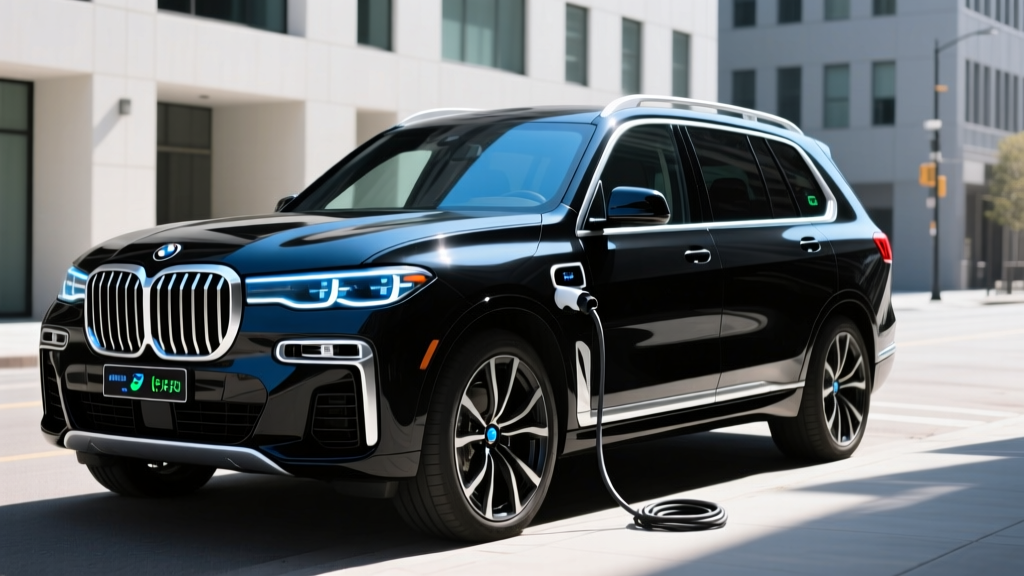
The BMW X7 xDrive60e is the plug-in hybrid (PHEV) variant of BMW's flagship three-row luxury SUV. It pairs a turbocharged inline-six with an electric motor integrated into the transmission, delivering 483 combined horsepower and approximately 30–35 miles of electric-only range. For buyers who want silent electric commuting during the week and gas-powered road trip flexibility on weekends, the X7 PHEV occupies a narrow but compelling niche. It is not a substitute for a full EV, and its $95,000+ starting price keeps it firmly in luxury territory — but as of 2026, it remains one of the few electrified three-row SUVs with genuine premium credentials.
HEV vs PHEV: What's the Difference?
Before diving into the X7 xDrive60e specifically, it's worth clarifying the distinction between conventional hybrids and plug-in hybrids, since BMW sells both architectures across its lineup:
Conventional Hybrid (HEV)
- Small battery (typically 1–2 kWh), charged by the engine and regenerative braking
- No plug-in charging required
- Electric-only driving limited to low speeds and short distances
- Improves fuel economy across all driving conditions
Plug-In Hybrid (PHEV)
- Larger battery (20+ kWh), charged via plug-in or regenerative braking
- Requires home or public charging to maximize electric range
- Can drive 20–40+ miles on electricity alone at highway speeds
- Operates as a conventional hybrid once the battery is depleted
The BMW X7 xDrive60e is a PHEV. If you cannot charge at home or work, you'll still get hybrid-level efficiency — but you'll leave most of its value proposition on the table.
EPA Fuel Economy and Electric Range
The X7 xDrive60e carries an EPA-estimated 29–31 MPGe (miles per gallon equivalent) when operating in combined electric-gas mode. Once the battery is depleted, it functions as a conventional hybrid with EPA estimates around 22–24 MPG combined.
| Mode | EPA Estimate | Real-World Expectation |
|---|---|---|
| Electric + Gas (MPGe) | ~29–31 MPGe | 26–30 MPGe (highway driving reduces) |
| Gas Only (city) | ~22–24 MPG | 23–26 MPG (city regen helps) |
| Gas Only (highway) | ~21–23 MPG | 19–22 MPG (heavy SUV, aerodynamic drag) |
| Gas Only (combined) | ~22–24 MPG | 20–23 MPG |
Real-world note: Hybrid and PHEV efficiency varies dramatically with driving style and conditions. City driving with frequent stops allows regenerative braking to recapture energy, often pushing real-world MPG above EPA estimates. Highway driving at 75+ mph in a 5,500-pound SUV works against you. In cold weather (below 30°F), expect the gasoline engine to engage more frequently for cabin heating, reducing electric-only range by 20–30%.
Electric-Only Range and Total Range
The X7 xDrive60e delivers an EPA-estimated 30–35 miles of electric-only range. This covers most daily commutes and errands without burning a drop of gasoline — provided you charge nightly.
EPA electric range: ~30–35 miles
Real-world electric range: 25–30 miles (mixed driving), 20–25 miles (highway or cold weather)
Total combined range: ~400–450 miles (electric + 24-gallon fuel tank)
The total range figure matters for road trips: you'll stop for gas roughly every 400 miles, similar to a conventional X7 xDrive40i. The electric portion simply eliminates fuel consumption for the first 30-ish miles of each trip.
Battery, Charging, and Powertrain Specs
| Specification | BMW X7 xDrive60e |
|---|---|
| Battery capacity (gross / usable) | ~25.7 kWh / ~22 kWh usable |
| Battery chemistry | NMC (nickel manganese cobalt) |
| AC charging (Level 2, 240V) | 7.4 kW onboard charger |
| DC fast charging | Not available |
| Charge time (Level 2, 0–100%) | ~3–3.5 hours |
| Engine | 3.0L turbocharged inline-6 |
| Electric motor | Integrated in 8-speed transmission |
| Combined horsepower | 483 hp |
| Combined torque | 516 lb-ft |
| 0–60 mph | ~5.5 seconds |
| Drivetrain | AWD (xDrive) |
| Towing capacity | ~5,000 lbs |
The absence of DC fast charging is typical for PHEVs in this segment. The 7.4 kW onboard charger means a full charge from a Level 2 home station takes about 3–3.5 hours — easily accomplished overnight. If you're relying on a standard 120V outlet (Level 1), expect 12–14 hours for a full charge, which still works for nightly top-ups if your daily electric use is under 20 miles.
Pricing, Trims, and Tax Credit Eligibility
The 2026 BMW X7 xDrive60e starts at approximately $95,000–$98,000 MSRP before destination charges. Options packages (Executive, M Sport, premium leather, advanced driver-assistance) can push well-equipped examples past $110,000.
Federal tax credit (§30D): As of 2026, the X7 xDrive60e is unlikely to qualify for the full $7,500 federal tax credit due to battery sourcing and critical mineral requirements under the Inflation Reduction Act. BMW's battery supply chain has not consistently met the escalating thresholds for North American mineral sourcing. Some partial credit ($3,750) may be available depending on model year and production date — but buyers should verify current eligibility on IRS.gov's qualified vehicle list before purchase. The $3,750 credit for vehicles under the MSRP cap ($80,000 for SUVs) does not apply here since the X7 exceeds that cap.
§30D credit eligibility for the X7 xDrive60e:
- MSRP cap: $80,000 for SUVs — X7 exceeds this, so federal credit is not available
- Buyer income cap: $300k joint / $225k head of household / $150k single — moot due to MSRP cap
- Battery sourcing: partial compliance, but irrelevant given MSRP cap
- State incentives: check your state's EV rebate program (some states offer PHEV rebates without MSRP caps)
Bottom line: do not count on federal tax credits when budgeting for the X7 PHEV. Some states (California, Colorado, New York) offer additional rebates that may apply — check AFDC's state incentive database for current programs.
Battery Warranty and Reliability
BMW PHEV battery warranty: 8 years / 80,000 miles (whichever comes first)
Capacity retention threshold: Battery is covered if it degrades below 70% of original capacity
Estimated replacement cost (out of warranty): $8,000–$12,000 (battery pack + labor, based on current PHEV pack pricing)
BMW's hybrid battery warranty aligns with industry standards. The 70% capacity threshold is typical — if your battery holds less than 70% of its original 22 kWh usable capacity within 8 years/80k miles, BMW replaces it at no cost. In practice, NMC batteries in PHEVs with active thermal management (which the X7 has) tend to degrade slowly, often retaining 85–90% capacity at the 8-year mark based on fleet data from similar BMW PHEV models.
Reliability concerns for the X7 PHEV center less on the battery and more on the vehicle's overall complexity: air suspension, advanced electronics, and the dual powertrain system. BMW's recent inline-six engines have proven durable, and the electric motor adds fewer moving parts than a traditional transmission. However, out-of-warranty repair costs for a flagship BMW are substantial — budget for extended warranty or prepaid maintenance if you plan to keep the vehicle past 100,000 miles.
Who Should Choose the X7 PHEV vs a Full EV or Gas SUV?
Choose the BMW X7 xDrive60e if:
- You need three rows and can charge at home nightly
- Your daily driving is under 30 miles, but you take regular road trips
- You want to reduce fuel consumption without range anxiety
- You value the X7's luxury, performance, and towing capacity
Choose a full EV (e.g., Tesla Model X, Rivian R1S) if:
- You have reliable home and workplace charging
- Your road trips are under 300 miles or you're comfortable with DC fast-charging stops
- You want zero tailpipe emissions and lower per-mile fuel costs
- You qualify for the $7,500 federal tax credit on eligible EVs
Choose a conventional gas X7 (xDrive40i) if:
- You cannot charge at home or work
- You want a lower purchase price (~$15,000 less than the PHEV)
- Your driving is primarily highway/long-distance where hybrid gains are minimal
The X7 PHEV's ideal owner has a predictable commute under 30 miles, a garage with a 240V outlet, and weekend plans that involve towing or long-distance travel. If your lifestyle doesn't include home charging, the PHEV premium buys you complexity without benefit — a conventional hybrid or gas model makes more sense.
Pros and Cons
Pros
- 30+ miles of electric-only range covers most daily driving
- 483 hp provides effortless acceleration for a 5,500-lb SUV
- Three-row seating with genuine adult space in all rows
- Silent electric mode in residential areas
- No range anxiety on road trips (gas engine takes over seamlessly)
- Strong resale value relative to competitors
Cons
- $95k+ starting price; no federal tax credit due to MSRP cap
- No DC fast charging (limits public charging utility)
- Electric range drops to 20–25 miles in cold weather
- Heavy vehicle: 22–24 MPG gas-only is modest for the class
- Complex powertrain increases long-term maintenance risk
- Third-row cargo space limited when all seats are in use
Frequently Asked Questions
How many MPG does the BMW X7 plug-in hybrid get?
The X7 xDrive60e achieves approximately 29–31 MPGe when using both electric and gas power. Once the battery is depleted, it operates as a conventional hybrid with 22–24 MPG combined. Real-world highway driving may yield 19–22 MPG gas-only.
How far can the X7 PHEV go on electric only?
EPA-estimated electric-only range is 30–35 miles. Real-world range is typically 25–30 miles in mixed driving, dropping to 20–25 miles on highways or in cold weather (below 30°F).
Does the BMW X7 plug-in hybrid qualify for a federal tax credit?
No. The X7 xDrive60e exceeds the $80,000 MSRP cap for SUVs under §30D, making it ineligible for the federal tax credit regardless of battery sourcing. Some state incentives may apply — check your state's EV rebate program.
Is the X7 PHEV reliable, and what does battery replacement cost?
BMW's PHEV powertrains have proven reasonably reliable, with the inline-six engine and electric motor both demonstrating durability. The battery is warrantied for 8 years/80,000 miles. Out-of-warranty replacement is estimated at $8,000–$12,000, though most PHEV batteries retain 85–90% capacity at the 8-year mark.
Can I charge the X7 PHEV at a DC fast charger?
No. The X7 xDrive60e only supports AC charging (Level 1 and Level 2) via its 7.4 kW onboard charger. DC fast charging is not available on this model. A full Level 2 charge takes approximately 3–3.5 hours.
Should I buy the X7 PHEV or a full EV like the Tesla Model X?
If you can charge at home and your road trips are under 300 miles, a full EV offers lower operating costs, zero tailpipe emissions, and access to the $7,500 federal tax credit (for eligible models). The X7 PHEV makes sense if you regularly tow, take long road trips, or lack reliable public charging infrastructure in your area.