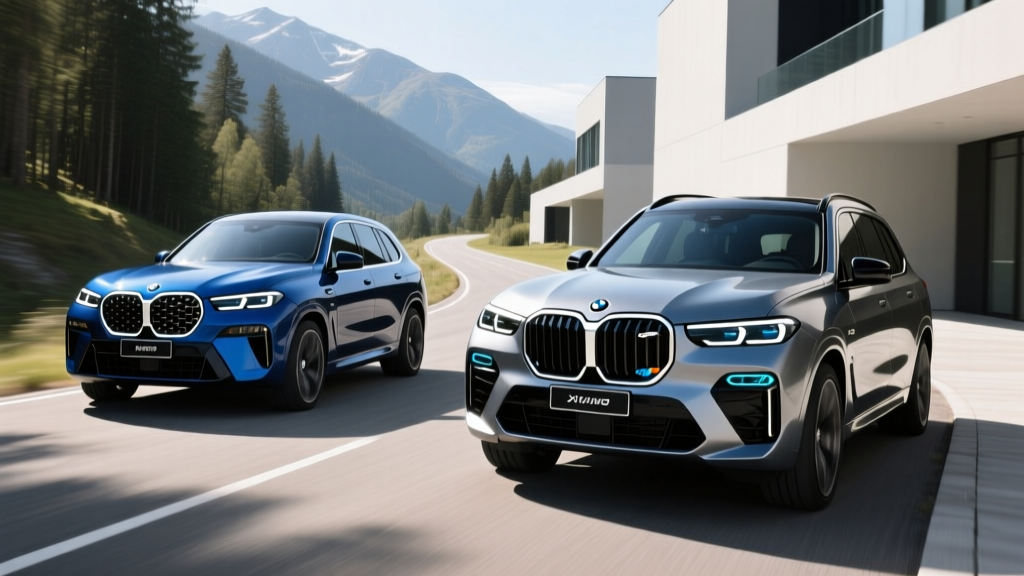
If you search for a BMW V8 hybrid in 2026, you are looking at three distinct machines that share BMW's S68 twin-turbo 4.4-liter V8 paired with an electric motor integrated into the transmission. But the similarities end quickly. The XM is a performance-first plug-in hybrid (PHEV) built on a dedicated platform. The X5 xDrive50e and X7 xDrive50e are luxury SUVs with mild electrification that prioritize efficiency. And the M variants of the X5 and X7 add a 48-volt mild-hybrid system to the V8 without any plug-in capability.
This guide untangles every current BMW V8 hybrid option, with exact EPA numbers, real-world expectations, battery specs, and whether any of them qualify for federal tax incentives under current IRS §30D rules.
BMW's V8 Hybrid Powertrain Explained: HEV vs. PHEV
Before diving into specific models, it is essential to understand the two hybrid architectures BMW uses with its V8 engine in 2026.
Conventional Hybrid (HEV) — Mild Hybrid in BMW's Case
BMW's X5 M60i and X7 M60i use a 48-volt mild-hybrid system bolted to the S68 V8. There is no plug, no electric-only driving mode, and no meaningful electric-only range. The system recovers energy during braking and provides a small torque assist during acceleration. You fuel it like a conventional car. The benefit is marginal fuel-economy improvement and smoother stop-start behavior.
Plug-In Hybrid (PHEV) — The True Electrified Option
The XM, X5 xDrive50e, and X7 xDrive50e are full plug-in hybrids. Each carries a high-voltage battery pack (ranging from 18.8 to 29.5 kWh usable) and an electric motor that can propel the vehicle on electricity alone for a limited distance. You plug these in to recharge. When the battery depletes, the V8 engine takes over seamlessly, and the vehicle operates as a conventional hybrid.
Key distinction: Only PHEVs offer electric-only range and require plug-in charging to realize their efficiency benefits. Mild hybrids (HEVs) never plug in and deliver only incremental gains.
2026 BMW XM: The Performance PHEV Flagship
The BMW XM is the brand's standalone M division PHEV — a 5,700-pound luxury performance SUV with up to 738 horsepower in Label Red trim. It is the most powerful BMW V8 hybrid available.
| Spec | XM (Base) | XM Label Red |
|---|---|---|
| Engine | 4.4L Twin-Turbo V8 + e-motor | 4.4L Twin-Turbo V8 + e-motor |
| Combined HP | 644 hp | 738 hp |
| Combined Torque | 590 lb-ft | 738 lb-ft |
| 0–60 mph | 4.1 sec | 3.7 sec |
| Battery (usable) | ~18.8 kWh (NMC) | ~18.8 kWh (NMC) |
| EPA Electric Range | 31 miles | 30 miles |
| EPA Combined MPGe | 46 MPGe | 43 MPGe |
| Gas-only MPG (combined) | ~14 mpg | ~13 mpg |
| Total Range | ~330 miles | ~320 miles |
| AC Charging (Level 2) | 7.4 kW (~2.5 hrs 0–100%) | 7.4 kW (~2.5 hrs 0–100%) |
| DC Fast Charge | Not supported | Not supported |
| Base MSRP | $159,995 | $185,995 |
Real-World Electric Range vs. EPA
The XM's EPA-rated 31 miles of electric range assumes moderate temperatures and conservative driving. In real-world testing, expect 22–27 miles of electric-only driving at highway speeds or in cold weather (below 40°F). Around town in mild conditions, you may match or slightly exceed the EPA figure. The battery's relatively small usable capacity (18.8 kWh) limits how much buffer you have.
Charging the XM
The XM charges exclusively via AC — Level 1 (120V household outlet) at roughly 1.4 kW takes about 13 hours for a full charge. A Level 2 home charger at 7.4 kW fills the battery in approximately 2.5 hours. There is no DC fast-charging capability, which is typical for PHEVs with smaller batteries. For daily use, a Level 2 home charger is essentially mandatory to make the electric range practical.
2026 BMW X5 xDrive50e: The Practical PHEV SUV
The X5 xDrive50e replaced the older xDrive45e for the current generation and represents BMW's most accessible V8-adjacent PHEV — though it is important to note that the xDrive50e actually uses BMW's B58 turbocharged inline-6, not a V8. If you specifically want a V8 in the X5, you are looking at the M60i (mild hybrid) or the X5 M Competition. The inline-6 PHEV is, however, the more efficient and arguably more rational choice.
For buyers specifically seeking a V8 in a BMW PHEV SUV, the X7 xDrive50e is the model to consider (detailed below). But because many shoppers cross-reference the X5 and X7, here are the X5 xDrive50e numbers for comparison:
| Mode | City | Highway | Combined |
|---|---|---|---|
| Electric + Gas (MPGe) | — | — | 56 MPGe |
| Gas Only (MPG) | 22 | 26 | 24 |
| Electric-Only Range | 38 miles (EPA) | ||
| Battery (usable) | ~25.7 kWh (NMC) | ||
The X5 xDrive50e starts at approximately $67,100 and delivers a genuinely useful 38 miles of electric range — enough for most daily commutes. Real-world electric range typically falls between 30 and 35 miles at highway speeds.
2026 BMW X7 xDrive50e: The Three-Row V8 PHEV
Now we reach the true BMW V8 plug-in hybrid SUV: the X7 xDrive50e. This model pairs the S68 4.4-liter twin-turbo V8 with an electric motor integrated into the 8-speed automatic transmission, delivering three-row luxury with plug-in capability.
| Spec | Value |
|---|---|
| Engine | 4.4L Twin-Turbo V8 (S68) + integrated e-motor |
| Combined HP | 483 hp |
| Combined Torque | 516 lb-ft |
| 0–60 mph | 5.0 sec |
| Battery (usable) | ~25.7 kWh (NMC lithium-ion) |
| EPA Electric-Only Range | 34 miles |
| EPA Combined MPGe | 50 MPGe |
| Gas-Only MPG (combined) | ~20 mpg |
| Total Combined Range | ~380 miles |
| AC Charging (Level 2) | 7.4 kW (~3.5 hrs 0–100%) |
| DC Fast Charge | Not supported |
| Base MSRP | $108,900 |
Real-World Electric Range vs. EPA
The X7 xDrive50e's 34-mile EPA electric rating is achievable in city driving at moderate temperatures. On the highway at 70+ mph, expect 25–30 miles before the V8 fires up. In winter conditions (below freezing), that figure drops to roughly 20–24 miles due to cabin heating demands and reduced battery efficiency. Preconditioning the cabin while plugged in helps preserve range.
Fuel Economy Deep Dive: Real-World MPG vs. EPA Stickers
Hybrid and PHEV fuel economy is notoriously dependent on driving habits and charging discipline. Here is how BMW's V8 hybrids stack up with EPA numbers and what to expect in practice.
| Model | Type | City MPG | Highway MPG | Combined | Electric Range |
|---|---|---|---|---|---|
| XM (Base) | PHEV | — | — | 46 MPGe / 14 mpg gas | 31 mi |
| X7 xDrive50e | PHEV | — | — | 50 MPGe / 20 mpg gas | 34 mi |
| X5 M60i | Mild HEV | 16 | 22 | 18 | N/A |
| X7 M60i | Mild HEV | 15 | 21 | 17 | N/A |
Real-world MPG notes:
- PHEVs (XM, X7 50e): If you charge daily and your commute falls within the electric range, you may use almost no gasoline during the week. On long road trips where the battery depletes quickly, expect the gas-only MPG figures (14 for the XM, 20 for the X7 50e). PHEV efficiency is entirely dependent on charging habits.
- Mild hybrids (X5/X7 M60i): The 48-volt system provides minimal real-world fuel savings over a non-hybrid V8 — typically 1–2 mpg in combined driving. In city traffic with frequent stops, the mild-hybrid system's regenerative braking and smooth engine restarts make the biggest difference. Highway driving sees negligible benefit.
Battery, Warranty, and Long-Term Reliability
BMW equips its PHEV models with NMC (nickel manganese cobalt) lithium-ion battery packs. These offer higher energy density than LFP (lithium iron phosphate) chemistries, which matters in the packaging-constrained underfloor space of an SUV, but they are more sensitive to sustained high state-of-charge and extreme heat.
BMW PHEV Battery Warranty
BMW covers the high-voltage battery in the XM, X5 xDrive50e, and X7 xDrive50e for 8 years or 80,000 miles (whichever comes first) against defects and excessive capacity loss. BMW defines excessive loss as the battery dropping below 70% of its original usable capacity during the warranty period. This aligns with the federal minimum requirement under EPA/CARB guidelines.
For the mild-hybrid 48-volt system in the M60i models, coverage falls under BMW's standard 4-year/50,000-mile new-vehicle limited warranty, as the 48V battery is not classified as a high-voltage traction battery under federal rules.
Battery Replacement Cost
Out-of-warranty high-voltage battery replacement for BMW's current PHEV models is estimated at $12,000–$18,000 including parts and labor, based on dealer pricing for the 25.7 kWh pack used in the X5/X7 xDrive50e. The XM's pack is somewhat smaller but similarly priced due to its bespoke packaging. These costs may decrease as third-party refurbishment options emerge, but for now, plan on dealer-only service for high-voltage components.
Reliability Outlook
BMW's S68 V8 is relatively new (introduced for 2023), so long-term reliability data is still accumulating. The PHEV powertrain adds complexity — an electric motor sandwiched between the engine and transmission, plus high-voltage power electronics and a cooling circuit for the battery. Early owner reports and Consumer Reports data suggest average reliability for BMW's large SUVs, with electronics and build quality being more common complaint areas than powertrain failures. The 8-year battery warranty provides meaningful peace of mind.
Tax Credits and Incentives: Do BMW V8 Hybrids Qualify?
Federal tax credit eligibility under IRS §30D is one of the most confusing aspects of buying a PHEV in 2026. Here is the reality for BMW's V8 hybrid lineup:
- MSRP cap: PHEV SUVs must have an MSRP at or below $80,000 to qualify. The XM ($159,995+) and X7 xDrive50e ($108,900) both exceed this cap and are not eligible for the federal credit.
- Battery capacity: The IRS requires a minimum 7 kWh battery for PHEV credit eligibility. All BMW PHEVs meet this threshold.
- Critical minerals and battery sourcing: Even if a vehicle meets the MSRP cap, it must satisfy escalating domestic-content requirements for battery components and critical minerals. BMW sources globally, and most of its PHEV models fail the sourcing requirements for the full $7,500 credit.
- Buyer income limits: Modified adjusted gross income must not exceed $300,000 (joint), $225,000 (head of household), or $150,000 (single).
- Point-of-sale transfer: If eligible, the credit can be applied at purchase rather than claimed on your tax return.
Bottom line: None of BMW's current V8 hybrid models qualify for the federal §30D clean vehicle credit in 2026 — either due to MSRP exceeding the cap or battery-sourcing requirements. Some states offer separate PHEV rebates (California's CVRP, for example, has income-based incentives), so check your state's energy office for local programs.
Who Should Buy a BMW V8 Hybrid — And Who Shouldn't
Choose a BMW V8 PHEV (XM or X7 xDrive50e) if:
- You have home charging access (Level 2 strongly recommended) and a daily commute under 30 miles
- You want V8 performance and three-row capability (X7) or flagship M performance (XM) without full EV commitment
- You take frequent road trips where charging infrastructure is unreliable
- You value the seamless transition between electric city driving and V8 highway power
Choose a BMW Mild-Hybrid V8 (X5/X7 M60i) if:
- You have no access to plug-in charging at home or work
- You want V8 power with zero change to your fueling habits
- You prioritize lower purchase price over electric-only driving
Choose a Full EV (e.g., BMW iX) instead if:
- You can install a Level 2 charger at home and want the lowest per-mile operating cost
- You want to eliminate engine maintenance entirely (no oil changes, no spark plugs)
- Your daily driving exceeds 30 miles and you want a vehicle that runs entirely on electricity
- You want to potentially qualify for federal or state EV incentives (the BMW iX may qualify depending on trim and sourcing)
BMW V8 PHEV Pros
- V8 power with electric torque fill — instant acceleration off the line
- Silent electric-only driving for short commutes (30–34 miles)
- No range anxiety — V8 takes over when battery depletes
- 8-year/80,000-mile high-voltage battery warranty
- Premium luxury with BMW's latest iDrive infotainment
BMW V8 PHEV Cons
- No DC fast charging — Level 2 only, 2.5–3.5 hours for full charge
- Gas-only MPG is poor once battery depletes (13–20 mpg combined)
- No federal tax credit eligibility due to MSRP caps and sourcing rules
- High purchase price ($109K–$186K) and premium maintenance costs
- Electric range drops significantly in cold weather and at highway speeds
- Added weight from battery and e-motor reduces handling agility vs. non-hybrid models
Frequently Asked Questions
How many MPG does the BMW V8 hybrid get?
It depends on the model and whether you charge. The X7 xDrive50e PHEV achieves 50 MPGe combined when using both electric and gas power, but only about 20 MPG combined once the battery is depleted. The XM gets roughly 14 MPG gas-only. The mild-hybrid M60i models get 17–18 MPG combined. Real-world numbers for PHEVs vary enormously based on charging habits — charge daily and you may burn very little fuel; road-trip without charging and you will see the gas-only figures.
How far can the BMW X7 PHEV go on electric only?
The 2026 X7 xDrive50e is EPA-rated for 34 miles of electric-only range. In real-world conditions — highway speeds, cold weather, or aggressive acceleration — expect 20–30 miles. The XM offers 31 miles EPA but delivers roughly 22–27 miles in practice. Both vehicles seamlessly switch to hybrid mode when the battery depletes, so you are never stranded.
Does any BMW V8 hybrid qualify for a tax credit?
As of 2026, no BMW V8 hybrid qualifies for the federal §30D clean vehicle tax credit. The XM and X7 xDrive50e both exceed the $80,000 MSRP cap for SUVs, and BMW's battery supply chains do not currently meet the critical-minerals sourcing requirements. Check your state's incentive programs — some states offer separate rebates for PHEVs regardless of federal eligibility.
Is the BMW V8 hybrid reliable, and what does battery replacement cost?
BMW's S68 V8 and PHEV system are relatively new, so long-term data is limited. The high-voltage battery is warrantied for 8 years/80,000 miles against capacity loss below 70%. Out-of-warranty battery replacement is estimated at $12,000–$18,000. The mild-hybrid 48V system in M60i models is simpler and covered under the standard 4-year/50,000-mile warranty. Overall, expect average reliability consistent with BMW's large-SUV segment.
Can I DC fast-charge a BMW V8 PHEV?
No. None of BMW's current PHEVs support DC fast charging. They accept up to 7.4 kW on Level 2 AC, which fully recharges the battery in 2.5 to 3.5 hours depending on pack size. This is standard for PHEVs — the batteries are small enough that Level 2 charging is adequate for overnight or workplace top-ups.
Hybrid vs. PHEV vs. full EV — which should I choose?
If you have home charging and a commute under 30 miles, a PHEV like the X7 xDrive50e gives you electric daily driving with V8 road-trip capability. If you cannot charge at home, a mild hybrid (M60i) avoids the cost and weight of a larger battery you will never use. If you want the lowest operating cost and can charge at home, a full EV like the BMW iX eliminates gasoline entirely and may qualify for incentives that the V8 PHEVs cannot.