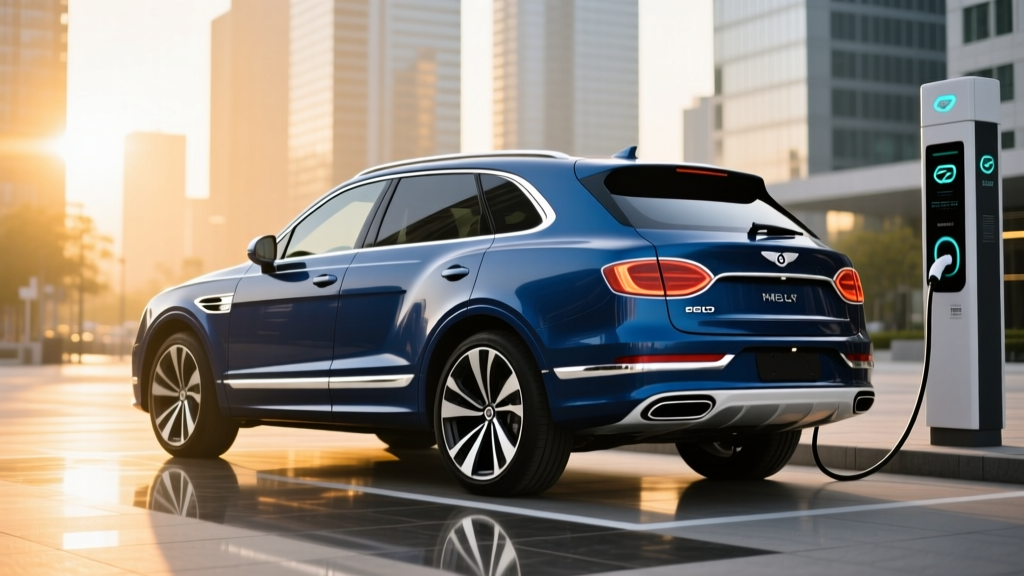
The Bentley Bentayga Hybrid occupies an unusual corner of the luxury SUV market: it promises the brand's handcrafted interior and effortless torque while offering a plug-in hybrid powertrain that can handle short commutes on electricity alone. For 2026, Bentley continues the Bentayga Hybrid with a revised V6 engine paired with an electric motor, targeting buyers who want ultra-luxury without the full fuel thirst of the W12 and V8 siblings — but who aren't quite ready to commit to a battery-electric vehicle.
This guide breaks down the Bentayga Hybrid's real-world efficiency, electric-only range, charging logistics, powertrain specs, and ownership economics. We'll also clarify where it fits against conventional hybrids, full EVs, and its own gas-only stablemates.
2026 Bentayga Hybrid at a Glance
| Spec | Value |
|---|---|
| Powertrain | 3.0L Turbo V6 + electric motor (PHEV) |
| Combined Horsepower | 456 hp |
| Combined Torque | 516 lb-ft |
| 0–60 mph | 5.3 seconds |
| Battery (usable) | 18.0 kWh lithium-ion |
| EPA Electric-Only Range | 29 miles |
| Total Combined Range | ~440 miles |
| EPA MPGe (combined) | 72 MPGe |
| EPA MPG (gas only, combined) | 19 MPG |
| Max AC Charging | 7.2 kW (Level 2) |
| DC Fast Charging | Not supported |
| Level 2 Charge Time (0–100%) | ~2.5 hours |
| Base MSRP | $209,100 |
| Federal Tax Credit (§30D) | Up to $7,500 (eligibility varies) |
| Battery Warranty | 8 years / 100,000 miles |
How the Bentayga PHEV Powertrain Works
The Bentayga Hybrid pairs a 3.0-liter turbocharged V6 with a permanent-magnet synchronous electric motor integrated into the 8-speed automatic transmission. Together they produce 456 hp and 516 lb-ft of torque, routed through Bentley's all-wheel-drive system.
The 18.0 kWh lithium-ion battery pack sits beneath the rear cargo floor. That's modest by full-EV standards (a Tesla Model X carries over 100 kWh), but it's sufficient for the Bentayga's intended use: short electric commutes followed by long-distance luxury cruising with the V6 taking over seamlessly.
Four driving modes manage the power split:
- EV Drive — electric-only, up to ~84 mph, for the 29-mile EPA range
- Hybrid — system blends motor and engine for optimal efficiency
- Hold — preserves battery charge for later use (e.g., saving EV miles for a city center)
- Charge — engine recharges the battery while driving, at the cost of fuel economy
HEV vs. PHEV: Why This Distinction Matters
The Bentayga Hybrid is a plug-in hybrid (PHEV), not a conventional hybrid (HEV). Here's what that means for ownership:
| Feature | Conventional Hybrid (HEV) | Plug-In Hybrid (PHEV) |
|---|---|---|
| Plug-in charging | No — charges via regen and engine | Yes — plug in to access EV range |
| Electric-only range | 0–2 miles at low speed | 29 miles (Bentayga) |
| Battery size | 1–2 kWh | 18 kWh |
| Tax credit eligible | No | Potentially (see §30D rules below) |
| Home charging needed | No | Yes, for meaningful EV use |
If you never plug the Bentayga Hybrid in, it operates as a heavy conventional hybrid — and you'll see fuel economy closer to 17–19 MPG combined, since the engine must haul 5,800+ lbs. Plugging in is what unlocks the efficiency advantage.
Fuel Economy: EPA Numbers vs. Real-World MPG
| Driving Condition | EPA Estimate | Real-World Expectation |
|---|---|---|
| Combined (PHEV, with charging) | 72 MPGe | 55–70 MPGe (depends on plug-in frequency) |
| Combined (gas only, battery depleted) | 19 MPG | 16–18 MPG highway, 18–20 city |
| City (gas only) | 18 MPG | 17–20 MPG (regen helps in stop-and-go) |
| Highway (gas only) | 22 MPG | 16–18 MPG at 75+ mph |
The EPA's 72 MPGe figure assumes you start every trip with a full battery and drive within the 29-mile EV window. In practice, your MPGe depends entirely on how often you charge and how far you drive between charges. Owners who plug in nightly and commute under 25 miles round-trip may rarely burn fuel at all during the week. Those who skip charging will see a heavy luxury SUV's fuel bill — around 16–19 MPG in mixed use.
Highway efficiency takes a hit in the Bentayga. Its aerodynamic profile and 5,800-lb curb weight mean the V6 works hard at sustained speed, and real-world highway MPG often lands in the 16–18 range at 75 mph — notably below the EPA's 22 MPG highway sticker. Cold weather further reduces both electric range (by roughly 20–30%) and gas efficiency.
Charging the Bentayga Hybrid: What You Need at Home
The Bentayga Hybrid supports Level 2 AC charging at up to 7.2 kW via its onboard charger. It does not support DC fast charging — a notable limitation shared with most luxury PHEVs in this class, since the battery is small enough that Level 2 replenishes it quickly.
| Charging Level | Power | 0–100% Time | Use Case |
|---|---|---|---|
| Level 1 (120V household) | ~1.4 kW | ~12–14 hours | Emergency / overnight trickle |
| Level 2 (240V, home wallbox) | 7.2 kW | ~2.5 hours | Daily charging, full battery each morning |
| DC Fast Charge | N/A | N/A | Not supported |
For daily use, a Level 2 home charger is essential. At 7.2 kW, you'll fully replenish the 18 kWh battery in about 2.5 hours — easily done overnight or during a workday. Relying on Level 1 (a standard 120V outlet) means 12+ hours for a full charge, which is impractical for daily EV-mode commuting.
Home Level 2 installation typically costs $800–$2,500 including the charger unit, electrician labor, and permits, depending on whether your electrical panel needs an upgrade. A 200-amp panel is usually sufficient for a 40-amp circuit feeding a 32-amp charger. Consult a licensed electrician for your specific setup.
Pricing, Trims, and Federal Tax Credit Eligibility
The 2026 Bentley Bentayga Hybrid starts at $209,100 (including destination). Bentley offers extensive personalization through its Mulliner division, and well-optioned examples routinely exceed $250,000. There are no distinct "trim levels" in the conventional sense — buyers configure paint, leather, veneers, and option packages à la carte.
Federal §30D Tax Credit: Does the Bentayga Hybrid Qualify?
The Bentayga Hybrid may qualify for up to $7,500 under the IRS §30D Clean Vehicle Credit, but several hurdles apply:
- MSRP cap: SUVs must be under $80,000 — the Bentayga at $209,100 exceeds this cap and is not eligible for the new-vehicle §30D credit.
- Buyer income cap: Even if MSRP qualified, AGI limits apply ($300K joint / $225K head of household / $150K individual).
- Battery sourcing: Critical mineral and battery component requirements phase in annually through 2029.
- Point-of-sale transfer: Eligible vehicles can apply the credit as a dealer discount at purchase.
Bottom line: The Bentayga Hybrid's MSRP far exceeds the §30D SUV cap of $80,000. No federal tax credit is available. Some states offer separate PHEV rebates with higher price caps — check your state's energy office for details. Consult a tax professional for personal eligibility.
Battery Longevity, Warranty, and Replacement Cost
The 18.0 kWh lithium-ion pack in the Bentayga uses proven NMC (nickel-manganese-cobalt) chemistry. Because PHEV batteries are smaller and the system manages charge/discharge conservatively (never using the full 100%–0% window), degradation tends to be gradual. Industry data from similar luxury PHEVs suggests 5–10% capacity loss over 8–10 years of normal use.
Out-of-warranty battery replacement is the concern every hybrid buyer raises. For the Bentayga Hybrid, expect a dealer-quoted replacement cost in the $12,000–$18,000 range, including the pack, labor, and programming. This is a significant sum, but it's a once-in-the-vehicle's-lifetime expense for most owners, and Bentley's 8-year/100,000-mile coverage provides substantial protection during typical ownership.
To maximize battery longevity:
- Avoid leaving the vehicle at 100% SoC for extended periods in hot weather
- Use the "Hold" mode on long highway trips rather than cycling the battery repeatedly
- Let the system precondition the battery in extreme cold (plug in before departure)
How Reliable Is the Bentayga Hybrid?
Bentley does not appear in mainstream reliability rankings from J.D. Power or Consumer Reports with the sample sizes of mass-market brands, given its low production volume. However, the underlying powertrain — the 3.0L V6 and ZF 8-speed transmission — is shared across the Volkswagen Group (including the Porsche Cayenne E-Hybrid and Audi Q7 PHEV) and has accumulated millions of real-world miles in those applications.
The electric motor and power electronics are comparatively simple components with few wear items. The most common PHEV-related issues across the industry involve the onboard charger, charge-port door mechanisms, and software integration — not the motor or battery itself.
Bentley's dealer network is limited (roughly 50 U.S. locations), so service access may require travel for some owners. Routine maintenance costs are steep by any standard — expect $800–$1,500 per annual service visit. The hybrid system adds no extra routine maintenance (no transmission fluid changes at typical intervals, regenerative braking extends pad life significantly).
Bentayga Hybrid vs. Full EV vs. Gas Bentayga: Which Fits You?
Choose the Bentayga Hybrid (PHEV) if:
- Your daily commute is under 25 miles round-trip and you can charge at home
- You want electric weekday driving but gas-powered weekend road trips without range planning
- You value the Bentayga's interior and presence but want modestly lower fuel costs
- You're not ready to rely on public DC charging infrastructure for long trips
Choose the Gas Bentayga V8 if:
- You lack home charging access and don't want to manage plug-in logistics
- You prioritize maximum power (542 hp in the V8) over efficiency
- You drive primarily long highway distances where PHEV EV range is irrelevant
Consider a Full EV (e.g., Lotus Eletre, BMW iX, Mercedes EQS SUV) if:
- You have reliable home Level 2 charging and want zero tailpipe emissions
- You drive under 250 miles daily and can plan DC fast-charge stops for road trips
- You want lower per-mile energy costs (~$0.04–$0.08/mile vs. $0.25–$0.35/mile in the Bentayga on gas)
- You're open to non-Bentley brands — Bentley does not yet offer a production BEV as of 2026
Pros
- 29 miles of silent, electric-only driving for daily commutes
- Handcrafted interior with unmatched material quality in the PHEV SUV segment
- Seamless powertrain transition — most drivers won't notice when the V6 engages
- 456 hp combined with 516 lb-ft of torque delivers effortless acceleration
- No range anxiety — 440+ mile total range with gas engine backup
- Regenerative braking extends brake pad life significantly
Cons
- $209,100 starting price with no federal tax credit (MSRP exceeds §30D cap)
- Real-world highway MPG drops to 16–18 when the battery is depleted
- No DC fast charging — not a road-trip convenience issue, but limits flexibility
- Limited Bentley dealer network for service
- 18 kWh battery is modest — EV range shrinks to ~22 miles in cold weather
- Insurance premiums are steep ($5,000–$8,000/year depending on profile)
Frequently Asked Questions
How many MPG does the Bentley Bentayga Hybrid get?
The EPA rates the 2026 Bentayga Hybrid at 72 MPGe combined when operating as a PHEV (starting with a full charge). Once the battery is depleted and the vehicle runs on gas alone, expect 19 MPG combined (EPA), with real-world figures of 16–20 MPG depending on driving style and conditions. Highway driving at 75+ mph typically yields 16–18 MPG.
How far can the Bentayga Hybrid go on electric only?
The EPA rates it at 29 miles of electric-only range. In real-world driving, expect 25–28 miles in mild weather and 22–25 miles in cold conditions (below 40°F). The vehicle can reach up to ~84 mph in EV Drive mode before the engine engages.
Does the Bentley Bentayga Hybrid qualify for a federal tax credit?
No. Under current IRS §30D rules, SUVs must have an MSRP below $80,000 to qualify. The Bentayga Hybrid starts at $209,100, well above the cap. Some states may offer separate PHEV incentives with higher price thresholds — check your state energy office. A tax professional can advise on any applicable local credits.
Is the Bentayga Hybrid reliable, and what does battery replacement cost?
The V6 and ZF 8-speed transmission are proven Volkswagen Group components used across multiple brands. The electric motor and battery have few wear items. Bentley covers the high-voltage battery for 8 years or 100,000 miles. Out-of-warranty replacement costs are estimated at $12,000–$18,000. Bentley's limited dealer network (~50 U.S. locations) is a practical consideration for service access.
Should I buy the Bentayga Hybrid or a fully electric luxury SUV?
If you can charge at home and your daily driving is under 25 miles, the Bentayga Hybrid gives you electric commuting with unlimited gas range for longer trips. If you want zero tailpipe emissions, lower per-mile energy costs, and don't mind planning DC charge stops on road trips, a full EV like the BMW iX or Lotus Eletre may suit you better. Bentley does not yet offer a production BEV as of 2026.
Do I need a home charger for the Bentayga Hybrid?
You don't need one — the vehicle will operate as a conventional hybrid without ever plugging in. But you'll miss the entire efficiency advantage. Without plug-in charging, expect 17–19 MPG combined and no electric-only driving. A Level 2 home charger ($800–$2,500 installed) unlocks the 29-mile EV range and is strongly recommended for PHEV ownership.
What is the total cost of ownership compared to the gas Bentayga V8?
Over 5 years and 75,000 miles, the Hybrid saves roughly $4,000–$7,000 in fuel costs if charged daily (assuming $3.80/gal premium and $0.14/kWh electricity). However, the Hybrid's higher purchase price and similar insurance costs mean the total cost of ownership is comparable to the V8 unless fuel prices rise significantly. The Hybrid's advantage is refinement and daily EV driving, not pure economics.
The Bentley Bentayga Hybrid is not an efficiency play — it's a luxury-first SUV that happens to offer a plug-in option for the daily school run or office commute. If you approach it as a Bentayga that can silently glide through your neighborhood on electric power before the V6 awakens for the open road, it delivers exactly what it promises. Just don't expect the tax credit, and do install a Level 2 charger at home.
Sources: EPA Fuel Economy — Bentley Bentayga Hybrid, IRS Clean Vehicle Credit (§30D), Bentley Motors — Bentayga Hybrid