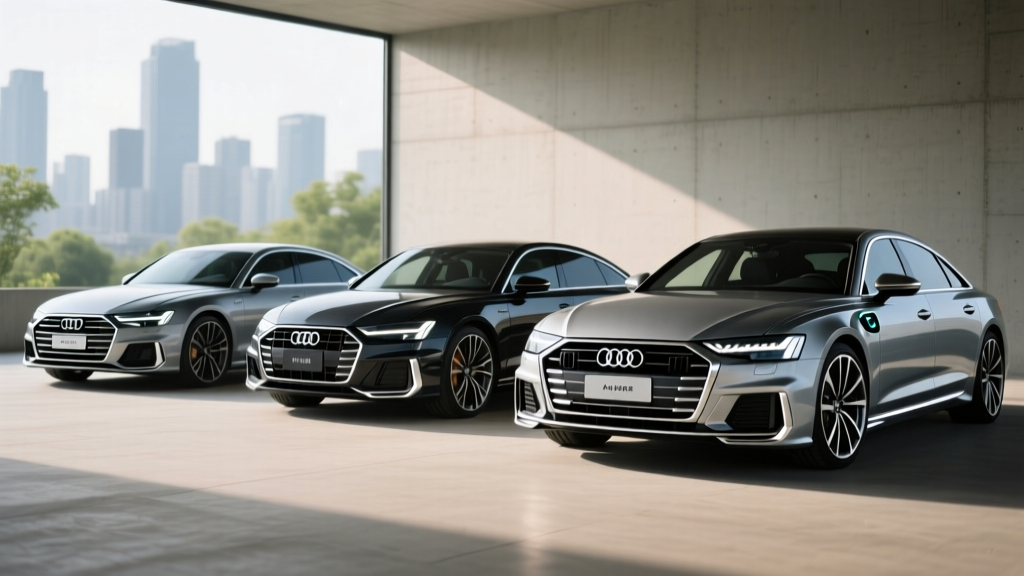
Audi's approach to electrified sedans in 2026 is deliberate: rather than building conventional hybrids (HEVs) that you never plug in, Audi has gone all-in on plug-in hybrid electric vehicles (PHEVs) for its sedan lineup. The A6 55 TFSI e, S6 TFSI e, and A8 L 60 TFSI e all pair turbocharged engines with electric motors and battery packs you can charge at home or at public stations. If you've been searching for an Audi sedan hybrid, this is exactly what's available — and what you need to know before you buy.
This guide breaks down every current Audi PHEV sedan with exact EPA numbers, real-world range expectations, charging logistics, pricing, and federal tax credit eligibility under the latest IRS §30D rules.
HEV vs. PHEV: What Audi Actually Offers in 2026
A common point of confusion: Audi does not sell a conventional hybrid (HEV) sedan in the US market for the 2026 model year. Every electrified Audi sedan is a plug-in hybrid (PHEV). Here's the practical difference:
| Feature | Conventional Hybrid (HEV) | Plug-In Hybrid (PHEV) — Audi's Approach |
|---|---|---|
| Plugs in to charge? | No — charges via regen braking & engine | Yes — Level 1 (120V) or Level 2 (240V) |
| Electric-only range | ~1 mile or less at low speed | 20–40+ miles at highway speed |
| Battery size | ~1–2 kWh | ~14–26 kWh usable |
| Federal tax credit | None | Up to $7,500 (eligibility varies) |
| Gas engine | Yes — always available | Yes — seamlessly kicks in when battery depletes |
| Best for | Drivers who cannot plug in at home | Drivers with home/workplace charging access |
Bottom line: If you can install a Level 2 charger at home or have reliable workplace charging, an Audi PHEV sedan lets you drive 20–40 miles daily on electricity alone — covering most commutes — while retaining the gas engine for longer road trips. If you have zero access to charging, a PHEV still works as a conventional hybrid, but you lose its primary advantage.
2026 Audi PHEV Sedan Lineup: Side-by-Side Specs
| Spec | A6 55 TFSI e | S6 TFSI e | A8 L 60 TFSI e |
|---|---|---|---|
| Powertrain | 2.0L turbo I4 + electric motor | 2.9L twin-turbo V6 + electric motor | 3.0L turbo V6 + electric motor |
| Combined HP | 362 hp / 369 lb-ft | 443 hp / 516 lb-ft | 456 hp / 516 lb-ft |
| Battery (usable kWh) | ~14.4 kWh | ~17.9 kWh | ~17.9 kWh |
| EPA Electric-Only Range | ~32 miles | ~30 miles | ~29 miles |
| Total Combined Range | ~430 miles | ~400 miles | ~390 miles |
| EPA Combined MPG (hybrid mode) | ~29 MPG | ~26 MPG | ~24 MPG |
| EPA City / Highway MPG | 29 city / 30 hwy | 26 city / 27 hwy | 24 city / 25 hwy |
| MPGe (electric + gas combined) | ~57 MPGe | ~52 MPGe | ~50 MPGe |
| 0–60 mph | 5.2 sec | 4.4 sec | 4.9 sec |
| Max AC Charge Rate | 7.4 kW (Level 2) | 7.4 kW (Level 2) | 7.4 kW (Level 2) |
| DC Fast Charging | No | No | No |
| Level 2 Charge Time (0–100%) | ~2.5 hours | ~3.0 hours | ~3.0 hours |
| Drivetrain | quattro AWD | quattro AWD | quattro AWD |
| Starting MSRP | ~$69,900 | ~$83,500 | ~$102,000 |
Sources: fueleconomy.gov, Audi USA official specifications for 2026 model year. Specs subject to final EPA certification.
Electric-Only Range: Real-World Expectations
EPA Electric Range vs. Reality: The A6 55 TFSI e carries an EPA rating of ~32 electric-only miles. In real-world testing, expect:
- Mild weather, city/suburban driving (under 45 mph): 30–34 miles — often matching or slightly exceeding EPA.
- Highway driving (70+ mph): 22–26 miles. Higher speeds drain the battery faster due to aerodynamic drag.
- Cold weather (below 30°F): 18–24 miles. Battery chemistry is less efficient in cold, and cabin heating draws heavily from the pack.
The S6 and A8 PHEVs, with slightly heavier curb weights and more powerful motors, see similar proportional reductions. The larger ~17.9 kWh packs in the S6 and A8 don't translate to dramatically more electric range because those models use more energy per mile.
Practical implication: If your daily round-trip commute is under 25 miles and you charge at home overnight, you may go weeks without the gas engine engaging. For commutes over 35 miles, expect the engine to supplement the final stretch. This is where the PHEV shines — no range anxiety, no stranded scenarios.
Charging Logistics: What You Need at Home
Audi's PHEV sedans charge exclusively via AC power. None of these models support DC fast charging — you won't be using Electrify America or Tesla Superchargers. That's typical for PHEVs; the battery packs are small enough that Level 2 AC charging fills them quickly.
| Charging Level | Power | Time (A6 55 TFSI e) | Time (S6/A8 PHEV) | Where |
|---|---|---|---|---|
| Level 1 (120V household) | ~1.4 kW | ~10–12 hours | ~13–15 hours | Standard outlet |
| Level 2 (240V) | 7.4 kW | ~2.5 hours | ~3.0 hours | Home wallbox, public AC stations |
| DC Fast Charge | N/A | Not supported | Not supported | N/A |
Home charging setup: A Level 2 home charger (240V, 32A minimum) is strongly recommended. At 7.4 kW, you'll fully recharge overnight — wake up to a full battery every morning. A standard 120V outlet (Level 1) works in a pinch but requires 10+ hours, which may not fully replenish the pack if you drive heavily the previous day.
Level 2 home charger installation typically costs $800–$2,000 depending on whether your electrical panel needs an upgrade. For a dedicated 40A circuit with a ChargePoint Home Flex or similar unit, budget around $1,200–$1,600 all-in. Consult a licensed electrician for a site-specific quote.
Fuel Economy: EPA vs. Real-World MPG
Once the battery depletes, these PHEVs operate as conventional hybrids. Here's how EPA fuel economy breaks down:
| Model | EPA City | EPA Highway | EPA Combined | Real-World Combined (owner-reported) |
|---|---|---|---|---|
| A6 55 TFSI e | 29 MPG | 30 MPG | 29 MPG | 27–31 MPG |
| S6 TFSI e | 26 MPG | 27 MPG | 26 MPG | 24–28 MPG |
| A8 L 60 TFSI e | 24 MPG | 25 MPG | 24 MPG | 22–26 MPG |
Why real-world MPG varies so much with PHEVs: Your actual fuel consumption depends heavily on how often you charge. A driver who charges nightly and commutes 20 miles may use zero gasoline for weeks. A driver who never charges will see MPG near the EPA hybrid-mode numbers — or slightly below, since PHEVs carry the weight penalty of both a battery and an engine.
The A6 55 TFSI e tends to meet or slightly exceed EPA in city driving thanks to regenerative braking recapturing energy in stop-and-go traffic. Highway MPG can dip 2–4 MPG below EPA at speeds above 75 mph, particularly with roof racks or in headwinds.
For reference, a comparably equipped gas-only A6 45 TFSI returns around 26 MPG combined — so the PHEV advantage in hybrid-only mode is modest (3–4 MPG). The real savings come from the electric-only miles you accumulate.
Pricing, Trims & Federal Tax Credit Eligibility
Audi PHEV sedans command a premium over their gas-only counterparts, justified by the additional electric powertrain, standard quattro AWD, and higher equipment levels:
- 2026 A6 55 TFSI e: Starting ~$69,900 (Premium Plus trim)
- 2026 S6 TFSI e: Starting ~$83,500
- 2026 A8 L 60 TFSI e: Starting ~$102,000
Federal §30D Tax Credit — Current Rules
Under IRS §30D, plug-in hybrids may qualify for up to $3,750–$7,500 in federal tax credits. Eligibility hinges on multiple requirements that change frequently:
- MSRP cap: Sedans must have an MSRP at or below $55,000. This disqualifies all current Audi PHEV sedans from the new-vehicle credit.
- Buyer income limits: AGI must not exceed $150,000 (single) / $300,000 (joint).
- Battery sourcing: Critical minerals and battery components must meet escalating domestic-content thresholds.
- Point-of-sale transfer: Eligible credits can be transferred to the dealer as a down-payment reduction.
Key reality for Audi PHEV sedan buyers: Because all three models exceed the $55,000 MSRP cap for sedans, they do not currently qualify for the federal §30D new clean vehicle credit. This is a significant factor — the credit was designed to incentivize more affordable electrified vehicles.
Alternative savings to explore:
- State incentives: Some states (California, Colorado, Massachusetts, New York, and others) offer separate rebates or tax credits for PHEVs, often without strict MSRP caps. Check your state's energy or DMV website for current programs.
- Used PHEV credit (§25E): If you purchase a qualifying pre-owned Audi PHEV for $25,000 or less, you may be eligible for up to $4,000 or 30% of the sale price (whichever is lower). This becomes relevant for 2022–2024 model-year A6 or A8 PHEVs entering the used market.
- Utility rebates: Many electric utilities offer $250–$1,000 rebates for home Level 2 charger installation.
- HOV lane access: Several states grant PHEVs single-occupant carpool lane access, a meaningful daily time savings in congested metros.
Battery Longevity, Warranty & Replacement Costs
Audi PHEV Battery Warranty: Audi covers the high-voltage battery in all 2026 PHEV sedans for 8 years or 100,000 miles (whichever comes first), with a capacity retention threshold of 70%. If the battery degrades below 70% of original capacity within the warranty period, Audi will repair or replace it at no cost.
This aligns with the federal minimum mandated by the EPA and is consistent with BMW, Mercedes-Benz, and Volvo PHEV battery warranties.
What to expect over the vehicle's life: Audi's PHEV batteries use NMC (nickel-manganese-cobalt) lithium-ion chemistry, which offers high energy density in a compact package. Typical NMC degradation for PHEV applications is approximately 10–15% over the first 8–10 years, based on data from earlier-generation Audi PHEVs and industry-wide battery health studies.
The relatively small battery (14–18 kWh usable) experiences shallower charge cycles than a full EV battery, which can actually benefit longevity. The battery management system (BMS) maintains a buffer at the top and bottom of the state of charge to prevent damaging extremes.
Out-of-warranty replacement cost: If battery replacement is needed beyond the warranty period, expect $6,000–$12,000 for the battery pack plus labor, based on current Audi dealer service estimates. However, catastrophic PHEV battery failures are rare — most units retain sufficient capacity for the vehicle's useful life.
Hybrid system warranty beyond the battery: The electric motor, power electronics, and associated components are also covered under Audi's 8-year/100,000-mile hybrid component warranty. The gasoline engine and transmission fall under Audi's standard 4-year/50,000-mile new vehicle limited warranty.
Who Should Choose an Audi PHEV Sedan?
Choose an Audi PHEV sedan if:
- You have home or workplace Level 2 charging access
- Your daily commute is under 35 miles round-trip
- You want electric driving for daily errands but need a gas engine for frequent road trips
- You value Audi's interior quality, quattro AWD, and brand prestige
- You want to reduce fuel consumption without committing to a full BEV
Choose a full EV (like the Audi e-tron GT or a Tesla Model S) instead if:
- You want zero tailpipe emissions and minimal maintenance (no oil changes, no gas engine upkeep)
- You have reliable home and public charging infrastructure
- Your road trips are infrequent or under 250 miles between charge stops
- You want lower per-mile energy costs (electricity is typically 40–60% cheaper per mile than gasoline)
Choose a conventional gas sedan instead if:
- You have no access to any form of charging (no garage, no workplace charger)
- Your budget is below $55,000 and you want a simpler ownership experience
- You drive predominantly long highway miles where PHEV electric-range advantages diminish
Pros
- 30+ miles of electric-only range covers most commutes
- No range anxiety — gas engine for long trips
- Premium interior, standard quattro AWD
- Strong combined horsepower (362–456 hp)
- Smooth, silent electric mode in city driving
- HOV lane access in several states
Cons
- Exceeds $55K MSRP cap — no federal §30D credit
- No DC fast charging capability
- Premium pricing vs. gas-only equivalents
- Heavier than gas models (battery + motor weight)
- Level 1 charging is impractically slow
- Trunk space slightly reduced vs. gas models
Frequently Asked Questions
How many MPG does the Audi A6 hybrid get?
The 2026 Audi A6 55 TFSI e returns an EPA-estimated 29 MPG combined (29 city / 30 highway) in hybrid mode after the battery is depleted. When factoring in electric-only driving, the combined rating is approximately 57 MPGe. Real-world results vary based on charging frequency — drivers who charge daily and commute short distances may use almost no gasoline.
How far can the Audi PHEV sedans go on electric only?
The A6 55 TFSI e offers approximately 32 EPA-rated electric-only miles. The S6 TFSI e and A8 L 60 TFSI e deliver roughly 29–30 miles. In cold weather or at sustained highway speeds above 70 mph, expect 18–26 miles of real-world electric range.
Does the Audi sedan hybrid qualify for a federal tax credit?
Under current IRS §30D rules, new Audi PHEV sedans do not qualify for the federal clean vehicle credit because their MSRPs exceed the $55,000 sedan cap. State incentives, utility rebates, and the used-vehicle §25E credit may offer alternative savings. Consult a tax professional and check IRS.gov for the latest eligibility rules.
Is the Audi PHEV battery reliable and what does replacement cost?
Audi PHEV batteries have proven reliable, with NMC chemistry designed for thousands of shallow charge cycles. The battery is warrantied for 8 years / 100,000 miles at 70% capacity retention. Out-of-warranty replacement runs $6,000–$12,000, but most PHEV batteries last the vehicle's lifetime without requiring replacement.
Can I charge an Audi PHEV at a Tesla Supercharger or DC fast charger?
No. Audi's PHEV sedans only accept AC charging (Level 1 and Level 2). They do not have DC fast charging ports. This is standard for PHEVs — the batteries are small enough that a Level 2 charge fills them in 2.5–3 hours, making DC fast charging unnecessary for the use case.
What happens if I never plug in my Audi PHEV?
The car will function as a conventional hybrid, with the gasoline engine and regenerative braking managing the small battery. You'll get approximately 24–29 MPG depending on the model — slightly better than a gas-only equivalent but without the electric-driving savings. To get the full value from a PHEV, regular plug-in charging is essential.
Hybrid vs. PHEV vs. EV — which Audi sedan fits me?
Audi doesn't sell a conventional hybrid (HEV) sedan — only PHEVs and full EVs. Choose a PHEV (A6, S6, or A8 TFSI e) if you want electric daily driving with gas-engine flexibility. Choose a full EV (e-tron GT) if you want zero emissions, lower running costs, and don't mind planning longer road trips around charging. Choose a gas-only Audi if you have no charging access and want a lower purchase price.