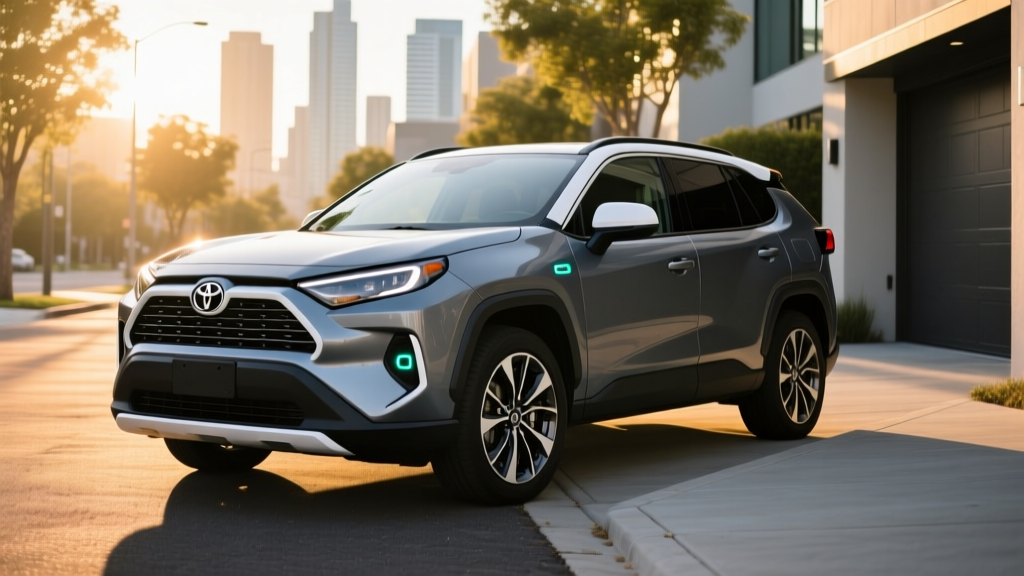
The 2024 Toyota RAV4 Hybrid XSE sits in a sweet spot for buyers who want the fuel-sipping efficiency of a hybrid without ever plugging in. As a conventional hybrid electric vehicle (HEV), the RAV4 Hybrid XSE pairs a 2.5-liter four-cylinder engine with a dual-motor electric system to deliver an EPA-estimated 39 MPG combined — and often beats that figure in real-world city driving. At a starting MSRP around $37,000, it's one of the most compelling electrified compact SUVs on the market, and it doesn't require any change to your fueling habits.
This guide breaks down every spec that matters: real-world MPG, the hybrid powertrain, battery longevity, how the XSE trim stacks up against the RAV4 Prime PHEV, and whether this is the right electrified vehicle for your daily drive.
2024 Toyota RAV4 Hybrid XSE: Key Specs at a Glance
| Specification | Value |
|---|---|
| Powertrain | 2.5L 4-cyl + dual electric motors (HEV) |
| Combined Horsepower | 219 hp |
| Drivetrain | Electronic On-Demand AWD |
| EPA MPG (City / Hwy / Combined) | 41 / 38 / 39 MPG |
| Fuel Tank Capacity | 14.5 gallons |
| Total Driving Range | ~565 miles |
| 0–60 mph | 7.4 seconds |
| Cargo Volume (behind rear seats) | 37.6 cu ft |
| Base MSRP (XSE AWD) | ~$37,060 |
| Hybrid Battery Warranty | 10 years / 150,000 miles |
| Federal Tax Credit (§30D) | Not eligible (HEV, not plug-in) |
Fuel Economy: EPA Numbers vs. Real-World MPG
The EPA rates the 2024 RAV4 Hybrid XSE AWD at 41 MPG city, 38 MPG highway, and 39 MPG combined, per fueleconomy.gov. These are strong numbers for a compact SUV with AWD, but what makes Toyota's hybrid system particularly impressive is how it performs in actual driving.
With a 14.5-gallon fuel tank, that 39 MPG combined rating translates to roughly 565 miles of total range between fill-ups. For drivers covering 12,000 miles per year, that means approximately 21 fill-ups annually — about 5 fewer than a comparable gas-only RAV4 AWD rated at 30 MPG combined.
Powertrain: How the RAV4 Hybrid XSE Makes 219 HP
The RAV4 Hybrid uses Toyota's fourth-generation hybrid system, which pairs a naturally aspirated 2.5-liter Dynamic Force four-cylinder engine with two electric motor-generators through a planetary gearset (eCVT). Here's the breakdown:
- Gasoline engine: 176 hp and 163 lb-ft of torque
- Front electric motor (MG2): 118 hp (88 kW)
- Rear electric motor (AWD): 54 hp (40 kW)
- Net combined system output: 219 hp (Toyota's net figure accounts for powertrain losses, not a simple sum)
The XSE trim adds paddle shifters and a sport-tuned suspension that firms up the ride slightly compared to the LE or XLE trims. The result is a 0–60 mph time of approximately 7.4 seconds — quick enough for confident highway merging and notably faster than the gas-only RAV4 AWD at 8.1 seconds.
One thing to understand: this is a self-charging hybrid. The small nickel-metal hydride (NiMH) traction battery — approximately 1.6 kWh — is charged exclusively through regenerative braking and the gasoline engine. There is no plug, no charging port, and no electric-only driving range beyond about a half-mile at very low speeds. If you want plug-in capability, you need the RAV4 Prime.
HEV vs. PHEV: RAV4 Hybrid XSE vs. RAV4 Prime
Toyota offers the RAV4 in two electrified flavors, and the distinction matters enormously for your wallet and daily routine:
| Feature | RAV4 Hybrid XSE (HEV) | RAV4 Prime SE (PHEV) |
|---|---|---|
| Type | Conventional Hybrid | Plug-In Hybrid |
| Plug-in Charging | No — self-charging | Yes — plug in to charge |
| Battery Capacity | ~1.6 kWh (NiMH) | 18.1 kWh (Li-ion) |
| Electric-Only Range | N/A (minimal low-speed EV mode) | 42 miles (EPA) |
| Combined MPG / MPGe | 39 MPG | 94 MPGe (EV mode) / 38 MPG (hybrid mode) |
| Combined HP | 219 hp | 302 hp |
| 0–60 mph | 7.4 sec | 5.7 sec |
| Base MSRP | ~$37,060 | ~$43,690 |
| Federal Tax Credit (§30D) | Not eligible | Up to $7,500 (subject to eligibility) |
| DC Fast Charging | N/A | No — Level 1/2 only (~2.5 hrs at 240V) |
Pricing, Tax Credits, and Total Cost of Ownership
The 2024 RAV4 Hybrid XSE AWD starts at approximately $37,060 MSRP, including destination charge. Popular options — such as the Electronic Interior Rearview Mirror, panoramic moonroof, and JBL audio — can push a well-equipped XSE to around $41,000–$42,000.
Federal Tax Credit Eligibility
Because the RAV4 Hybrid is a conventional HEV (not a plug-in vehicle), it does not qualify for the IRS §30D Clean Vehicle Credit, which is reserved for battery electric vehicles (BEVs) and plug-in hybrids (PHEVs) with batteries of at least 7 kWh. The hybrid battery in the RAV4 Hybrid XSE is approximately 1.6 kWh — far below the threshold.
However, some states offer rebates or incentives for conventional hybrids. These vary by jurisdiction and change frequently, so check your state's energy office or fueleconomy.gov's incentives page for current local programs.
Five-Year Fuel Cost Comparison
Where the RAV4 Hybrid XSE earns its keep is at the pump. Based on 15,000 miles/year and $3.50/gallon regular unleaded:
| Vehicle | MPG Combined | Gallons/Year | Annual Fuel Cost |
|---|---|---|---|
| RAV4 Hybrid XSE AWD | 39 MPG | 385 | ~$1,347 |
| RAV4 Gas AWD (LE) | 30 MPG | 500 | ~$1,750 |
| Compact SUV avg (gas) | 27 MPG | 556 | ~$1,944 |
Over five years, the RAV4 Hybrid XSE saves approximately $2,000–$3,000 in fuel compared to the gas-only RAV4 AWD — effectively paying back most of the hybrid premium.
Battery Warranty, Reliability, and Replacement Cost
Longevity and Real-World Reliability
Toyota's hybrid system has been in production since the 1997 Prius, and the RAV4 Hybrid benefits from decades of refinement. The NiMH battery in the RAV4 Hybrid is notably conservative in its charge/discharge cycles — the system never fully depletes or fully charges the battery, keeping it in a narrow state-of-charge window (roughly 40–80%) that dramatically extends cell life.
Based on fleet data and long-term owner reports, Toyota hybrid batteries routinely last 150,000–200,000+ miles before significant degradation. Some first-generation Prius batteries have exceeded 300,000 miles. The RAV4 Hybrid's battery is less stressed than the Prius's due to the larger vehicle's lower charge/discharge C-rates.
Battery Replacement Cost
If the hybrid battery does eventually need replacement outside of warranty, expect to pay between $2,000 and $4,000 for a new OEM battery pack installed at a Toyota dealer. Refurbished or reconditioned battery packs are available from third-party suppliers for $1,000–$2,000. Individual module replacement (only the degraded cells) can bring the cost below $1,000 at a hybrid-specialist shop.
For context, this is far less than a full EV battery replacement and is comparable to the cost of a transmission replacement on a conventional vehicle — an event that hybrid owners essentially avoid thanks to the eCVT's lack of traditional gear mechanisms.
Who Should Choose the RAV4 Hybrid XSE?
Choose the RAV4 Hybrid XSE if:
- You want 39+ MPG without ever plugging in or changing your fueling routine
- You lack reliable access to home or workplace Level 2 charging
- You want AWD for snow/rain without the fuel penalty of a gas AWD SUV
- Your budget is $35,000–$42,000 and you don't qualify for or want to deal with EV tax credits
- You prioritize long-term reliability and low maintenance costs
Choose the RAV4 Prime (PHEV) instead if:
- You can charge at home nightly and have a commute under 42 miles
- You want to drive mostly on electricity while keeping gas-engine road-trip range
- You qualify for the up-to-$7,500 federal tax credit (subject to IRS §30D income and sourcing rules)
- You want 302 hp and a 5.7-second 0–60 time
Choose a full BEV (e.g., Tesla Model Y, Hyundai Ioniq 5) instead if:
- You have reliable home Level 2 charging and want zero tailpipe emissions
- Your daily driving is under 250 miles and you rarely tow
- You want the lowest per-mile fuel cost (electricity at $0.04–$0.15/mile vs. gas at $0.10–$0.16/mile)
- You want to eliminate oil changes and engine maintenance entirely
Pros and Cons
✓ Pros
- 39 MPG combined — exceeds EPA in city driving
- No plug-in charging required; zero habit change
- Standard AWD across all Hybrid trims
- 10-year / 150,000-mile hybrid battery warranty
- Strong resale value and Toyota reliability reputation
- 565+ mile total range per tank
✗ Cons
- No federal tax credit eligibility (HEV, not PHEV/BEV)
- Highway MPG drops to ~35–37 at 75+ mph
- XSE sport suspension is firmer than some buyers prefer
- No EV-only driving mode for short trips
- Infotainment system lags behind competitors in responsiveness
- Cannot DC fast charge (not applicable to HEVs)
Frequently Asked Questions
How many MPG does the 2024 RAV4 Hybrid XSE get?
The EPA rates it at 41 city / 38 highway / 39 combined MPG. In real-world city and suburban driving, many owners achieve 40–43 MPG thanks to Toyota's regenerative braking system. Highway-only driving at higher speeds typically yields 35–37 MPG.
Does the RAV4 Hybrid need to be plugged in?
No. The RAV4 Hybrid is a conventional hybrid (HEV). It charges its small battery entirely through regenerative braking and the gasoline engine. There is no plug, no charging cable, and no charging port on the vehicle.
How far can the RAV4 Hybrid drive on electric power alone?
Essentially zero meaningful distance. The hybrid system can propel the vehicle on electric-only power for roughly a half-mile at speeds below 25 mph under light load — useful for creeping through a parking lot, but not a substitute for a plug-in hybrid or EV. If you want electric-only commuting, the RAV4 Prime PHEV offers 42 miles of EPA-rated EV range.
Is the RAV4 Hybrid reliable, and what does battery replacement cost?
Toyota's hybrid system has an exceptional reliability track record spanning over 25 years. The hybrid battery is warranted for 10 years / 150,000 miles, and real-world data shows these batteries routinely lasting 150,000–200,000+ miles. Out-of-warranty replacement costs $2,000–$4,000 for a new OEM pack, or $1,000–$2,000 for a refurbished unit.
Does the RAV4 Hybrid qualify for any tax credit?
The conventional RAV4 Hybrid does not qualify for the federal §30D Clean Vehicle Credit, which requires plug-in capability and a battery of at least 7 kWh. Some states may offer separate hybrid incentives — check your state energy office for current programs.
What's the difference between the RAV4 Hybrid and the RAV4 Prime?
The RAV4 Hybrid is a self-charging HEV with 39 MPG and no plug. The RAV4 Prime is a plug-in hybrid (PHEV) with an 18.1 kWh battery, 42 miles of electric-only range, 302 hp, and eligibility for up to $7,500 in federal tax credits. The Prime costs approximately $6,600 more at base MSRP but can be significantly cheaper after incentives.
How does the XSE trim differ from other RAV4 Hybrid trims?
The XSE adds a sport-tuned suspension, paddle shifters, SofTex synthetic leather seats, a 9-inch touchscreen with wireless Apple CarPlay and Android Auto, and unique exterior styling with dark chrome accents. It sits above the XLE in Toyota's trim hierarchy and below the limited-edition Woodland Edition and the top-tier Limited trim.