Quick Verdict: The Audi Q5 55 TFSI e PHEV in 2026
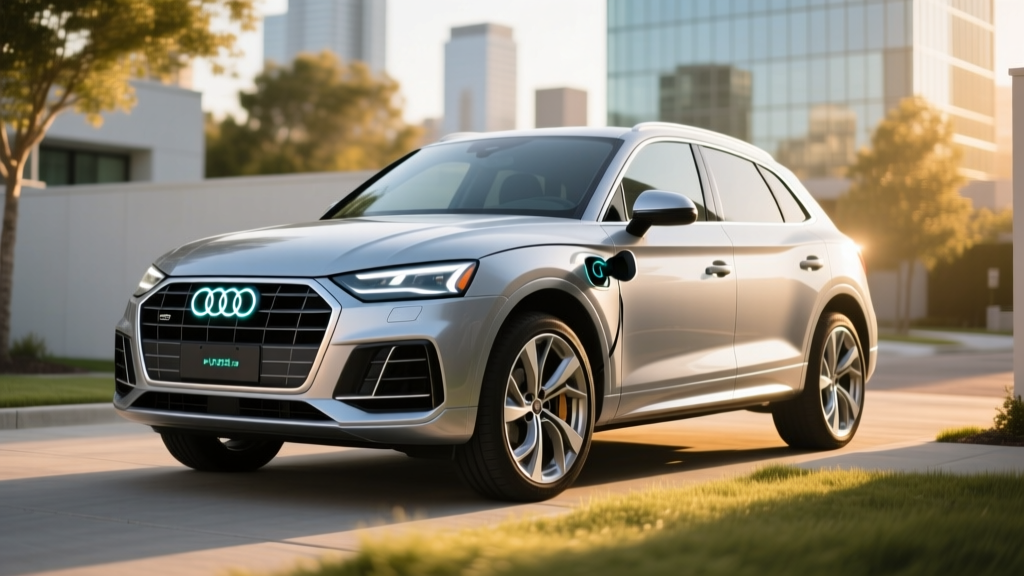
The 2026 Audi Q5 55 TFSI e is a plug-in hybrid (PHEV) luxury compact SUV that bridges the gap between traditional gasoline ownership and a full battery-electric vehicle. With an EPA-estimated 32 miles of electric-only range, a combined 362 horsepower, and the ability to drive cross-country without range anxiety, the Q5 PHEV targets buyers who want daily electric commuting but aren't ready to commit to a full BEV. It is not a conventional hybrid (HEV) — you plug it in to unlock its full efficiency potential, though the gas engine ensures you're never stranded.
Starting at approximately $58,395 for the Premium trim (before destination), the Q5 55 TFSI e qualifies for a partial federal tax credit under current IRS §30D rules, though buyers must verify battery sourcing and income eligibility. For 2026, Audi has refined the powertrain with a slightly larger battery pack and updated infotainment, keeping it competitive against the BMW X5 xDrive50e, Volvo XC60 Recharge, and Lexus NX 450h+.
HEV vs. PHEV: What the Audi Q5 Hybrid Actually Is
Conventional Hybrid (HEV): Uses a small battery recharged solely by regenerative braking and the gas engine. No plug. Electric-only driving is limited to brief low-speed coasting. Example: Toyota RAV4 Hybrid.
Plug-In Hybrid (PHEV): Features a larger battery you charge via a plug (Level 1 or Level 2). Delivers meaningful electric-only range (20–40+ miles) before the gas engine engages. Example: Audi Q5 55 TFSI e.
Battery Electric (BEV): No gas engine at all. Runs entirely on a large battery charged from the grid. Example: Audi Q4 e-tron.
The 2026 Audi Q5 hybrid lineup in the U.S. is exclusively PHEV in the form of the 55 TFSI e. Audi does not currently sell a conventional (non-plug) HEV version of the Q5 in North America. If you see references to a "Q5 Hybrid" without the plug-in designation, those typically refer to older discontinued models or mild-hybrid (MHEV) systems in international markets that do not offer electric-only driving.
Specs at a Glance: 2026 Audi Q5 55 TFSI e
| Specification | 2026 Audi Q5 55 TFSI e |
|---|---|
| Powertrain Type | Plug-in Hybrid (PHEV) |
| Engine | 2.0L Turbocharged 4-cylinder |
| Electric Motor | Permanent magnet synchronous, integrated in transmission |
| Combined Horsepower | 362 hp |
| Combined Torque | 369 lb-ft |
| Transmission | 7-speed S tronic dual-clutch automatic |
| Drivetrain | quattro AWD |
| Battery Capacity (Gross / Usable) | 17.9 kWh / ~14.4 kWh usable |
| Battery Chemistry | NMC (Nickel Manganese Cobalt) |
| EPA Electric-Only Range | 32 miles |
| EPA MPGe (Combined, Electric+Gas) | 61 MPGe |
| EPA MPG (Gas Only, Charge-Sustaining) | 26 combined (24 city / 29 highway) |
| Total Combined Range (Est.) | ~420 miles |
| 0–60 mph | 5.0 seconds |
| Level 2 Charge Time (0–100%) | ~2.5 hours at 7.7 kW |
| DC Fast Charging | Not available |
| Fuel Tank Capacity | 14.5 gallons |
| Cargo Volume (Behind Rear Seats) | 24.7 cu ft |
| Base MSRP (Premium Trim) | $58,395 |
| Battery & Powertrain Warranty | 8 years / 100,000 miles |
Fuel Economy: EPA Numbers vs. Real-World MPG
| Driving Mode | EPA City | EPA Highway | EPA Combined | Real-World Expectation |
|---|---|---|---|---|
| Electric + Gas (MPGe) | — | — | 61 MPGe | 50–65 MPGe depending on charge frequency |
| Gas Only (Charge-Sustaining) | 24 MPG | 29 MPG | 26 MPG | 23–28 MPG; better on highway, worse in stop-and-go |
| Electric Only | — | — | 32 miles range | 25–30 miles in cold weather or at highway speeds |
The real-world fuel economy of the Q5 55 TFSI e depends heavily on your charging habits. Owners who plug in nightly and commute under 30 miles round-trip may go weeks without using gasoline, effectively achieving 80–100+ MPGe in mixed use. Once the battery depletes and the vehicle operates in charge-sustaining (hybrid) mode, expect around 24–27 MPG combined — respectable for a 4,700-pound luxury AWD SUV but not class-leading.
Cold-weather impact: In temperatures below 32°F, expect electric-only range to drop by 20–30%, bringing the usable EV range down to roughly 22–26 miles. The gasoline engine may also engage sooner to provide cabin heat unless you precondition the vehicle while plugged in.
Electric-Only Range, Charging, and Battery Details
The 2026 Q5 55 TFSI e carries a 17.9 kWh gross battery (approximately 14.4 kWh usable) using NMC lithium-ion chemistry. Audi reserves a buffer at the top and bottom of the pack to protect long-term battery health — a standard practice across the industry.
Charging speeds:
- Level 1 (120V household outlet): ~1.4 kW — full charge in roughly 10–12 hours. Suitable for overnight top-ups if you drive less than the electric range daily.
- Level 2 (240V home or public charger): Up to 7.7 kW — full charge in approximately 2.5 hours. This is the recommended home charging setup.
- DC Fast Charging: Not supported. The Q5 PHEV uses a J1772 connector for AC charging only. This is typical for PHEVs in this segment — DC fast charging is generally reserved for full BEVs.
For most PHEV owners, a Level 2 home charger (such as a ChargePoint Home Flex or Wallbox Pulsar Plus) installed on a 240V circuit is the ideal setup. Expect to pay $500–$800 for the charger hardware and $600–$2,000 for professional installation depending on your electrical panel's capacity and the run distance. Consult a licensed electrician for a site-specific quote.
Performance and Powertrain
The Q5 55 TFSI e pairs a 2.0-liter turbocharged inline-four (producing roughly 261 hp on its own) with an electric motor integrated into the 7-speed S tronic transmission housing. Combined output reaches 362 hp and 369 lb-ft of torque, routed through Audi's quattro all-wheel-drive system.
The 0–60 mph sprint takes 5.0 seconds — noticeably quicker than the gasoline-only Q5 45 TFSI (which runs around 6.1 seconds). The electric motor fills in the torque gap at low RPM, making the PHEV feel punchier in city driving and during passing maneuvers. The S tronic dual-clutch transmission shifts crisply, though it can occasionally hesitate from a stop when the system is deciding whether to launch on electric or gas power.
Three drive modes manage the powertrain:
- EV mode: Pure electric driving up to ~84 mph (throttle-dependent).
- Hybrid mode: The system automatically blends gas and electric for optimal efficiency.
- Battery Hold / Charge mode: Preserves battery charge for later use (useful when approaching a city center or zero-emission zone) or uses the gas engine to recharge the battery while driving.
Pricing, Trims, and Tax Credit Eligibility
The 2026 Audi Q5 55 TFSI e is available in three trims:
- Premium: ~$58,395
- Premium Plus: ~$62,895
- Prestige: ~$67,395
All prices are base MSRP before the $1,195 destination charge. Options packages, metallic paint, and dealer-installed accessories can push a Prestige model above $75,000.
Federal Tax Credit (§30D) Eligibility
The 2026 Q5 55 TFSI e may qualify for a partial federal tax credit of up to $3,750 under IRS §30D, depending on battery component and critical mineral sourcing compliance. The full $7,500 credit requires meeting both the battery components and critical minerals thresholds, and Audi's PHEV sourcing has historically met only one of the two requirements.
Key eligibility requirements (verify with a tax professional):
- Buyer AGI must not exceed $150,000 (single) or $300,000 (joint filing)
- Vehicle MSRP must not exceed $80,000 for SUVs (the Q5 PHEV qualifies)
- Battery sourcing must meet annual threshold requirements per the IRS §30D guidelines
- Credit can now be transferred to the dealer at point of sale as an upfront discount
Sourcing requirements tighten annually. Always verify current-year eligibility at fueleconomy.gov before purchasing.
Battery Warranty, Reliability, and Replacement Cost
Audi PHEV Battery Warranty: 8 years or 100,000 miles (whichever comes first), covering defects and capacity loss below approximately 70% of original capacity. This aligns with federal requirements for hybrid and EV battery coverage.
Powertrain Warranty: 4 years / 50,000 miles (Audi's standard new-vehicle limited warranty).
Audi's PHEV battery packs use proven NMC chemistry with active thermal management (liquid cooling), which significantly extends cell life compared to passively cooled packs. Industry data from PHEVs with similar architectures (BMW, Volvo) suggests battery degradation of 8–15% over 100,000 miles under normal use, meaning most owners will retain well above the warranty threshold.
Out-of-warranty replacement cost: If a battery replacement is needed outside the warranty period, expect a dealer quote in the range of $8,000–$12,000 for the pack, plus $1,500–$2,500 in labor. However, PHEV battery replacements remain rare — the smaller pack size, buffered chemistry, and thermal management mean most packs outlast the vehicle's useful life.
General reliability: The Q5 platform is well-established, now in its second generation. The PHEV-specific components (electric motor, power electronics, battery) have been in Audi's lineup since 2019 with iterative updates. Common non-powertrain complaints from owners center on infotainment responsiveness and MMI touchpad quirks rather than hybrid system failures. NHTSA and IIHS ratings should be checked for the current model year's crash-test performance.
Q5 PHEV vs. Full EV vs. Gas: Which Should You Choose?
Choose the Audi Q5 55 TFSI e (PHEV) if:
- Your daily commute is under 30 miles round-trip and you can charge at home
- You regularly take road trips exceeding 200 miles and don't want to plan around chargers
- You want a luxury compact SUV with strong acceleration and AWD capability
- You live in an area with limited DC fast-charging infrastructure
Choose a full EV (like the Audi Q4 e-tron or Q8 e-tron) if:
- You have reliable Level 2 home charging and your daily driving is under 250 miles
- You want to eliminate gasoline costs and maintenance (no oil changes, fewer moving parts)
- You qualify for the full $7,500 federal tax credit on a qualifying BEV
- You prioritize the lowest per-mile fuel cost
Choose the gasoline Q5 45 TFSI if:
- You cannot install a home charger (apartment, street parking, no garage)
- Your budget is tighter — the gas Q5 starts ~$12,000 lower than the PHEV
- You drive predominantly long highway stretches where PHEV electric range offers minimal benefit
Pros and Cons
Pros
- 32 miles of electric-only range covers most daily commutes
- 362 hp delivers genuinely quick acceleration (5.0s 0–60)
- No range anxiety — gas engine for long trips
- Premium interior with updated MMI infotainment for 2026
- Standard quattro AWD for all-weather confidence
- Partial federal tax credit eligibility
Cons
- No DC fast charging — Level 2 only
- Gas-only MPG (26 combined) is average, not exceptional
- High starting price vs. non-luxury PHEV competitors
- Cargo space slightly reduced vs. gas Q5 due to battery placement
- Only partial §30D tax credit, not the full $7,500
- Electric range drops significantly in cold weather
Frequently Asked Questions
How many MPG does the Audi Q5 hybrid get?
The 2026 Audi Q5 55 TFSI e achieves an EPA-estimated 61 MPGe when combining electric and gasoline operation. Once the battery depletes and it runs on gas alone, it returns 26 MPG combined (24 city / 29 highway). Real-world MPG depends heavily on how often you charge — daily plug-in users may see effective MPGe well above the sticker number.
How far can the Q5 PHEV go on electric only?
The EPA rates the Q5 55 TFSI e at 32 miles of electric-only range. In real-world conditions, expect 25–30 miles in moderate weather and 22–26 miles in cold weather or at sustained highway speeds above 70 mph. The electric motor can propel the vehicle up to approximately 84 mph before the gas engine must engage.
Does the Audi Q5 hybrid qualify for a tax credit?
It may qualify for a partial federal tax credit of up to $3,750 under IRS §30D, depending on battery sourcing compliance for the current year. Eligibility also depends on your income (AGI caps of $150K single / $300K joint) and the vehicle's MSRP (must be under $80K for SUVs). Always verify at fueleconomy.gov and consult a tax professional before relying on the credit.
Is the Q5 hybrid reliable and what does battery replacement cost?
The Q5 PHEV powertrain has been in production since 2019 with steady refinements. The high-voltage battery is warrantied for 8 years / 100,000 miles against defects and excessive degradation. Out-of-warranty replacement costs are estimated at $8,000–$12,000 for the battery pack plus labor, though replacements are uncommon given the thermal management and buffered chemistry.
Can I charge the Q5 PHEV at a Tesla Supercharger or DC fast charger?
No. The 2026 Q5 55 TFSI e supports AC charging only (Level 1 and Level 2) via a J1772 connector. It cannot use DC fast chargers, Tesla Superchargers, or CCS/NACS-equipped fast-charging stations. A Level 2 home charger at 7.7 kW will fully recharge the battery in about 2.5 hours.
What's the difference between the Q5 55 TFSI e and the SQ5?
The SQ5 uses a 3.0L turbocharged V6 (349 hp) with a conventional mild-hybrid system — it is not a plug-in hybrid and offers no electric-only range. The Q5 55 TFSI e PHEV produces more combined horsepower (362 hp) with the benefit of electric-only driving, but has a higher starting price and a 4-cylinder engine. Choose the SQ5 for exhaust note and V6 smoothness; choose the 55 TFSI e for efficiency and daily electric commuting.