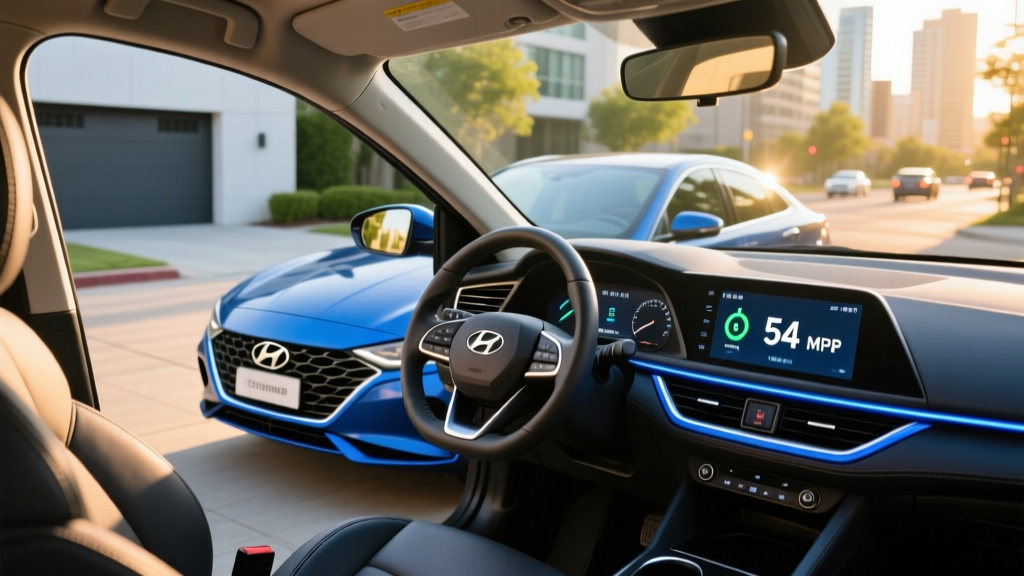
The 2023 Hyundai Elantra Hybrid Blue occupies a specific niche: maximum fuel economy without plugging in. With an EPA-estimated 54 MPG combined, it undercuts nearly every non-plug-in sedan on the market while carrying a base MSRP that undercuts most competitors. But sticker MPG and real-world MPG rarely match perfectly, and hybrid ownership comes with its own set of long-term questions around battery longevity, warranty coverage, and whether a conventional hybrid still makes sense as EV prices fall.
This guide breaks down exactly what the Elantra Hybrid Blue delivers — measured in miles per gallon, dollars per mile, and years of expected battery life — so you can decide if it's the right bridge to electrification or a destination unto itself.
EPA MPG Ratings vs. Real-World Fuel Economy
The headline number is what draws buyers to the Blue trim specifically. Hyundai tuned this variant for maximum efficiency, and the EPA figures reflect that.
| Driving Cycle | EPA Estimate | Real-World Expectation |
|---|---|---|
| City | 53 MPG | 50–58 MPG |
| Highway | 56 MPG | 48–54 MPG |
| Combined | 54 MPG | 49–55 MPG |
Source: EPA Fuel Economy Guide
Hybrids like the Elantra Blue frequently exceed their EPA city rating in stop-and-go traffic because regenerative braking recaptures energy that a gas car wastes as heat. In mixed suburban driving with frequent stops, owners regularly report 55–60 MPG on the trip computer.
Highway driving tells a different story. At sustained 75+ MPH speeds, the electric motor contributes less, the gasoline engine carries the load, and aerodynamic drag increases exponentially. Expect 48–52 MPG on long interstate trips. Cold weather further reduces efficiency — engine coolant must reach operating temperature, the cabin heater draws energy, and battery internal resistance rises. Winter city driving may drop to 44–48 MPG.
Hybrid (HEV) vs. Plug-In Hybrid (PHEV): Where the Elantra Fits
The 2023 Elantra lineup includes both a conventional hybrid (HEV) and no plug-in variant for this generation in the U.S. market. Understanding the distinction is essential before comparing it to alternatives like the Toyota Prius Prime or Hyundai's own Tucson PHEV.
| Feature | Conventional Hybrid (HEV) | Plug-In Hybrid (PHEV) |
|---|---|---|
| Plug-in charging required? | No — charges via regen & engine | Yes — for electric-only miles |
| Electric-only range | ~1 mile at low speed | 20–45 miles typical |
| Battery size | 1.32 kWh (Elantra HEV) | 11–18 kWh typical |
| Federal tax credit (§30D) | Not eligible | Up to $7,500 (if qualified) |
| Home charging needed? | No | Yes, for EV-range benefit |
| Best for | No garage/outlet access, long commutes | Home charging + short daily commute |
The Elantra Hybrid Blue is a conventional hybrid. You never plug it in. The 1.32 kWh lithium-ion battery charges exclusively through regenerative braking and the gasoline engine. This is its core advantage for apartment dwellers, street parkers, and anyone without reliable access to a charging outlet.
Powertrain Specs and Driving Character
| Specification | 2023 Elantra Hybrid Blue |
|---|---|
| Engine | 1.6L GDI 4-cylinder |
| Engine output | 104 HP / 109 lb-ft torque |
| Electric motor | 32 kW (43 HP) / 125 lb-ft torque |
| Combined system output | 139 HP / 195 lb-ft torque |
| Transmission | 6-speed dual-clutch automatic (DCT) |
| Drivetrain | Front-wheel drive |
| 0–60 MPH | ~8.6 seconds (est.) |
| Battery capacity | 1.32 kWh lithium-ion polymer |
| Curb weight | ~3,029 lbs |
| Fuel tank | 11.4 gallons |
| Base MSRP | $24,550 (+ $1,095 destination) |
Hyundai pairs the 1.6-liter Atkinson-cycle engine with a 6-speed dual-clutch transmission rather than the continuously variable transmission (CVT) found in the Toyota Prius. The result is a more natural acceleration feel — shifts are perceptible, and there's no rubber-band drone under hard throttle. The trade-off is slightly less seamless low-speed creep compared to a CVT, though most drivers adapt within a day.
At 139 combined horsepower, the Elantra Hybrid Blue is not quick by modern standards. The 0–60 time of roughly 8.6 seconds is adequate for merging and passing but won't satisfy anyone coming from a turbocharged compact. The electric motor's instant torque does provide responsive takeoffs from stoplights, which is where most city driving happens.
Tax Credit Eligibility and Ownership Economics
The absence of a federal tax credit is the Elantra Hybrid Blue's main economic disadvantage versus a PHEV like the Toyota Prius Prime (which may qualify for up to $3,750 depending on battery sourcing and model year). However, the lower upfront cost partly offsets this gap.
| Cost Category | Elantra Hybrid Blue (HEV) | Typical Gas Compact (30 MPG) |
|---|---|---|
| MSRP (base) | $24,550 | $22,000 |
| Fuel cost (5 yr, 75,000 mi, $3.50/gal) | ~$4,861 | ~$8,750 |
| Fuel savings vs. gas | ~$3,889 over 5 years | |
| Maintenance (5 yr est.) | ~$2,200 | ~$2,800 |
| Insurance (5 yr est.) | ~$7,500 | ~$7,000 |
| Estimated 5-yr total cost | ~$39,111 | ~$40,550 |
The fuel savings alone — roughly $3,900 over five years at 15,000 miles/year — close most of the price gap with a conventional gas compact. Hybrids also tend to experience less brake wear (regenerative braking reduces pad use) and no transmission-fluid changes on the DCT at typical intervals.
Some states offer their own hybrid incentives. Check your state's energy office or AFDC state law database for current programs, as these change frequently.
Battery Warranty, Lifespan, and Replacement Costs
Hybrid battery anxiety is the number one concern we hear from prospective buyers. Here's what the data shows for the Elantra Hybrid Blue:
- 10 years / 100,000 miles (original owner, powertrain & hybrid battery)
- 5 years / 60,000 miles (subsequent owners, if transferred)
- Covers battery capacity loss below a defined threshold and cell/module failure
The 1.32 kWh battery in the Elantra Hybrid Blue is far smaller than a BEV battery (typically 60–100 kWh), and it operates within a narrow state-of-charge window managed by the hybrid control system. Hyundai never fully charges or fully depletes it, which dramatically extends cycle life. Real-world data from Hyundai's hybrid fleet (Ioniq, Sonata, Elantra) shows minimal measurable degradation at 100,000+ miles.
If replacement is needed outside warranty — rare before 150,000 miles — expect a hybrid battery replacement cost of $2,000–$3,500 including labor at a dealership. Independent hybrid specialists may offer refurbished units for $1,200–$2,000. This is a fraction of BEV battery replacement costs ($8,000–$20,000+), which is one reason hybrids carry lower long-term risk anxiety.
Reliability and Safety Ratings
The 2023 Elantra Hybrid shares its platform with the standard Elantra, which earned strong safety marks:
- IIHS: Top Safety Pick+ (highest rating) when equipped with specific headlights — check IIHS ratings for trim-specific results
- NHTSA: 5-star overall safety rating
On reliability, Hyundai's 1.6L GDI engine and 6-speed DCT are proven components carried over from prior model years with minimal reported issues. The hybrid system adds complexity (inverter, electric motor, battery management) but eliminates other wear items (no traditional starter motor, reduced brake wear, no alternator). Consumer-reported reliability for the Elantra Hybrid line has been average to above average, with the main complaints centering on infotainment software rather than powertrain.
Who Should Choose the Elantra Hybrid Blue?
- You lack access to home or workplace charging (apartment, street parking)
- Your commute is long (40+ miles daily) where a PHEV's 25-mile EV range wouldn't cover it
- You want maximum MPG without behavioral changes — just drive and fill up
- Budget is a priority: ~$25,645 out-the-door is competitive with gas compacts
- You plan to own the car 8–10 years (warranty covers the hybrid system fully)
- You have a garage or dedicated outlet for overnight Level 1/2 charging
- Your daily round-trip commute is under 30 miles (PHEV covers it on electricity alone)
- You want to reduce gasoline use by 60–80% on typical weekdays
- You may qualify for the federal §30D credit on a qualifying PHEV
- You can install a Level 2 home charger ($500–$2,000 installation)
- You want zero tailpipe emissions and minimal maintenance
- You qualify for the full $7,500 federal tax credit on a BEV
- Road trips are infrequent or you're comfortable planning DC fast-charge stops
Frequently Asked Questions
How many MPG does the 2023 Hyundai Elantra Hybrid Blue actually get?
The EPA rates it at 53 city / 56 highway / 54 combined. In real-world mixed suburban driving, most owners see 50–58 MPG. Highway-only driving at 75+ MPH typically yields 48–52 MPG. Cold weather can reduce city MPG by 5–10 MPG due to engine warm-up cycles and cabin heating demand.
Does the Elantra Hybrid Blue need to be plugged in?
No. This is a conventional hybrid (HEV), not a plug-in hybrid (PHEV). The battery charges entirely through regenerative braking and the gasoline engine. You fuel it at any gas station and never need a charging cable or outlet.
Does the 2023 Elantra Hybrid qualify for any federal tax credit?
No. The §30D federal clean vehicle credit applies only to plug-in hybrids (PHEVs) and battery-electric vehicles (BEVs) that meet battery sourcing, MSRP, and buyer income requirements. Conventional hybrids like the Elantra Hybrid Blue are not eligible. Some states offer separate hybrid rebates — check your state energy office.
How long will the hybrid battery last, and what does replacement cost?
Hyundai warranties the hybrid battery for 10 years / 100,000 miles for the original owner. Real-world data from Hyundai's hybrid fleet shows these batteries commonly last 150,000+ miles with minimal degradation due to the narrow state-of-charge operating window. Out-of-warranty replacement costs $2,000–$3,500 at a dealer, or $1,200–$2,000 for a refurbished unit from an independent specialist.
Is the Elantra Hybrid Blue slower than the gas-only Elantra?
Marginally. The hybrid produces 139 combined HP versus 147 HP for the 2.0L gas model, but the hybrid's electric motor torque (125 lb-ft available instantly) makes it feel responsive in city driving. The 0–60 time difference is roughly 0.5 seconds — imperceptible in daily driving. Highway passing power is similar between both.
How does the Elantra Hybrid Blue compare to the Toyota Prius?
The 2023 Prius LE achieves an EPA 57 MPG combined (3 MPG more than the Elantra Blue) but starts at a higher MSRP (~$27,450). The Elantra Blue offers a lower entry price (~$24,550), a more conventional driving feel with its DCT versus the Prius's CVT, and Hyundai's 10-year powertrain warranty versus Toyota's 8-year hybrid warranty. Both are excellent; the choice comes down to budget versus maximum MPG.