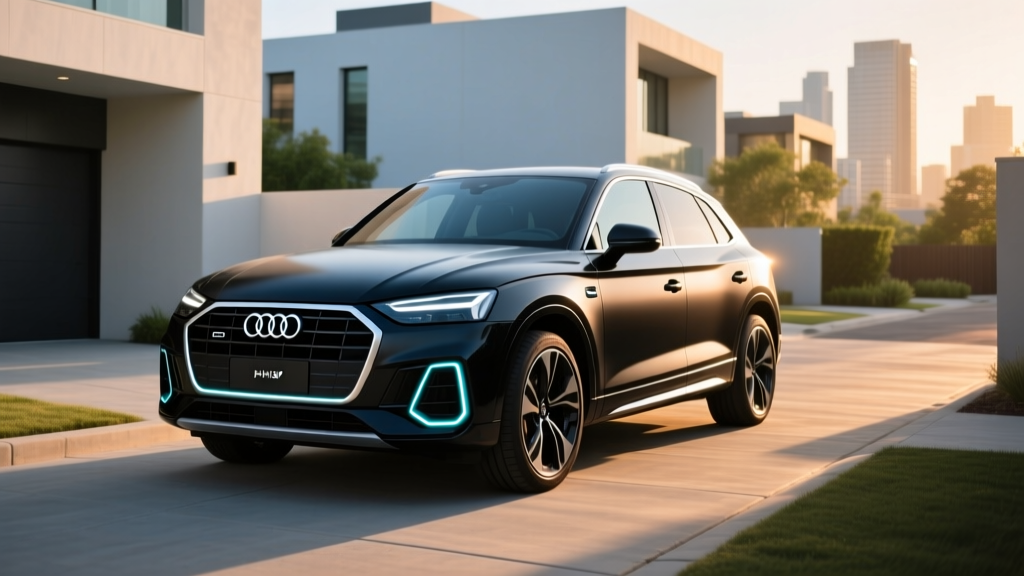
The 2026 Audi Q5 PHEV — officially badged the Q5 55 TFSI e — occupies a narrow but appealing lane: a compact luxury SUV that handles school-dropoff duties on battery power alone, then fires up a turbocharged four-cylinder for weekend road trips without a second thought. But with an MSRP starting near $60,000, a modest electric-only range, and no DC fast-charging capability, the Q5 plug-in hybrid makes sense only for a specific type of buyer. Let's break down the exact numbers.
Quick Verdict: Who the Audi Q5 PHEV Is For
The Q5 55 TFSI e rewards a very particular ownership pattern: a household with Level 2 home charging, a daily commute under 20 miles round-trip, and a desire for a premium badge without committing to a full battery-electric vehicle. If that describes you, the Q5 PHEV delivers near-silent, zero-tailpipe-emission daily driving with the safety net of 400+ miles of total range. If your commute is longer, or you lack reliable home charging, a conventional Q5 hybrid or a full EV like the Audi Q4 e-tron will serve you better.
A conventional hybrid (HEV) like the standard Audi Q5 Hybrid uses a small battery recharged solely by the engine and regenerative braking — you never plug it in. A plug-in hybrid (PHEV) like the Q5 55 TFSI e carries a larger battery (17.9 kWh) that you charge via an outlet, enabling a meaningful electric-only driving range before the gasoline engine takes over. The Q5 PHEV is strictly a plug-in; Audi does not currently sell a non-plug HEV version of the Q5 in the US market.
Spec Table: 2026 Audi Q5 55 TFSI e at a Glance
| Spec | Value |
|---|---|
| EPA Electric Range | 23 miles |
| Total Combined Range | ~440 miles |
| MPGe (Electric + Gas) | 61 MPGe combined |
| Gas-Only MPG (Charge-Depleted) | 26 MPG combined (25 city / 27 highway) |
| Battery Capacity | 17.9 kWh (gross), ~14.4 kWh usable |
| Battery Chemistry | Lithium-ion (NMC pouch cells) |
| Level 2 Charge Time (0–100%) | ~2.5 hours at 7.4 kW |
| DC Fast Charging | Not supported |
| Combined Horsepower | 362 hp / 369 lb-ft torque |
| 0–60 mph | 5.0 seconds |
| Drivetrain | quattro AWD (7-speed S tronic) |
| Base MSRP (Premium Plus) | $59,800 (est.) |
| Federal §30D Tax Credit | Up to $3,750 (see eligibility below) |
| Hybrid Battery Warranty | 8 years / 100,000 miles |
Sources: EPA fueleconomy.gov, Audi USA specifications. MSRP and credit figures reflect 2026 estimates and current IRS §30D rules.
Electric-Only Range and Real-World Efficiency
The EPA rates the Q5 55 TFSI e at 23 miles of electric-only driving. In real-world testing, expect closer to 18–21 miles in mixed driving with climate control active, and potentially as low as 15 miles in cold weather (below 35°F), where battery efficiency drops and cabin heating draws heavily from the pack.
EPA: 23 miles electric. Real-world expectation: 18–21 miles (mild weather, mixed driving); 15–17 miles (highway or cold weather). If your one-way commute exceeds 12 miles, you'll be burning gasoline on part of your trip. The 14.4 kWh of usable battery capacity simply can't push a 4,700-lb luxury SUV much farther.
Once the battery is depleted, the 2.0-liter turbocharged inline-four takes over. The EPA rates charge-sustaining (gas-only) operation at 26 MPG combined — 25 city and 27 highway. In practice, many owners report 27–29 MPG in city driving thanks to regenerative braking assisting the engine in stop-and-go traffic, while highway cruising at 75+ mph may return 24–25 MPG. This is respectable for a 4,700-lb AWD luxury SUV, but it's not class-leading — the Volvo XC60 Recharge achieves similar numbers, while the Lexus NX 450h+ delivers 37 miles of electric range and 36 MPG gas-only.
Charging: Level 2 Only, No DC Fast Charging
The Q5 PHEV accepts a maximum of 7.4 kW on Level 2 (240V) AC charging, using a standard J1772 connector. A full 0–100% charge takes approximately 2.5 hours. On a standard 120V household outlet (Level 1), expect a full charge in roughly 8–10 hours — viable for overnight topping up but slow for same-day turnaround.
Critical limitation: The Q5 PHEV does not support DC fast charging. There is no CCS or NACS port. This is typical for PHEVs — the battery is too small to justify the cost and weight of DC hardware — but it means you cannot top up quickly on a road trip. On the highway, you're running on gasoline.
| Charging Level | Power | 0–100% Time | Miles of Range Added/Hr |
|---|---|---|---|
| Level 1 (120V) | ~1.4 kW | ~8–10 hours | ~3 mi/hr |
| Level 2 (240V) | 7.4 kW | ~2.5 hours | ~10 mi/hr |
| DC Fast Charge | N/A | Not supported | — |
Powertrain and Performance
Audi pairs a 2.0-liter TFSI turbocharged four-cylinder engine (261 hp on its own) with an electric motor integrated into the 7-speed S tronic dual-clutch transmission. Combined system output is 362 horsepower and 369 lb-ft of torque, routed through quattro all-wheel drive. The 0–60 mph sprint takes 5.0 seconds, making the PHEV the quickest Q5 variant — faster than the gas-only Q5 45 TFSI (5.8 seconds).
Driving modes include EV-only (forces electric operation until the battery is depleted), Hybrid (the car decides the optimal blend), and Battery Hold (preserves charge for later use — useful if you're entering a zero-emission zone or want electric driving at your destination). The regenerative braking is modest compared to a full EV; don't expect true one-pedal driving. You'll still use the brake pedal regularly.
Pricing, Trims, and Federal Tax Credit Eligibility
The 2026 Q5 55 TFSI e is offered in Premium Plus and Prestige trims. Expect base pricing around $59,800 for Premium Plus and $64,500 for Prestige, before destination charges and options.
Regarding the federal §30D Clean Vehicle Credit: PHEVs qualify for a partial credit based on battery capacity. The Q5's 17.9 kWh pack makes it eligible for up to $3,750 (the base $2,500 plus $417 for each kWh over 5 kWh, capped at $7,500). However, several conditions apply:
- MSRP cap: SUVs must be under $80,000 MSRP — the Q5 PHEV clears this.
- Buyer income cap: Modified AGI must not exceed $150,000 (single), $225,000 (head of household), or $300,000 (joint).
- Battery sourcing: Critical-mineral and battery-component requirements phase in annually. For 2026, a larger percentage of minerals and components must come from the US or FTA partners. Audi's supply chain determines whether the full $3,750 is available or if it is reduced.
- Point-of-sale transfer: You can transfer the credit to the dealer at purchase, reducing your out-of-pocket cost immediately, rather than waiting for tax filing.
Always verify current eligibility on IRS.gov before purchasing, as battery-sourcing compliance can change model by model and quarter by quarter.
Battery Warranty, Reliability, and Replacement Cost
Audi covers the Q5 PHEV's high-voltage battery for 8 years or 100,000 miles (whichever comes first), warranting it against capacity loss below approximately 70% of original capacity. This is the industry-standard PHEV battery warranty, mandated in part by CARB-emissions states.
For reliability context, Audi's PHEV powertrain is now in its second generation, and early first-generation Q5 TFSI e models (2020–2022) have not shown widespread battery failure patterns. However, Audi as a brand consistently scores mid-pack or below-average in long-term reliability surveys from Consumer Reports and J.D. Power. The complexity of a PHEV — an engine, a turbocharger, a dual-clutch transmission, an electric motor, power electronics, and a high-voltage battery — means more potential failure points than either a pure EV or a conventional gas car.
If the battery does need replacement out of warranty, expect a cost in the range of $8,000 to $12,000 for the pack itself, plus labor. This is significantly less than a full EV battery replacement (often $15,000–$25,000) because the PHEV pack is smaller. In practice, most PHEV batteries show gradual degradation (loss of 10–20% capacity over 8–10 years) rather than catastrophic failure.
Audi Q5 PHEV vs. Competitors vs. Full EV
| Metric | Audi Q5 55 TFSI e | Volvo XC60 Recharge | Lexus NX 450h+ | Audi Q4 e-tron (Full EV) |
|---|---|---|---|---|
| Electric Range | 23 mi | 35 mi | 37 mi | 242 mi |
| Gas-Only MPG | 26 | 25 | 36 | N/A |
| Combined HP | 362 | 455 | 304 | 295 |
| Battery (kWh) | 17.9 | 18.8 | 18.1 | 77.0 |
| DC Fast Charge | No | No | No | Yes (175 kW) |
| Base MSRP | ~$59,800 | ~$59,000 | ~$59,000 | ~$49,800 |
- 362 hp makes it the quickest Q5
- Quiet, refined electric-mode city driving
- No range anxiety — 440+ total miles
- Premium interior and tech
- quattro AWD standard
- Only 23 miles of electric range
- No DC fast charging
- Complex powertrain = more failure points
- Mid-pack brand reliability scores
- Pricier than Q4 e-tron with less EV benefit
Decision Framework: Should You Buy the Q5 PHEV, a Gas Q5, or Go Full EV?
Choose the Q5 55 TFSI e (PHEV) if:
- Your round-trip commute is under 20 miles and you can charge at home every night
- You take regular road trips (200+ miles) where EV charging infrastructure feels unreliable
- You want the prestige and performance of the Q5 with lower daily fuel costs
Choose the Audi Q4 e-tron (full EV) if:
- Your daily driving is under 200 miles and you have reliable home Level 2 charging
- You want to eliminate oil changes, spark plugs, and transmission maintenance entirely
- You want a lower purchase price and access to the full $7,500 federal tax credit
Choose the gas-only Q5 45 TFSI if:
- You cannot charge at home (apartment, street parking)
- Your budget is closer to $45,000–$50,000
- You want simpler long-term maintenance with fewer hybrid-system components
Frequently Asked Questions
How many MPG does the Audi Q5 PHEV get?
The EPA rates the Q5 55 TFSI e at 61 MPGe when operating with a charged battery (combining electric and gasoline driving). Once the battery is depleted, it returns 26 MPG combined on gasoline alone (25 city / 27 highway). In real-world city driving with frequent regenerative braking, some owners see 27–29 MPG in gas-only mode.
How far can the Q5 PHEV go on electric only?
The EPA rates it at 23 miles of electric-only range. Real-world expectations are 18–21 miles in moderate weather and 15–17 miles in cold weather or sustained highway driving. The total combined range (electric + gasoline) is approximately 440 miles.
Does the Audi Q5 PHEV qualify for a tax credit?
Under current IRS §30D rules, the Q5 PHEV may qualify for up to $3,750 in federal tax credit, subject to buyer income limits ($300,000 joint AGI cap for SUVs), MSRP caps ($80,000 for SUVs), and battery-sourcing requirements that change annually. The credit can be transferred to the dealer at point of sale. State incentives vary — check AFDC's state incentive database for your location.
Is the Q5 PHEV reliable, and what does battery replacement cost?
Audi's PHEV system is in its second generation with no widespread battery failure reports. However, Audi scores average to below-average in major reliability surveys. The hybrid battery is warranted for 8 years / 100,000 miles. Out-of-warranty replacement is estimated at $8,000–$12,000. The overall powertrain is more complex than either a pure EV or a gas car, meaning more potential maintenance items over a 10-year ownership period.
Can I charge the Q5 PHEV at a public fast charger?
No. The Q5 55 TFSI e supports only AC charging (Level 1 at 120V and Level 2 at 240V via J1772 connector). It does not have a DC fast-charge port. This is standard for PHEVs — the 17.9 kWh battery is too small to benefit meaningfully from DC charging. Plan to charge at home or at Level 2 destination chargers.