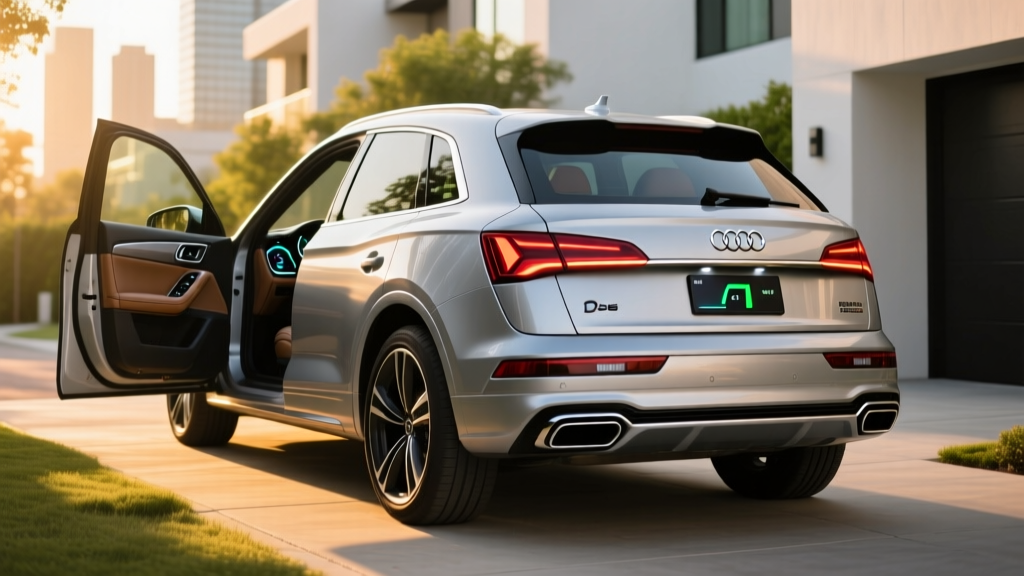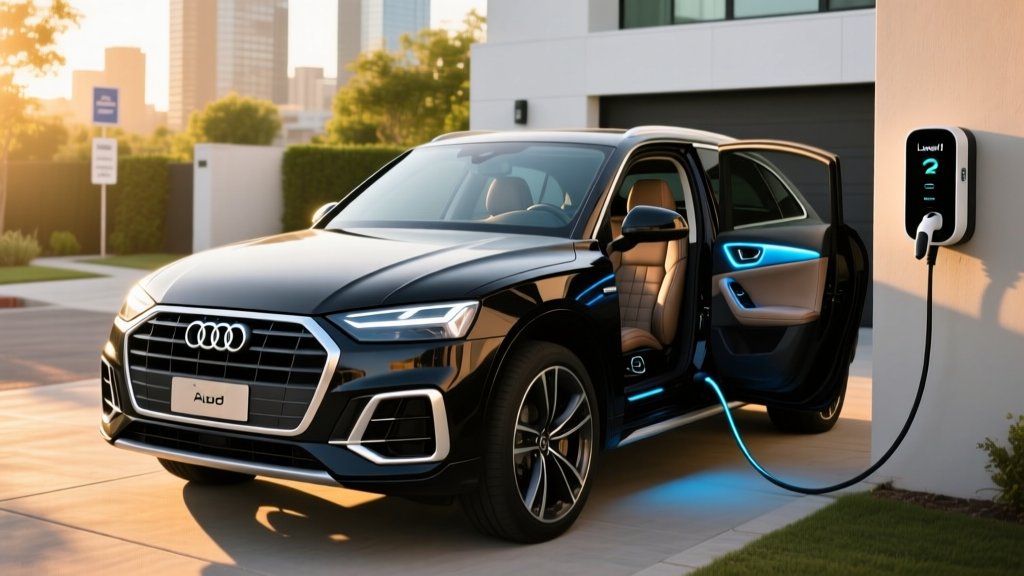
The 2026 Audi Q5 Hybrid Prestige sits at a crossroads that many luxury SUV shoppers recognize: you want electric commuting without range anxiety, premium refinement without learning a new brand, and enough cargo space for real life. This plug-in hybrid (PHEV) version of Audi's best-selling crossover pairs a turbocharged 2.0-liter engine with a more powerful electric motor and a larger battery than its predecessor, promising meaningful electric-only miles around town and seamless gas-engine backup for road trips.
But the Prestige trim—the top of the Q5 lineup—pushes the sticker well north of $60,000. At that price, buyers have to ask: does the PHEV powertrain justify the premium over the gas-only Q5, and does it make more sense than going full EV with something like the Audi Q4 e-tron or BMW iX? This review breaks down the exact EPA numbers, real-world efficiency, charging logistics, tax-credit eligibility, and long-term ownership costs so you can decide.
2026 Audi Q5 Hybrid Prestige: Core Specifications
| Specification | 2026 Audi Q5 PHEV Prestige |
|---|---|
| Powertrain | 2.0L turbo I-4 + electric motor (PHEV) |
| Combined Horsepower | 362 hp / 369 lb-ft torque |
| Battery (usable) | ~22 kWh lithium-ion (NMC chemistry) |
| EPA Electric-Only Range | ~32 miles (est.) |
| Total Combined Range | ~420 miles (gas + electric) |
| EPA MPGe (electric+gas) | ~72 MPGe (est.) |
| EPA MPG (gas-only, combined) | ~27 MPG combined (est.) |
| DC Fast Charging | Not available (AC only) |
| Level 2 Charge Time (0-100%) | ~2.5 hours at 7.2 kW |
| 0-60 mph | ~5.0 seconds |
| Drivetrain | quattro AWD |
| Cargo Volume | ~25 cu ft (rear seats up) |
| Base MSRP (Prestige trim) | ~$63,900 (est., incl. destination) |
| Battery/Powertrain Warranty | 8 yr / 100,000 mi (hybrid components) |
Note: The 2026 Q5 PHEV represents a generational refresh. Final EPA certification figures may vary slightly from estimates above. Always confirm at fueleconomy.gov before purchasing.
HEV vs PHEV: What the Audi Q5 Hybrid Actually Is
Before diving deeper, it's critical to distinguish between hybrid types, because Audi's naming can blur the lines:
- Conventional Hybrid (HEV): A small battery recharged only by the engine and regenerative braking. You never plug it in. Electric-only driving is limited to very low speeds and short distances. Think Toyota RAV4 Hybrid.
- Plug-in Hybrid (PHEV): A larger battery (typically 15-25 kWh) that you plug in to recharge. Offers 20-40 miles of true electric-only driving before the gas engine takes over. The Audi Q5 Hybrid is a PHEV.
- Battery Electric (BEV): No gas engine at all. 100% electric, 200-400+ miles of range. Think Audi Q4 e-tron or Tesla Model Y.
The 2026 Q5 Hybrid is exclusively a PHEV. If you see references to a "Q5 HEV," those apply to other markets or older mild-hybrid (MHEV) variants that lack meaningful electric-only capability. For US buyers, the plug-in version is the one that matters.
How Many MPG Does the Audi Q5 Hybrid Get?
| Driving Mode | City | Highway | Combined |
|---|---|---|---|
| EPA MPG (gas engine only) | ~25 | ~29 | ~27 |
| MPGe (electric + gas blended) | ~72 MPGe (est.) | ||
| Real-World MPG (gas, highway-heavy) | ~24-26 MPG | ||
| Real-World MPG (city, frequent regen) | ~28-31 MPG | ||
The EPA combined figure of ~27 MPG on gas alone is respectable for a 4,700-lb luxury AWD SUV, but it's not class-leading—the Toyota RAV4 Prime PHEV achieves ~38 MPG on gas. Where the Q5 PHEV earns its keep is in the MPGe rating when you're regularly charging and using electric mode for daily commutes.
Real-world reality check: Hybrids and PHEVs typically exceed their EPA city ratings in stop-and-go traffic because regenerative braking recovers energy that gas cars waste as heat. On the highway, however, expect MPG to drop below the EPA combined figure—especially at sustained 75-80 mph speeds where aerodynamic drag dominates and the electric motor contributes less. In cold weather (below 35°F), plan for a 10-15% MPG reduction due to cabin heating demands and reduced battery efficiency.
Electric-Only Range and Charging: The PHEV Daily Equation
The 2026 Q5 PHEV's ~22 kWh usable battery delivers an estimated 32 miles of electric-only range per the EPA. For many commuters, that covers a full round-trip daily drive without burning a drop of gasoline—provided you charge at home or work.
Here's the charging reality:
- Level 1 (120V household outlet): Adds ~3-4 miles of range per hour. A full charge takes roughly 7-8 hours—feasible for overnight top-ups if your daily electric driving is under 25 miles.
- Level 2 (240V home charger or public station): At the Q5's maximum 7.2 kW onboard charger acceptance rate, a full 0-100% charge takes approximately 2.5 hours. This is the practical daily charging method.
- DC Fast Charging: Not available. The Q5 PHEV cannot accept DC fast charging. This is typical for PHEVs—the battery is too small to justify the added weight and cost of DC hardware. You will not be able to use Electrify America or Tesla Supercharger stalls to quick-charge this vehicle.
Battery Warranty: Audi covers the Q5 PHEV's high-voltage battery and hybrid-specific components for 8 years or 100,000 miles, whichever comes first. This is standard across the industry and mandated in several states (California and CARB-adopting states require 10 years / 150,000 miles for PZEV components). The warranty covers battery capacity loss below a specified threshold (typically 70% of original capacity). Out-of-warranty battery replacement for a PHEV of this size typically ranges from $6,000 to $9,000 including labor, though most PHEV batteries outlast the vehicle itself based on current degradation data.
Powertrain Performance and Driving Dynamics
The combined output of 362 horsepower and 369 lb-ft of torque makes the Q5 PHEV Prestige genuinely quick. The 0-60 mph time of approximately 5.0 seconds puts it in the territory of the Audi S4 sedan, which is remarkable for a family SUV. The electric motor fills in the torque gap below the turbo's spool-up, delivering immediate thrust from a stoplight.
The seven-speed S tronic dual-clutch transmission handles shifts smoothly in automatic mode, though it can exhibit slight hesitation at low speeds—a characteristic of DCT designs rather than a flaw. The quattro all-wheel system is permanently active, with the electric motor powering the rear axle in EV mode for an e-quattro effect.
Drive modes include EV-only, Hybrid (automatic blending), Battery Hold (preserves charge for later, useful before entering city centers or low-emission zones), and Battery Charge (uses the engine to recharge the battery—inefficient but useful in specific scenarios). The Prestige trim adds adaptive air suspension, which improves ride quality over the standard steel springs and allows ride-height adjustment for rough roads or loading.
Prestige Trim: What You Get for the Premium
The Prestige sits above the Premium and Premium Plus trims in the Q5 hierarchy. For 2026, the Prestige adds or includes over lower trims:
- Matrix-design LED headlights with dynamic turn signals
- Head-up display
- Bang & Olufsen 3D premium audio (19 speakers)
- Navigation with real-time traffic and predictive routing
- Audi virtual cockpit plus (12.3-inch digital instrument cluster)
- Surround-view camera system with 3D rendering
- Warm-weather package (ventilated front seats, 4-zone climate)
- Leather-wrapped dashboard and door uppers
The MSRP for the 2026 Q5 PHEV Prestige is estimated at $63,900 including destination charges. Options like specific paint colors, 21-inch wheels, and the Night Optic package can push the as-tested price toward $68,000-$70,000.
Tax Credit Eligibility: Does the Q5 PHEV Qualify?
This is where PHEV buyers often face confusion. Under the current IRS §30D Clean Vehicle Credit rules, the 2026 Audi Q5 PHEV may qualify for up to $7,500 in federal tax credits—but only if several conditions are met simultaneously:
- MSRP Cap: SUVs must have a base MSRP under $80,000. The Q5 PHEV Prestige at ~$63,900 clears this threshold.
- Battery Capacity: Must be at least 7 kWh. The Q5 PHEV's ~22 kWh battery qualifies.
- Buyer Income Limits: Modified AGI must not exceed $150,000 (single), $225,000 (head of household), or $300,000 (married filing jointly).
- Critical Minerals & Battery Sourcing: A percentage of battery minerals must be sourced from the US or FTA-partner countries, and battery components must be manufactured or assembled in North America. These thresholds increase annually. Audi's compliance with 2026 sourcing requirements must be verified at the point of sale—dealers should provide the IRS-required seller report.
- Point-of-Sale Transfer: Eligible buyers can transfer the credit to the dealer at purchase, reducing the purchase price directly rather than waiting for a tax refund.
Key caveat: Because Audi is a Volkswagen Group brand with significant non-North-American battery sourcing, the Q5 PHEV's eligibility for the full $7,500 (vs. a partial $3,750 or zero) depends on the specific battery pack sourcing for the 2026 model year. Always confirm with your dealer and cross-reference the fueleconomy.gov tax credit database before finalizing a purchase. State incentives (California, Colorado, New York, and others) may stack on top—check your local DMV or energy office for details.
Real-World Ownership: Who Should Buy the Q5 Hybrid Prestige?
Choose the Audi Q5 PHEV Prestige if:
- Your daily commute is under 30 miles round-trip and you can charge at home (Level 2 ideal, Level 1 workable)
- You regularly take road trips of 200+ miles where charging infrastructure is sparse or unreliable
- You want Audi's interior quality, dealer network, and quattro AWD without committing to full electric
- You value the Prestige trim's luxury features and don't want to option up a lower trim
- You have a household AGI under the §30D income caps and can verify tax credit eligibility
Choose a full EV (like the Audi Q4 e-tron or BMW iX) instead if:
- You have reliable home and/or workplace charging and rarely drive more than 250 miles in a day
- You want to eliminate oil changes, spark plugs, and transmission fluid entirely
- Your state offers additional EV-only incentives (HOV lane access, rebate programs) that don't apply to PHEVs
- You want the lowest per-mile fuel cost—electricity at $0.13/kWh is roughly equivalent to $1.20/gallon gasoline
Choose the gas-only Q5 (or a conventional HEV like the Lexus NX 350h) if:
- You cannot charge at home or work (apartment, street parking, no electrical access)
- Your budget is closer to $50,000-$55,000 and the PHEV premium doesn't pencil out
- You drive mostly highway miles where the PHEV's electric range provides minimal benefit
Reliability and Long-Term Costs
Audi's reliability reputation has improved in recent years, though it still trails Toyota/Lexus and Porsche in long-term dependability surveys (J.D. Power, Consumer Reports). The PHEV powertrain adds complexity—two power sources, additional cooling circuits, high-voltage cabling—but the hybrid components are covered under the 8-year/100,000-mile warranty.
Expected maintenance differences vs. the gas-only Q5:
- Less brake wear: Regenerative braking handles much of the deceleration, extending pad and rotor life significantly. Some PHEV owners report 80,000+ miles on original brake pads.
- Same engine maintenance: The 2.0T still needs oil changes (~$150-$200 at a dealer, every 10,000 miles), air filters, and spark plugs on the standard schedule.
- Battery degradation: PHEV batteries are smaller and cycle more frequently than BEV batteries, but the 22 kWh pack in the Q5 is relatively conservative in its charge/discharge parameters. Expect 5-10% capacity loss over 8 years based on industry averages—well within warranty coverage.
Insurance costs for the Q5 PHEV Prestige tend to run 10-20% higher than the gas-only Q5 due to the higher replacement value and repair complexity of hybrid components. Get a quote from your insurer before committing.
Pros and Cons at a Glance
Pros
- 32 miles of electric-only range covers most daily commutes
- 362 hp provides genuinely sporty acceleration (5.0 sec 0-60)
- Prestige trim delivers top-tier luxury without aftermarket upgrades
- No range anxiety—420+ miles total range for road trips
- Eligible for up to $7,500 federal tax credit (verify sourcing)
- quattro AWD standard, excellent in snow and rain
Cons
- No DC fast charging—limited to 7.2 kW AC
- Prestige trim pushes MSRP near $64K before options
- Gas-only MPG (~27 combined) lags behind competitors like RAV4 Prime
- PHEV complexity means higher out-of-warranty repair risk
- Tax credit eligibility uncertain due to battery sourcing rules
- Cargo space slightly reduced vs. gas Q5 due to battery placement
Frequently Asked Questions
How many MPG does the 2026 Audi Q5 Hybrid get?
The EPA estimates approximately 27 MPG combined (25 city / 29 highway) when operating on gasoline alone. In real-world city driving with frequent regenerative braking, owners often see 28-31 MPG. Highway driving at 75+ mph typically returns 24-26 MPG. When regularly charged and driven in EV mode for short trips, the effective MPGe rating rises to approximately 72 MPGe.
How far can the Audi Q5 PHEV go on electric only?
The estimated EPA electric-only range is 32 miles. Real-world range varies: expect 28-30 miles in warm weather with moderate speeds, and 22-26 miles in cold weather (below 35°F) due to cabin heating demands and reduced battery efficiency. Highway driving at 70+ mph will deplete the battery faster than the EPA cycle suggests—plan for ~24-26 electric miles at sustained highway speeds.
Is the Audi Q5 Hybrid reliable and what does battery replacement cost?
Audi's hybrid systems have proven reasonably reliable, though not at Toyota/Lexus levels. The high-voltage battery and hybrid components are covered for 8 years / 100,000 miles (10 years / 150,000 miles in California and CARB states). Out-of-warranty battery replacement typically costs $6,000-$9,000, but industry data suggests PHEV batteries rarely require full replacement within the vehicle's normal lifespan.
Does the Audi Q5 Hybrid qualify for a tax credit?
The 2026 Q5 PHEV may qualify for up to $7,500 under the IRS §30D Clean Vehicle Credit, subject to buyer income limits (under $300K joint), MSRP caps (under $80K for SUVs—met), and battery sourcing requirements. The critical minerals and battery component sourcing thresholds are strict and change annually. Verify eligibility at fueleconomy.gov and request the IRS seller report from your dealer before purchase. State incentives may stack additionally.
Can I charge the Q5 PHEV at a DC fast charger?
No. The Audi Q5 PHEV only accepts AC charging—Level 1 (120V) or Level 2 (240V). It cannot use DC fast chargers like Electrify America, EVgo, or Tesla Superchargers. The onboard charger maxes out at 7.2 kW, meaning a full Level 2 charge takes about 2.5 hours.
Hybrid vs PHEV vs EV — which is right for me?
If you can charge at home and your daily driving is under 35 miles, the Q5 PHEV lets you commute electric while keeping gas backup for longer trips—ideal for one-car households or apartment-to-road-trip lifestyles. If you drive 200+ miles regularly and have charging access, a full EV like the Q4 e-tron eliminates gas entirely with lower per-mile costs. If you cannot charge at home at all, a conventional hybrid (HEV) like the Lexus NX 350h avoids the PHEV's dead-weight problem (carrying an uncharged battery wastes fuel).
The 2026 Audi Q5 Hybrid Prestige is a compelling luxury PHEV for buyers who want electric daily driving without committing fully to a BEV. Its 32-mile electric range, 362-hp powertrain, and Prestige-level refinement make it one of the most capable plug-in hybrids in the luxury compact SUV segment. Just verify your tax credit eligibility, confirm you can charge at home, and accept that gas-only MPG won't match a Toyota—and you'll have a sophisticated, practical, and quick luxury SUV that bridges the gap between today's infrastructure and tomorrow's electric ambitions.