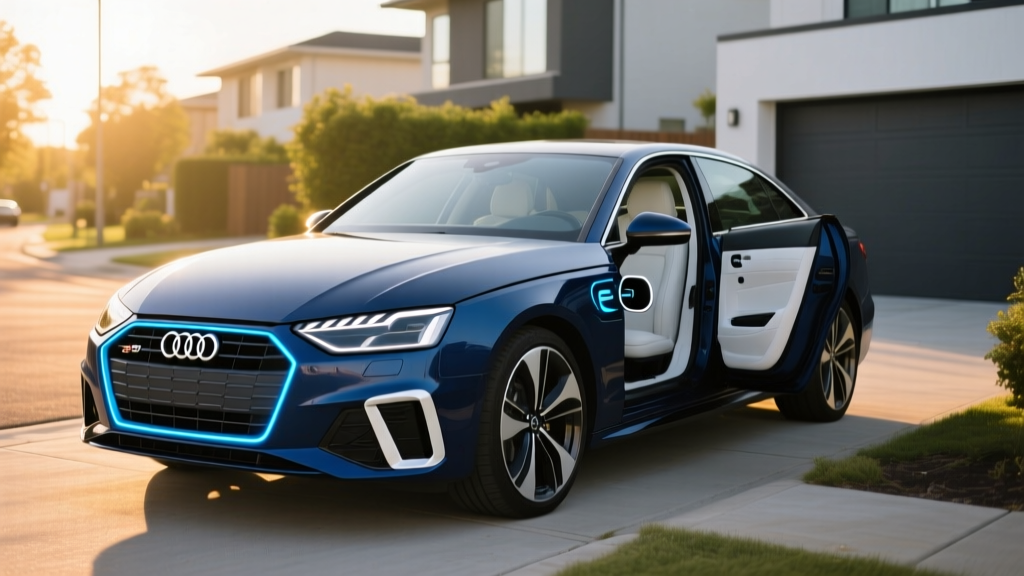
If you have been searching for an Audi A4 hybrid, you have likely discovered a frustrating reality: Audi does not currently sell a plug-in hybrid or conventional hybrid version of the A4 sedan in the United States. The A4 lineup remains exclusively powered by a 2.0-liter turbocharged four-cylinder engine with a 12-volt mild-hybrid system — which assists with stop-start smoothness and minor efficiency gains but cannot drive the car on electric power alone.
That does not mean Audi has abandoned electrified compact sedans. The automaker offers plug-in hybrid powertrains in larger models, and the broader Volkswagen Group platform that underpins the A4 does support PHEV configurations sold in other markets. This guide explains exactly what is available, what is not, and which Audi (or competitor) actually delivers the hybrid experience A4 shoppers are looking for.
Does an Audi A4 Hybrid Actually Exist?
The short answer: not in the U.S. market. The current-generation Audi A4 (sold as the A4 sedan and A4 allroad in the United States) uses Audi's 2.0L TFSI engine paired with a seven-speed S tronic dual-clutch transmission and the brand's 12V mild-hybrid (MHEV) system. This MHEV system includes a belt-driven starter-generator that recovers small amounts of energy during deceleration and enables smoother engine restarts at stoplights. It is not a full hybrid, and it cannot propel the vehicle on electric power.
Mild Hybrid (MHEV): Small 48V or 12V system that assists the gas engine. Cannot drive on electric power alone. No plug. This is what the current A4 has.
Conventional Hybrid (HEV): Larger battery and electric motor that can briefly drive the wheels electrically. Self-charging via regenerative braking — no plug required. Example: Toyota Camry Hybrid.
Plug-in Hybrid (PHEV): Larger battery (typically 12–25 kWh) with meaningful electric-only range (20–50 miles). Plugs into a wall outlet or charger. Example: BMW 330e.
In European and Chinese markets, Audi has offered the A4 as a mild hybrid across most trims, and the previous-generation A4 was available in some regions with more advanced electrified powertrains. But American buyers looking for a true Audi A4 hybrid — one that can drive on electricity and reduce fuel consumption significantly — will not find one in showrooms.
The Closest Audi Alternative: A6 TFSI e Plug-in Hybrid
Audi's plug-in hybrid sedan offering in the U.S. is the Audi A6 55 TFSI e, a midsize luxury sedan that sits one class above the A4. It pairs a 2.0-liter turbocharged four-cylinder engine with an electric motor integrated into the transmission, delivering a combined output of 362 horsepower and 369 lb-ft of torque.
| Spec | Value |
|---|---|
| Powertrain | 2.0L turbo I4 + electric motor (PHEV) |
| Combined Horsepower | 362 hp |
| Combined Torque | 369 lb-ft |
| Battery Capacity | 17.9 kWh (gross) |
| EPA Electric-Only Range | ~38 miles |
| EPA Combined MPG (gas) | ~29 MPG combined |
| MPGe (electric + gas) | ~63 MPGe combined |
| Level 2 Charge Time (0–100%) | ~2.5 hours at 7.2 kW |
| DC Fast Charging | Not supported |
| 0–60 mph | 5.1 seconds |
| Base MSRP | ~$70,000 |
The A6 TFSI e is the most accessible plug-in hybrid sedan Audi sells in America. It offers genuine electric-only commuting capability for most daily drives, with the gas engine available for longer trips. However, it starts around $70,000 — roughly $25,000 more than a base A4 — which puts it in a different purchase bracket entirely.
Fuel Economy: What the A4 Mild-Hybrid Actually Delivers
Since the A4 lacks a true hybrid powertrain, its fuel economy reflects a conventional turbocharged sedan with minor MHEV assistance. Here is how the current A4 40 TFSI (the U.S.-spec base engine, rated at 201 hp) stacks up on EPA estimates:
| Cycle | EPA MPG | Real-World Expectation |
|---|---|---|
| City | 27 MPG | 25–28 MPG |
| Highway | 35 MPG | 33–37 MPG |
| Combined | 30 MPG | 28–32 MPG |
The 12V MHEV system contributes marginal gains — perhaps 1–2 MPG in stop-and-go traffic compared to a non-MHEV equivalent. Real-world highway driving can exceed the EPA estimate if you maintain moderate speeds, but aggressive driving or cold-weather short trips will push city figures toward the low 20s.
For comparison, a true PHEV competitor like the BMW 330e achieves an EPA-estimated 75 MPGe when factoring in electric driving and returns roughly 28 MPG combined once the battery is depleted. That is a significant gap for commuters with short, chargable drives.
Audi A4 Hybrid vs. Competitors: What Else Can You Buy?
If you want a compact luxury sedan with genuine hybrid or plug-in hybrid capability, the market does offer alternatives that the A4 simply does not match:
BMW 330e (PHEV)
- EPA electric range: ~23 miles
- Combined output: 288 hp
- EPA combined (gas only): ~28 MPG
- MPGe: ~75 MPGe
- Base MSRP: ~$46,000
- Battery: 12.0 kWh usable, 8 yr/80,000 mi warranty
Mercedes-Benz C 300 e (PHEV — not U.S.)
- Available in Europe with ~60 miles EV range
- Not sold in the United States
- U.S. C-Class is gas-only or mild-hybrid
Lexus ES 300h (HEV)
- EPA combined: ~44 MPG
- Conventional hybrid, no plug needed
- Combined output: 215 hp
- Base MSRP: ~$44,000
- Best for: buyers who want high MPG without charging
The BMW 330e is the most direct competitor to what an Audi A4 PHEV would be. It offers real electric-only commuting, a usable battery, and pricing that undercuts the A6 TFSI e by a wide margin. If Audi introduces an A4 plug-in hybrid for a future model year, the 330e is the benchmark it would need to beat.
Tax Credit Eligibility: Does Any Audi Hybrid Qualify?
Under the current IRS §30D Clean Vehicle Credit rules, plug-in hybrids can qualify for up to $7,500 in federal tax credits — but only if they meet strict battery sourcing, critical mineral, MSRP, and buyer income requirements.
- Vehicle type: Must be a new PHEV or BEV with at least 7 kWh of battery capacity (the A4 MHEV does not qualify).
- MSRP cap: Sedans must have an MSRP at or below $55,000; SUVs, vans, and trucks up to $80,000.
- Buyer income cap: Modified AGI must not exceed $150,000 (single), $225,000 (head of household), or $300,000 (joint).
- Battery sourcing: Battery components must be manufactured or assembled in North America; critical minerals must be sourced from the U.S. or free-trade-agreement partners. The required percentage increases each year.
- Point-of-sale transfer: Eligible buyers can transfer the credit to the dealer for an immediate price reduction at purchase.
Always verify eligibility with a tax professional and check the latest IRS guidance — sourcing requirements tighten annually.
Here is the practical reality for Audi hybrid shoppers: The A6 55 TFSI e starts around $70,000, which exceeds the $55,000 MSRP cap for sedans under §30D. This means the A6 PHEV does not qualify for the federal EV tax credit as a sedan. The BMW 330e, starting near $46,000, is more likely to clear the MSRP threshold — though battery sourcing requirements still apply and can change by model year.
The conventional A4, being a mild-hybrid without plug-in capability, does not qualify for any federal electrified-vehicle tax credit.
Reliability and Battery Warranty: What Hybrid Buyers Need to Know
Because the A4 does not have a high-voltage hybrid battery, its warranty coverage follows Audi's standard new-vehicle terms. For reference on what genuine hybrid battery warranties look like across the industry:
- Audi A6 TFSI e (PHEV): 8 years / 62,000 miles (whichever comes first) on high-voltage battery, covering defects and capacity below a specified threshold.
- BMW 330e (PHEV): 8 years / 80,000 miles on hybrid battery.
- Toyota/Lexus hybrids (HEV): 10 years / 150,000 miles on hybrid battery — among the longest in the industry.
- Hyundai/Kia PHEVs: 10 years / 100,000 miles on hybrid battery.
Replacement cost: PHEV battery replacement typically ranges from $6,000 to $12,000 depending on the model and battery size. HEV batteries (smaller capacity) generally cost $2,000–$5,000. Most hybrid batteries outlast their warranty periods — real-world data shows degradation is gradual and most units retain 80%+ capacity at 100,000 miles.
The Audi A4's 12V mild-hybrid system uses a small lithium-ion battery that is far less expensive to replace than a PHEV or HEV traction battery. Expect replacement costs in the $300–$600 range if it ever fails outside the standard 4-year/50,000-mile new-vehicle warranty. The A4's overall reliability has been rated average to slightly above average by major testing organizations, with the turbocharged 2.0L TFSI engine being a well-established powertrain in the VW Group portfolio.
Hybrid vs. PHEV vs. Full EV: Which Should You Choose?
If you came here looking for an Audi A4 hybrid, you are likely weighing how much electrification fits your lifestyle. Here is a practical decision framework:
- You cannot charge at home or work.
- You want better MPG without changing any habits.
- You drive mostly in the city, where hybrids shine (regen braking recovers energy).
- Look at: Lexus ES 300h, Toyota Camry Hybrid.
- You can install a Level 2 charger at home (240V outlet).
- Your daily commute is under 30 miles round-trip (covers most PHEV electric ranges).
- You still want a gas engine for road trips without range anxiety.
- Look at: BMW 330e, Audi A6 55 TFSI e (if budget allows).
- You have reliable home charging and your daily drive is under 250 miles.
- You want the lowest per-mile fuel cost and minimal maintenance.
- You are ready to plan around DC fast charging for road trips.
- Look at: Tesla Model 3, BMW i4, Audi Q4 e-tron (SUV).
Will Audi Ever Build an A4 Plug-in Hybrid?
Audi has not announced a plug-in hybrid A4 for the U.S. market. The brand's electrification strategy has increasingly focused on full battery-electric vehicles (the e-tron family) rather than expanding PHEV offerings to smaller sedans. In Europe, where stricter CO₂ fleet targets incentivize PHEV sales, Audi has offered electrified A4 variants — but the American market has not received them.
The next-generation A4 (expected to ride on an updated platform) could potentially support a PHEV variant, but Audi has signaled that future compact sedans may skip plug-in hybrid entirely and transition directly from mild-hybrid to fully electric. If a PHEV A4 is important to you, monitoring Audi's annual model-year announcements and checking Audi's U.S. site periodically is the best approach.
Pros and Cons: The Electrified Audi Sedan Situation
Pros — Audi A4 (MHEV)
- Refined, quiet cabin with premium materials
- Smooth stop-start thanks to MHEV system
- Strong Quattro AWD availability
- Competitive base pricing (~$42,000)
- Well-established 2.0T powertrain reliability
Cons — No True Hybrid A4
- No PHEV or HEV option in the U.S.
- 30 MPG combined trails rival hybrids by 10–15 MPG
- MHEV provides negligible real-world fuel savings
- No federal tax credit eligibility
- A6 TFSI e (the closest PHEV) costs $25K+ more
- BMW 330e offers PHEV at a lower price point
Frequently Asked Questions
How many MPG does the Audi A4 get?
The current Audi A4 40 TFSI with front-wheel drive achieves an EPA-estimated 27 city / 35 highway / 30 combined MPG. The Quattro all-wheel-drive version drops slightly to approximately 25 city / 33 highway / 28 combined. These figures reflect the mild-hybrid system's marginal contribution — it is not a true hybrid.
Is there a plug-in hybrid Audi A4?
No. Audi does not sell a plug-in hybrid A4 in the United States. The closest Audi PHEV sedan is the A6 55 TFSI e, which starts around $70,000 and offers approximately 38 miles of electric-only range. The BMW 330e is the closest competitor to what an A4 PHEV would be.
Does the Audi A4 qualify for any hybrid tax credit?
No. The A4's 12V mild-hybrid system does not meet the minimum requirements for the IRS §30D Clean Vehicle Credit, which requires a plug-in vehicle with at least 7 kWh of battery capacity. Only PHEVs and BEVs are eligible.
Is the Audi A4 reliable?
The A4's 2.0L TFSI engine and S tronic transmission are well-established components used across the VW Group. Overall reliability ratings are average to above average. The MHEV system adds minimal complexity compared to a full hybrid or PHEV, reducing potential failure points. Audi's standard warranty covers 4 years / 50,000 miles.
What is the best hybrid alternative to the Audi A4?
If you want a compact luxury PHEV, the BMW 330e is the strongest alternative, offering 23 miles of electric range, 288 hp, and a starting price near $46,000. If you prefer a conventional hybrid with no plug, the Lexus ES 300h delivers 44 MPG combined in a premium package, though it is larger than the A4.
Does the Audi A4 mild-hybrid need to be plugged in?
No. The A4's 12V mild-hybrid system charges itself through regenerative braking and the alternator. There is no plug, no external charging, and no electric-only driving mode. It simply smooths the engine's stop-start behavior and recovers small amounts of energy.