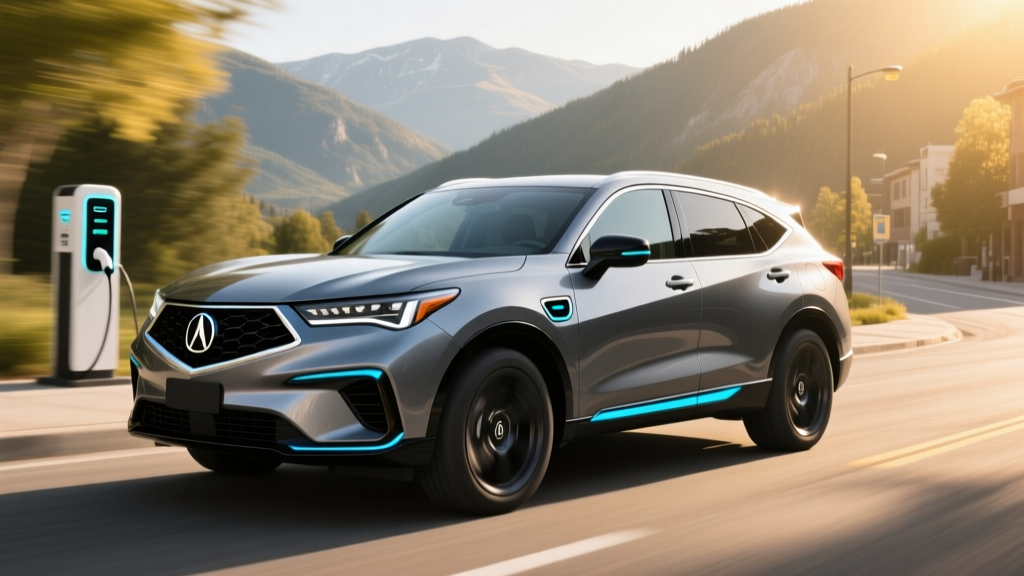
If you've been searching whether Acura offers a hybrid SUV, the answer is yes — but the lineup is narrower than you might expect from Honda's luxury division. For the 2026 model year, Acura's hybrid SUV offering centers on the MDX Sport Hybrid, a three-row luxury crossover that pairs a V6 engine with a three-motor system. Notably, Acura does not currently sell a plug-in hybrid (PHEV) SUV in the United States, and the previously available RDX has never received a hybrid powertrain.
This guide covers the full picture: what Acura's hybrid SUV actually delivers in EPA and real-world fuel economy, how the powertrain works, what you'll pay, and whether a conventional hybrid (HEV), a plug-in hybrid (PHEV), or a full battery-electric vehicle (BEV) is the right move for your next purchase.
HEV vs. PHEV: What Acura Actually Offers
Before diving into specs, it's critical to understand the difference between hybrid types — because Acura only makes one of them.
Conventional Hybrid (HEV) — What Acura Sells
A conventional hybrid like the MDX Sport Hybrid uses a small battery (typically 1–2 kWh) that charges itself through regenerative braking and the gasoline engine. You never plug it in. The electric motor assists the engine during acceleration and low-speed driving, improving fuel economy by 20–35% over a gas-only equivalent. It cannot drive on electricity alone for meaningful distances.
Plug-In Hybrid (PHEV) — What Acura Does NOT Currently Offer
A plug-in hybrid carries a larger battery (typically 12–25 kWh) that you charge from a wall outlet or public charger. PHEVs deliver 20–50 miles of pure electric range before the gas engine kicks in. Competitors like the BMW X5 xDrive50e, Volvo XC90 Recharge, and Lincoln Corsair Grand Touring all offer PHEV SUVs. Acura does not — at least not in the 2026 US market.
2026 Acura MDX Sport Hybrid: Full Spec Breakdown
The MDX Sport Hybrid is Acura's sole hybrid SUV. It uses the brand's Sport Hybrid SH-AWD system — a three-motor setup with two rear motors enabling true torque vectoring to individual rear wheels. Here's what the numbers look like for the 2026 model year.
| Specification | 2026 Acura MDX Sport Hybrid |
|---|---|
| Powertrain | 3.0L V6 + 3-motor hybrid system (SH-AWD) |
| Combined Horsepower | 355 HP |
| Combined Torque | 354 lb-ft |
| Transmission | 7-speed dual-clutch automatic |
| Drivetrain | Sport Hybrid SH-AWD (standard) |
| EPA MPG (City / Highway / Combined) | 28 / 27 / 28 MPG |
| Fuel Tank Capacity | 18.5 gallons |
| Total Driving Range | ~518 miles |
| 0–60 MPH | ~5.7 seconds |
| Hybrid Battery Type | Lithium-ion (approx. 1.3 kWh) |
| Plug-In Capable? | No (conventional HEV) |
| Towing Capacity | 5,000 lbs |
| Cargo Volume (behind 3rd / 2nd row) | 16.3 / 48.4 cu ft |
| Base MSRP (Technology Package) | $62,350 |
| Top Trim MSRP (Type S Advance) | $73,550 |
| Hybrid Battery Warranty | 8 years / 100,000 miles (10 yr / 150,000 mi in CARB states) |
Real-World MPG: What You'll Actually See
The EPA rates the 2026 MDX Sport Hybrid at 28 MPG city, 27 MPG highway, and 28 MPG combined, per fueleconomy.gov. But hybrid fuel economy behaves differently than gas cars in the real world, and the MDX is no exception.
City driving: Hybrids thrive in stop-and-go traffic, where regenerative braking recovers energy and the electric motor handles low-speed propulsion. Expect to meet or slightly exceed the EPA city figure — owners commonly report 28–30 MPG in urban and suburban driving.
Highway driving: At sustained 70–80 MPH speeds, the electric motor contributes less and the V6 does the heavy lifting. Real-world highway fuel economy tends to drop to 24–26 MPG, especially with roof racks, heavy cargo, or headwinds.
Cold weather: In temperatures below 30°F, expect a 10–15% reduction in fuel economy. The engine runs more frequently to generate cabin heat and maintain battery temperature, reducing the hybrid system's efficiency advantage.
EPA Combined: 28 MPG | Real-World Expectation: 25–29 MPG depending on driving mix. City-heavy commuters will see the high end; highway road-trippers should plan for 24–26 MPG. Total real-world range: approximately 460–535 miles per tank.
| Driving Scenario | Expected MPG | Range per Tank |
|---|---|---|
| City / Suburban (mixed) | 28–30 MPG | 518–555 mi |
| Highway (70–80 MPH) | 24–26 MPG | 444–481 mi |
| Cold Weather (below 30°F) | 23–26 MPG | 425–481 mi |
| Combined (annual average) | 26–28 MPG | 481–518 mi |
Powertrain Deep Dive: The Sport Hybrid SH-AWD System
The MDX Sport Hybrid's powertrain is one of the more sophisticated hybrid setups in the luxury SUV segment. Here's how the components work together:
- 3.0L turbocharged V6 engine: Produces the bulk of the power, mounted transversely and driving the front wheels through a 7-speed dual-clutch transmission.
- Front electric motor: Integrated into the transmission, providing torque fill during acceleration and enabling smooth engine stop-start operation.
- Twin rear electric motors: Each rear wheel has its own dedicated motor, enabling true torque vectoring. The system can send up to 70% of available torque to the rear axle, and then distribute 100% of that rear torque to either the left or right wheel. This isn't just an efficiency play — it meaningfully improves cornering grip and stability.
The combined output of 355 HP and 354 lb-ft of torque makes the MDX Sport Hybrid substantially quicker than the non-hybrid MDX (which produces 290 HP from its 3.5L V6). The 0–60 MPH time of roughly 5.7 seconds puts it in the territory of sport-tuned luxury crossovers, though it stops short of the 447-HP MDX Type S (which, notably, is not available as a hybrid).
Pricing, Trims, and Tax Credit Eligibility
The 2026 Acura MDX Sport Hybrid is available in several trim configurations, all featuring the SH-AWD hybrid system as standard:
- MDX Sport Hybrid with Technology Package: $62,350 — includes leather seats, ELS Studio audio, navigation, and AcuraWatch safety suite.
- MDX Sport Hybrid with Advance Package: $67,850 — adds ventilated front seats, heated rear seats, head-up display, and surround-view camera.
- MDX Sport Hybrid Type S: $70,550 — sport-tuned air suspension, larger brakes, unique styling, and more aggressive throttle mapping.
- MDX Sport Hybrid Type S with Advance Package: $73,550 — the full luxury-and-performance package.
Does the MDX Hybrid Qualify for a Federal Tax Credit?
No. Under current IRS §30D rules, the federal Clean Vehicle Credit of up to $7,500 applies only to plug-in electric vehicles — battery-electric vehicles (BEVs) and plug-in hybrids (PHEVs) with a minimum battery capacity of 7 kWh. Because the MDX Sport Hybrid is a conventional HEV with a ~1.3 kWh battery and no plug-in capability, it does not qualify for any federal EV tax credit.
Some states offer their own incentives for hybrids, but these are increasingly rare as state programs shift toward full electric vehicles. Check your state's energy or DMV website for current programs. As always, consult a tax professional for eligibility specifics — incentive rules change frequently and vary by jurisdiction.
Hybrid Battery Warranty & Replacement Cost
Acura covers the MDX Sport Hybrid's lithium-ion battery under its hybrid component warranty: 8 years or 100,000 miles nationwide. In California Air Resources Board (CARB) states — which include CA, NY, MA, CT, and several others — the warranty extends to 10 years or 150,000 miles.
If the hybrid battery does require replacement outside of warranty, expect a cost in the range of $2,000–$4,000 for the battery pack plus labor. However, real-world data from Honda/Acura hybrid systems shows these batteries are highly durable. It's common for them to last 150,000+ miles with minimal degradation, since the small battery is never deeply cycled the way a full EV battery is.
Hybrid vs. PHEV vs. Full EV: Which Is Right for You?
Choosing between Acura's hybrid, a competitor's PHEV, or a full battery-electric vehicle comes down to your daily driving patterns, charging access, and priorities.
Choose the Acura MDX Sport Hybrid (HEV) If:
- You have no access to home or workplace charging
- You want better fuel economy with zero behavior change — no plugging in, no route planning
- You regularly take long road trips and want 500+ miles of range without stopping
- You value Acura's SH-AWD torque-vectoring system for all-weather confidence
- You want a proven, reliable hybrid system backed by an 8–10 year warranty
Consider a PHEV (BMW X5, Volvo XC90) If:
- You can install a Level 2 charger at home and have a short commute (under 30 miles)
- You want to drive mostly on electricity during the week but need gas-engine range for weekend trips
- You want to qualify for the federal §30D tax credit (up to $7,500, subject to income and sourcing rules)
- You're willing to pay a higher upfront price for lower daily operating costs
Quick Decision Framework
No home charging access? → HEV (Acura MDX Sport Hybrid) is your best option. PHEVs and BEVs lose most of their advantage without regular plug-in charging.
Home charging + commute under 30 miles? → A PHEV lets you drive electric daily while keeping gas range for trips. Consider the BMW X5 xDrive50e or Volvo XC90 Recharge.
Home charging + mostly under 250 miles/day? → A full BEV like the BMW iX, Rivian R1S, or Tesla Model X eliminates gasoline entirely and offers the lowest per-mile cost.
Reliability and Long-Term Ownership
Acura (and parent company Honda) has one of the strongest track records in hybrid reliability. The Sport Hybrid SH-AWD system has been in production since 2014 (debuted in the RLX sedan) and has seen continuous refinement. The MDX Sport Hybrid specifically has been in the lineup since the previous-generation model, giving Acura substantial real-world durability data.
Key reliability considerations:
- Hybrid battery: Honda/Acura hybrid batteries rarely fail prematurely. The shallow charge-discharge cycles (the battery is never fully depleted or fully charged) are gentle on lithium-ion chemistry. Expect the battery to outlast 150,000 miles in most cases.
- Dual-clutch transmission: The 7-speed DCT is more complex than a conventional automatic. While Acura has addressed early-generation issues, some owners report occasional low-speed shift hesitation. Regular fluid changes per the maintenance schedule are important.
- Rear motor unit: The twin rear electric motors are sealed units with no regular maintenance. Failure rates are low, but replacement (if needed outside warranty) can cost $1,500–$2,500 per motor.
- Overall: According to IIHS, the MDX earns top safety ratings, and Acura's dealer network provides strong service coverage nationwide.
Frequently Asked Questions
How many MPG does the Acura MDX hybrid get?
The EPA rates the 2026 Acura MDX Sport Hybrid at 28 MPG city, 27 MPG highway, and 28 MPG combined. In real-world city driving, owners commonly see 28–30 MPG. Highway driving at 75+ MPH typically yields 24–26 MPG. Cold weather can reduce these figures by 10–15%.
Does Acura make a plug-in hybrid SUV?
No. As of the 2026 model year, Acura does not sell a plug-in hybrid (PHEV) SUV in the United States. The MDX Sport Hybrid is a conventional hybrid (HEV) that does not plug in. If you need a luxury PHEV SUV, competitors like the BMW X5 xDrive50e, Volvo XC90 Recharge, and Lincoln Corsair Grand Touring are available.
Does the Acura MDX hybrid qualify for a tax credit?
No. The federal §30D Clean Vehicle Credit applies only to plug-in vehicles (BEVs and PHEVs) with at least 7 kWh of battery capacity. The MDX Sport Hybrid is a conventional HEV with a ~1.3 kWh battery and does not qualify. Some states may offer small hybrid incentives — check your state's energy office for current programs. Consult a tax professional for personal eligibility guidance.
Is the Acura MDX hybrid reliable?
Yes. Acura's Sport Hybrid SH-AWD system has been in production since 2014 and benefits from Honda's extensive hybrid engineering experience. The hybrid battery carries an 8-year/100,000-mile warranty (10 years/150,000 miles in CARB states) and real-world data suggests these batteries commonly last 150,000+ miles. The main complexity concern is the dual-clutch transmission, which benefits from strict adherence to maintenance schedules.
How much does it cost to replace the hybrid battery?
Outside of warranty, expect $2,000–$4,000 for hybrid battery replacement including labor. However, premature failure is uncommon in Honda/Acura hybrid systems. The battery's shallow cycling (never fully charged or fully depleted) is gentle on the cells, and most owners will never need a replacement during typical ownership.
Can I charge the Acura MDX hybrid at home?
No. The MDX Sport Hybrid is a conventional hybrid — it charges its own small battery through regenerative braking and the gasoline engine. There is no plug, no charging port, and no electric-only driving mode. You simply fill it with gas and drive.
Is the MDX Sport Hybrid faster than the regular MDX?
Yes. The Sport Hybrid produces 355 combined horsepower versus 290 HP for the standard 3.5L V6 MDX. The 0–60 MPH time drops from approximately 6.4 seconds to roughly 5.7 seconds. The twin rear motors also improve traction and cornering through torque vectoring, giving the Sport Hybrid a noticeably more planted feel in spirited driving.
The Acura MDX Sport Hybrid occupies a specific niche: a luxury three-row SUV with meaningful fuel economy gains over its gas counterpart, strong all-weather capability, and no lifestyle compromises. It won't give you electric-only commuting or access to federal tax credits — but for buyers who want a refined, efficient, and reliable hybrid SUV without changing how they fuel up, it's one of the strongest options in its class.