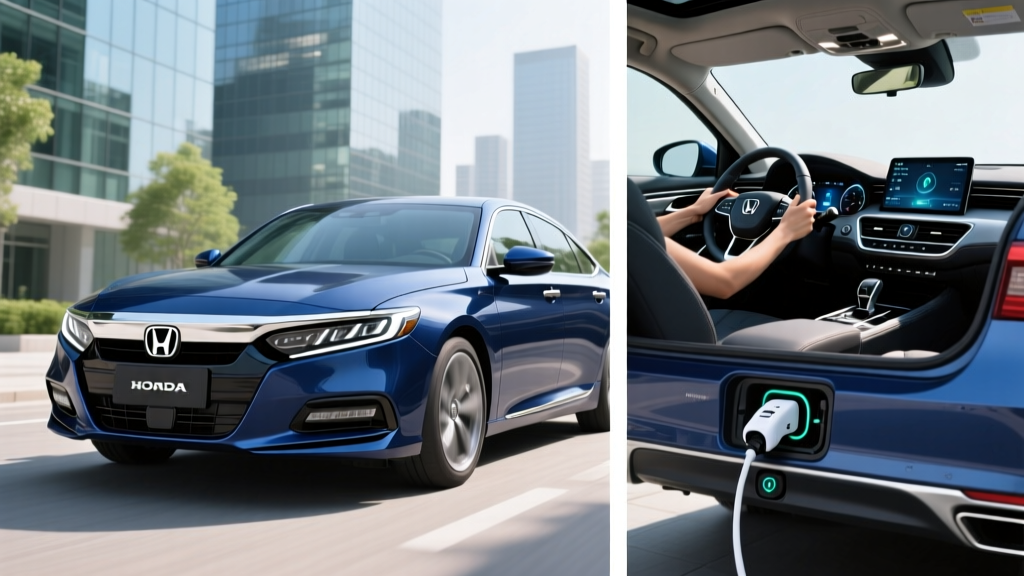
The midsize sedan segment has thinned considerably, but the Honda Accord Hybrid remains a benchmark for buyers who want electrified efficiency without plugging in. The EX-L trim sits near the top of the lineup, adding leather, a premium audio system, and wireless smartphone integration to Honda's proven two-motor hybrid system. For 2026, the Accord Hybrid EX-L continues with the same powertrain that made its predecessor an EPA-rated efficiency leader in the segment.
This guide covers everything a research-driven buyer needs: exact EPA MPG figures, real-world fuel economy expectations, powertrain specs, pricing, warranty coverage, and how the Accord Hybrid stacks up against plug-in hybrids and full EVs. No fluff — just the data you need to decide.
2026 Accord Hybrid EX-L: Quick Specs at a Glance
| Spec | Value |
|---|---|
| Powertrain | 2.0L 4-cyl Atkinson + 2 electric motors (e-CVT) |
| Combined Horsepower | 204 hp |
| Combined Torque | 247 lb-ft (electric motor) |
| EPA MPG (City / Highway / Combined) | 51 / 44 / 48 |
| Fuel Tank | 12.8 gallons |
| Total Range | ~614 miles |
| 0–60 mph | ~7.0 seconds |
| Drivetrain | Front-wheel drive |
| Hybrid Battery | Lithium-ion, ~1.1 kWh (self-charging HEV) |
| Battery Warranty | 8 years / 100,000 miles (10 yr/150,000 mi in CARB states) |
| MSRP (2026 EX-L) | ~$36,490 (incl. destination) |
| Federal Tax Credit | Not eligible (§30D requires plug-in capability) |
How Many MPG Does the Accord Hybrid EX-L Get?
The 2026 Honda Accord Hybrid is EPA-rated at 51 mpg city, 44 mpg highway, and 48 mpg combined. These figures apply to the EX-L and other trims equipped with Honda's fourth-generation two-motor hybrid system paired with the 2.0-liter Atkinson-cycle engine.
| Scenario | EPA Rating | Real-World Expectation |
|---|---|---|
| City | 51 mpg | 48–54 mpg (hybrids often exceed EPA in stop-and-go) |
| Highway (70 mph cruise) | 44 mpg | 40–44 mpg (less regenerative benefit at steady speed) |
| Combined | 48 mpg | 44–50 mpg depending on driving mix |
| Cold weather (below 30°F) | N/A | 38–44 mpg (engine runs more for cabin heat) |
The Accord Hybrid's city advantage is the defining trait of Honda's series-parallel system. At low speeds, the electric motor handles most propulsion while the engine acts as a generator. This means stop-and-go commuting — where gas-only sedans waste fuel at idle and during acceleration — is exactly where the Accord Hybrid shines. Real-world owners frequently report exceeding the EPA city estimate in warm-weather urban driving, with some seeing 52–55 mpg on low-speed routes.
Highway efficiency is more modest. At sustained 70–80 mph speeds, the engine directly drives the wheels through a lock-up clutch, and regenerative braking opportunities are minimal. Expect 40–44 mpg on flat interstate stretches, dropping further in mountainous terrain or with heavy cargo.
Powertrain Deep Dive: Honda's Two-Motor Hybrid System
The Accord Hybrid uses Honda's fourth-generation Intelligent Multi-Mode Drive (i-MMD) system. Unlike traditional planetary-gear hybrids (think Toyota), Honda's setup operates primarily in series-hybrid mode — the gas engine generates electricity for the drive motor — with a direct-drive clutch for efficient highway cruising.
How it works in practice:
- EV Drive: At low speeds and light loads, the 181-hp drive motor propels the car using energy from the small lithium-ion battery. The engine stays off.
- Hybrid Drive: Under moderate acceleration, the engine spins a generator motor to produce electricity that feeds the drive motor. The engine never mechanically connects to the wheels in this mode.
- Engine Drive: At steady highway speeds (typically above 45 mph), a lock-up clutch engages, connecting the 2.0L engine directly to the wheels for maximum efficiency.
The result is seamless transitions that most drivers never notice. Total system output is 204 horsepower, with the electric motor delivering 247 lb-ft of torque from a standstill — giving the Accord Hybrid surprisingly responsive off-the-line acceleration. The 0–60 mph sprint takes approximately 7.0 seconds, competitive with turbocharged gas-only midsize sedans.
One practical advantage: Honda's system does not use a conventional CVT belt or planetary gearset. There's no rubber-band acceleration feel. The engine revs are matched to vehicle speed more naturally than in Toyota's e-CVT, though under hard acceleration you'll still hear the engine drone at high RPM.
HEV vs PHEV vs EV: Which Powertrain Fits You?
The Accord Hybrid EX-L is a conventional hybrid (HEV). It cannot plug in, has no meaningful electric-only range (roughly 1 mile at very low speeds), and requires no behavioral change from a gas-car owner. You fuel it at gas stations and the hybrid system handles the rest.
| Factor | HEV (Accord Hybrid) | PHEV (e.g., Toyota Prius Prime) | BEV (e.g., Tesla Model 3) |
|---|---|---|---|
| Plug-in required? | No | Yes (for EV range benefit) | Yes (always) |
| Electric-only range | ~1 mile | 25–45 miles | 250–360 miles |
| Total range | ~614 miles | ~400–600 miles | 250–360 miles |
| Fueling / charging | Gas only | Gas + Level 1/2 plug | Level 1/2/DC plug |
| Home charging install | Not needed | Recommended ($500–$2,000) | Required ($500–$2,500+) |
| Federal tax credit (§30D) | Not eligible | Up to $7,500 (if eligible) | Up to $7,500 (if eligible) |
| Best for | No home charging access; long road trips | Short commute + home charging + road-trip flexibility | Home charging access; lower running costs; tech-forward |
| Maintenance complexity | Low (engine + hybrid system) | Moderate (dual systems) | Low (no engine, fewer fluids) |
Choose the Accord Hybrid EX-L if you lack reliable home or workplace charging, regularly drive more than 300 miles between stops, live in an apartment without plug access, or want electrified efficiency with zero lifestyle change.
Choose a PHEV if your commute is under 40 miles round-trip, you can install a Level 2 charger at home, and you want to drive mostly on electricity while keeping gas-engine backup for road trips.
Choose a full EV if you have home charging, your daily driving is under 250 miles, you want the lowest per-mile fuel cost, and you're ready to plan around DC fast-charging on longer trips.
Pricing, Trim Value, and Tax Credit Reality
The 2026 Honda Accord Hybrid EX-L carries an MSRP of approximately $36,490 including destination charges. The EX-L is the second-highest Hybrid trim, sitting above the Sport Hybrid and below the Sport-L Hybrid and Touring Hybrid.
Key EX-L equipment includes:
- Leather-trimmed seats with heated front seats
- 10-speaker audio system
- Wireless Apple CarPlay and Android Auto
- 12.3-inch infotainment touchscreen
- Honda Sensing suite (adaptive cruise, lane-keeping, collision mitigation)
- Wireless phone charging pad
- Heated side mirrors with integrated turn signals
Federal Tax Credit Eligibility
The Accord Hybrid does not qualify for the federal §30D clean vehicle tax credit. Under current IRS rules, only plug-in electric vehicles (PHEVs and BEVs) with a battery capacity of at least 7 kWh are eligible. The Accord Hybrid's small ~1.1 kWh battery is charged solely by the engine and regenerative braking — it has no plug-in port.
This means your out-of-pocket cost is the negotiated sale price minus any state or local incentives. A handful of states offer rebates for conventional hybrids, but these are rare and typically modest ($250–$500). Check your state's energy office or department of environmental quality for current programs.
Cost Per Mile vs Gas-Only Accord
At $3.40/gallon (national average for regular unleaded) and 48 mpg combined, the Accord Hybrid costs roughly $0.071 per mile in fuel. The gas-only Accord (33 mpg combined) costs about $0.103 per mile. Over 15,000 annual miles, that's approximately $480 in annual fuel savings, or about $2,400 over five years. The hybrid premium over a comparably equipped gas Accord is roughly $1,500–$2,000 at the EX-L level, meaning the fuel savings typically recoup the premium within 3–4 years.
Battery Warranty, Lifespan, and Replacement Cost
• 8 years / 100,000 miles in most states
• 10 years / 150,000 miles in CARB-adopting states (CA, CO, CT, ME, MD, MA, NJ, NY, OR, RI, VT, WA, and others adopting California emissions standards)
• Covers battery capacity loss below a functional threshold and all hybrid system components including the inverter, DC-DC converter, and electric motors
Hybrid battery longevity is the single most common concern among first-time hybrid buyers. Here's what the data shows:
Honda's lithium-ion hybrid battery pack in the Accord Hybrid is small (~1.1 kWh usable) and operates within a narrow state-of-charge window — typically between 20% and 80%. The vehicle's battery management system never allows full depletion or full charge, which dramatically reduces cell stress and degradation. This is fundamentally different from a full EV battery, which cycles through a much wider SoC range.
Expected lifespan: Based on real-world data from Honda's hybrid fleet (including the Insight, CR-V Hybrid, and prior-generation Accord Hybrid), most hybrid battery packs last 150,000–200,000+ miles before significant capacity loss. Many exceed the vehicle's useful life without requiring replacement.
Replacement cost if needed: A new OEM Honda Accord Hybrid battery pack costs approximately $2,000–$3,500 including parts and labor at a dealership. Aftermarket and refurbished options are emerging in the $1,200–$2,000 range. Given the narrow SoC operating window and Honda's track record, battery replacement is uncommon within the first 10–12 years of ownership.
Reliability outlook: The Accord Hybrid's powertrain has fewer wear components than a conventional gas car — no traditional automatic transmission, no starter motor, no alternator, and regenerative braking extends brake pad life significantly (often 80,000–100,000 miles before replacement). Honda's hybrid system has earned strong reliability marks from both Consumer Reports and J.D. Power.
Accord Hybrid EX-L vs the Competition
The midsize hybrid sedan segment is small but competitive. Here's how the Accord Hybrid EX-L compares to its closest rivals:
| Model | EPA Combined MPG | Combined HP | Starting MSRP | 0–60 mph |
|---|---|---|---|---|
| Honda Accord Hybrid EX-L | 48 mpg | 204 hp | ~$36,490 | ~7.0 sec |
| Toyota Camry Hybrid XLE | 52 mpg | 225 hp (AWD) | ~$35,295 | ~6.7 sec |
| Hyundai Sonata Hybrid Limited | 47 mpg | 192 hp | ~$37,250 | ~7.5 sec |
The Camry Hybrid edges the Accord on EPA MPG (52 vs 48 combined) and now offers available all-wheel drive — a meaningful advantage for snow-belt buyers. However, the Accord Hybrid counters with a more spacious rear seat (40.8 inches of legroom vs the Camry's 38.0), a larger trunk (16.7 cu ft vs 15.1 cu ft), and what most reviewers consider a more refined ride quality at highway speeds.
The Sonata Hybrid offers solar-panel roof charging (adding roughly 2 miles of range per day) and a conventional 6-speed automatic that some drivers prefer over Honda's and Toyota's e-CVT feel. Its efficiency and power figures trail both Japanese rivals slightly.
Who Should Buy the Accord Hybrid EX-L?
The Accord Hybrid EX-L occupies a specific niche, and it fills it well:
- Apartment dwellers and street parkers who can't install a home charger but still want electrified efficiency.
- High-mileage commuters (15,000+ miles/year) who will recoup the hybrid premium quickly through fuel savings.
- Road trippers who value the 600+ mile range and 3-minute gas-station refueling over EV charging logistics.
- Buyers not ready for EVs who want a proven, low-risk electrified vehicle with no behavioral change required.
- Families needing rear-seat space — the Accord's back seat is among the roomiest in the segment, comfortably fitting rear-facing child seats.
Pros
- 48 mpg combined, often exceeded in city driving
- 614-mile total range — fewer fill-ups
- Spacious rear seat and trunk
- Refined, quiet highway cruising
- Proven hybrid system with strong reliability data
- No plug-in needed — zero lifestyle change
- Comprehensive Honda Sensing safety suite
Cons
- No federal tax credit (HEV, not PHEV)
- FWD only — no AWD option (Camry Hybrid offers AWD)
- Engine drone under hard acceleration
- Highway MPG trails city MPG by 7 mpg
- ~$36,500 MSRP is not budget-friendly
- No DC fast charging (not applicable to HEV)
Frequently Asked Questions
How many MPG does the 2026 Accord Hybrid EX-L get in real-world driving?
The EPA rates it at 51 city / 44 highway / 48 combined. In real-world mixed driving, most owners average 44–49 mpg. City-heavy routes in warm weather can yield 50–55 mpg, while sustained 80-mph highway driving and cold weather can drop it to 38–42 mpg. The hybrid system rewards stop-and-go driving where regenerative braking recharges the battery most frequently.
Does the Accord Hybrid need to be plugged in?
No. The Accord Hybrid is a conventional hybrid (HEV). Its small lithium-ion battery charges through regenerative braking and the gasoline engine. There is no plug, no charging port, and no electric-only driving range beyond roughly one mile at parking-lot speeds. You fuel it exactly like a gas car.
Is the Accord Hybrid eligible for any federal tax credit?
No. Under IRS §30D rules, only plug-in vehicles (PHEVs and BEVs) with a battery of at least 7 kWh qualify for the federal clean vehicle credit. The Accord Hybrid's ~1.1 kWh battery does not meet this threshold. Some states or utilities offer small hybrid incentives, but these vary by location and are typically under $500.
How long does the Accord Hybrid battery last, and what does replacement cost?
Honda warranties the hybrid battery for 8 years/100,000 miles (10 years/150,000 miles in CARB states). Real-world data suggests these packs routinely last 150,000–200,000+ miles. If replacement is eventually needed, expect to pay $2,000–$3,500 for an OEM pack at a dealership. The narrow state-of-charge operating window (20–80%) significantly reduces degradation compared to full EV batteries.
Accord Hybrid vs Camry Hybrid — which is better?
It depends on your priorities. The Toyota Camry Hybrid wins on fuel economy (52 vs 48 mpg combined) and offers available AWD. The Honda Accord Hybrid wins on interior space (more rear legroom and trunk volume), ride refinement, and a more natural-feeling powertrain. Both are excellent, reliable choices — test-driving both back-to-back is the best way to decide.
Should I buy the Accord Hybrid or wait for a plug-in hybrid Accord?
Honda has not announced a plug-in hybrid (PHEV) variant of the Accord for the US market. If plug-in capability is essential to you, consider the Toyota Prius Prime (40 miles EV range, ~$33,000) or the Hyundai Tucson PHEV (33 miles EV range). But if your priority is simple, reliable efficiency without plugging in, the Accord Hybrid is among the best options available today.
Sources: fueleconomy.gov (EPA ratings), IRS §30D clean vehicle credit rules, Honda Newsroom official specifications.