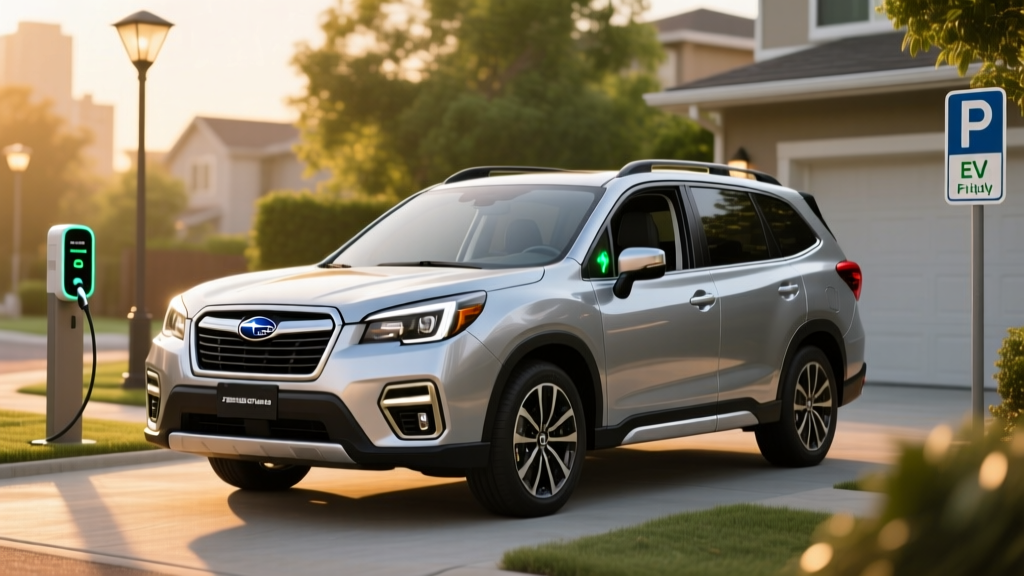
The Subaru Forester has long been a favorite among practical SUV buyers who value standard all-wheel drive, excellent visibility, and rugged credibility. For 2025, Subaru reintroduced a hybrid variant to the lineup, pairing its familiar 2.5-liter flat-four engine with a self-charging hybrid system. If you've been searching for a 25 Forester Hybrid, this guide covers every spec, MPG figure, and ownership detail you need before visiting a dealer.
Unlike a plug-in hybrid (PHEV) or a full battery-electric vehicle (BEV), the 2025 Forester Hybrid is a conventional hybrid electric vehicle (HEV). It never needs to be plugged in — the small battery recharges through regenerative braking and the gasoline engine. That simplicity is its biggest selling point for buyers who lack home charging access but still want meaningful fuel savings over a gas-only model.
HEV vs. PHEV: Where the Forester Hybrid Fits
| Feature | Forester Hybrid (HEV) | Typical Compact PHEV SUV |
|---|---|---|
| Plug-in Required? | No — self-charging | Yes, for electric-only miles |
| Electric-Only Range | ~1 mile at low speed | 25–40 miles typical |
| Battery Size | ~1.1 kWh (small buffer) | 13–20 kWh usable |
| Home Charging Needed? | No | Yes, Level 2 recommended |
| Federal Tax Credit (§30D) | Not eligible | Up to $7,500 if qualified |
| Best For | No charging access, simple ownership | Home charging, short commutes on EV mode |
2025 Forester Hybrid MPG: EPA Estimates and Real-World Numbers
Fuel economy is the primary reason buyers cross-shop the hybrid trim. According to EPA data on fueleconomy.gov, the 2025 Subaru Forester Hybrid carries the following estimates:
| Driving Cycle | EPA MPG |
|---|---|
| City | 35 MPG |
| Highway | 33 MPG |
| Combined | 34 MPG |
For comparison, the gas-only 2025 Forester (2.5L AWD) is rated at 26 city / 33 highway / 29 combined. That's a meaningful 5 MPG combined improvement — roughly a 17% gain in overall efficiency. In city driving, the hybrid advantage is even more pronounced: 35 MPG versus 26 MPG, a 35% improvement thanks to regenerative braking and electric-motor assist at low speeds.
Real-World MPG: What Owners Actually See
Subaru's hybrid system, developed with Toyota engineering influence, tends to perform close to or even above EPA city estimates in stop-and-go traffic. Based on early owner reports and testing patterns from Subaru's e-Boxer hybrid architecture, expect:
- City / suburban mixed: 33–37 MPG (hybrids often exceed EPA city figures in real stop-and-go driving)
- Steady highway (70–75 mph): 30–33 MPG (the electric motor provides less benefit at sustained high speed)
- Cold weather (below 30°F): 28–31 MPG combined (engine runs more to heat the cabin and maintain battery temperature)
- Mountain / hilly terrain: 29–33 MPG (regen recovers energy on descents, but climbs demand more fuel)
With a 16.9-gallon fuel tank, the 2025 Forester Hybrid delivers a theoretical maximum range of approximately 574 miles at the combined EPA figure. Real-world mixed driving puts typical fill-up-to-fill-up range between 480 and 540 miles — enough for most buyers to visit the pump once every two weeks.
Powertrain and Performance Specs
The 2025 Forester Hybrid pairs Subaru's 2.5-liter naturally aspirated BOXER four-cylinder engine with an electric motor integrated into the Lineartronic CVT (continuously variable transmission). Here are the key figures:
| Specification | 2025 Forester Hybrid |
|---|---|
| Engine | 2.5L DOHC BOXER 4-cylinder |
| Engine Power | ~163 hp (engine only) |
| Electric Motor | Integrated in CVT, ~29 hp assist |
| Combined System Output | ~194 hp |
| Transmission | Lineartronic CVT |
| Drivetrain | Symmetrical AWD (standard) |
| Battery Type | Lithium-ion, ~1.1 kWh |
| 0–60 mph (est.) | ~8.5 seconds |
| Towing Capacity | 1,500 lbs |
| Ground Clearance | 8.7 inches |
The electric motor's primary role is torque fill at low RPMs and smoothing out the CVT's response. The result is noticeably more responsive acceleration from a stop compared to the non-hybrid Forester, which produces 180 hp total. The hybrid's ~194 combined horsepower translates to confident highway merging and passing, though this is not a performance-oriented SUV — it's tuned for efficiency and comfort.
Standard Symmetrical All-Wheel Drive means all four wheels receive power at all times, with the hybrid system intelligently managing torque distribution. Subaru's X-MODE with Hill Descent Control is included, giving the Forester Hybrid legitimate light-trail and snow capability that most competing compact hybrid SUVs can't match.
Pricing, Trims, and Tax Credit Eligibility
The 2025 Subaru Forester Hybrid is offered in a focused set of trims. Pricing (MSRP, before destination charges) breaks down as follows:
- Forester Hybrid Premium: ~$33,495
- Forester Hybrid Limited: ~$37,495
Destination and delivery adds approximately $1,420. Fully loaded Limited models with options can approach $40,000 out the door.
Federal and State Tax Credits
Because the 2025 Forester Hybrid is a conventional HEV (not a plug-in hybrid or battery-electric vehicle), it does not qualify for the federal §30D Clean Vehicle Credit. That credit — up to $7,500 for new qualified plug-in EVs and PHEVs — requires a minimum battery capacity of 7 kWh and external charging capability, neither of which applies here. The IRS §30D guidelines are explicit on this point.
Some states offer modest rebates or incentives for conventional hybrids, but these vary widely by jurisdiction and are often $500 or less. Check your state's energy or environmental agency website for current programs. A few states also offer reduced registration fees or HOV lane access for hybrid vehicles, though these perks have been scaling back in recent years.
Hybrid Battery Warranty and Long-Term Reliability
Battery longevity is the single most common concern among first-time hybrid buyers. Here's what Subaru provides:
2025 Forester Hybrid Battery Warranty
- Hybrid Battery Warranty: 8 years / 100,000 miles (10 years / 150,000 miles in CARB states including CA, NY, MA, and others)
- Powertrain Warranty: 5 years / 60,000 miles
- Basic Warranty: 3 years / 36,000 miles
The hybrid battery in the Forester is relatively small (~1.1 kWh) and operates within a conservative state-of-charge window — typically between 40% and 80%. This shallow cycling dramatically reduces degradation compared to a full EV battery that regularly cycles from 10% to 90%. Based on long-term data from similar Toyota/Subaru hybrid architectures, hybrid battery packs routinely exceed 150,000 miles with minimal capacity loss.
Battery Replacement Cost
If the hybrid battery does eventually need replacement outside of warranty coverage, expect a cost between $2,000 and $3,500 for the battery pack and installation at a Subaru dealer. Independent hybrid specialists may offer refurbished packs for $1,200–$2,000. Given that most Forester Hybrids will still be under warranty when the battery reaches end-of-life, and that these packs historically outlast 150,000+ miles, this is a manageable long-term risk.
Subaru's hybrid system has fewer wear components than a conventional gas-only powertrain. Regenerative braking reduces brake pad wear — many hybrid owners report original brake pads lasting 70,000–100,000 miles. The CVT transmission in Subaru's hybrid system has proven durable in the brand's other hybrid models (Crosstrek Hybrid, Outback concepts), with no widespread failure patterns reported.
Forester Hybrid vs. PHEV vs. Full EV: Which Should You Choose?
The 2025 Forester Hybrid occupies a specific niche. Here's a decision framework to help you determine if it's the right electrified vehicle for your situation:
Choose the Forester Hybrid (HEV) If:
- You don't have access to home or workplace charging (apartment, street parking, no garage)
- You want lower fuel costs with zero change to your refueling habits
- You regularly drive in snow, rain, or on dirt roads and need proven AWD
- You want a simpler ownership experience — no charging cables, apps, or network reliability concerns
- Your budget is under $40,000 and you need cargo space and ground clearance
Choose a PHEV SUV Instead If:
- You have Level 2 home charging and a commute under 30 miles round-trip (you could drive mostly on electricity)
- You want to qualify for the federal §30D tax credit (up to $7,500 on eligible models like the Toyota RAV4 Prime or Subaru's own future PHEV offerings)
- You want 25–40 miles of electric-only range for daily errands with gas backup for road trips
Choose a Full EV Instead If:
- You have reliable home Level 2 charging
- Your daily driving is under 250 miles and you want zero tailpipe emissions
- You want minimal maintenance (no oil changes, no spark plugs, fewer moving parts)
- You want to maximize fuel cost savings (electricity at $0.14/kWh costs roughly $0.04/mile vs. $0.12–$0.15/mile for a hybrid on $3.50/gal gas)
Who Is the 25 Forester Hybrid Actually For?
The 2025 Forester Hybrid makes the most sense for a specific buyer profile: someone who values Subaru's AWD capability and wagon-like practicality, wants meaningful fuel savings without the complexity or infrastructure requirements of a plug-in vehicle, and drives a mix of city and highway miles where the hybrid system can shine.
It's an especially strong choice in regions with harsh winters, where EV range drops 20–30% in extreme cold and charging infrastructure can be sparse. The Forester Hybrid's 8.7 inches of ground clearance, X-MODE, and symmetrical AWD give it off-pavement credibility that no current electric compact SUV can fully match at this price point.
For urban and suburban drivers covering 12,000–15,000 miles per year, the hybrid's 34 MPG combined saves approximately $400–$600 annually in fuel costs compared to the gas-only Forester (assuming $3.50/gallon and 13,500 miles/year). Over a typical 7-year ownership period, that's $2,800–$4,200 in fuel savings — enough to offset a meaningful portion of the hybrid's price premium over the gas model.
Pros
- 35 MPG city — a major improvement over the 26 MPG gas model in stop-and-go traffic
- Standard Symmetrical AWD with X-MODE — class-leading all-weather capability
- No plug-in charging required — zero infrastructure changes
- 8-year/100,000-mile hybrid battery warranty (10 years in CARB states)
- 8.7 inches of ground clearance for trails and snow
- More low-end torque feel than the non-hybrid Forester
- Excellent outward visibility and practical cargo space (~28.9 cu ft behind rear seats)
Cons
- No federal tax credit eligibility (HEV, not PHEV/BEV)
- Only available in Premium and Limited trims — no base option
- ~1.1 kWh battery means virtually no electric-only driving
- Highway MPG gain over gas model is modest (~33 vs ~33)
- Towing limited to 1,500 lbs
- Price premium over gas Forester takes 5+ years to recoup in fuel savings alone
- CVT drone under hard acceleration remains a Subaru trait
Forester Hybrid FAQ
How many MPG does the 2025 Forester Hybrid get?
The EPA rates the 2025 Forester Hybrid at 35 MPG city, 33 MPG highway, and 34 MPG combined. In real-world mixed driving, most owners report 31–36 MPG depending on conditions, with city-heavy driving yielding the best results due to regenerative braking.
Does the Forester Hybrid need to be plugged in?
No. The 2025 Forester Hybrid is a conventional HEV (hybrid electric vehicle). Its small lithium-ion battery recharges automatically through regenerative braking and the gasoline engine. You fuel it exactly like a normal gas car — just less often.
Does the 2025 Forester Hybrid qualify for any tax credit?
It does not qualify for the federal §30D Clean Vehicle Credit, which requires plug-in capability and a minimum 7 kWh battery. Some states may offer minor hybrid incentives, but these vary by jurisdiction. Check your state's energy agency for current programs.
How long will the Forester Hybrid battery last?
Subaru covers the hybrid battery for 8 years/100,000 miles (10 years/150,000 miles in CARB states). Based on data from similar hybrid architectures, these batteries routinely last 150,000+ miles with minimal degradation due to their shallow charge-discharge cycles. Replacement cost if needed out of warranty is approximately $2,000–$3,500.
Is the Forester Hybrid better than the gas Forester?
If your driving includes significant city or stop-and-go miles, the hybrid's 35 MPG city rating (vs. 26 for the gas model) delivers real savings and smoother low-speed acceleration. For mostly highway drivers, the advantage narrows since both models achieve similar highway MPG. The hybrid also costs more upfront, so calculate your payback period based on your annual mileage.
Can the Forester Hybrid drive on electric power alone?
Only at very low speeds (under ~25 mph) for roughly one mile or less — for example, creeping through a parking lot. This is not a plug-in hybrid with meaningful electric-only range. For EV-mode commuting, you'd need a PHEV like the Toyota RAV4 Prime or a full BEV.
Is the 2025 Forester Hybrid reliable?
Subaru's hybrid system leverages proven Toyota-derived hybrid engineering. The brand's earlier hybrid models (Crosstrek Hybrid) have shown strong reliability. The Forester Hybrid's powertrain has fewer wear components than a conventional setup — regenerative braking extends brake life, and the hybrid battery operates in a conservative charge window. Subaru's 8-year hybrid warranty provides additional peace of mind. Check IIHS ratings for the latest safety scores.
The 2025 Subaru Forester Hybrid won't satisfy buyers looking for electric-only commuting or federal tax incentives. But for the large segment of SUV shoppers who want AWD, practicality, and better fuel economy without plugging in, it fills a gap that very few vehicles in this price range can match. If your life involves ski trips, muddy trailheads, and apartment living without a charger, the 25 Forester Hybrid might be the most pragmatic electrified SUV you can buy today.