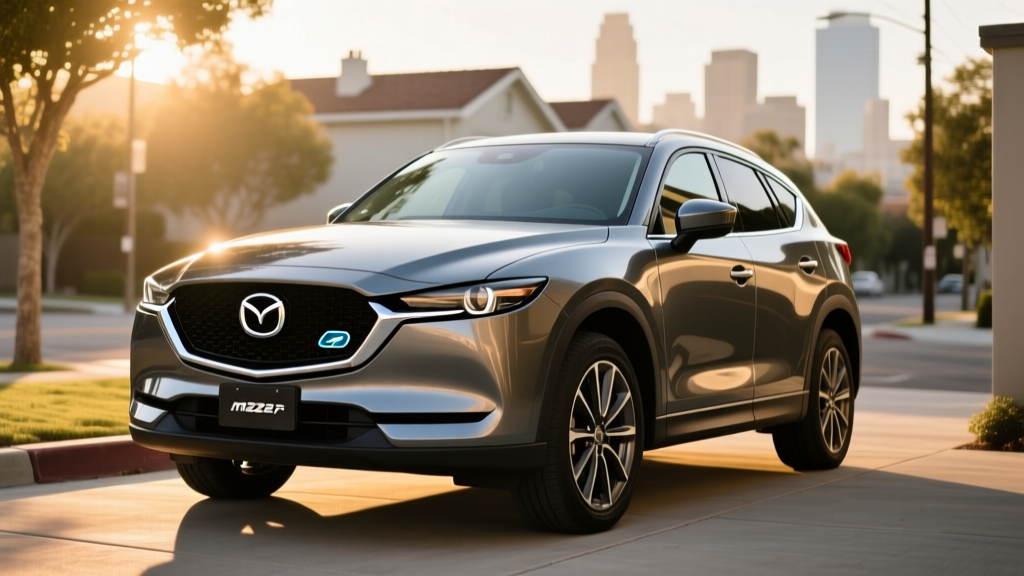
Mazda's best-selling crossover is finally going hybrid. The 2027 Mazda CX-5 Hybrid represents the first time Mazda's compact SUV will offer an electrified powertrain for the U.S. market, and it arrives through an unusual partnership: Mazda is borrowing Toyota's proven hybrid system to make it happen. For buyers who've loved the CX-5's driving dynamics and premium interior but winced at its thirst, this could be the version that makes the lineup complete.
Because the 2027 CX-5 Hybrid has been announced but is not yet on sale as of early 2026, the specifications below reflect Mazda's preliminary disclosures and Toyota-sourced powertrain data. Final EPA ratings and pricing will be confirmed closer to the on-sale date.
What We Know About the 2027 Mazda CX-5 Hybrid Powertrain
Mazda confirmed that the next-generation CX-5 will ride on a new platform and will offer a hybrid variant derived from Toyota's hybrid synergy drive architecture. This isn't a mild hybrid or a stop-start system — it's a full parallel hybrid (HEV) where an electric motor assists the gasoline engine and can propel the vehicle at low speeds independently.
The expected setup pairs a 2.5-liter four-cylinder engine with one or two electric motors and a nickel-metal hydride (NiMH) or lithium-ion battery pack mounted under the rear seat or cargo floor. Combined output is projected in the 215–230 horsepower range, a meaningful bump over the current gas-only CX-5's 187 hp naturally aspirated engine.
| Specification | Expected Figure |
|---|---|
| Engine | 2.5L inline-4 + electric motor(s) |
| Combined Horsepower | ~215–230 hp (estimated) |
| Transmission | eCVT (planetary gearset) |
| Drivetrain | AWD (standard, per Mazda's U.S. strategy) |
| Battery Type | Li-ion or NiMH (hybrid, not plug-in) |
| Plug-In Required? | No — self-charging via regenerative braking |
The 2027 CX-5 Hybrid is a conventional hybrid (HEV), not a plug-in hybrid. It charges its own battery through regenerative braking and engine operation — you never plug it in. A plug-in hybrid (PHEV) has a larger battery, offers 20–40 miles of electric-only driving, and must be plugged in to realize its efficiency advantage. Mazda has not announced a CX-5 PHEV for the U.S. market at this time.
Fuel Economy: How Many MPG Will the CX-5 Hybrid Get?
This is the question driving most of the search traffic, and it's the one without a final answer yet. However, we can make an informed projection based on the Toyota RAV4 Hybrid, which uses a closely related powertrain and is similar in size and weight.
| Vehicle | City MPG | Highway MPG | Combined MPG |
|---|---|---|---|
| 2025 Mazda CX-5 (2.5L AWD, gas) | 23 | 29 | 26 |
| 2025 Toyota RAV4 Hybrid AWD | 41 | 38 | 39 |
| 2027 Mazda CX-5 Hybrid (projected) | ~36–40 | ~33–36 | ~35–38 |
Mazda's emphasis on driving refinement — including a potentially heavier body structure, more sound insulation, and AWD tuning — could cost it 1–3 MPG versus the RAV4 Hybrid. Still, even a conservative 35 MPG combined would represent a 35% improvement over the current gas CX-5.
Real-World MPG vs. EPA Sticker
Hybrids typically exceed their EPA city rating in stop-and-go driving because regenerative braking recaptures energy that gas cars waste as heat. On the highway, where the engine does most of the work, real-world MPG often drops slightly below the sticker. In our experience with Toyota-sourced hybrid systems:
- City driving: Expect to match or slightly beat the EPA number (37–42 MPG real-world)
- Highway cruising (70+ mph): Expect 30–34 MPG, below the EPA highway estimate
- Cold weather (below 30°F): A 10–15% MPG reduction is normal as the engine runs more to heat the cabin and warm the battery
For data-backed EPA figures once finalized, check fueleconomy.gov.
Pricing and Tax Credit Eligibility
Mazda has not released official pricing for the 2027 CX-5 Hybrid. Based on the current CX-5 lineup (starting at $29,990 for the 2025 base model) and the typical hybrid premium across the industry, we project:
- Base hybrid trim: ~$33,000–$35,000 MSRP
- Mid-tier (Preferred/Carbon): ~$36,000–$39,000 MSRP
- Top trim (Premium Plus): ~$41,000–$43,000 MSRP
Does the CX-5 Hybrid Qualify for a Federal Tax Credit?
No. Under current IRS §30D rules, the federal clean vehicle credit applies only to battery electric vehicles (BEVs) and plug-in hybrids (PHEVs) that meet battery-sourcing, critical-mineral, MSRP, and buyer-income requirements. Conventional hybrids like the CX-5 Hybrid do not qualify for the §30D credit. There is currently no federal tax incentive specifically for HEVs.
Some states may offer rebates or reduced registration fees for hybrid vehicles — check your state's energy office or the AFDC state laws database for specifics. These vary widely and change frequently.
Reliability, Battery Warranty, and Replacement Cost
This is where the Toyota partnership works in Mazda's favor. Toyota's hybrid systems are among the most proven in the automotive industry, with over 25 years of real-world data. The Prius, RAV4 Hybrid, and Camry Hybrid have demonstrated hybrid battery longevity well beyond 150,000 miles with minimal degradation.
Hybrid Battery Replacement Cost
If the battery does fail outside warranty — statistically uncommon before 200,000 miles — replacement cost for a compact SUV hybrid battery typically ranges from $2,500 to $4,500 including labor, depending on whether you go OEM or refurbished. Third-party reconditioning services can reduce this to $1,500–$2,500.
By comparison, the current CX-5's conventional automatic transmission is also a long-lived component, so the hybrid doesn't introduce a uniquely expensive failure point — it simply shifts the cost risk to a different component that has proven highly durable in Toyota applications.
How the CX-5 Hybrid Compares to Rivals
The compact hybrid SUV segment is competitive. Here's how the 2027 CX-5 Hybrid is likely to stack up against established players:
| Vehicle | Combined MPG | Horsepower | Starting MSRP | AWD Standard? |
|---|---|---|---|---|
| 2027 Mazda CX-5 Hybrid | ~35–38 | ~215–230 | ~$33,000–$35,000 | Yes |
| 2025 Toyota RAV4 Hybrid | 39 | 219 | $33,425 | Yes |
| 2025 Honda CR-V Hybrid | 37 | 204 | $35,395 | Yes (Sport trims) |
| 2025 Hyundai Tucson Hybrid | 37 | 226 | $33,425 | Yes |
Mazda's differentiator won't be class-leading MPG — it will be interior quality, driving dynamics, and noise isolation. The current CX-5 already punches above its weight in perceived luxury, and the hybrid variant should continue that positioning.
Hybrid vs PHEV vs EV — Which Should You Choose?
Not sure whether the CX-5 Hybrid is the right electrification level for your situation? Use this framework:
- You don't have access to home or workplace charging
- You want better fuel economy with zero behavior change — just fill up less often
- You regularly drive long distances where EV charging infrastructure is sparse
- You want a lower purchase price than a PHEV or EV
- You can charge at home (Level 1 or 2) and have a short commute (under 35 miles)
- You want electric-only daily driving but gas flexibility for road trips
- You want to reduce fuel consumption by 60–80% on typical weekdays
- You have reliable home Level 2 charging
- Your daily driving is under 250 miles and you road-trip infrequently
- You want to eliminate gas costs entirely and qualify for the §30D federal tax credit (up to $7,500, subject to IRS eligibility rules)
When Will the 2027 CX-5 Hybrid Be Available?
Mazda has confirmed the next-generation CX-5 will enter production for the 2027 model year, with the hybrid variant included in the launch plan. Based on typical automotive timelines, expect a full reveal in late 2026 and dealer arrivals in early-to-mid 2027. Final EPA certification, pricing, and trim details should emerge in the months preceding launch.
We'll update this guide with confirmed specifications as Mazda releases them.
Frequently Asked Questions
How many MPG does the 2027 Mazda CX-5 Hybrid get?
Official EPA numbers are not yet published. Based on the Toyota-sourced hybrid system and the CX-5's weight and aerodynamics, we project 35–38 MPG combined, with city MPG likely higher than highway. The current gas CX-5 gets 26 MPG combined for comparison.
Do I need to plug in the CX-5 Hybrid?
No. The CX-5 Hybrid is a conventional hybrid (HEV). It charges its battery through regenerative braking and the gasoline engine. You fuel it like any other car — just less often.
Does the 2027 CX-5 Hybrid qualify for a federal tax credit?
No. The IRS §30D clean vehicle credit applies only to plug-in hybrids (PHEVs) and battery electric vehicles (BEVs). Conventional hybrids do not qualify. Check your state for any local hybrid incentives.
Is the hybrid battery reliable, and what does replacement cost?
Toyota's hybrid systems have a strong reliability record spanning 25+ years. The battery is warrantied for 8 years/100,000 miles minimum (10/150,000 in CARB states). Out-of-warranty replacement runs $2,500–$4,500, but most hybrid batteries last well past 150,000 miles.
Will there be a CX-5 PHEV (plug-in hybrid)?
Mazda has not announced a plug-in hybrid CX-5 for the U.S. market. The CX-50 offers a PHEV variant (using Toyota's plug-in system), but for the CX-5, only the conventional hybrid has been confirmed so far.
How does the CX-5 Hybrid compare to the CX-50 Hybrid?
The CX-50 Hybrid is already on sale and uses a similar Toyota-sourced system rated at 219 hp and 38 MPG combined. The CX-5 Hybrid will likely share powertrain DNA but in a slightly more refined, car-oriented package. Expect similar efficiency but different styling, interior appointments, and ride tuning.