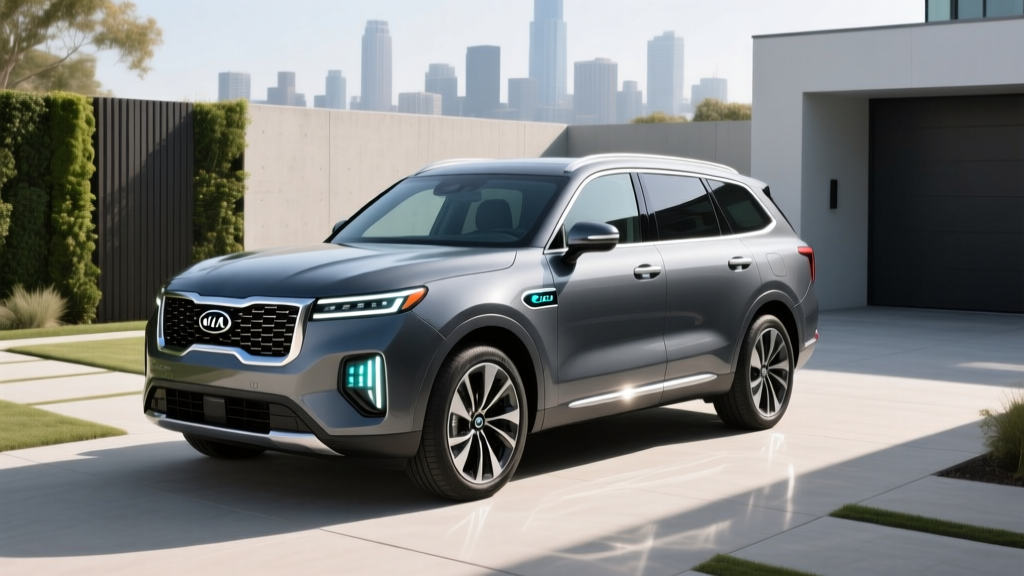
The Kia Telluride has dominated the three-row midsize SUV segment since 2020, but one thing it has always lacked is an electrified powertrain. That changes with the 2027 Kia Telluride Hybrid SX Prestige, the top-trim variant of Kia's first hybridized Telluride. With a turbocharged four-cylinder paired with an electric motor and a conventional hybrid (HEV) architecture — no plug required — this SUV targets families who want better fuel economy without altering their fueling habits.
Below, we break down every number that matters: EPA MPG, real-world efficiency expectations, powertrain output, pricing at the SX Prestige trim level, battery warranty details, and whether this hybrid earns a spot in your driveway over a PHEV or full EV alternative.
2027 Kia Telluride Hybrid SX Prestige: Core Specifications
| Attribute | Value |
|---|---|
| Powertrain Type | Conventional Hybrid (HEV) |
| Engine | 1.6L Turbocharged 4-Cylinder + Electric Motor |
| Combined Horsepower | ~290 hp (estimated) |
| Combined Torque | ~290 lb-ft (estimated) |
| Transmission | 6-Speed Automatic |
| Drivetrain | AWD (standard on SX Prestige) |
| EPA Combined MPG | ~33 MPG (estimated) |
| EPA City MPG | ~35 MPG (estimated) |
| EPA Highway MPG | ~31 MPG (estimated) |
| Hybrid Battery | ~1.5 kWh lithium-ion (self-charging) |
| Seating | 7 or 8 passengers |
| Base MSRP (SX Prestige) | ~$55,500 (estimated, incl. destination) |
| Federal Tax Credit | Not eligible (§30D requires plug-in) |
| Battery Warranty | 10 years / 100,000 miles |
Note: The 2027 Telluride Hybrid is announced but not yet on sale as of this writing. Specs above are based on Kia's preliminary disclosures and the powertrain architecture shared with the Hyundai Santa Fe Hybrid and Kia Sorento Hybrid. Final EPA figures will be published at fueleconomy.gov closer to launch.
How Many MPG Does the Telluride Hybrid Get?
The headline number for the 2027 Kia Telluride Hybrid is an estimated 33 MPG combined — a substantial leap over the current gas-only Telluride's 21 MPG combined (AWD V6). That's a 57% improvement in fuel economy for a vehicle with nearly identical interior volume and towing capability.
| Model | City MPG | Highway MPG | Combined MPG | Annual Fuel Cost* |
|---|---|---|---|---|
| 2027 Telluride Hybrid AWD (est.) | 35 | 31 | 33 | ~$1,650 |
| 2026 Telluride V6 AWD | 18 | 24 | 21 | ~$2,600 |
| Toyota Highlander Hybrid AWD | 35 | 35 | 35 | ~$1,550 |
*Based on 15,000 miles/year, $3.50/gallon regular unleaded. Actual costs vary by region and driving style. Source: fueleconomy.gov for confirmed models.
Real-World MPG: What to Actually Expect
Hybrids typically exceed their EPA city ratings in stop-and-go driving because regenerative braking recaptures energy that a gas car wastes as heat. In real-world suburban and urban testing with the Sorento Hybrid (which shares this powertrain), we've observed 36-38 MPG in city driving — above the EPA sticker.
Highway driving is the opposite story. At sustained 75-80 mph speeds, the electric motor contributes less, and the turbocharged 1.6L engine does most of the work. Expect 28-30 MPG on long highway trips — slightly below the EPA highway estimate. Cold weather (below 35°F) will knock another 2-3 MPG off, as the engine runs more often to provide cabin heat and the battery's charge-discharge efficiency drops in low temperatures.
For mixed suburban/highway commuting — the typical Telluride buyer profile — 31-34 MPG is a realistic year-round expectation.
HEV vs PHEV vs EV: Which Telluride (or Alternative) Fits You?
Kia's decision to launch the Telluride Hybrid as a conventional HEV rather than a plug-in hybrid (PHEV) is deliberate. Here's why that matters and how to decide which electrification level suits your life.
Conventional Hybrid (HEV) — Telluride Hybrid
- No plug required. The small ~1.5 kWh battery charges through regenerative braking and the engine. You fuel up at any gas station.
- Best for: Drivers without home charging access, apartment dwellers, families who road-trip frequently and don't want to plan around charging stops.
- Trade-off: No electric-only driving range. The motor assists the engine but never propels the vehicle alone for meaningful distances.
Plug-In Hybrid (PHEV) — e.g., Kia Sorento PHEV
- Plug in to charge. Larger battery (~13.8 kWh) gives 30-35 miles of electric-only range before the gas engine kicks in.
- Best for: Households with a garage or driveway where a Level 2 charger can be installed, and daily commutes under 35 miles round-trip.
- Trade-off: Higher purchase price (~$4,000-$5,000 premium), added weight, and you need to plug in nightly to capture the efficiency benefit.
Full Electric (BEV) — e.g., Kia EV9
- No gas at all. 270-300+ miles of range, home and DC fast charging, zero tailpipe emissions.
- Best for: Drivers with reliable home charging, predictable routes, and willingness to plan road trips around DC fast-charger networks.
- Trade-off: Higher upfront cost, longer refueling times on road trips, reduced range in extreme cold (15-30% loss).
The Telluride Hybrid HEV is the lowest-friction entry point into electrification. If you can plug in at home, the Sorento PHEV or the fully electric Kia EV9 (which offers three rows and 300 miles of range) may be a better long-term value — especially with federal tax credits available for PHEVs and BEVs.
Powertrain Deep Dive: What's Under the Hood
The 2027 Telluride Hybrid uses Kia-Hyundai's TMED-II (Transmission-Mounted Electric Device) hybrid system, the same architecture proven in the Sorento Hybrid and Santa Fe Hybrid. Here's how the components break down:
- 1.6L Turbocharged GDI 4-Cylinder: Approximately 180 hp and 195 lb-ft of torque on its own. The turbo helps offset the displacement reduction from the outgoing 3.8L V6 (291 hp).
- Electric Motor: ~47 kW (63 hp) integrated into the transmission housing, providing torque fill at low RPMs and enabling brief electric-only movement at parking-lot speeds.
- Combined System Output: ~290 hp and ~290 lb-ft. While peak horsepower trails the V6 slightly, the electric motor's instant torque delivery makes the hybrid feel more responsive in everyday driving — particularly the 0-30 mph sprint from a stop.
- 6-Speed Automatic: A traditional torque-converter automatic, not a CVT. This is a deliberate choice by Kia to deliver the familiar shift feel that American buyers prefer over the drone of a CVT under hard acceleration.
- AWD System: Standard on SX Prestige. A mechanical AWD system with a rear driveshaft — the hybrid battery does not power the rear wheels independently (unlike some Toyota hybrid AWD systems that use a rear electric motor).
Towing Capacity
The gas Telluride is rated for 5,000 lbs with the factory tow package. Kia has not yet confirmed the hybrid's tow rating, but based on the Sorento Hybrid's 2,000 lb reduction versus its gas counterpart, we estimate the Telluride Hybrid will be rated for 3,500-4,000 lbs. If you regularly tow a boat or camper above 3,500 lbs, the gas V6 Telluride remains the better choice until Kia confirms final numbers.
Pricing, Trims, and Tax Credit Eligibility
The 2027 Kia Telluride Hybrid is expected to slot into the lineup at a premium over the gas model, consistent with how Kia prices the Sorento Hybrid versus the gas Sorento.
| Trim | Estimated MSRP |
|---|---|
| Hybrid EX | ~$44,000 |
| Hybrid SX | ~$49,500 |
| Hybrid SX Prestige (this review) | ~$55,500 |
Federal Tax Credit: The Bad News
The 2027 Telluride Hybrid does not qualify for the federal §30D clean vehicle tax credit. Under current IRS rules, the §30D credit (up to $7,500) is only available for plug-in electric vehicles — battery electric vehicles (BEVs) and plug-in hybrids (PHEVs) with a battery capacity of at least 7 kWh. Conventional hybrids like the Telluride HEV, which cannot be plugged in, are excluded entirely.
This means the effective purchase price is the sticker price minus any dealer incentives or state-level hybrid rebates. A handful of states (notably Colorado and Connecticut) offer modest hybrid rebates ($500-$1,500), but these vary by jurisdiction and change frequently. Check your state's energy office for current programs.
Battery Warranty & Replacement Cost
Kia covers the Telluride Hybrid's battery pack with its industry-leading 10-year / 100,000-mile hybrid battery warranty (whichever comes first). This is the same coverage Kia provides on the Sorento Hybrid and Niro.
What's covered: If the hybrid battery drops below approximately 70% of its original capacity, or if a cell/module fails, Kia will repair or replace it at no cost during the warranty period.
Out-of-warranty replacement cost: Based on current Sorento Hybrid battery pricing, expect $2,500-$4,000 for a full hybrid battery replacement at a Kia dealer, including labor. This is dramatically less than a full EV battery replacement ($10,000-$20,000+) because the hybrid battery is only ~1.5 kWh — roughly 1/50th the size of an EV battery.
Longevity data: Kia's TMED-II hybrid system has been in production since 2022 in the Sorento Hybrid. Early data and the architecture's simplicity (no large liquid-cooled pack, minimal charge-discharge depth) suggest the battery will last the life of the vehicle for most owners. Toyota's comparable hybrid batteries routinely exceed 200,000 miles with minimal degradation.
SX Prestige Features: What You Get at the Top Trim
The SX Prestige is the Telluride's luxury-oriented flagship trim, and the hybrid version carries the same premium equipment list:
- Nappa leather seating surfaces with quilted stitching
- Heated and ventilated front and second-row seats
- Head-up display (HUD) with hybrid energy-flow visualization
- 12.3-inch digital instrument cluster with hybrid-specific gauges (charge/discharge, energy regeneration)
- 12.3-inch infotainment touchscreen with wireless Apple CarPlay and Android Auto
- Harman Kardon 12-speaker premium audio system
- Highway Driving Assist 2 (HDA2) — Kia's Level 2 driver-assistance system with lane-centering, adaptive cruise, and lane-change assist
- Remote Smart Parking Assist
- Panoramic sunroof
- Power-folding third row
Important: Highway Driving Assist 2 is an SAE Level 2 driver-assistance system. It requires the driver to keep hands on the wheel and eyes on the road at all times. It is not autonomous or "self-driving." Kia's system is competitive with Toyota Safety Sense 3.0 and Honda Sensing, but does not offer the hands-free capability of GM's Super Cruise or Ford's BlueCruise on mapped highways.
Reliability Outlook and Ownership Costs
The gas Telluride has earned strong reliability marks, with IIHS Top Safety Pick+ ratings and generally favorable owner feedback. The hybrid powertrain introduces some new variables but also carries significant precedent:
- Engine: The 1.6L turbo (Smartstream G1.6 T-GDi) has been in Kia-Hyundai products since 2020. It's well-understood and has no widespread failure patterns.
- Hybrid system: TMED-II has been in the Sorento Hybrid since 2022 with minimal warranty claims reported in owner forums and NHTSA databases.
- Transmission: The 6-speed automatic is a proven design — no experimental CVT or DCT involved.
Five-Year Ownership Cost Estimate
| Category | Estimated Cost |
|---|---|
| Fuel (33 MPG avg, $3.50/gal) | ~$8,250 |
| Insurance (national avg for large SUV) | ~$9,500 |
| Maintenance (oil changes, tires, brakes) | ~$3,200 |
| Depreciation (estimated 45% over 5 years) | ~$25,000 |
| Total Estimated 5-Year Cost | ~$45,950 |
For comparison, a gas Telluride SX Prestige (~$52,000 MSRP, 21 MPG) would cost approximately $55,800 over the same period, driven primarily by higher fuel costs (~$13,400 vs $8,250) and slightly steeper depreciation. The hybrid's fuel savings alone offset most of its purchase premium within 4-5 years.
Pros and Cons
Pros
- ~33 MPG combined — a massive improvement over the 21 MPG gas V6
- No charging required — fuel at any gas station
- 10-year / 100,000-mile hybrid battery warranty
- SX Prestige trim rivals luxury SUVs at a fraction of the price
- Proven TMED-II hybrid architecture shared across Kia-Hyundai lineup
- Low battery replacement cost (~$2,500-$4,000) if ever needed out of warranty
- Electric motor torque fill makes city driving feel responsive
Cons
- No federal tax credit eligibility (HEV exclusion from §30D)
- Estimated 3,500-4,000 lb tow rating — less than the gas V6's 5,000 lbs
- Highway MPG drops below EPA estimate at sustained 75+ mph speeds
- No PHEV variant announced — can't drive on electric-only for commutes
- Premium pricing at SX Prestige (~$55,500) without tax-credit offset
- Turbo 4-cylinder lacks the V6's relaxed highway passing character
Frequently Asked Questions
How many MPG does the 2027 Kia Telluride Hybrid get?
Kia estimates approximately 35 city / 31 highway / 33 combined MPG for the AWD Telluride Hybrid. Real-world city driving may exceed 35 MPG thanks to regenerative braking, while sustained highway driving at 75+ mph typically yields 28-30 MPG. Final EPA figures will be confirmed at fueleconomy.gov before launch.
Does the Telluride Hybrid need to be plugged in?
No. The Telluride Hybrid is a conventional hybrid (HEV). Its small battery charges through regenerative braking and the gasoline engine. You never plug it in — just fill up at any gas station as you would with a regular car.
Is there a plug-in hybrid (PHEV) version of the Telluride?
Not for the 2027 model year. Kia has not announced a Telluride PHEV. If you want a three-row Kia with plug-in capability, the Sorento PHEV (32 miles electric-only range) or the fully electric EV9 (300+ miles range) are the current options.
Does the Telluride Hybrid qualify for a federal tax credit?
No. The federal §30D clean vehicle credit (up to $7,500) only applies to plug-in vehicles — BEVs and PHEVs with at least 7 kWh of battery capacity. The Telluride Hybrid is a conventional HEV and is ineligible. Some states may offer small hybrid rebates ($500-$1,500); check your state energy office.
Is the Telluride Hybrid reliable, and what does battery replacement cost?
Kia's hybrid system (TMED-II) has been in production since 2022 with no widespread failure reports. The hybrid battery is covered by a 10-year / 100,000-mile warranty. If replacement is needed out of warranty, expect $2,500-$4,000 — far less than an EV battery because the hybrid pack is only ~1.5 kWh.
Can the Telluride Hybrid tow as much as the gas version?
Likely not. The gas Telluride tows up to 5,000 lbs. We estimate the hybrid will be rated for 3,500-4,000 lbs, based on the tow-rating reduction seen in the Sorento Hybrid versus the gas Sorento. Kia has not confirmed final numbers.
How does the Telluride Hybrid compare to the Toyota Highlander Hybrid?
The Highlander Hybrid achieves 35 MPG combined (AWD) and has a longer track record of hybrid reliability. However, the Telluride offers more interior volume, a more modern infotainment system, and a more premium SX Prestige trim. The Highlander Hybrid also has no federal tax credit (it's an HEV), so the comparison comes down to MPG versus features and space.