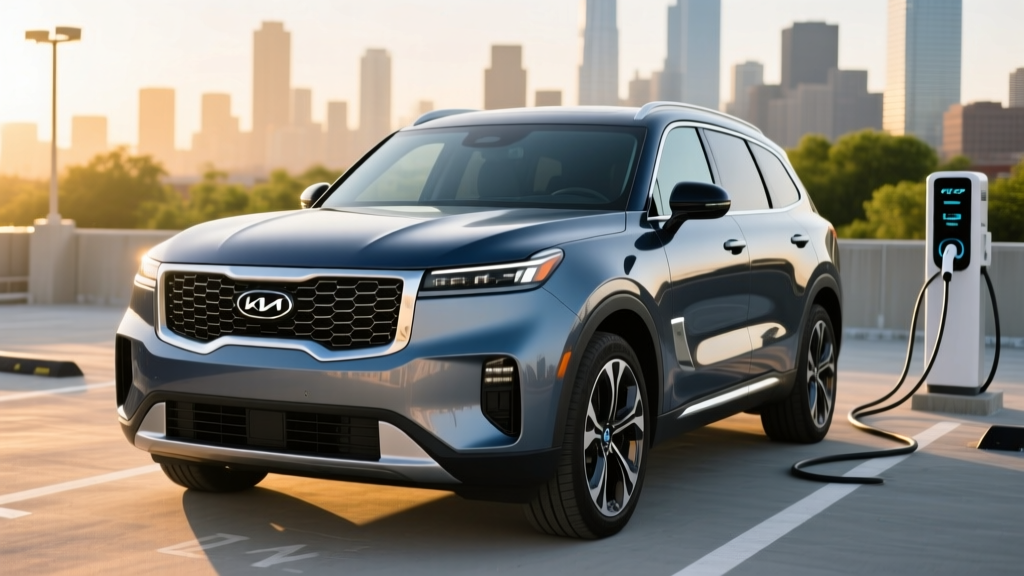
The three-row SUV segment has been one of the last holdouts for electrification, but that's changing fast. With the next-generation Telluride expected to debut for the 2027 model year, one of the most anticipated questions from family SUV shoppers is whether Kia will finally offer a hybrid variant. Based on Kia's current global powertrain strategy, platform architecture, and confirmed statements from the automaker, a 2027 Kia Telluride Hybrid appears increasingly likely — and it could arrive in both conventional hybrid (HEV) and plug-in hybrid (PHEV) forms.
Here's what we know, what's estimated, and what buyers should expect when this model reaches dealerships.
As of mid-2026, Kia has confirmed a next-generation Telluride is in development. Hybrid powertrain variants are widely expected based on the brand's electrification roadmap and the shared platform with the Hyundai Palisade hybrid. Final EPA figures, pricing, and trim details have not been officially published. All specs below are estimated based on Kia's existing hybrid systems and platform engineering. We will update this article when official data is released.
HEV vs PHEV: What's the Difference for the Telluride?
Before diving into expected specs, it's critical to understand the two hybrid flavors Kia is likely to offer — because they serve very different use cases and have different pricing, charging, and tax-credit implications.
| Feature | Conventional Hybrid (HEV) | Plug-In Hybrid (PHEV) |
|---|---|---|
| Needs to plug in? | No — charges via regenerative braking and engine | Yes — plug in for electric-only driving |
| Battery size (est.) | ~1.5–2.0 kWh | ~18–25 kWh |
| Electric-only range | N/A (motor assists engine only) | Est. 30–40 miles |
| DC fast charging? | No | Possible (Kia's PHEV systems have been limited to Level 2) |
| Federal tax credit (§30D)? | No | Potentially — if battery sourcing and MSRP caps are met |
| Best for | Drivers without home charging who want better MPG | Drivers with home charging and short daily commutes |
The conventional HEV is a drop-in replacement for the gas Telluride — no behavior change required, just better fuel economy. The PHEV demands access to a Level 2 home charger (a 240V outlet or installed wallbox) to unlock its electric-only range advantage, but it rewards owners with near-EV daily commuting and gas-engine flexibility for road trips.
Expected Fuel Economy: How Many MPG Will the Telluride Hybrid Get?
The current gas-only Telluride (2026 model year) returns an EPA-estimated 20 city / 26 highway / 23 combined MPG with front-wheel drive, and 18/24/20 with AWD, per fueleconomy.gov. A hybrid powertrain would represent a substantial improvement.
Using Kia's existing 1.6-liter turbocharged hybrid system (as found in the Sorento Hybrid and Sportage Hybrid) as a baseline, scaled for the Telluride's larger mass and frontal area, here are reasonable EPA estimates:
| Powertrain | City MPG | Highway MPG | Combined MPG |
|---|---|---|---|
| Gas Telluride FWD (current) | 20 | 26 | 23 |
| Telluride HEV FWD (est.) | 27–30 | 28–31 | 28–30 |
| Telluride HEV AWD (est.) | 25–28 | 26–29 | 26–28 |
| Telluride PHEV AWD (est.) | 30+ MPG (gas) / 75+ MPGe (electric) | 28–30 | 29–32 (gas) / 80+ MPGe |
Conventional hybrids typically exceed their EPA city rating in real-world stop-and-go driving because regenerative braking recovers energy that gas cars waste as heat. On the highway, however, the advantage narrows — aerodynamic drag dominates at 70+ mph and the engine does most of the work. Expect the Telluride HEV to deliver 28–32 MPG in mixed city driving but closer to 26–28 on sustained highway trips. Cold weather (below 30°F) can reduce hybrid efficiency by 10–15% as the engine runs more frequently for cabin heat.
Powertrain Specs: Engine, Motor, and Combined Horsepower
Kia's modular hybrid architecture pairs a turbocharged gasoline engine with an electric motor integrated into the transmission housing. For a vehicle the Telluride's size (~4,500–4,800 lbs curb weight), the expected configurations are:
| Spec | HEV | PHEV |
|---|---|---|
| Engine | 1.6L turbo I-4 | 1.6L turbo I-4 |
| Engine output | ~180 hp / 195 lb-ft | ~180 hp / 195 lb-ft |
| Electric motor | ~60 hp / 195 lb-ft | ~100 hp / 258 lb-ft |
| Combined system output | ~240–270 hp | ~290–320 hp |
| Transmission | 6-speed automatic | 6-speed automatic |
| Drivetrain | FWD or AWD | AWD (expected standard) |
| 0–60 mph (est.) | ~7.5–8.0 sec | ~6.5–7.0 sec |
| Towing capacity (est.) | ~4,500–5,000 lbs | ~4,000–4,500 lbs |
The PHEV's larger motor and battery give it a meaningful power advantage — the instant electric torque fills in the low-end gap that turbocharged engines typically exhibit. Expect the PHEV variant to feel noticeably quicker off the line, especially in electric-only mode around town.
PHEV Electric-Only Range and Charging
If Kia offers a Telluride PHEV, the critical number for daily-driving practicality is electric-only range. Based on the battery capacity Kia has deployed in the Sorento PHEV (13.8 kWh, EPA 32 miles) and the larger battery expected for a full-size SUV:
With an expected battery of 18–25 kWh (usable), the Telluride PHEV should cover most daily commutes and school runs without burning a drop of gasoline. Total combined range (electric + full gas tank) is projected at 450–520 miles.
Charging the PHEV: Kia's current PHEV lineup supports Level 2 (240V) AC charging at approximately 3.3–7.2 kW. At 7.2 kW, a full charge from empty would take roughly 3–4 hours. DC fast charging has not been a feature of Kia's PHEV systems to date — the relatively small battery doesn't justify the added cost and weight of DC hardware. Expect Level 2 charging via a standard J1772 connector (or NACS if Kia completes its transition to the Tesla-standard plug by 2027).
For context, kW (kilowatts) measures charging power — the rate at which energy flows into the battery. kWh (kilowatt-hours) measures battery energy capacity — the total amount of electricity stored. A 20 kWh battery charging at 7 kW would take roughly 2.8 hours from 0–100% (in practice, charging slows near full capacity).
Pricing and Tax Credit Eligibility
The current 2026 Kia Telluride starts at approximately $37,500 (LX FWD) and climbs to about $54,000 for the SX Prestige X-Pro. Hybrid variants always carry a premium over gas models, but the gap has narrowed as battery costs have fallen.
| Trim / Variant | Est. MSRP | Federal Tax Credit |
|---|---|---|
| Gas Telluride LX (baseline) | ~$38,000 | None |
| HEV EX (est.) | ~$42,000–$44,000 | None |
| HEV SX Prestige (est.) | ~$52,000–$55,000 | None |
| PHEV SX (est.) | ~$50,000–$53,000 | Up to $7,500 (if eligible) |
| PHEV SX Prestige (est.) | ~$57,000–$60,000 | Up to $7,500 (if eligible) |
Federal Tax Credit Rules for the PHEV
The conventional HEV Telluride will not qualify for the federal §30D clean vehicle tax credit — that credit is reserved for plug-in vehicles with a minimum battery capacity of 7 kWh. The PHEV variant, however, could qualify for up to $7,500 if it meets all current IRS requirements.
- MSRP cap: SUVs must have a base MSRP at or below $80,000 (per IRS §30D guidelines). All Telluride PHEV trims should clear this.
- Buyer income cap: Modified adjusted gross income must not exceed $150,000 (single), $225,000 (head of household), or $300,000 (joint filers).
- Battery sourcing: The $7,500 credit is split into two halves — $3,750 for critical minerals sourcing and $3,750 for battery component manufacturing. Both must meet phased-in domestic/FTA-country thresholds that tighten each year. Whether the Telluride PHEV qualifies for the full $7,500, half ($3,750), or none depends on Kia's supply chain at time of sale.
- Point-of-sale transfer: Under current rules, buyers can transfer the credit to the dealer at purchase, reducing the purchase price directly rather than waiting for a tax refund.
Tax credit eligibility is complex and subject to change. Consult a tax professional and verify current rules at IRS.gov before purchasing.
Battery Warranty, Reliability, and Replacement Costs
Kia currently provides a 10-year / 100,000-mile hybrid battery warranty on its HEV and PHEV models, and there is no reason to expect this to change for the 2027 Telluride. This warranty covers battery capacity loss below a defined threshold (typically 70% of original capacity) and is transferable to subsequent owners on some trims — a significant resale-value factor. The general powertrain warranty is expected at 10 years / 100,000 miles, with bumper-to-bumper at 5 years / 60,000 miles.
Reliability outlook: Kia's 1.6L turbo hybrid system has been in production since 2020 across the Sorento, Sportage, and Tucson (via Hyundai) platforms. Early models had some transmission calibration complaints, but no widespread battery failure patterns have emerged. Hyundai Motor Group's hybrid systems are generally regarded as durable, with battery degradation rates of approximately 1–2% per year under normal use — meaning a 10-year-old hybrid battery might retain 80–90% of its original capacity.
Battery replacement cost: If the hybrid battery does need replacement outside warranty, expect approximately $2,500–$4,000 for the HEV's smaller battery pack and $5,000–$8,000 for the PHEV's larger pack (parts and labor). These figures are based on current Kia/Hyundai hybrid battery pricing and may shift as battery costs continue their long-term decline. For context, very few hybrid batteries require replacement within the first 10–15 years of service.
Who Should Choose the Telluride Hybrid vs. a Full EV or Gas Model?
The 2027 Telluride Hybrid will sit in a competitive cross-shopping zone. Here's a practical decision framework:
Choose the HEV if:
- You don't have access to home or workplace charging
- You want better MPG with zero behavior change
- You regularly take long road trips and don't want to plan charging stops
- You want a lower purchase price than the PHEV
- Your annual mileage is moderate (10,000–15,000 mi/yr)
Choose the PHEV if:
- You can install a Level 2 (240V) charger at home
- Your daily driving is under 30–40 miles (most commutes)
- You want EV-like daily driving with gas-engine road-trip flexibility
- You qualify for the federal tax credit (income + sourcing rules)
- You want stronger acceleration from the larger electric motor
Consider a Full EV Instead if:
- You have reliable home Level 2 charging
- You want zero tailpipe emissions and minimal maintenance
- Your daily driving is under 250 miles and you're comfortable with DC fast-charging on road trips
- Models like the Kia EV9 or Hyundai Ioniq 9 meet your space needs
Stick with Gas if:
- Your budget is strictly under $38,000
- You drive very low annual miles (under 7,000/yr — the hybrid premium won't pay back)
- You plan to keep the vehicle under 4 years
Pros and Cons: 2027 Kia Telluride Hybrid
✓ Pros
- Significant MPG improvement over gas model (est. 28–30 combined vs 23)
- No range anxiety — gas engine covers long trips seamlessly
- Kia's industry-leading 10-year / 100,000-mile hybrid battery warranty
- PHEV variant enables gas-free daily commuting (30–40 mi electric)
- Three-row seating retained — no cargo compromise vs gas model
- Strong resale value expected given hybrid demand in family SUV segment
✗ Cons
- Hybrid premium adds $3,000–$6,000 over gas equivalent
- HEV does not qualify for federal tax credit
- PHEV tax credit depends on battery sourcing rules — not guaranteed at $7,500
- Towing capacity may decrease slightly vs gas V6 (est. 4,500 vs 5,000 lbs)
- Not yet officially confirmed — specs are estimated until Kia publishes final data
- PHEV likely limited to Level 2 charging only (no DC fast charge)
Frequently Asked Questions
How many MPG does the 2027 Kia Telluride Hybrid get?
Based on Kia's existing hybrid systems and the Telluride's size, we estimate the HEV will achieve approximately 27–30 MPG city, 28–31 highway, and 28–30 combined (FWD). AWD models will be 1–2 MPG lower. The PHEV variant should return 30+ MPG combined when running on gasoline, plus 75+ MPGe when factoring in electric-only driving. Final EPA numbers will be published closer to the on-sale date.
How far can the Telluride PHEV go on electric only?
We estimate 30–40 miles of electric-only range with an 18–25 kWh battery pack. This covers most daily commutes and errands. Once the battery is depleted, the gasoline engine takes over seamlessly, providing a total combined range of 450–520 miles.
Does the Telluride Hybrid qualify for a federal tax credit?
The conventional HEV does not qualify for the §30D federal tax credit — it's reserved for plug-in vehicles. The PHEV variant may qualify for up to $7,500 depending on the buyer's income (under $150K single / $300K joint), the vehicle's MSRP (must be under $80K for SUVs), and battery component/critical-mineral sourcing requirements. Rules tighten annually — verify current eligibility at IRS.gov and consult a tax professional.
Is the hybrid battery reliable and what does replacement cost?
Kia's hybrid systems have shown strong reliability since their 2020 introduction. The hybrid battery is covered by a 10-year / 100,000-mile warranty. Out-of-pocket replacement, if needed, is estimated at $2,500–$4,000 for the HEV battery and $5,000–$8,000 for the PHEV battery. In practice, most hybrid batteries last 15+ years with gradual, manageable degradation.
When will the 2027 Kia Telluride Hybrid be available?
Kia has not published an exact on-sale date. Based on typical model-year cadences and industry reporting, the next-generation Telluride is expected to be revealed in late 2026 with deliveries beginning in early-to-mid 2027. Hybrid variants may arrive simultaneously or follow several months after the gas model launch.
Does the Telluride Hybrid sacrifice cargo space or third-row room?
Based on Kia's packaging in the Sorento Hybrid — where the battery is mounted under the floor without impacting seating — we expect the Telluride Hybrid to retain its full three-row configuration and comparable cargo volume to the gas model. Official cubic-foot measurements will be confirmed at launch.