The midsize three-row SUV segment is crowded, but the 2027 Kia Sorento Hybrid occupies a specific niche: it's one of the few vehicles offering three rows of seating, a conventional hybrid (HEV) powertrain, and a plug-in hybrid (PHEV) variant under one nameplate. For buyers who want electric-assisted efficiency without committing to a full battery-electric vehicle, the Sorento Hybrid lineup warrants a close look.
This guide breaks down both the HEV and PHEV versions of the 2027 Sorento — EPA fuel economy, electric-only range, powertrain specs, real-world efficiency, pricing, tax credit eligibility, and long-term battery reliability. Whether you're cross-shopping against the Toyota Highlander Hybrid or a full EV like the Kia EV9, the numbers below will clarify which version fits your driving pattern.
HEV vs PHEV: Which 2027 Sorento Hybrid Is Right for You?
Before diving into specs, it's critical to understand the difference between the two powertrains available in the Sorento lineup. Confusion here leads to disappointed owners — and it's entirely avoidable.
| Attribute | Sorento Hybrid (HEV) | Sorento Plug-In Hybrid (PHEV) |
|---|---|---|
| Needs to be plugged in? | No — self-charging via regen & engine | Yes — plug in for electric-only driving |
| Electric-only range | N/A (motor assists engine only) | ~32 miles EPA est. |
| Battery size | ~1.49 kWh (small buffer) | ~13.8 kWh usable |
| Home charging | Not applicable | Level 2 (~3.5 hours to full) |
| DC fast charging | N/A | Not available |
| Combined horsepower | 232 hp | 261 hp |
| Drivetrain | AWD standard | AWD standard |
| Federal tax credit (§30D) | Not eligible | Eligible — up to $7,500 (rules apply) |
The bottom line: The HEV is for drivers who want better fuel economy with zero lifestyle change — no charging cable, no plug, just fill up with gas. The PHEV is for drivers with predictable commutes under ~30 miles who have access to Level 2 charging at home or work and want to run mostly on electricity day-to-day while keeping gas-engine range for road trips.
2027 Kia Sorento Hybrid (HEV): MPG and Fuel Economy
The conventional Sorento Hybrid pairs a turbocharged 1.6-liter four-cylinder engine with a 47.7 kW electric motor integrated into the six-speed automatic transmission. Combined system output is 232 horsepower and 262 lb-ft of torque, routed through standard all-wheel drive.
| Metric | EPA Estimate |
|---|---|
| City MPG | 36 MPG |
| Highway MPG | 35 MPG |
| Combined MPG | 35 MPG |
| Fuel tank capacity | 14.8 gallons |
| Total driving range | ~518 miles |
Source: fueleconomy.gov
Real-World MPG vs. EPA Sticker
Hybrids typically overperform their EPA city estimates in stop-and-go traffic because regenerative braking recaptures energy that a gas-only car wastes as heat. In real-world urban driving, owners commonly report 37–39 MPG in city conditions. Highway driving is a different story — at sustained 75–80 mph speeds, the electric motor contributes less, and aerodynamic drag dominates. Expect 30–33 MPG on extended highway trips, especially with the AWD system engaged and a loaded cabin.
Cold weather also reduces hybrid efficiency. Below freezing, the engine runs more frequently to heat the cabin (since there's no waste heat from a large battery pack as in an EV), which can drop observed MPG by 10–15% during winter months.
2027 Kia Sorento PHEV: Electric-Only Range and MPGe
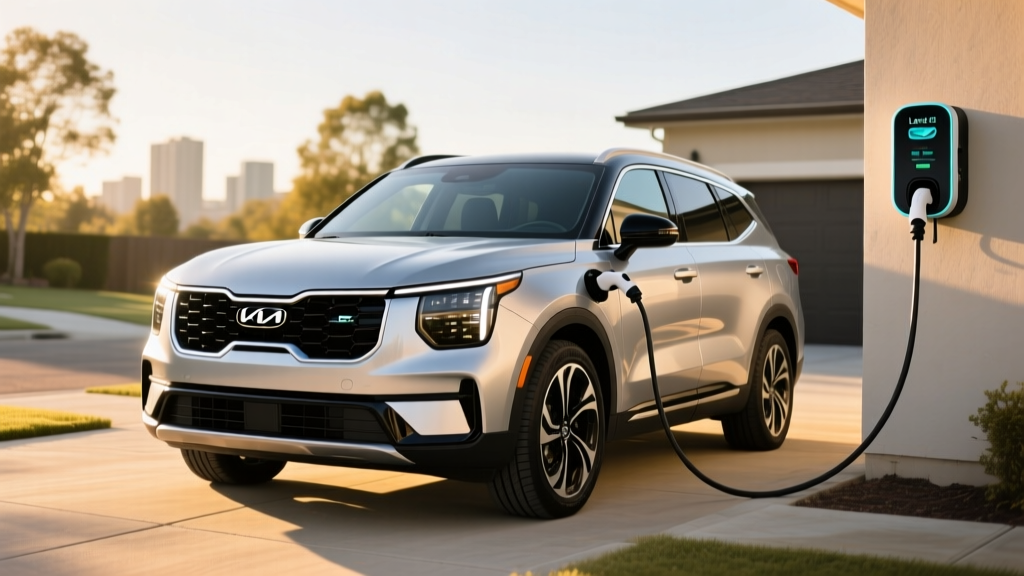
The plug-in hybrid variant uses the same 1.6-liter turbo engine but pairs it with a more powerful 74 kW electric motor and a larger 13.8 kWh lithium-ion battery pack. Combined system output rises to 261 horsepower and 271 lb-ft of torque.
| Metric | EPA Estimate |
|---|---|
| Electric-only range | ~32 miles |
| Combined MPGe (electric + gas) | 79 MPGe |
| Gas-only combined MPG (after battery depleted) | 33 MPG |
| Total combined range (electric + gas) | ~440 miles |
| Battery capacity (usable) | 13.8 kWh |
| Level 2 charge time (240V, 3.3 kW) | ~3.5 hours (0–100%) |
| DC fast charging | Not supported |
| Charge connector | J1772 (Level 2) |
Source: fueleconomy.gov
Real-World Electric Range Expectations
The 32-mile EPA electric range assumes moderate temperatures, flat terrain, and speeds under 55 mph. In practice:
- Warm weather, city driving: 30–34 miles on electric before the engine engages
- Highway at 70 mph: 22–26 miles electric-only (aerodynamic drag drains the battery faster)
- Cold weather (below 32°F): 18–24 miles, as cabin heating draws significant energy and the battery's usable capacity shrinks
For a commuter with a 20-mile round trip and home Level 2 charging, the PHEV can operate as a de facto EV most weekdays, burning zero gasoline for daily driving. The gas engine remains available for weekend road trips with no range compromise.
Powertrain and Performance Specs
| Specification | Sorento HEV | Sorento PHEV |
|---|---|---|
| Engine | 1.6L turbo I-4 | 1.6L turbo I-4 |
| Electric motor output | 47.7 kW (64 hp) | 74 kW (99 hp) |
| Combined system HP | 232 hp | 261 hp |
| Combined torque | 262 lb-ft | 271 lb-ft |
| Transmission | 6-speed automatic | 6-speed automatic |
| Drivetrain | AWD | AWD |
| 0–60 mph (est.) | ~7.8 seconds | ~6.7 seconds |
| Towing capacity | 2,000 lbs | 2,000 lbs |
| Seating capacity | 6 (captain's chairs) or 7 | 6 (captain's chairs) or 7 |
Neither variant is a performance SUV, but the PHEV's larger motor delivers noticeably stronger acceleration from stops and during highway merging. The six-speed automatic is a deliberate choice — Kia avoids the CVT found in the Toyota Highlander Hybrid, which some drivers find droning under hard acceleration.
Pricing, Trims, and Tax Credit Eligibility
2027 Kia Sorento Hybrid (HEV) MSRP
- S Hybrid (base): ~$38,890
- EX Hybrid: ~$41,990
- SX Prestige Hybrid: ~$46,590
2027 Kia Sorento PHEV MSRP
- EX PHEV: ~$51,490
- SX Prestige PHEV: ~$56,190
Pricing includes destination charge. Prices reflect estimated 2027 model-year MSRP based on Kia's current trajectory and may shift at official launch.
Federal Tax Credit (§30D) for the PHEV
The Sorento PHEV may qualify for the federal clean vehicle credit under IRS §30D — but eligibility is not automatic. Here are the current requirements:
- MSRP cap: SUVs/vans must be at or below $80,000 — the Sorento PHEV clears this easily
- Buyer income cap: AGI must not exceed $150,000 (single), $225,000 (head of household), or $300,000 (joint)
- Battery sourcing: Critical minerals and battery components must meet phased-in domestic/free-trade sourcing thresholds that tighten annually — verify current-year compliance on IRS.gov
- Point-of-sale transfer: Eligible buyers can transfer the credit to the dealer at purchase, reducing the sale price directly rather than waiting for a tax refund
- HEV eligibility: The conventional hybrid does NOT qualify for §30D — it has no plug and no sufficient battery capacity
Maximum credit is $7,500 if both critical-mineral and battery-component requirements are met; $3,750 if only one is satisfied. Always confirm eligibility with a tax professional before purchase, as sourcing rules evolve yearly.
Battery Warranty, Reliability, and Replacement Costs
Kia Hybrid/PHEV Battery Warranty: 10 years / 100,000 miles (whichever comes first) for the high-voltage battery pack. This covers defects and capacity loss below a specified threshold (typically ~70% of original capacity). The standard powertrain warranty covers 10 years / 100,000 miles as well.
Source: Kia America Warranty Coverage
How Reliable Is the Sorento Hybrid System?
Kia's 1.6L turbo hybrid powertrain has been in production since the 2021 model year across the Sorento, Tucson (corporate sibling Hyundai), and Sportage lineups. The six-speed automatic transmission is a proven conventional unit — no CVT belt failures or e-CVT planetary-gear concerns. The most commonly reported issues in early model years (2021–2022) involved software glitches in the hybrid control module and occasional rough engine engagement from stop, most of which were addressed through dealer software updates.
The lithium-ion battery packs in both the HEV and PHEV use NMC (nickel-manganese-cobalt) chemistry. These packs are liquid-cooled, which significantly slows degradation compared to passively cooled packs. Real-world data from earlier Kia/Hyundai hybrids suggests less than 10% capacity loss over 100,000 miles under normal use — well within the warranty threshold.
Battery Replacement Cost
If the high-voltage battery fails outside warranty, replacement costs are significant:
- HEV battery replacement: ~$2,500–$3,500 (small 1.49 kWh pack)
- PHEV battery replacement: ~$6,000–$9,000 (larger 13.8 kWh pack)
These figures include parts and labor at a dealership. Independent hybrid specialists may offer lower pricing. Given Kia's 10-year/100,000-mile warranty, most original owners will never face this cost — but second owners should verify remaining warranty transferability (Kia's hybrid battery warranty transfers to subsequent owners for the same duration, unlike the powertrain warranty which drops to 5yr/60,000mi for second owners).
Who Should Buy the Sorento Hybrid vs. a Full EV or Gas SUV?
Choose the Sorento HEV if:
- You don't have reliable access to home or workplace charging
- You want three rows and AWD without a plug-in commitment
- Your annual mileage is high (15,000+ miles) and you want to minimize fuel costs without range trade-offs
- You tow occasionally (2,000-lb capacity covers small trailers and boats)
Choose the Sorento PHEV if:
- Your daily commute is under 30 miles round-trip
- You can install a Level 2 charger at home (240V outlet or hardwired station)
- You want EV-like daily driving with gas-engine freedom for road trips
- You qualify for the §30D tax credit, which effectively reduces the PHEV price premium over the HEV by up to $7,500
Choose a full EV (e.g., Kia EV9) if:
- You have home Level 2 charging and your trips rarely exceed 250 miles
- You want zero tailpipe emissions and minimal maintenance (no oil changes, no engine)
- You're willing to accept DC fast-charging logistics on road trips
- You want access to the full $7,500 federal credit with a qualifying EV
Stick with a gas-only SUV if:
- You drive very low annual miles (under 8,000) where fuel savings won't offset a hybrid's higher MSRP
- You regularly tow over 3,500 lbs (the Sorento Hybrid's 2,000-lb limit won't suffice)
Pros and Cons at a Glance
Pros
- One of few hybrid SUVs with three rows of seating
- HEV achieves 35–37 MPG combined real-world (city-biased)
- PHEV covers most commutes on electric alone (~32 mi)
- AWD standard on all trims — no FWD penalty
- Industry-leading 10yr/100kmi hybrid battery warranty
- PHEV eligible for up to $7,500 federal tax credit
- Conventional 6-speed auto avoids CVT drone
Cons
- Third row is tight for adults on long trips
- PHEV has no DC fast charging — Level 2 only
- Highway MPG drops noticeably above 75 mph
- 2,000-lb towing limit trails V6 gas competitors
- PHEV price premium is steep without the tax credit
- Cold weather reduces PHEV electric range by 25–35%
Frequently Asked Questions
How many MPG does the 2027 Kia Sorento Hybrid get?
The HEV is EPA-rated at 36 city / 35 highway / 35 combined MPG. Real-world city driving often yields 37–39 MPG thanks to regenerative braking, while sustained highway driving at 75+ mph drops to approximately 30–33 MPG.
How far can the Sorento PHEV go on electric only?
The EPA estimates approximately 32 miles of electric-only range. In warm-weather city driving, expect 30–34 miles. Highway speeds and cold weather reduce this to 18–26 miles depending on conditions.
Does the Sorento Hybrid qualify for a tax credit?
The conventional HEV does not qualify for any federal tax credit. The PHEV may qualify for up to $7,500 under IRS §30D, subject to buyer income limits, battery-sourcing requirements, and the $80,000 MSRP cap. Verify current eligibility at IRS.gov before purchasing.
Is the Sorento Hybrid reliable, and what does battery replacement cost?
Kia's hybrid powertrain has proven reliable since its 2021 introduction, with the 10-year/100,000-mile battery warranty providing strong coverage. Out-of-warranty replacement runs ~$2,500–$3,500 for the HEV pack and ~$6,000–$9,000 for the PHEV pack.
Do I need to plug in the Sorento Hybrid (HEV)?
No. The conventional HEV charges its small battery through regenerative braking and the gas engine. You never plug it in — you simply refuel at a gas station. Only the PHEV variant requires plugging in to access its electric-only range.
Can the Sorento PHEV DC fast charge?
No. The Sorento PHEV supports only Level 2 AC charging (J1772 connector, ~3.3 kW), taking approximately 3.5 hours for a full charge. DC fast charging is not available on this platform.
How does the Sorento Hybrid compare to the Toyota Highlander Hybrid?
The Highlander Hybrid offers slightly higher combined MPG (~35–36 EPA) and a higher towing capacity (3,500 lbs), but it uses a CVT and does not offer a PHEV variant. The Sorento's advantage is the PHEV option for electric commuting, a more conventional transmission feel, and a lower starting price for the HEV base trim.