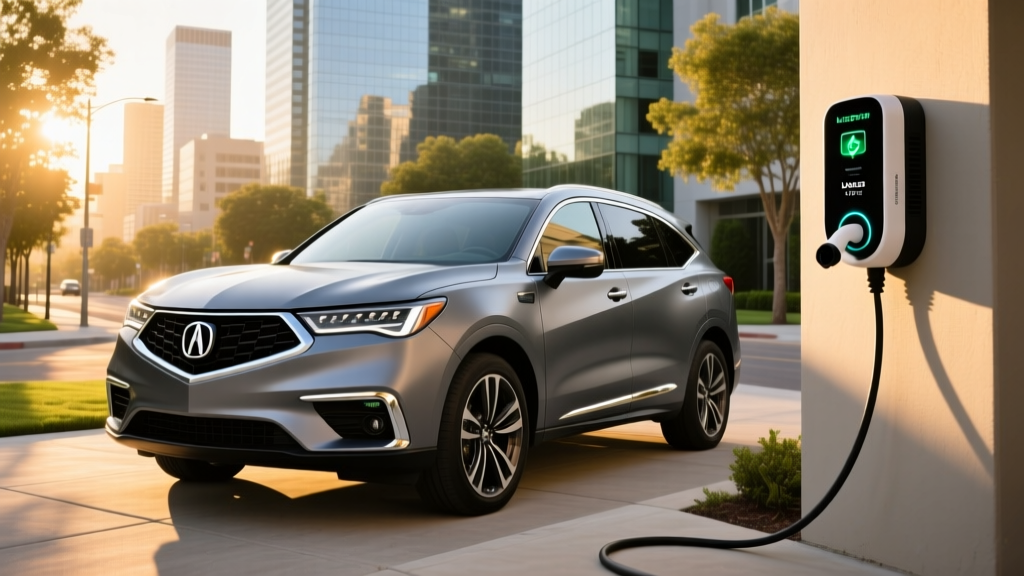
Acura's three-row MDX has long been a benchmark luxury crossover, but one gap has persisted: a proper electrified powertrain. As Honda's premium arm finalizes its next-generation e:PHEV architecture, the 2027 Acura MDX hybrid is shaping up to be the nameplate's most significant update in years. This guide breaks down what we know, what's estimated, and how a hybrid or plug-in hybrid MDX stacks up against the full-EV competition and the current gas-only model.
HEV vs PHEV: What Acura Is Actually Building
Before parsing specs, it's essential to distinguish between the two hybrid architectures Acura could deploy in the MDX. Honda has confirmed its next-generation e:PHEV (plug-in hybrid) system for larger vehicles, making a PHEV variant the most likely electrified MDX offering.
Conventional Hybrid (HEV)
- No plug required — charges via regenerative braking and engine
- Smaller battery (~1.5–2.0 kWh)
- Electric-only driving limited to low speeds, short distances
- MPG improvement over gas: typically 20–35%
- No federal tax credit eligibility under §30D
Plug-In Hybrid (PHEV) — Expected for MDX
- Plugs in to charge; also regenerates and uses engine
- Larger battery (~17–20 kWh usable)
- 30–40+ miles of electric-only range
- Functions as a conventional hybrid once battery is depleted
- May qualify for partial or full $7,500 federal tax credit (see §30D rules below)
Honda's current e:PHEV system — already deployed in the China-market Accord e:PHEV and the European CR-V e:PHEV — pairs a 2.0-liter Atkinson-cycle four-cylinder with a dual-motor setup and a 17.7 kWh battery pack. Acura is expected to adapt this architecture for the MDX, potentially with a larger displacement engine or additional power output to match the luxury crossover's performance positioning.
Expected Powertrain and Performance Specs
| Specification | Estimated (PHEV) | Current Gas MDX (2026) |
|---|---|---|
| Engine | 2.0L turbo 4-cyl + dual electric motors | 3.5L V6 (290 hp) |
| Combined System Output | ~320–360 hp (est.) | 290 hp / 267 lb-ft |
| Transmission | e-CVT (Honda direct-drive hybrid) | 10-speed automatic |
| Drivetrain | SH-AWD (rear motor-driven) | FWD or SH-AWD |
| Battery (Usable) | ~17–20 kWh (NMC lithium-ion) | N/A |
| 0–60 mph | ~5.8–6.5 sec (est.) | 6.4 sec (AWD) |
| Towing Capacity | ~3,500–5,000 lbs (est.) | 3,500 lbs (AWD) / 5,000 lbs (Type S) |
Acura's SH-AWD (Super Handling All-Wheel Drive) is a key differentiator. In the PHEV configuration, expect the rear axle to be driven primarily by an electric motor, providing torque-vectoring capability without a mechanical driveshaft — similar to the approach used in Honda's larger PHEV platforms. This improves both efficiency and handling dynamics.
Fuel Economy: EPA MPG Estimates and Real-World Expectations
Fuel economy is the headline number for any hybrid buyer. Based on Honda's e:PHEV efficiency data from the CR-V e:PHEV and Accord e:PHEV, scaled for the MDX's heavier curb weight and larger frontal area, here are our projected EPA figures:
| Mode | City | Highway | Combined |
|---|---|---|---|
| PHEV — Charge-Sustaining (Hybrid Mode) | ~28–30 MPG (est.) | ~26–28 MPG (est.) | ~27–29 MPG (est.) |
| PHEV — Charge-Depleting (EV + Hybrid Blended) | ~56–62 MPGe (est.) | ||
| Current Gas MDX AWD (2026 EPA) | 19 MPG | 25 MPG | 21 MPG |
MPGe explained: Miles Per Gallon equivalent is the EPA's way of comparing electricity consumption to gasoline. When the MDX PHEV is running on its battery (charge-depleting mode), the EPA rates efficiency in MPGe — a higher number means less energy per mile. Once the battery is depleted, the vehicle reverts to standard MPG ratings in hybrid mode.
For context, the current gas-only MDX AWD returns just 21 MPG combined per fueleconomy.gov. A PHEV variant running in hybrid mode after battery depletion would represent a ~30–38% improvement in fuel consumption, while daily commutes within the electric-only range could eliminate gasoline use entirely on most weekdays.
Electric-Only Range, Battery, and Charging
For PHEV buyers, electric-only range is the make-or-break spec. Honda's e:PHEV platform in the CR-V delivers an EPA-rated 34 miles of electric range with a 17.7 kWh battery. The MDX, being heavier (likely 4,700–4,900 lbs curb weight vs. the CR-V's ~3,900 lbs), will see slightly lower efficiency per kWh.
🔋 Projected Electric-Only Range
EPA estimated: ~30–35 miles (est.)
Real-world expectation: ~25–30 miles in mixed driving; ~20–25 miles in cold weather (below 40°F) or sustained highway speeds above 70 mph.
Total combined range (electric + gas tank): ~420–480 miles (est.)
| Charging Spec | Estimated Value |
|---|---|
| Battery Chemistry | NMC (Nickel Manganese Cobalt) |
| Battery Capacity (Usable) | ~17–20 kWh |
| Level 1 (120V) Charge Time | ~14–18 hours (0–100%) |
| Level 2 (240V, 7.2 kW) Charge Time | ~2.5–3.5 hours (0–100%) |
| DC Fast Charging | Not expected — most PHEVs in this class do not support DCFC |
| Charge Port | J1772 (standard for Level 1/2) |
kW vs kWh — a critical distinction: kW (kilowatts) measures the rate of charging — like water flow from a hose. kWh (kilowatt-hours) measures the total energy stored in the battery — like the size of the tank. A 7.2 kW Level 2 charger fills a 17 kWh battery in roughly 2.5 hours.
The lack of DC fast charging is standard for PHEVs. Honda's e:PHEV architecture does not include a CCS or NACS DC port — the battery is sized for overnight Level 2 replenishment, not highway fast-charging stops. This is perfectly adequate for a vehicle designed to cover daily commutes on electricity and switch to hybrid mode for longer trips.
Pricing and Federal Tax Credit Eligibility
Acura has not published official MSRP for the 2027 MDX hybrid, but we can project based on the current MDX lineup and the typical PHEV premium observed across Honda/Acura products:
| Trim (Projected) | Est. MSRP | Notes |
|---|---|---|
| MDX e:PHEV (Base) | ~$56,000–$58,000 | SH-AWD standard, Tech Package |
| MDX e:PHEV w/ Advance Pkg | ~$62,000–$65,000 | Premium leather, ELS audio, HUD |
| MDX e:PHEV Type S (if offered) | ~$68,000–$72,000 | Sport-tuned suspension, Brembo brakes |
For comparison, the 2026 gas-only MDX starts at $51,500 and the Type S tops out around $69,000 per Acura's official site. The PHEV premium is typically $4,000–$7,000 over an equivalently trimmed gas model, reflecting the larger battery, electric motors, and power electronics.
Does the 2027 MDX Hybrid Qualify for a Tax Credit?
Under current IRS §30D rules, plug-in hybrids may qualify for up to $7,500 in federal tax credits — but eligibility depends on several conditions that change frequently. Here's the checklist as of early 2026:
- MSRP cap: SUVs/crossovers must have an MSRP ≤ $80,000
- Buyer income cap: Modified AGI ≤ $300,000 (joint) / $225,000 (head of household) / $150,000 (individual)
- Battery sourcing: Critical minerals and battery components must meet phased-in domestic/free-trade-partner sourcing thresholds (these tighten annually through 2029)
- Point-of-sale transfer: Eligible buyers can transfer the credit to the dealer for an immediate price reduction at purchase
- Minimum battery capacity: ≥ 7 kWh (the MDX PHEV's ~17–20 kWh pack clears this easily)
The MDX PHEV's projected MSRP falls well under the $80,000 SUV cap. The critical question is whether Honda/Acura's battery supply chain will meet the sourcing requirements for the 2027 model year. Honda has been actively localizing battery production in Ohio through its LG Energy Solution joint venture, which positions the MDX PHEV favorably — but final credit eligibility should be confirmed against the IRS clean vehicle credit page at time of purchase.
Conventional HEV note: If Acura also offers a standard (non-plug-in) hybrid MDX, it will not qualify for the §30D federal tax credit. That credit is exclusively for plug-in vehicles (BEVs and PHEVs) meeting the above criteria.
Battery Warranty, Reliability, and Replacement Cost
🛡️ Hybrid Battery Warranty (Projected)
Federal mandate: All hybrid and PHEV batteries sold in the US must carry a minimum warranty of 8 years / 100,000 miles (10 years / 150,000 miles in CARB states including CA, NY, MA, and others).
Acura/Honda precedent: Honda currently provides a 10-year / 150,000-mile hybrid battery warranty nationwide on its electrified models, exceeding the federal minimum. Expect the same or better for the 2027 MDX PHEV.
Capacity retention threshold: Honda typically warrants against battery capacity loss below 70% of original capacity during the warranty period.
Is the hybrid powertrain reliable? Honda's hybrid systems have an excellent track record. The two-motor e:PHEV architecture has fewer moving parts than a conventional automatic transmission — there are no clutch packs, torque converters, or gear-shifting mechanisms in the electric drive path. The engine operates primarily in its most efficient RPM range, reducing wear. Based on long-term data from Honda's hybrid fleet, the battery packs show minimal degradation: typically 5–10% capacity loss over 10 years / 150,000 miles under normal use.
Battery replacement cost: If a PHEV battery needs replacement outside warranty, expect a parts-and-labor cost in the range of $6,000–$9,000 for a pack of this size (17–20 kWh). However, individual module replacement — where only degraded cells are swapped — can reduce this to $2,000–$4,000 at a qualified hybrid specialist. In practice, complete battery failure before 200,000+ miles is rare with Honda's thermal management systems.
Who Should Buy the 2027 MDX Hybrid — and Who Shouldn't
Decision Framework: Is the MDX PHEV Right for You?
✅ Choose the MDX PHEV if:
- Your daily commute is under 30 miles round-trip and you can charge at home (Level 2 overnight)
- You want a three-row luxury crossover but want to reduce fuel costs significantly
- You take road trips regularly and don't want to plan around charging stops (hybrid mode eliminates range anxiety)
- You want SH-AWD performance with lower running costs
- You may qualify for the federal tax credit, offsetting the PHEV price premium
❌ Look at a full EV (BEV) instead if:
- You never want to buy gasoline again and are comfortable with 250–350+ mile range
- You have reliable home and workplace charging plus good public DC fast-charging access
- You want the lowest possible maintenance costs (no oil changes, no engine)
- Consider: Tesla Model X, Rivian R1S, BMW iX, or the upcoming Acura ZDX (full BEV)
❌ Stick with the gas MDX if:
- You cannot install a Level 2 home charger (apartment, no garage, no electrical access)
- The $5,000–$7,000 PHEV premium doesn't pencil out given your annual mileage
- You drive fewer than 8,000 miles per year (fuel savings won't offset the premium)
✅ Projected Pros
- 30+ miles electric-only eliminates most daily gas use
- SH-AWD with electric rear torque vectoring
- No range anxiety on road trips — hybrid mode kicks in seamlessly
- Significantly lower fuel cost vs gas MDX (~30–38% improvement)
- Likely qualifies for up to $7,500 federal credit
- Honda's proven hybrid reliability track record
- Three-row seating retained (no battery intrusion expected)
❌ Projected Cons
- $5,000–$7,000 premium over gas MDX (before credits)
- No DC fast charging — Level 2 only
- Electric range (~30 mi) is less than some PHEV rivals (Toyota RAV4 PHEV: 42 mi)
- Must install Level 2 charger at home to maximize value
- Heavier than gas MDX — may slightly affect cargo capacity and handling
- Final specs, pricing, and tax credit eligibility still unconfirmed
Frequently Asked Questions
How many MPG does the 2027 Acura MDX hybrid get?
In hybrid mode (after the battery is depleted), the MDX PHEV is projected to achieve approximately 27–29 MPG combined (est.), a substantial improvement over the current gas MDX's 21 MPG combined. In blended EV+hybrid mode with a charged battery, the EPA rating is expected around 56–62 MPGe. Final EPA numbers will be confirmed before launch.
How far can the 2027 MDX PHEV go on electric only?
We estimate 30–35 miles of EPA-rated electric-only range, with a real-world expectation of 25–30 miles in mixed driving and 20–25 miles in cold weather or highway-speed driving. This is sufficient for most daily commutes but shorter than some competitors — the Toyota RAV4 Prime delivers 42 miles, while the Jeep Grand Cherokee 4xe manages 25 miles.
Hybrid vs PHEV vs EV — which version of the MDX should I buy?
If Acura offers both an HEV and PHEV, the PHEV is the better choice for anyone with home charging access, thanks to its electric-only commute capability and potential tax credit eligibility. The HEV makes sense only if you cannot plug in at all. A full EV (like the Acura ZDX) is ideal if you want zero gasoline use and have robust charging access — but requires more trip planning for long road trips.
Is the MDX hybrid reliable, and what does a battery replacement cost?
Honda/Acura hybrid systems are among the most reliable in the industry, with battery packs routinely lasting 200,000+ miles with minimal degradation. The battery is warrantied for at least 8 years / 100,000 miles (likely 10/150,000 based on Honda precedent). Out-of-warranty replacement runs $6,000–$9,000 for a full pack, though module-level repair can cost significantly less.
Does the 2027 Acura MDX hybrid qualify for a tax credit?
The PHEV version may qualify for up to $7,500 under IRS §30D, provided it meets battery-sourcing requirements and the buyer meets income caps ($150K–$300K depending on filing status). The MSRP cap for SUVs is $80,000, which the MDX PHEV should clear. A conventional HEV (non-plug-in) would not qualify. Always verify current eligibility at IRS.gov before purchasing.
Can I charge the MDX PHEV at a Tesla Supercharger or DC fast charger?
No. The MDX PHEV is expected to charge via J1772 at Level 1 (120V) and Level 2 (240V) only. It will not have a DC fast-charge port (CCS or NACS). This is standard for nearly all PHEVs — the battery is designed to be replenished overnight at home, not at highway charging stations.
Will the hybrid battery reduce cargo space?
Honda's e:PHEV platform is designed to mount the battery pack low and flat beneath the floor, typically under the rear seats or cargo area. Based on the CR-V e:PHEV, which retains full cargo volume, we expect the MDX PHEV to preserve its three-row seating and comparable cargo space (~16.3 cu ft behind the third row, ~71 cu ft with both rows folded) — though a slight reduction of 1–2 cu ft is possible. Acura will confirm final cargo figures before launch.
Editor's note: This article reflects information available as of early 2026. The 2027 Acura MDX hybrid is an announced/upcoming vehicle. Final specifications, pricing, EPA ratings, and tax credit eligibility are subject to change. We will update this guide when Acura releases official data. Always confirm details with your local Acura dealer and consult a tax professional regarding credit eligibility.