Quick Verdict: VW's Plug-In Hybrid SUV for the Cautious Electrifier
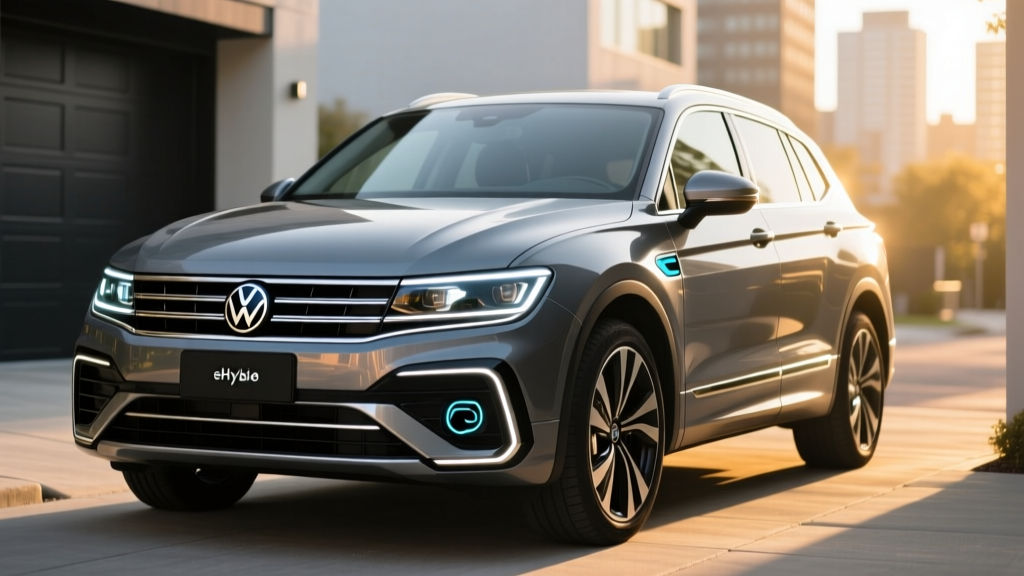
If you've been searching for a hybrid VW SUV, the 2026 Volkswagen Tiguan eHybrid is the brand's primary answer for the US market. It pairs a turbocharged 1.5-liter four-cylinder with a front-mounted electric motor and a 19.7 kWh (usable) battery pack to deliver an EPA-estimated 33 miles of electric-only driving and a combined 80 MPGe when the battery is charged. Once that battery depletes, it operates as a conventional hybrid returning approximately 38 MPG combined.
For buyers who want electric commuting without committing to a full BEV — or who lack reliable home charging — the Tiguan eHybrid occupies a practical middle ground. But with a starting MSRP around $40,490 and partial §30D tax credit eligibility, the value proposition depends heavily on your commute length and charging access.
2026 VW Tiguan eHybrid — Key Specifications
| Spec | Value |
|---|---|
| Powertrain | 1.5L turbo I-4 + electric motor (FWD) |
| Combined Horsepower | 245 hp / 258 lb-ft torque |
| Battery (usable) | 19.7 kWh, NMC chemistry |
| EPA Electric-Only Range | 33 miles |
| Total Combined Range | ~430 miles (gas + electric) |
| EPA MPGe (charge-depleting) | 80 MPGe combined |
| EPA MPG (charge-sustaining) | 38 city / 36 hwy / 38 combined |
| Level 2 Charge Time (0–100%) | ~3.75 hours at 3.7 kW |
| DC Fast Charging | Not available |
| 0–60 mph | 7.5 seconds (est.) |
| Cargo Volume | 33.0 cu ft (behind 2nd row) |
| Base MSRP (SE trim) | $40,490 |
| Federal Tax Credit (§30D) | Up to $3,750 (battery sourcing dependent) |
HEV vs PHEV: Understanding What the Tiguan eHybrid Actually Is
Volkswagen's US lineup can confuse shoppers looking for a hybrid VW SUV. Here's the critical distinction:
| Feature | Conventional Hybrid (HEV) | Plug-In Hybrid (PHEV) — Tiguan eHybrid |
|---|---|---|
| Plugs in? | No — regenerates via braking/engine | Yes — Level 1 or Level 2 AC charging |
| Battery Size | ~1–2 kWh | 19.7 kWh usable |
| Electric-Only Range | Less than 1 mile at low speed | 33 miles EPA |
| Gas Engine | Always assists or drives | Stays off for short trips if charged |
| Fuel Savings | Moderate (5–15 MPG over gas) | Major if daily driving < 33 mi |
| Tax Credit | None | Up to $3,750 under §30D |
The Tiguan eHybrid is strictly a plug-in hybrid (PHEV). VW does not currently sell a conventional (non-plug) HEV version of the Tiguan in the US for the 2026 model year. If you want a VW that never needs plugging in, you'd need to look at the standard gas Tiguan or consider competitors like the Toyota RAV4 Hybrid (HEV).
Fuel Economy: Real-World MPG vs EPA Estimates
The EPA rates the 2026 Tiguan eHybrid at 38 MPG combined (38 city / 36 highway) once the battery is depleted and the vehicle operates in charge-sustaining hybrid mode. With a full charge, the combined rating is 80 MPGe over the first 33 miles.
EPA Fuel Economy Breakdown
| Mode | City | Highway | Combined |
|---|---|---|---|
| Charge-Sustaining (hybrid) | 38 MPG | 36 MPG | 38 MPG |
| Charge-Depleting (EV + gas) | 80 MPGe combined (first 33 mi) | ||
Real-world expectations: In mixed suburban driving with regular Level 2 charging, owners who commute under 30 miles round-trip report burning very little gasoline — sometimes going weeks between fill-ups. However, on long highway trips where the battery depletes within the first 30 minutes, expect sustained MPG closer to 33–35 MPG at 70–75 mph, particularly in colder weather when the engine runs more frequently for cabin heat. This is typical for PHEVs: the EPA's charge-sustaining figure assumes moderate temperatures and mixed driving.
Compared to the gas-only 2026 Tiguan (rated at 26 MPG combined per fueleconomy.gov), the eHybrid delivers a 46% improvement in charge-sustaining mode — and far greater savings if you charge daily.
Electric-Only Range, Charging, and Battery Specs
The Tiguan eHybrid's 19.7 kWh usable battery (25.7 kWh gross) provides 33 miles of EPA-rated electric-only range. This is competitive with the segment — the Toyota RAV4 Prime offers 42 miles, while the Hyundai Tucson PHEV delivers 33 miles.
Charging Speeds and Times
| Level | Power | 0–100% Time | Notes |
|---|---|---|---|
| Level 1 (120V outlet) | ~1.4 kW | ~14 hours | Overnight top-up only |
| Level 2 (240V, 16A) | 3.7 kW | ~3.75 hours | Recommended for daily use |
| DC Fast Charging | N/A | N/A | Not equipped — no CCS DC port |
Critical limitation: The Tiguan eHybrid does not support DC fast charging. The onboard AC charger maxes out at 3.7 kW (a single-phase 16A limit), meaning even at a public Level 2 station, you'll need nearly four hours for a full charge. This is standard for compact/midsize PHEVs — the battery is small enough that DC charging hardware would add cost and weight for minimal time savings. For daily use, a home Level 2 charger (240V) installed in your garage or driveway is the practical charging solution.
Preconditioning note: The eHybrid supports scheduled departure preconditioning while plugged in, warming or cooling the cabin using grid power before your commute. This preserves electric range in extreme temperatures — a feature worth using in both winter and summer.
Powertrain and Performance
The 2026 Tiguan eHybrid pairs Volkswagen's latest EA211 evo2 1.5-liter turbocharged four-cylinder engine (producing 177 hp on its own) with a 115 hp electric motor integrated into the six-speed DSG automatic transmission. Combined system output is 245 horsepower and 258 lb-ft of torque, sent exclusively to the front wheels.
The 0–60 mph time lands at approximately 7.5 seconds — brisk enough for confident highway merging and passing. The electric motor fills in the low-end torque gap that turbocharged engines typically exhibit, resulting in smooth, responsive acceleration from a stop. In pure EV mode, the Tiguan eHybrid can reach up to 84 mph before the gas engine engages.
Driving modes: Drivers can select E-Mode (electric only), Hybrid mode (automatic blending), GTE mode (maximum combined power with sharper throttle and steering response), and Battery Hold (preserves charge for later use — useful on highway segments before entering a city).
Pricing, Trims, and Federal Tax Credit Eligibility
The 2026 Tiguan eHybrid is offered in two trims:
- SE: $40,490 MSRP (includes destination)
- SEL: $44,990 MSRP (adds panoramic roof, leather, IQ.DRIVE assist, premium audio)
§30D Federal Tax Credit
Under the current IRS §30D Clean Vehicle Credit rules, the Tiguan eHybrid may qualify for up to $3,750 — not the full $7,500. The credit is split into two $3,750 halves: one tied to critical minerals sourcing and one to battery component manufacturing. As of the 2026 model year, VW's PHEV battery supply chain meets the critical minerals threshold but the component manufacturing requirement remains partially unmet, capping the credit at $3,750.
§30D Eligibility Requirements (2026)
- MSRP cap: SUVs must be under $80,000 — both trims qualify ✓
- Buyer income cap: $150,000 single / $225,000 head of household / $300,000 joint filers
- Battery sourcing: Critical minerals + component rules phase in annually — check fueleconomy.gov for current VIN-level eligibility
- Point-of-sale transfer: Eligible buyers can apply the credit as a down-payment reduction at the dealer
- New vehicle only: Must be purchased new; leased PHEVs follow different §25D commercial rules
After the maximum $3,750 credit, the effective price of the SE trim drops to approximately $36,740 — competitive with the Toyota RAV4 Prime ($44,000+ before incentives) and well below the Hyundai Tucson PHEV Limited.
Battery Warranty, Reliability, and Replacement Cost
VW PHEV Battery Warranty
Volkswagen covers the Tiguan eHybrid's high-voltage battery for 8 years or 100,000 miles (whichever comes first), with a capacity retention threshold of 70%. If the battery degrades below 70% of its original usable capacity within the warranty period, VW will repair or replace it at no cost.
The conventional powertrain (engine, transmission, hybrid components) carries a 4-year/50,000-mile limited warranty, with an available extended coverage option up to 10 years.
Reliability Outlook
VW's 1.5L turbo engine family (EA211 evo2) is in its third generation and has proven dependable in European-market PHEVs (Golf eHybrid, Passat GTE) since 2020. The DSG-integrated electric motor design eliminates a separate motor/generator unit, reducing component count. Volkswagen's hybrid system has not appeared in major recall campaigns through the 2024–2025 model years per NHTSA data.
Battery replacement cost: If the battery fails outside of warranty, a full pack replacement for the Tiguan eHybrid is estimated at $8,000–$12,000 (parts + labor) based on comparable VW Group PHEV battery pricing. However, PHEV batteries experience far fewer charge cycles than full BEVs — a 19.7 kWh pack used for 30-mile daily commutes and recharged nightly accumulates roughly 1,000–1,500 cycles over 10 years, well within the 2,000–3,000 cycle life typical of NMC chemistry. Most PHEV batteries outlast the vehicle itself.
Who Should Choose the Tiguan eHybrid vs a Full EV or Gas SUV?
Decision Framework
Choose the Tiguan eHybrid (PHEV) if:
- Your daily round-trip commute is 25–35 miles and you can charge at home overnight
- You take 4+ road trips per year exceeding 200 miles and don't want to plan around DC chargers
- Your household has one vehicle that must handle both commuting and long-distance travel
- You want meaningful fuel savings without range anxiety or charging-desert risk
Choose a full EV (e.g., VW ID.4, Hyundai Ioniq 5) if:
- You have reliable home Level 2 charging and rarely drive more than 250 miles in a single day
- You want to eliminate gasoline purchases and oil changes entirely
- You qualify for the full $7,500 §30D credit (available on many BEVs, not this PHEV)
- You prioritize lower per-mile energy costs (electricity at $0.14/kWh ≈ $0.04/mi vs gas at $3.40/gal ≈ $0.12/mi)
Choose the gas Tiguan or a conventional HEV (e.g., RAV4 Hybrid) if:
- You cannot install a home charger (apartment, street parking, no garage)
- Your budget is under $35,000 and you want lower upfront cost
- You drive mostly highway miles where PHEV electric-range advantages disappear
Pros
- 33 miles electric covers most daily commutes gas-free
- 38 MPG hybrid mode is strong for a turbo AWD-class SUV
- No range anxiety — 430+ total miles on a tank + full battery
- Up to $3,750 federal credit reduces effective price
- Smooth EV-mode driving in city traffic
- Practical cargo space (33 cu ft) retained vs gas Tiguan
Cons
- No DC fast charging — irrelevant for PHEV but limits public top-ups
- 3.7 kW onboard charger is slow for public Level 2 stations
- FWD only — no AWD option (RAV4 Prime offers AWD)
- Only $3,750 of the $7,500 federal credit available
- Heavier than gas Tiguan — slightly firmer ride quality
- Electric range drops to ~24–27 miles in freezing weather
Frequently Asked Questions
How many MPG does the VW Tiguan hybrid get?
The 2026 Tiguan eHybrid achieves an EPA-estimated 38 MPG combined (38 city / 36 highway) in hybrid mode after the battery is depleted. With a full charge, the first 33 miles use electric power rated at 80 MPGe. In real-world highway driving at 70+ mph, expect 33–35 MPG once the battery is empty.
How far can the Tiguan eHybrid go on electric only?
The EPA rates the Tiguan eHybrid at 33 miles of electric-only range. In warm weather city driving at moderate speeds, some drivers report 35–37 miles. In freezing temperatures with cabin heat, expect 24–27 miles before the gas engine starts.
Does the VW Tiguan hybrid qualify for a tax credit?
Yes, partially. Under current IRS §30D rules, the 2026 Tiguan eHybrid qualifies for up to $3,750 (half the maximum $7,500 credit) based on battery sourcing compliance. Eligibility depends on your income (under $150K single / $300K joint) and the vehicle's VIN-level sourcing status. Check fueleconomy.gov before purchasing. The credit can be transferred to the dealer at point of sale as a down-payment reduction.
Is the VW Tiguan hybrid reliable? What about battery replacement cost?
VW's PHEV powertrain has a solid track record in European models since 2020, with no major recalls on the hybrid system. The high-voltage battery is warrantied for 8 years/100,000 miles at 70% capacity retention. Out-of-warranty replacement is estimated at $8,000–$12,000, but PHEV batteries typically last 15+ years due to low cycle counts from the small pack size.
Does the Tiguan eHybrid need to be plugged in?
No — you can drive it without ever plugging in, and it will operate as a conventional hybrid returning ~38 MPG. However, you'll miss the entire value proposition. To capture the 33 miles of electric driving and 80 MPGe, plug in daily using a standard 120V outlet (14 hours for full charge) or an installed 240V Level 2 charger (3.75 hours).
Hybrid vs PHEV vs EV — which VW SUV is right for me?
VW offers the gas Tiguan, the Tiguan eHybrid (PHEV), and the ID.4 (full BEV). If you have home charging and a commute under 33 miles, the eHybrid lets you drive electric daily while keeping gas for road trips. If you can charge at home and rarely exceed 250 miles between stops, the ID.4 (275-mile range, $7,500 credit eligible) eliminates gasoline entirely. If you have no charging access, stick with the gas Tiguan or consider a conventional HEV from Toyota or Honda — VW does not sell a non-plug hybrid SUV in the US for 2026.