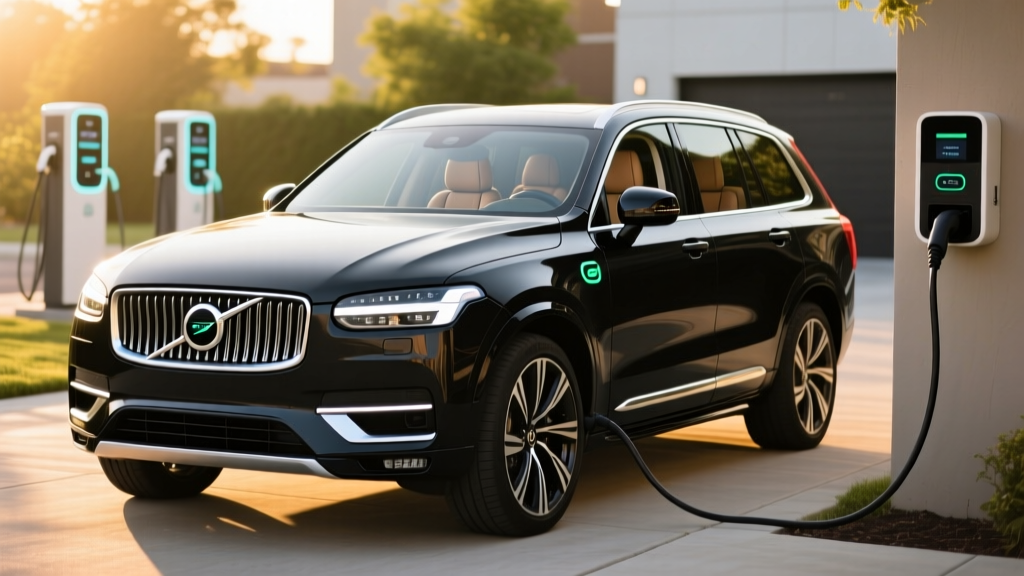
The 2026 Volvo XC90 Hybrid—officially the XC90 Recharge—represents Volvo's plug-in hybrid flagship, a three-row luxury SUV that bridges the gap between a conventional gas-only XC90 and a fully electric EX90. With a combined 455 horsepower, an EPA-estimated 32 to 38 miles of electric-only driving, and a usable 18.6 kWh battery, the 2026 XC90 Hybrid targets families who want daily electric commuting without sacrificing long road-trip range. But does the math work for your household? This guide breaks down every spec, from real-world MPG and charging logistics to federal tax credit eligibility under current IRS §30D rules.
2026 Volvo XC90 Recharge: Hybrid Specs at a Glance
| Specification | 2026 Volvo XC90 Recharge (PHEV) |
|---|---|
| Powertrain | 2.0L turbocharged + supercharged 4-cyl + rear electric motor (eAWD) |
| Combined Horsepower | 455 hp / 523 lb-ft torque |
| Battery (usable) | 18.6 kWh, lithium-ion NMC |
| EPA Electric-Only Range | 32–38 miles (varies by trim/wheels) |
| EPA Combined Range (gas + electric) | ~380–410 miles |
| EPA MPGe (electric + gas) | 55–58 MPGe combined |
| EPA MPG (gas only, charge-sustaining) | 27 city / 28 hwy / 27 combined |
| 0–60 mph | 5.0 seconds |
| Level 2 Charge Time (0–100%) | ~5 hours at 3.6 kW |
| DC Fast Charging | Not supported |
| Seating / Cargo | 6 or 7 passengers / 12.9 cu ft (behind 3rd row) |
| Starting MSRP | ~$82,350 (Core trim, including destination) |
| Battery Warranty | 8 years / 100,000 miles |
HEV vs. PHEV: Understanding the 2026 XC90 Hybrid Lineup
Volvo offers two distinct electrified versions of the XC90 for 2026, and confusing them is easy—especially because both wear "hybrid" badges in casual conversation. Here's the critical distinction:
XC90 B5 / B6 (Mild Hybrid / HEV)
- 48-volt mild-hybrid system with integrated starter-generator
- Cannot plug in; no electric-only driving
- 247 hp (B5) or 295 hp (B6)
- EPA: 23 city / 30 hwy / 26 combined (B5 FWD)
- Starting MSRP: ~$58,600
- No federal tax credit eligibility
XC90 Recharge (Plug-In Hybrid / PHEV)
- 18.6 kWh traction battery + rear electric motor
- Plugs in; 32–38 miles of electric-only range
- 455 hp combined
- EPA: 55–58 MPGe combined; 27 MPG gas-only
- Starting MSRP: ~$82,350
- May qualify for federal tax credit (see eligibility below)
The B5/B6 mild hybrid recovers a small amount of energy during braking and assists the engine at low speeds, but it cannot propel the vehicle on electricity alone. The Recharge PHEV is a fundamentally different powertrain with a much larger battery, a dedicated electric motor driving the rear axle, and a charge port on the driver's side. When we discuss the "2026 Volvo XC90 Hybrid" in this review, we're focused on the Recharge PHEV.
Electric-Only Range and Real-World Efficiency
The EPA rates the 2026 XC90 Recharge at 32 to 38 miles of electric-only range, depending on trim level and wheel size. The Plus and Ultimate trims with 20-inch wheels tend toward the higher end of that range, while the heavier Ultra with 22-inch wheels pulls the figure down.
EPA Electric Range: 32–38 miles
Real-World Expectation: Expect 26–34 miles in mixed driving. Highway speeds above 70 mph, cold temperatures below 40°F, and aggressive acceleration will push you toward the lower end. In mild weather with city-speed driving, some owners report matching or slightly exceeding the EPA figure thanks to regenerative braking.
Once the battery depletes, the XC90 Recharge operates as a conventional hybrid in charge-sustaining mode, delivering an EPA-estimated 27 MPG combined (27 city / 28 highway). That's respectable for a 5,100-pound three-row SUV, though it trails the Toyota Grand Highlander Hybrid (35 MPG combined) by a significant margin.
| Driving Mode | City | Highway | Combined |
|---|---|---|---|
| Electric-only (MPGe) | 58 MPGe | 52 MPGe | 55 MPGe |
| Gas-only (charge-sustaining) | 27 MPG | 28 MPG | 27 MPG |
Real-World MPG vs. EPA: What Owners Report
Plug-in hybrids reward daily charging. If your commute falls within the 32–38 mile electric window and you charge every night, you may use almost zero gasoline for weeks. Over a mixed 10,000-mile year with regular charging, many owners see effective fuel consumption equivalent to 45–60+ MPG. Skip charging entirely and you're carrying 500+ pounds of dead battery weight, settling at that 27 MPG combined—or slightly below in city-heavy driving where the electric motor can't assist as often.
Charging the XC90 Recharge: What You Need to Know
The 2026 XC90 Recharge charges exclusively via AC power. There is no DC fast-charging capability—a notable limitation compared to PHEVs like the Chrysler Pacifica Hybrid or the Toyota RAV4 Prime (which also lacks DCFC but has a larger battery).
| Charging Level | Power | 0–100% Time | Miles of Range Added/Hour |
|---|---|---|---|
| Level 1 (120V household) | ~1.4 kW | ~13–14 hours | ~2–3 miles/hr |
| Level 2 (240V home/public) | 3.6 kW (max) | ~5 hours | ~7–8 miles/hr |
| DC Fast Charge | N/A | Not supported | — |
The onboard charger is limited to 3.6 kW, meaning even a 48-amp Level 2 home charger won't push energy into the battery any faster than a basic 16-amp 240V unit. A full charge from empty takes roughly five hours on Level 2. For most owners, plugging in overnight at home replenishes the battery completely, regardless of whether you're using Level 1 or Level 2.
Practical tip: Volvo's onboard scheduler lets you set a departure time and precondition the cabin while still plugged in—warming or cooling the interior using grid power rather than battery energy. This preserves your full electric range for the drive itself, especially valuable in winter.
Powertrain and Performance
The XC90 Recharge pairs a 2.0-liter four-cylinder engine (both turbocharged and supercharged) with an electric motor integrated into the rear axle. Combined output is 455 horsepower and 523 lb-ft of torque, routed through an 8-speed automatic transmission. Volvo calls this eAWD—the front wheels are driven by the gas engine, the rear wheels by the electric motor, with no mechanical connection between axles.
The result is a 0–60 mph time of approximately 5.0 seconds, making the Recharge the quickest XC90 variant by a wide margin. In Pure mode, the vehicle runs on electricity alone up to about 75 mph. In Hybrid mode, the system blends gas and electric seamlessly. Power mode delivers maximum combined output for highway passing or spirited driving.
Driving dynamics are composed but comfort-oriented. The air suspension (standard on Ultimate, optional on Plus) absorbs road imperfections well, though the Recharge's additional ~500 pounds of battery mass is noticeable during quick direction changes. This is a family cruiser, not a sports SUV.
Pricing, Trims, and Federal Tax Credit Eligibility
The 2026 XC90 Recharge is offered in three trims:
- Plus Bright: ~$82,350 — 20" wheels, leatherette, panoramic roof, Pilot Assist
- Ultimate Bright: ~$87,450 — adds Nappa leather, air suspension, 360° camera, head-up display
- Ultra (Dark/Ultimate): ~$90,000+ — 22" wheels, upgraded audio, additional luxury packages
Federal Tax Credit (§30D) — Current Rules
Under the federal §30D clean vehicle credit, the XC90 Recharge may qualify for up to $7,500, but eligibility is far from guaranteed and depends on multiple factors. Here's the current checklist per IRS guidelines:
- MSRP Cap: SUVs must have an MSRP at or below $80,000. Higher XC90 Recharge trims may exceed this cap—verify the exact MSRP on the window sticker, including mandatory options but excluding destination.
- Buyer Income Limits: Modified AGI must not exceed $300,000 (joint), $225,000 (head of household), or $150,000 (single).
- Battery Sourcing: A percentage of critical minerals and battery components must be sourced from the U.S. or free-trade-agreement countries. These percentages increase annually. Volvo's supply chain compliance varies by model year—confirm current-year status on fueleconomy.gov.
- Final Assembly: Vehicle must undergo final assembly in North America. Volvo's XC90 is built in Ridgeville, South Carolina, which satisfies this requirement.
- Point-of-Sale Transfer: As of 2024, eligible buyers can transfer the credit to the dealer at purchase, reducing the purchase price upfront rather than waiting for a tax refund.
⚠️ Important: The higher-end XC90 Recharge trims (Ultimate, Ultra) frequently push past the $80,000 MSRP cap for SUVs. If your configured vehicle exceeds $80,000, it is not eligible for the federal credit regardless of other factors. Always verify the exact MSRP before assuming credit eligibility. Consult a tax professional for your specific situation.
Battery Warranty, Reliability, and Replacement Cost
Volvo covers the XC90 Recharge's high-voltage battery with an 8-year / 100,000-mile warranty (whichever comes first), consistent with the industry standard for PHEV and EV batteries. The warranty covers defects and excessive capacity degradation—typically defined as falling below 70% of original capacity during the warranty period.
Volvo XC90 Recharge Battery Warranty:
Coverage: 8 years / 100,000 miles
Degradation threshold: ~70% state of health
Powertrain warranty: 4 years / 50,000 miles
Basic vehicle warranty: 4 years / 50,000 miles
Is the XC90 Recharge Reliable?
Volvo's PHEV powertrain has been in production since 2015 (with successive updates), and the twin-engine layout is well-understood by now. The most common complaints in earlier model years involved software glitches and infotainment bugs rather than powertrain failures. The switch to Google Built-in (Android Automotive OS) in recent years has improved stability, though some owners report occasional connectivity issues.
The 18.6 kWh battery is relatively small compared to a full EV's pack, meaning fewer cells and lower overall replacement cost if needed out of warranty. Industry estimates for PHEV battery replacement range from $5,000 to $9,000 depending on labor rates, though most PHEV batteries outlast their warranty periods with minimal degradation due to conservative charge buffers and active thermal management.
XC90 Hybrid vs. Full EV vs. Gas: Which Should You Choose?
Choose the XC90 Recharge PHEV if:
- Your daily commute is under 35 miles round-trip and you can charge at home
- You take road trips longer than 300 miles several times per year
- You want three rows and luxury features but aren't ready to commit to a full EV
- Your household has one vehicle that must do everything
Choose a Full EV (e.g., Volvo EX90, Tesla Model X) if:
- You have reliable home Level 2 charging and access to DC fast chargers for trips
- Your daily driving rarely exceeds 250 miles and you plan road trips around charging
- You want the lowest per-mile fuel cost and minimal maintenance
- You're motivated by tailpipe-emissions reduction
Choose the XC90 B5/B6 (Gas HEV) if:
- You cannot charge at home (apartment, street parking, no garage)
- Your budget is under $65,000
- You don't want to manage charging logistics
- You drive mostly highway miles where PHEV electric range provides less benefit
Pros and Cons of the 2026 XC90 Recharge
Pros
- 32–38 miles of electric range covers most daily commutes
- 455 hp delivers confident acceleration (5.0s to 60)
- Three-row seating with premium Scandinavian interior
- Strong safety credentials (IIHS Top Safety Pick+ historically)
- North American assembly supports §30D tax credit eligibility
- Google Built-in infotainment with native Google Maps EV routing
Cons
- No DC fast charging — Level 2 only at 3.6 kW max
- Higher trims exceed the $80,000 MSRP cap for the federal tax credit
- 27 MPG gas-only is unremarkable for a hybrid SUV this size
- Third-row space is tight for adults on long trips
- Premium pricing vs. non-luxury PHEV alternatives (RAV4 Prime, Tucson PHEV)
- 12.9 cu ft cargo behind third row is limited for the class
Frequently Asked Questions
How many MPG does the 2026 Volvo XC90 Hybrid get?
The XC90 Recharge achieves an EPA-estimated 55–58 MPGe when combining electric and gas driving. Once the battery is depleted, it operates as a conventional hybrid at 27 MPG combined (27 city / 28 highway). Real-world MPG depends heavily on how often you charge—daily charging can push effective fuel economy well above 50 MPG equivalent over a typical commute cycle.
How far can the XC90 Recharge go on electric only?
The EPA rates it at 32–38 miles of electric-only range depending on trim. In real-world conditions, expect 26–34 miles. Highway speeds, cold weather, and hilly terrain reduce range; city driving with regenerative braking can help you match or approach the EPA figure.
Does the 2026 XC90 Hybrid qualify for the $7,500 federal tax credit?
It may, but eligibility is not automatic. The vehicle must have an MSRP at or below $80,000 (SUV cap), the buyer must meet income limits, and battery sourcing requirements must be satisfied. Many XC90 Recharge configurations exceed the $80,000 MSRP cap, which disqualifies them. Check fueleconomy.gov for the specific trim's eligibility and consult a tax professional.
Can the XC90 Recharge DC fast charge?
No. The XC90 Recharge supports only AC charging—Level 1 (120V) and Level 2 (240V) at a maximum of 3.6 kW. A full charge takes about five hours on Level 2. There is no CCS or NACS port for DC fast charging. This is typical for PHEVs with smaller batteries but limits flexibility on longer road trips.
What is the battery replacement cost for the XC90 Recharge?
Out-of-warranty PHEV battery replacement typically costs between $5,000 and $9,000 including labor. However, the 18.6 kWh battery is covered by Volvo's 8-year/100,000-mile warranty, and PHEV batteries generally experience slower degradation than full EV batteries due to smaller charge cycles and conservative buffer management. Most owners will never need a replacement.
Is the XC90 Recharge better than the Volvo EX90?
They serve different buyers. The EX90 is a full battery-electric SUV with 300+ miles of range, DC fast charging, and a more advanced sensor suite, but it starts above $76,000 and requires charging infrastructure. The XC90 Recharge is the better choice if you need road-trip flexibility without charging stops, want a proven platform, or lack reliable home charging for a full EV.
How does the XC90 Recharge compare to the BMW X5 xDrive50e?
The BMW X5 xDrive50e offers a larger 25.7 kWh battery with roughly 38–40 miles of EPA electric range, slightly better gas-only MPG, and a more engaging driving experience. The Volvo counters with standard third-row seating (the X5's third row is a tight option), a more comfortable ride, and potentially lower starting price. Both lack DC fast charging. Choose the Volvo for family practicality; choose the BMW for driving dynamics and electric range.