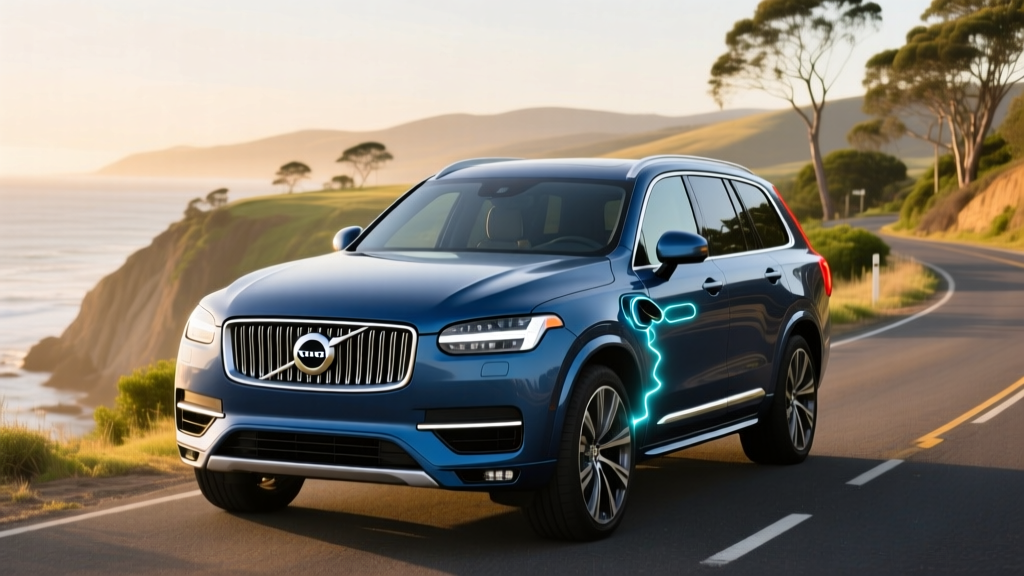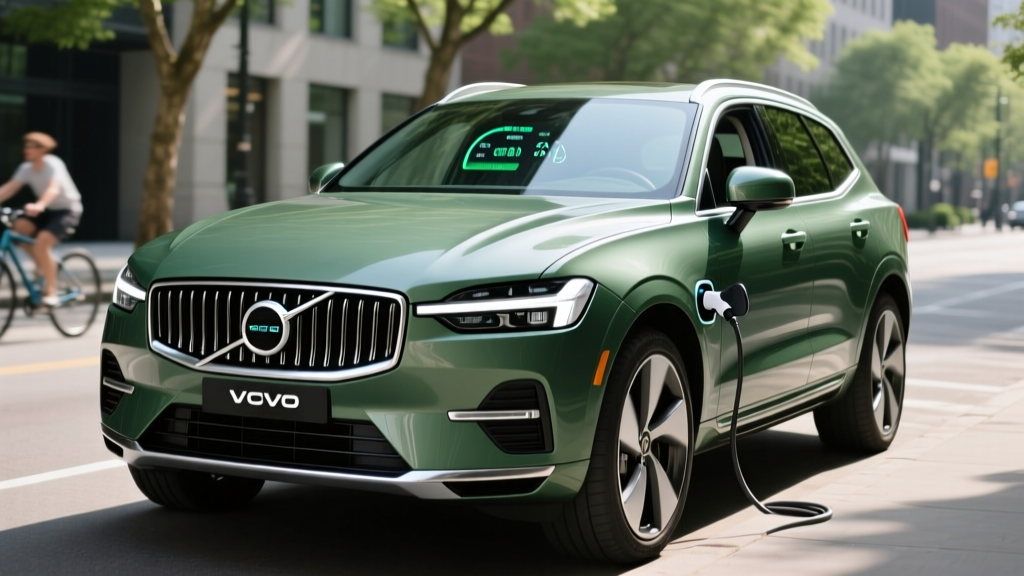
The 2026 Volvo XC60 plug-in hybrid (PHEV) — badged as the XC60 T8 AWD Recharge — sits at the intersection of daily electric commuting and long-distance gasoline flexibility. With a refreshed powertrain delivering 455 combined horsepower and roughly 28 to 31 miles of electric-only range, it targets luxury SUV buyers who want EV-like driving around town but aren't ready to depend solely on charging infrastructure. This guide breaks down the exact numbers — EPA MPG, battery capacity, charging time, warranty coverage, and federal tax credit eligibility — so you can decide whether the XC60 Recharge fits your driving pattern.
HEV vs PHEV: What the 2026 XC60 Actually Is
Volvo discontinued the mild-hybrid-only XC60 (B5) in the U.S. market after the 2024 model year, making every new XC60 sold in America a plug-in hybrid. This is an important distinction for shoppers cross-referencing older reviews.
Conventional Hybrid (HEV)
- No plug — charges via regenerative braking and the engine
- Small battery (~1-2 kWh)
- No electric-only driving beyond very low speeds
- Example: Toyota RAV4 Hybrid
Plug-In Hybrid (PHEV) — XC60 T8 Recharge
- Plugs in to charge — Level 1 (120V) or Level 2 (240V)
- 18.8 kWh battery (usable ~14.9 kWh)
- 28-31 miles of electric-only driving at highway speeds
- Gas engine takes over when battery depletes
The XC60 T8 Recharge is squarely a PHEV. You plug it in at home or at public Level 2 chargers to unlock its electric range. If you never plug it in, it still functions as a hybrid — but you'd be carrying around 400+ pounds of battery you're not utilizing, and your fuel economy drops significantly.
2026 Volvo XC60 PHEV Specifications
| Specification | 2026 XC60 T8 AWD Recharge |
|---|---|
| Powertrain | 2.0L turbocharged + supercharged I-4 + rear electric motor (eAWD) |
| Combined Horsepower | 455 hp |
| Combined Torque | 523 lb-ft |
| Battery (Total / Usable) | 18.8 kWh total / ~14.9 kWh usable |
| Battery Chemistry | NMC (Nickel Manganese Cobalt) |
| Electric-Only Range (EPA) | 28-31 miles (varies by trim/wheel size) |
| Total Combined Range | ~430-460 miles |
| MPGe (Electric + Gas) | 63 MPGe combined |
| MPG (Gas Only, Charge-Depleted) | 28 city / 28 highway / 28 combined |
| Onboard Charger | 3.7 kW (Level 2 AC only) |
| DC Fast Charging | Not supported |
| Level 2 Charge Time (0-100%) | ~5 hours at 3.7 kW |
| Level 1 Charge Time (120V) | ~12-14 hours |
| 0-60 mph | 4.5 seconds |
| Drivetrain | eAWD (engine drives front wheels, electric motor drives rear) |
| Towing Capacity | 3,500 lbs |
| Cargo Volume (rear seats up / down) | 22.4 / 63.3 cu ft |
Fuel Economy: EPA Numbers vs Real-World MPG
| Driving Mode | City | Highway | Combined |
|---|---|---|---|
| Charge-Depleted (Gas Only) | 28 MPG | 28 MPG | 28 MPG |
| With Regular Charging | 63 MPGe (varies by trip length and charging frequency) | ||
| Electric-Only | ~2.0-2.2 kWh/mile (equivalent to ~130 MPGe) | ||
Real-world expectations: The EPA rates the XC60 T8 Recharge at 28 MPG combined once the battery is depleted. In practice, PHEV owners who charge daily and drive less than 30 miles per day may use almost no gasoline for weeks. On a 300-mile highway road trip with no charging, expect approximately 26-28 MPG — the EPA figure is reasonably accurate for mixed driving, though aggressive acceleration and cold weather can push it to 24-25 MPG.
According to fueleconomy.gov, the 28 MPG charge-depleted rating puts the XC60 T8 ahead of many non-hybrid luxury compact SUVs but behind dedicated hybrids like the Lexus NX 350h (39 MPG combined). The value proposition here is the electric-only commuting, not the gas-only efficiency.
Electric Range and Charging: What to Expect
The 2026 XC60 T8 Recharge carries an 18.8 kWh battery pack with approximately 14.9 kWh usable. The EPA rates electric-only range at 28 to 31 miles depending on trim — the Plus and Core trims with 19-inch wheels achieve 31 miles, while the Ultimate trim with 20-inch wheels drops to 28 miles due to increased rolling resistance and weight.
Real-World Electric Range
EPA Rating: 28-31 miles (trim-dependent)
Real-World Expectation: 22-28 miles in mild weather; 17-22 miles in freezing temperatures (below 32°F)
Highway-Only at 75 mph: ~20-24 miles
Cold weather reduces battery efficiency by roughly 20-30%, and highway-speed electric driving depletes the battery faster than city driving due to aerodynamic drag.
Charging reality: The XC60's 3.7 kW onboard charger is a notable limitation. At a public Level 2 station or a home wallbox, a full charge takes approximately 5 hours. This is slow compared to competitors like the BMW X5 xDrive50e (7.4 kW charger, ~3 hours). The XC60 does not support DC fast charging — no CCS, no NACS, no CHAdeMO. For overnight home charging, 5 hours is perfectly adequate: plug in when you arrive home, and the battery is full by morning. For mid-day top-ups on road trips, however, the slow AC charging means you'll rely on the gas engine rather than waiting at a public charger.
The charge port uses a standard J1772 connector for Level 1 and Level 2 AC charging. Volvo has not adopted the NACS (Tesla) connector for the XC60, as NACS is primarily relevant for DC fast charging — which this vehicle doesn't support.
Powertrain Deep Dive: How the T8 eAWD System Works
The T8 Recharge powertrain pairs a 2.0-liter four-cylinder engine (both turbocharged and supercharged) with an electric motor integrated into the rear axle. The engine produces 312 hp and drives the front wheels, while the 143-hp electric motor drives the rear wheels. Combined output is 455 hp and 523 lb-ft of torque.
This "eAWD" layout means there's no mechanical connection between the engine and the rear wheels — the rear axle is purely electric. In practice, this delivers seamless all-wheel-drive traction and instant torque from the electric motor. The 0-60 mph time of 4.5 seconds makes it one of the quickest vehicles in its class, rivaling the Porsche Macan T and BMW X3 M40i.
Drive modes include Pure (electric-only, up to 87 mph), Hybrid (default, blends gas and electric), Power (maximum combined output), and Off-Road (low-speed AWD lock). The Pure mode is ideal for city commuting and neighborhood driving, while Hybrid mode manages the powertrain automatically for longer trips.
Pricing, Trims, and Tax Credit Eligibility
The 2026 Volvo XC60 T8 AWD Recharge starts at approximately $59,250 (including destination) for the Core trim and climbs to roughly $69,000 for the Ultra trim with premium packages. Key pricing:
- Core: ~$59,250
- Plus: ~$62,550
- Ultimate: ~$67,250
- Ultra (Ultimate + Bowers & Wilkins, air suspension): ~$69,000+
Federal Tax Credit (§30D) — Does It Qualify?
The 2026 Volvo XC60 T8 Recharge is not currently eligible for the full $7,500 federal §30D new clean vehicle credit. The primary disqualifying factor is battery component and critical mineral sourcing — Volvo's PHEV battery supply chain does not meet the 2026 domestic-content thresholds mandated by the Inflation Reduction Act.
Under current IRS §30D rules, eligibility requires meeting escalating percentages of North American battery component manufacturing and critical mineral sourcing from U.S. or free-trade-agreement partners. Volvo has not certified the XC60 T8 Recharge as qualifying.
Important caveats: Tax credit eligibility changes frequently as manufacturers adjust supply chains. Always verify current status on fueleconomy.gov before purchasing. Additionally, the §30D credit has income caps ($150,000 single / $300,000 joint MAGI), MSRP caps ($80,000 for SUVs), and is available as a point-of-sale transfer at the dealer. Consult a tax professional for your specific situation.
Some states offer additional PHEV incentives — California's CVRP rebate, Colorado's state tax credit, and various utility company rebates may apply. These vary by jurisdiction and change frequently, so check your state energy office and local utility for current programs.
Battery Warranty, Reliability, and Replacement Costs
Volvo Hybrid Battery Warranty
- Coverage: 8 years / 100,000 miles (whichever comes first)
- Capacity Threshold: Battery is warranted to retain at least 70% of original capacity during the warranty period
- What's Covered: Defects, excessive degradation below 70%, hybrid system components (electric motor, inverter, charge system)
- Standard Vehicle Warranty: 4 years / 50,000 miles bumper-to-bumper
Reliability: Volvo's T8 powertrain has been in production since 2016 (with the larger battery since 2022), giving it a meaningful track record. The 18.8 kWh pack introduced for the 2022 model year has shown modest degradation — owner reports suggest 5-8% capacity loss over 3 years of daily charging, which is within normal NMC battery behavior. The engine and transmission are conventional Volvo components with established service histories.
Battery replacement cost: If the high-voltage battery requires replacement out of warranty, expect a cost between $8,000 and $12,000 including parts and labor at a Volvo dealer. This is a significant expense, though it's worth noting that complete battery failure is rare — most degradation is gradual, and the battery typically remains functional well beyond the warranty period at reduced capacity.
According to IIHS, the XC60 has historically earned top safety ratings, which supports long-term ownership confidence. Volvo's dealer network provides hybrid-specific service training, though PHEV maintenance costs are higher than a conventional hybrid like the Toyota RAV4 Prime due to the complexity of the dual powertrain.
XC60 PHEV vs Full EV vs Gas: Which Fits Your Life?
Choose the XC60 T8 Recharge (PHEV) if:
- Your daily commute is under 30 miles and you can charge at home overnight
- You take road trips of 200+ miles several times per year and don't want to plan around charging
- You want luxury, performance (455 hp), and AWD without range anxiety
- You live in a cold climate where EV range loss is a concern
Choose a Full EV (e.g., Volvo EX60, Tesla Model Y, BMW iX3) if:
- You have reliable home Level 2 charging and your daily driving is under 250 miles
- You want to eliminate gasoline entirely and minimize maintenance (no oil changes, no engine)
- You qualify for the $7,500 federal tax credit (available on many EVs but not this PHEV)
- You prioritize lowest per-mile energy cost — electricity at $0.14/kWh costs roughly $0.04/mile vs $0.15/mile for gas
Choose a Conventional Hybrid (HEV, e.g., Lexus NX 350h) if:
- You cannot charge at home (no garage, no outlet access)
- You want maximum MPG without any plug-in behavior
- You prefer a lower purchase price ($40,000-$50,000 range)
Pros and Cons at a Glance
Pros
- 28-31 miles electric range covers most daily commutes gas-free
- 455 hp delivers genuinely quick acceleration (4.5s 0-60)
- Premium Scandinavian interior with Google Built-in infotainment
- AWD with no mechanical linkage — seamless electric rear axle
- 8-year/100,000-mile battery warranty
- No range anxiety on road trips — gas engine takes over seamlessly
Cons
- 3.7 kW onboard charger is slow — 5 hours for a full Level 2 charge
- No DC fast charging capability
- Does not qualify for $7,500 federal §30D tax credit
- 28 MPG gas-only is unimpressive for a hybrid — Lexus NX 350h achieves 39 MPG
- Premium pricing ($59K-$69K) with limited tax incentive offset
- Maintenance complexity of dual powertrain (engine + electric motor)
Frequently Asked Questions
How many MPG does the 2026 Volvo XC60 Hybrid get?
Once the battery is depleted, the XC60 T8 Recharge achieves 28 MPG combined (28 city / 28 highway) according to the EPA. If you charge regularly and drive under 30 miles per day, your effective fuel consumption can drop to near zero for daily driving. The 63 MPGe combined rating reflects mixed electric and gasoline operation.
How far can the XC60 go on electric only?
The EPA rates the 2026 XC60 T8 Recharge at 28 to 31 miles of electric-only range depending on trim and wheel size. In real-world driving, expect 22-28 miles in mild weather and 17-22 miles in freezing temperatures. Highway driving at 75 mph reduces electric range to approximately 20-24 miles.
Does the 2026 XC60 Hybrid qualify for a tax credit?
The XC60 T8 Recharge does not currently qualify for the full $7,500 federal §30D tax credit due to battery sourcing requirements. State incentives may apply depending on your jurisdiction. Always verify current eligibility on fueleconomy.gov and consult a tax professional before purchasing.
Can the XC60 charge at Tesla Superchargers?
No. The XC60 uses a J1772 connector for AC Level 1 and Level 2 charging and does not support DC fast charging at all — including Tesla Superchargers, Electrify America, or any CCS/NACS DC network. This is typical for PHEVs, which rely primarily on home and workplace Level 2 charging.
Is the Volvo XC60 Hybrid reliable?
The T8 powertrain has been in production since 2016 with the current 18.8 kWh battery since 2022. Owner-reported degradation is modest (5-8% over 3 years). The 8-year/100,000-mile hybrid battery warranty provides strong coverage. However, the dual powertrain adds maintenance complexity compared to a pure EV or conventional hybrid.
What does it cost to charge the XC60 at home?
Charging the ~14.9 kWh usable battery from empty to full at the U.S. average residential rate of $0.16/kWh costs approximately $2.38. This provides 22-28 real-world electric miles, equating to roughly $0.09-$0.11 per mile — significantly cheaper than gasoline at current prices.
How long will the hybrid battery last?
Volvo warrants the battery for 8 years/100,000 miles at 70% capacity retention. Based on NMC chemistry degradation patterns and owner data, the battery should remain functional for 12-15 years with gradual capacity loss. Most PHEV batteries are not "replaced" but rather continue operating at reduced range.