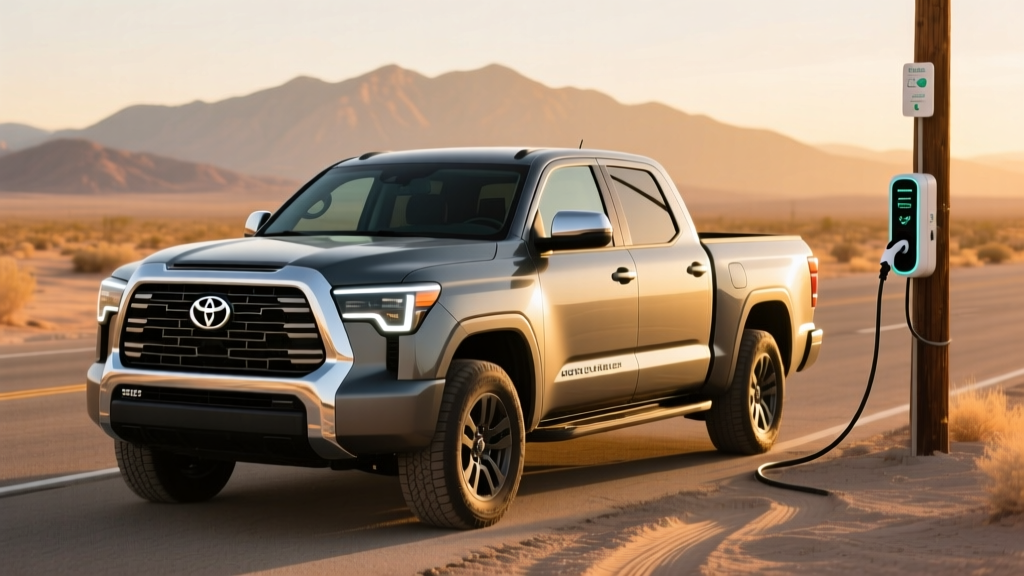
The full-size pickup segment hasn't exactly been a hotbed of electrification, but the 2026 Toyota Tundra Hybrid — officially badged as the i-FORCE MAX — remains one of the few mainstream hybrid trucks you can actually buy. It's a conventional hybrid (HEV), not a plug-in, meaning you never plug it in and it generates electricity through regenerative braking and its twin-turbo V6. For truck buyers who want meaningful fuel economy gains without changing their fueling habits or sacrificing towing capacity, the Tundra i-FORCE MAX occupies a specific and increasingly relevant niche.
This guide breaks down the exact EPA fuel economy figures, real-world MPG expectations, powertrain specs, pricing, battery warranty details, and tax credit eligibility for the 2026 model year — along with a clear-eyed assessment of who should buy this truck versus a full EV or a conventional gas pickup.
HEV vs PHEV: What Kind of Hybrid Is the Tundra?
Before examining specs, it's critical to understand what the Tundra Hybrid is — and what it isn't. The i-FORCE MAX is a conventional hybrid electric vehicle (HEV), sometimes called a "self-charging hybrid." It has a small battery pack (roughly 1.87 kWh) that is charged exclusively by the engine and regenerative braking. You cannot plug it in. There is no electric-only driving range to speak of — the electric motor assists the gas engine but cannot propel the truck on its own for any meaningful distance.
| Feature | HEV (Tundra i-FORCE MAX) | PHEV (Plug-In Hybrid) | BEV (Full Electric) |
|---|---|---|---|
| Plug-in charging | No | Yes | Yes |
| Battery size | ~1.87 kWh | 15–25 kWh typical | 75–130+ kWh |
| Electric-only range | N/A | 20–50 miles | 200–400+ miles |
| Gas engine | Yes (primary) | Yes (backup) | No |
| Fueling | Gas station only | Gas + plug | Plug only |
| Federal tax credit (§30D) | Not eligible | Up to $7,500 (if qualified) | Up to $7,500 (if qualified) |
This distinction matters because many shoppers confuse hybrid types. If you're looking for electric-only commuting in a truck, the Tundra i-FORCE MAX won't deliver that. It will, however, cut your fuel consumption noticeably versus the non-hybrid V6 — especially in city and stop-and-go driving where the electric motor does the most work.
Fuel Economy: EPA Ratings and Real-World MPG
The headline number for the 2026 Toyota Tundra Hybrid is its EPA-estimated fuel economy. Toyota offers the i-FORCE MAX powertrain across several trims and configurations, and the MPG varies slightly depending on 4x2 vs 4x4 and cab/bed configuration.
| Configuration | City MPG | Highway MPG | Combined MPG |
|---|---|---|---|
| 4x2 CrewMax (i-FORCE MAX) | 20 | 24 | 21 |
| 4x4 CrewMax (i-FORCE MAX) | 19 | 22 | 20 |
| 4x4 CrewMax TRD Pro (i-FORCE MAX) | 18 | 21 | 19 |
Source: EPA Fuel Economy. Verify exact trim ratings at fueleconomy.gov.
For comparison, the non-hybrid 2026 Tundra with the standard i-FORCE twin-turbo V6 (no electric motor) rates around 16 city / 20 highway / 18 combined for a 4x4 CrewMax. That makes the hybrid roughly a 2 MPG combined improvement, or about 11% better fuel economy — meaningful over 15,000 miles per year.
Real-World MPG: What to Actually Expect
Hybrids tend to outperform their EPA city ratings in real-world stop-and-go traffic, where regenerative braking recaptures energy most effectively. In mixed suburban and city driving, owners frequently report matching or slightly exceeding the EPA combined figure. However, highway-heavy commutes and towing will pull real-world numbers below the EPA sticker.
Real-World MPG Expectations (4x4 CrewMax):
- City-dominant driving: 20–22 MPG (hybrid system shines in stop-and-go)
- Mixed driving: 19–21 MPG (close to EPA combined)
- Highway-dominant (70+ mph sustained): 17–19 MPG (aerodynamic drag dominates)
- While towing (5,000+ lb trailer): 10–13 MPG (varies heavily by load and terrain)
At current national average gas prices (~$3.30/gallon in early 2026), the 2 MPG improvement over the non-hybrid translates to roughly $250–$350 in annual fuel savings for a driver covering 15,000 miles per year. Over a 5-year ownership period, that's $1,250–$1,750 in fuel savings — which helps offset the hybrid powertrain's price premium.
Powertrain Specs: Horsepower, Torque, and Towing
The i-FORCE MAX powertrain pairs a 3.4-liter twin-turbocharged V6 with a 48-horsepower electric motor integrated into the bell housing between the engine and the 10-speed automatic transmission. Combined output is substantial.
| Specification | 2026 Tundra i-FORCE MAX |
|---|---|
| Engine | 3.4L twin-turbo V6 + electric motor |
| Combined horsepower | 437 hp |
| Combined torque | 583 lb-ft |
| Transmission | 10-speed automatic |
| Drivetrain | RWD (4x2) or 4WD (4x4) |
| 0–60 mph (est.) | ~5.7 seconds |
| Max towing capacity | Up to 10,890 lbs (4x2) |
| Max payload | Up to 1,760 lbs |
| Hybrid battery | ~1.87 kWh, nickel-metal hydride |
| Regenerative braking | Yes (multi-level) |
The 583 lb-ft of torque arrives low in the rev range thanks to the electric motor's instant torque delivery. This makes the Tundra Hybrid feel notably more responsive off the line and when merging onto highways compared to the non-hybrid V6, which produces 389 hp and 479 lb-ft. The hybrid's extra grunt also helps when towing — the electric motor smooths out the initial pull and reduces turbo lag.
Towing capacity varies by configuration. The 4x2 CrewMax with the i-FORCE MAX tops out at 10,890 pounds, while 4x4 models and off-road trims (TRD Pro, TRD Off-Road) see slight reductions due to added weight and different axle ratios. Always verify the specific tow rating for your exact configuration on the Toyota spec sheet.
Pricing, Trims, and Tax Credit Eligibility
The i-FORCE MAX hybrid powertrain is available across a wide range of 2026 Tundra trims, from the Limited up through the TRD Pro and Capstone. It's not available on the base SR or SR5 trims, which limits how low the entry price can go.
| Trim (i-FORCE MAX) | Approx. Starting MSRP |
|---|---|
| Limited 4x2 | ~$57,000 |
| Limited 4x4 | ~$60,000 |
| Platinum 4x4 | ~$66,000 |
| 1794 Edition 4x4 | ~$66,000 |
| TRD Pro 4x4 | ~$73,000 |
| Capstone 4x4 | ~$79,000 |
MSRP figures are approximate for the 2026 model year. Verify with your local Toyota dealer for exact pricing including destination charges and options.
Federal Tax Credit: Does the Tundra Hybrid Qualify?
IRS §30D Clean Vehicle Credit — Tundra i-FORCE MAX Eligibility:
- Not eligible. The §30D credit applies only to plug-in electric vehicles (BEVs and PHEVs) with a battery capacity of at least 7 kWh.
- The Tundra i-FORCE MAX's ~1.87 kWh battery does not meet the minimum threshold.
- No federal tax credit is available for conventional hybrids (HEVs) under current IRS rules.
- Some states may offer separate incentives for hybrid vehicles — check your state energy office or AFDC incentive database.
This is a common point of confusion. Many buyers assume "hybrid" automatically means a tax credit, but under current IRS §30D rules, only plug-in vehicles qualify. The Tundra Hybrid's value proposition rests entirely on fuel savings and performance, not incentives.
Battery Warranty, Reliability, and Replacement Cost
Hybrid battery longevity is consistently one of the top concerns for buyers considering their first hybrid truck. Toyota has decades of hybrid experience (the Prius launched in 1997), and the Tundra i-FORCE MAX benefits from that institutional knowledge.
2026 Tundra Hybrid Battery Warranty:
- Hybrid battery coverage: 10 years / 150,000 miles (whichever comes first)
- Hybrid system components: 8 years / 100,000 miles
- Powertrain warranty: 5 years / 60,000 miles
- Basic warranty: 3 years / 36,000 miles
Toyota's 10-year/150,000-mile hybrid battery warranty applies nationwide (not just in CARB states, as was previously the case). This is one of the longest hybrid battery warranties in the truck segment.
How Long Will the Hybrid Battery Last?
Toyota's nickel-metal hydride (NiMH) hybrid batteries have a well-documented track record. In real-world usage across Toyota's hybrid lineup, these batteries routinely last 150,000–200,000+ miles before significant degradation. The Tundra's relatively small 1.87 kWh pack undergoes shallow charge-discharge cycles (it never fully depletes or fully charges), which dramatically extends cell life.
If a replacement is needed out of warranty, a new OEM hybrid battery for the Tundra i-FORCE MAX typically costs between $2,500 and $4,000 including labor at a Toyota dealership. Third-party refurbishment shops may offer replacements for $1,500–$2,500. Given the robust warranty and Toyota's track record, most owners will never face this expense.
Reliability Track Record
The current-generation Tundra (introduced for 2022, refreshed since) has accumulated several years of reliability data. The i-FORCE MAX powertrain has proven generally robust, though some early-model-year trucks experienced issues with the wastegate actuator on the twin-turbo V6 — a problem Toyota addressed through service campaigns. The hybrid system itself (electric motor, inverter, battery) has been notably trouble-free in field data. Check current ratings from IIHS and owner forums for the latest reliability feedback on 2026 models.
Who Should Buy the Tundra Hybrid vs. an EV or Gas Truck?
The Tundra i-FORCE MAX serves a specific buyer profile. Here's a decision framework to determine if it's the right truck for your situation.
Choose the Tundra i-FORCE MAX Hybrid if:
- You need a full-size truck for towing (5,000–10,000 lbs regularly) and want better fuel economy than a gas-only V6
- You don't have reliable access to home or workplace charging (making a BEV impractical)
- You drive a mix of city and highway miles and want the most fuel savings from a truck you never have to plug in
- You value the extra low-end torque the electric motor provides for towing and merging
- You plan to keep the truck 8–10+ years (the hybrid warranty covers you)
Choose a gas-only Tundra (i-FORCE) if:
- You want the lowest possible purchase price (SR/SR5 trims start ~$10,000 less than the hybrid)
- You drive mostly highway miles where the hybrid's MPG advantage is smallest
- You rarely tow and don't need the extra torque
Choose a full EV truck (Rivian R1T, Ford F-150 Lightning, Chevy Silverado EV) if:
- You have reliable Level 2 home charging
- You want the lowest per-mile "fuel" cost (electricity is typically 1/3 the cost of gas per mile)
- You want to qualify for the §30D federal tax credit (up to $7,500 if eligible)
- Your towing needs are moderate (EV trucks lose significant range when towing heavy loads)
Pros and Cons at a Glance
Pros
- 437 hp / 583 lb-ft — the most powerful Tundra powertrain available
- 2–3 MPG improvement over non-hybrid V6 (meaningful over high annual mileage)
- 10-year/150,000-mile hybrid battery warranty
- No behavior change required — fuel it like any other truck
- Strong low-end torque for towing and off-road crawling
- Proven Toyota hybrid reliability track record
Cons
- No plug-in capability — no electric-only range, no §30D tax credit
- Hybrid premium adds $3,000–$5,000 vs. comparable non-hybrid trims
- Not available on base SR/SR5 trims (higher entry price)
- Highway MPG advantage is modest — hybrid system benefits city driving most
- Towing fuel economy still drops significantly (10–13 MPG)
- Competitors like the F-150 PowerBoost hybrid offer similar MPG with plug-in options emerging
Frequently Asked Questions
How many MPG does the 2026 Toyota Tundra Hybrid get?
The EPA rates the 2026 Tundra i-FORCE MAX at 19 city / 22 highway / 20 combined for 4x4 CrewMax configurations (4x2 models rate slightly higher at 20/24/21). Real-world mixed driving typically yields 19–21 MPG, with city-dominant driving sometimes exceeding the EPA estimate thanks to regenerative braking.
Does the Tundra Hybrid need to be plugged in?
No. The Tundra i-FORCE MAX is a conventional hybrid (HEV). It charges its small battery pack through regenerative braking and the gas engine. You never plug it in — you fuel it at a gas station like any other truck.
How far can the Tundra Hybrid go on electric only?
It can't — at least not for any meaningful distance. The ~1.87 kWh battery and 48-hp electric motor are designed to assist the gas engine, not to drive the truck independently. You may get a few hundred yards of electric-only creeping at very low speeds (in a parking lot, for example), but this is not a usable electric-only range. If electric-only commuting is a priority, look at a PHEV or BEV.
Does the 2026 Tundra Hybrid qualify for any tax credit?
Not the federal §30D Clean Vehicle Credit — that applies only to plug-in vehicles (BEVs and PHEVs) with at least 7 kWh of battery capacity. The Tundra Hybrid's 1.87 kWh pack doesn't qualify. Some states may offer separate hybrid incentives; check the Alternative Fuels Data Center for your state's rules.
Is the Tundra Hybrid battery reliable, and what does replacement cost?
Toyota's hybrid batteries have an excellent longevity record, routinely lasting 150,000–200,000+ miles. The Tundra i-FORCE MAX hybrid battery is covered by a 10-year/150,000-mile warranty. Out-of-warranty replacement costs range from roughly $2,500–$4,000 at a dealership, or $1,500–$2,500 from a third-party refurbisher.
How does the Tundra Hybrid compare to the Ford F-150 PowerBoost?
The Ford F-150 PowerBoost hybrid is the Tundra i-FORCE MAX's closest competitor. Both are conventional (non-plug-in) hybrids with twin-turbo V6 engines plus an electric motor. The F-150 PowerBoost rates similarly in fuel economy (roughly 22–23 MPG combined for 4x2) and offers comparable towing. The Tundra delivers more combined horsepower (437 vs. 430) and torque (583 vs. 570 lb-ft), while the F-150 has a slightly lower starting price for hybrid trims. Both are strong choices — the decision often comes down to brand preference, dealer relationships, and specific trim/feature needs.
Can the Tundra Hybrid tow as much as the gas-only version?
Yes, and in some configurations slightly more. The i-FORCE MAX's additional low-end torque helps with initial trailer pull. Maximum towing for the hybrid reaches 10,890 lbs (4x2 CrewMax), which is competitive with or exceeds the non-hybrid V6's ratings in equivalent configurations. Always check the specific tow rating for your trim and axle ratio.
The 2026 Toyota Tundra i-FORCE MAX isn't trying to be an electric truck. It's a pragmatic fuel-economy upgrade for full-size pickup buyers who need towing capability, don't want to plug in, and plan to keep their truck long enough to recoup the hybrid premium through fuel savings. For that specific use case, it remains one of the best-executed hybrid powertrains in the segment.