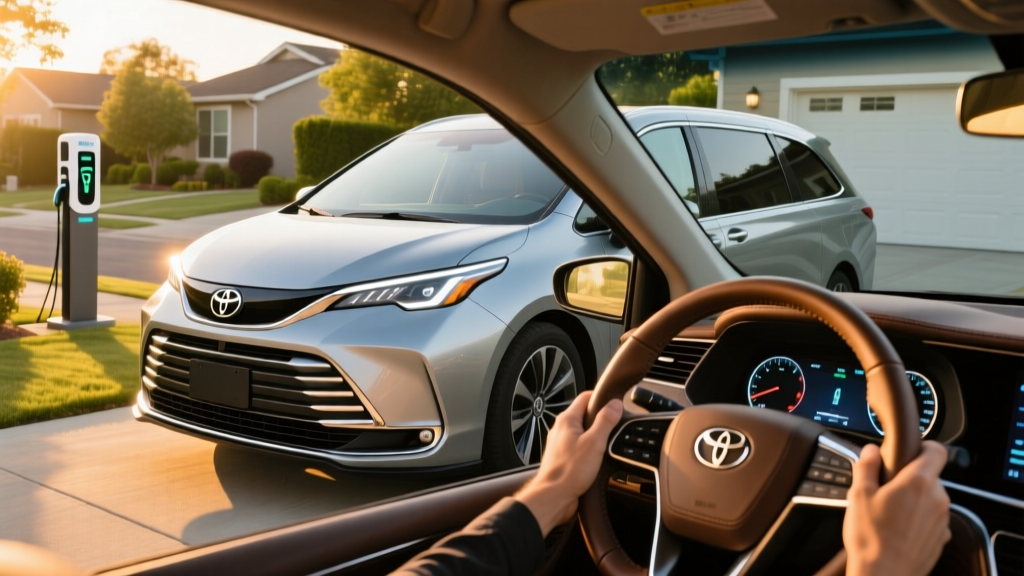
The minivan segment has largely abandoned electrification, but the 2026 Toyota Sienna hybrid remains the sole all-hybrid family hauler you can buy new. Toyota committed to a hybrid-only Sienna lineup starting with the 2021 redesign, and the 2026 model continues with the proven fourth-generation 2.5-liter four-cylinder hybrid powertrain rated at 36 MPG combined. For families who need three rows, serious cargo volume, and AWD availability without plugging in, the Sienna occupies a category of one.
This review covers every number that matters: EPA and real-world fuel economy, the 245-horsepower hybrid system, pricing across all seven trims, battery warranty details, and whether the Sienna hybrid makes sense against plug-in hybrid and full-electric alternatives.
2026 Toyota Sienna Hybrid Powertrain and Performance
Every 2026 Sienna uses Toyota's fourth-generation hybrid system pairing a 2.5-liter Dynamic Force inline-four engine with two front-mounted electric motors (three motors on AWD trims, which add a rear electric motor). The combined system output is 245 horsepower.
| Specification | Detail |
|---|---|
| Engine | 2.5L inline-4 (Atkinson cycle) |
| Hybrid System | Toyota Hybrid System (THS) IV, series-parallel |
| Combined Horsepower | 245 hp |
| Transmission | eCVT (planetary gearset, no traditional belts) |
| Drivetrain | FWD standard; electronic AWD available (LE through Limited) |
| Towing Capacity | 3,500 lbs (all trims) |
| Seating | 7 or 8 passengers (trim dependent) |
| Cargo Volume (behind 3rd row) | 33.5 cu ft |
| Max Cargo (seats folded) | 101.0 cu ft |
| Curb Weight | 4,635–4,755 lbs (varies by trim/AWD) |
The eCVT is not a belt-driven continuously variable transmission like you'd find in a Subaru or Nissan. Toyota's system uses a planetary gearset to blend engine and motor power, which eliminates the rubber-band drone common to traditional CVTs. Acceleration to 60 mph takes approximately 7.1 seconds — adequate for highway merging and passing, though the Sienna prioritizes smoothness over urgency.
The AWD system is worth clarifying: there is no mechanical driveshaft to the rear axle. Instead, a separate 54-horsepower electric motor powers the rear wheels when the system detects slip or during initial acceleration. This means AWD adds roughly 140 pounds but does not reduce the EPA fuel economy rating, a notable engineering advantage.
Fuel Economy: EPA Ratings and Real-World MPG
The 2026 Sienna's headline number is its EPA fuel economy, which remains consistent across most trims thanks to the shared powertrain.
| Drivetrain | City MPG | Highway MPG | Combined MPG |
|---|---|---|---|
| FWD (LE, XLE, Limited, Platinum) | 36 | 36 | 36 |
| AWD (LE, XLE, Limited) | 35 | 36 | 35 |
| Woodland Edition (AWD) | 34 | 34 | 34 |
Source: EPA Fuel Economy
Real-World MPG: What Owners Actually See
Toyota's hybrid system excels in city and suburban driving, where regenerative braking and electric-motor assist do the heavy lifting. In real-world mixed driving, most Sienna owners report 34–38 MPG combined, with city-heavy commutes occasionally pushing into the low 40s.
Highway-only driving at 75+ mph tends to return 30–33 MPG, as the gasoline engine carries more of the load without regenerative braking opportunities. Cold weather (below 35°F) typically reduces fuel economy by 5–10% due to cabin heating demands and reduced battery efficiency — expect 31–34 MPG combined in winter conditions for FWD trims.
HEV vs PHEV vs EV: Where the Sienna Fits
The 2026 Sienna is a conventional hybrid (HEV), not a plug-in hybrid (PHEV). This distinction matters for buyers cross-shopping electrified family vehicles.
| Feature | HEV (Sienna) | PHEV (e.g., Chrysler Pacifica Hybrid) | Full EV (e.g., Kia EV9) |
|---|---|---|---|
| Plug-in Required? | No | Yes (Level 1 or 2) | Yes (Level 2 or DC fast) |
| Electric-Only Range | ~1 mile at low speed | 32 miles (Pacifica Hybrid) | 230–310 miles (EV9) |
| Total Range | ~644 miles | ~490 miles combined | 230–310 miles |
| Combined Efficiency | 36 MPG | 30 MPG + 82 MPGe | 83–89 MPGe |
| Home Charging Needed? | No | Recommended | Essential |
| Starting MSRP | $38,085 | $47,695 | $54,900 |
| Federal Tax Credit | None | Up to $7,500* | Up to $7,500* |
* Federal §30D tax credit eligibility depends on MSRP caps, buyer income limits, and battery sourcing requirements. See the tax credit section below for details. Source: IRS.gov
Choose the Sienna HEV if: You don't have access to home charging, you drive more than 40 miles daily, you want maximum total range for road trips, and you prefer a lower purchase price without managing charging logistics.
Choose a PHEV minivan if: You can charge at home nightly, most daily trips are under 30 miles (school runs, errands), and you want electric-only commuting with gas backup for longer trips.
Choose a full EV three-row SUV if: You have reliable home Level 2 charging, your daily driving stays under 200 miles, you want the lowest per-mile energy cost, and you're comfortable planning DC fast-charging stops on road trips.
2026 Sienna Trim Levels and Pricing
The 2026 Sienna is offered in seven trims. Toyota has maintained the hybrid-only strategy, so every trim shares the same powertrain and nearly identical fuel economy.
| Trim | Seating | Drivetrain | MSRP |
|---|---|---|---|
| LE | 8 | FWD / AWD | $38,085 / $39,485 |
| XLE | 7 or 8 | FWD / AWD | $42,135 / $43,535 |
| XSE | 7 | FWD / AWD | $44,165 / $45,565 |
| 25th Anniversary Edition | 7 | FWD / AWD | $45,315 / $46,715 |
| Limited | 7 | FWD / AWD | $48,635 / $49,385 |
| Platinum | 7 | FWD | $53,335 |
| Woodland Edition | 7 | AWD | $49,995 |
Destination charge adds approximately $1,395. Prices reflect 2026 model-year MSRP as published by Toyota.
Tax Credit Eligibility
The 2026 Toyota Sienna hybrid does not qualify for the federal §30D Clean Vehicle Credit. The §30D credit applies only to plug-in electric vehicles (PHEVs and BEVs) with a battery capacity of at least 7 kWh. Because the Sienna is a conventional hybrid with a small ~1.6 kWh nickel-metal hydride battery pack, it does not meet the plug-in requirement.
- Requires plug-in capability (PHEV or BEV) — Sienna is HEV only
- Requires minimum 7 kWh battery — Sienna uses ~1.6 kWh
- Conventional hybrids are not eligible under current IRS rules
Hybrid Battery Warranty and Longevity
Hybrid battery longevity is the most common concern among first-time hybrid buyers. Toyota addresses this with one of the strongest hybrid battery warranties in the industry.
- Hybrid Battery: 10 years / 150,000 miles (whichever comes first)
- Hybrid System Components: 8 years / 100,000 miles (inverter, transaxle, control modules)
- Basic Vehicle Warranty: 3 years / 36,000 miles
- Powertrain Warranty: 5 years / 60,000 miles
The 10-year/150,000-mile hybrid battery warranty applies in all 50 states, not just CARB states. Toyota covers the hybrid battery if it drops below a defined capacity threshold or fails outright during the warranty period.
Real-World Battery Lifespan
Toyota's hybrid battery packs have demonstrated exceptional longevity in the field. Data from fleet operators, taxi services, and long-term owners of Toyota hybrids (Prius, Camry Hybrid, Highlander Hybrid, Sienna) consistently shows hybrid batteries lasting 150,000–250,000+ miles before requiring replacement. Many original batteries in 2004–2010 Prius models are still in service at over 200,000 miles.
The Sienna's nickel-metal hydride (NiMH) battery chemistry is less energy-dense than the lithium-ion packs in PHEVs and EVs, but NiMH is proven, thermally stable, and tolerant of the shallow charge-discharge cycles that characterize conventional hybrid operation. The battery never fully charges or fully depletes — the hybrid system keeps it in a 40–80% state of charge window, which dramatically reduces degradation.
Replacement Cost if Out of Warranty
If a Sienna hybrid battery does fail outside the warranty window, replacement costs are:
- New OEM battery from Toyota: $3,000–$4,000 (parts and labor)
- Refurbished/remanufactured battery: $1,500–$2,500
- Individual cell replacement (specialist shops): $500–$1,200
Compared to EV traction battery replacements ($8,000–$20,000+), hybrid battery service is relatively affordable, and the failure rate within the first 15 years is low.
Driving Experience, Interior, and Daily Usability
The Sienna's 245-horsepower hybrid system provides smooth, linear acceleration from a stop — the electric motors deliver instant torque that makes the van feel more responsive than its horsepower figure suggests. The eCVT keeps engine RPMs low during cruising, and the cabin is well-insulated against road and wind noise at highway speeds.
The XSE and Woodland Edition trims feature a sport-tuned suspension with firmer damping, which improves body control on winding roads at the cost of slightly firmer ride quality over broken pavement. The LE, XLE, Limited, and Platinum trims prioritize comfort with softer tuning.
Cargo and Passenger Practicality
With 33.5 cubic feet behind the third row and 101.0 cubic feet with both rear rows folded, the Sienna offers class-competitive cargo volume. The second-row captain's chairs (standard on XLE and above) slide on long tracks, providing limousine-like legroom when cargo isn't a priority. Eight-passenger seating with a second-row bench is available on LE and XLE trims.
One limitation versus the Chrysler Pacifica: the Sienna's second-row seats do not fold into the floor (Stow 'n Go). They slide forward and tumble, but they cannot be removed without tools. This is a tradeoff — Toyota's seats are more comfortable and better padded than the Pacifica's thin stowable seats, but you lose the flat-floor versatility.
Technology and Safety
All 2026 Sienna trims include Toyota Safety Sense 3.0 as standard equipment, which provides:
- Pre-Collision System with Pedestrian Detection
- Full-Speed Range Dynamic Radar Cruise Control
- Lane Departure Alert with Steering Assist
- Lane Tracing Assist
- Road Sign Assist
- Automatic High Beams
- Proactive Driving Assist (low-speed gentle braking/steering support)
This is a Level 2 driver-assistance system under SAE classification — the driver must remain engaged, keep hands on the wheel, and monitor the road at all times. It is not autonomous or self-driving.
Infotainment is handled by Toyota's 12.3-inch touchscreen (8.0-inch on LE) with wireless Apple CarPlay and Android Auto, Wi-Fi hotspot capability, and available JBL premium audio on Limited and Platinum trims.
Sienna Hybrid vs the Competition
The minivan market has narrowed, and the Sienna's hybrid-only positioning gives it a unique efficiency advantage over its remaining rivals.
| Vehicle | Powertrain | Combined MPG/MPGe | Starting MSRP | AWD Available? |
|---|---|---|---|---|
| Toyota Sienna | 2.5L Hybrid (HEV) | 36 MPG (FWD) | $38,085 | Yes |
| Honda Odyssey | 3.5L V6 | 22 MPG | $38,540 | No |
| Chrysler Pacifica | 3.6L V6 | 22 MPG | $39,645 | Yes |
| Chrysler Pacifica Hybrid | 3.6L PHEV | 30 MPG + 82 MPGe | $47,695 | No |
| Kia Carnival | 3.5L V6 | 22 MPG | $34,590 | No |
| Kia Carnival Hybrid | 1.6L Turbo Hybrid | 34 MPG | $40,590 | No |
The Sienna's closest efficiency rival is the newly available Kia Carnival Hybrid at 34 MPG combined, but the Sienna still leads by 2 MPG and offers AWD. The Chrysler Pacifica Hybrid (PHEV) delivers 32 miles of electric-only range and 82 MPGe when charged, but requires plug-in access and costs nearly $10,000 more before any tax credit.
Who Should Buy the 2026 Sienna Hybrid?
- You need a three-row family vehicle with 35+ MPG and no charging hassle
- You drive 15,000+ miles per year (the fuel savings compound significantly)
- You want AWD for snow and rain without sacrificing efficiency
- You prefer Toyota's long-term reliability track record and 10-year hybrid warranty
- You take regular road trips and want 600+ miles of range per tank
- You want electric-only daily driving (consider the Pacifica Hybrid PHEV)
- You need Stow 'n Go flat-floor cargo versatility (Pacifica)
- You want the lowest possible per-mile energy cost and have home charging (consider a three-row EV like the Kia EV9)
- 245 horsepower feels insufficient for your towing or mountain-driving needs
Ownership Costs: 5-Year Estimate
| Category | Estimated Cost |
|---|---|
| Purchase Price (MSRP + destination) | $39,480 |
| Fuel (75,000 mi ÷ 36 MPG × $3.40/gal avg) | $7,083 |
| Insurance (national avg, 5 years) | $8,500–$10,500 |
| Maintenance (oil changes, tires, brakes) | $2,800–$3,500 |
| Federal Tax Credit | $0 (HEV not eligible) |
| Estimated Depreciation (5-year) | $14,000–$17,000 |
| Total Estimated 5-Year Cost | $58,000–$67,000 |
For comparison, a gas-only minivan at 22 MPG would cost approximately $11,591 in fuel over 75,000 miles at $3.40/gallon — roughly $4,500 more in fuel alone over five years. That fuel savings partially offsets the Sienna's slightly higher starting price versus the Kia Carnival or Honda Odyssey.
Pros and Cons
- Best-in-class 36 MPG combined for a hybrid minivan
- Available AWD with no MPG penalty (FWD vs AWD: only 1 MPG difference)
- 10-year/150,000-mile hybrid battery warranty in all 50 states
- Proven Toyota hybrid reliability with 20+ years of NiMH field data
- 644-mile total range per tank — excellent for road trips
- Standard Toyota Safety Sense 3.0 on every trim
- Smooth, quiet hybrid operation with no plug-in requirement
- 245 hp is adequate but not quick — 7.1-second 0-60 time
- No plug-in hybrid option for electric-only commuting
- Second-row seats don't fold into the floor (no Stow 'n Go)
- No federal tax credit (HEV exclusion under §30D)
- Platinum trim pushes $55,000 — premium territory for a minivan
- Infotainment system lags behind competitors in responsiveness
- Third-row seat is tighter than Pacifica or Carnival for adult passengers
Frequently Asked Questions
How many MPG does the 2026 Toyota Sienna hybrid get?
The 2026 Sienna hybrid is EPA-rated at 36 MPG city, 36 MPG highway, and 36 MPG combined for FWD trims. AWD trims drop to 35 MPG combined. Real-world mixed driving typically yields 34–38 MPG, with city-heavy routes occasionally reaching the low 40s.
Is the Toyota Sienna a plug-in hybrid?
No. The 2026 Sienna is a conventional hybrid (HEV). It charges its own battery through regenerative braking and the gasoline engine. You never plug it in. If you want plug-in hybrid capability in a minivan, the Chrysler Pacifica Hybrid is the only current PHEV option, offering 32 miles of electric-only range.
How long will the Sienna hybrid battery last?
Toyota warranties the Sienna's hybrid battery for 10 years or 150,000 miles in all 50 states. Real-world data from Toyota's hybrid fleet shows most NiMH hybrid batteries last 150,000–250,000+ miles. The battery operates in a shallow charge window (40–80% SoC), which minimizes degradation. If replacement is needed out of warranty, expect $3,000–$4,000 for a new OEM pack.
Does the 2026 Sienna qualify for any tax credit?
The Sienna hybrid does not qualify for the federal §30D Clean Vehicle Credit because it is a conventional hybrid, not a plug-in vehicle. Some states may offer separate incentives for high-efficiency vehicles — check your state energy office for details. The Sienna's fuel savings versus a gas minivan (~$4,500 over 5 years at 15,000 miles/year) partially offset the lack of a tax credit.
Is the Sienna hybrid good for road trips?
Yes. With a 17.9-gallon fuel tank and 36 MPG combined, the Sienna delivers approximately 644 miles of range per fill-up. That translates to roughly 10 hours of highway driving between stops — fewer fuel stops than any gas-powered minivan. The comfortable ride, quiet cabin, and Toyota Safety Sense cruise control make it one of the best road-trip vehicles in its class.
Can the Sienna hybrid tow?
Yes. All 2026 Sienna trims are rated to tow 3,500 pounds when properly equipped with the available tow hitch. This is sufficient for a small camping trailer, utility trailer, or a pair of personal watercraft. Note that towing will reduce fuel economy significantly — expect 20–25 MPG while towing depending on trailer weight and terrain.
How does the Sienna hybrid compare to the Kia Carnival Hybrid?
The Kia Carnival Hybrid (new for the 2025 model year, continuing into 2026) uses a 1.6-liter turbocharged hybrid system rated at 34 MPG combined — 2 MPG less than the Sienna. The Carnival Hybrid starts slightly higher at approximately $40,590 and does not offer AWD. The Sienna retains advantages in fuel economy, AWD availability, and Toyota's longer hybrid track record. The Carnival offers more third-row space and a lower base price on gas-only trims.