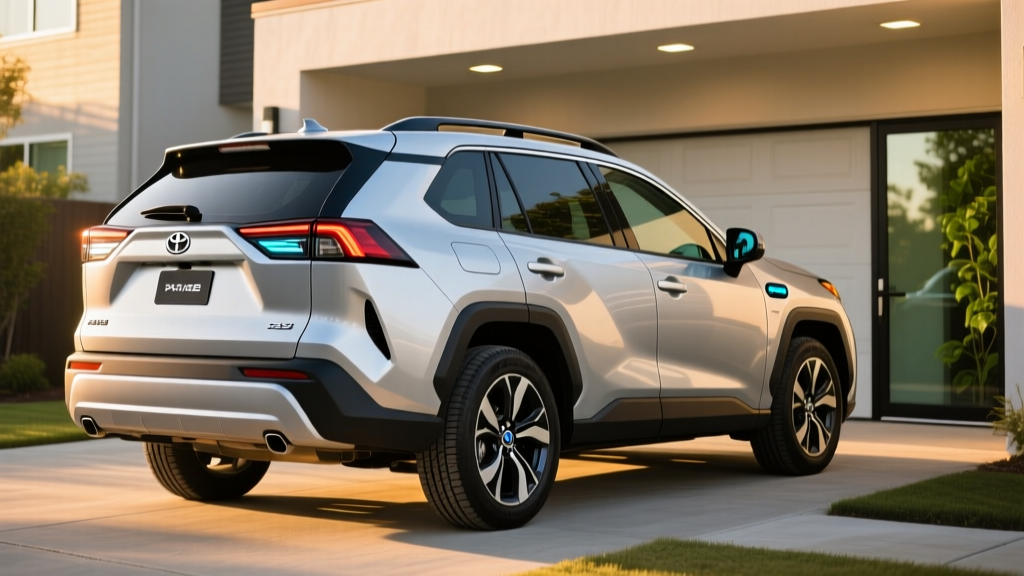
The 2026 Toyota RAV4 XSE Hybrid sits in the sweet spot of Toyota's compact SUV lineup: sport-tuned suspension, standard electronic all-wheel drive, and a hybrid powertrain that sips fuel without asking you to plug in. For buyers who want electric-motor efficiency without the lifestyle change of charging infrastructure, this conventional hybrid (HEV) remains one of the most practical vehicles on the market.
But the RAV4 family is sprawling. There's the standard hybrid, the plug-in hybrid (Prime), and fully gas trims. This guide zeroes in on the XSE Hybrid specifically — what it delivers, where it falls short, and whether you should cross-shop it against the RAV4 Prime PHEV or a full battery-electric SUV.
2026 RAV4 XSE Hybrid Powertrain and Performance Specs
The XSE Hybrid pairs a 2.5-liter four-cylinder Atkinson-cycle engine with front and rear electric motors for standard electronic on-demand AWD. Unlike mechanical AWD systems with a driveshaft, the rear axle is powered entirely by a separate electric motor, giving it instant torque to the rear wheels when slip is detected.
| Spec | Value |
|---|---|
| Powertrain | 2.5L 4-cyl hybrid + front/rear electric motors (AWD-i) |
| Combined Horsepower | 219 hp (net system) |
| Gas Engine Output | 176 hp / 163 lb-ft torque |
| Front Electric Motor | 118 hp / 149 lb-ft |
| Rear Electric Motor | 54 hp / 89 lb-ft |
| Transmission | eCVT (planetary gearset, no traditional belts) |
| 0–60 mph | ~7.4 seconds (manufacturer estimate) |
| Towing Capacity | 1,750 lbs |
| Drivetrain | Electronic AWD (AWD-i) |
| Hybrid Battery | 1.6 kWh (sealed NiMH), self-charging — no plug-in |
| Base MSRP (XSE Hybrid AWD) | ~$37,500 (est. incl. destination) |
The 219 combined horsepower makes the XSE Hybrid notably quicker than the non-hybrid gas RAV4 LE AWD (203 hp) and far more refined under acceleration. The eCVT eliminates shift-hunt, though enthusiastic drivers will notice the characteristic drone under hard throttle common to planetary hybrid systems.
Fuel Economy: EPA Ratings vs. Real-World MPG
This is where the XSE Hybrid earns its keep. Toyota's hybrid synergy drive system recaptures energy under braking and coasting, then deploys it for acceleration — the exact driving conditions where conventional gas engines waste the most fuel.
| Driving Cycle | EPA Rating |
|---|---|
| City | 41 MPG |
| Highway | 38 MPG |
| Combined | 39 MPG |
For context, the non-hybrid RAV4 AWD gas model returns 27 MPG combined — a 44% improvement with the hybrid for roughly $1,500–$2,000 more in upfront trim cost. Over 15,000 miles per year at $3.40/gallon, the hybrid saves approximately $600–$750 annually in fuel.
HEV vs. PHEV: Should You Consider the RAV4 Prime Instead?
The RAV4 lineup includes both the conventional hybrid (the XSE reviewed here) and the RAV4 Prime plug-in hybrid (PHEV). Understanding the difference is critical before you buy.
| Attribute | RAV4 XSE Hybrid (HEV) | RAV4 Prime (PHEV) |
|---|---|---|
| Plug-in Required? | No — self-charging via regen & engine | Yes — plug in for electric-only driving |
| Electric-Only Range | None (EV mode limited to ~1 mile at low speed) | 42 miles (EPA est.) |
| Battery Size | 1.6 kWh (NiMH) | 18.1 kWh (lithium-ion) |
| Combined HP | 219 hp | 302 hp |
| 0–60 mph | ~7.4 sec | ~5.7 sec |
| EPA Combined (gas) | 39 MPG | 38 MPG (94 MPGe w/ electric) |
| DC Fast Charging | N/A | No — AC Level 1/2 only |
| Level 2 Charge Time | N/A | ~2.5 hours (240V, 32A) |
| Federal Tax Credit (§30D) | Not eligible | Eligible — up to $7,500 (rules apply) |
| Starting MSRP | ~$37,500 | ~$46,000 |
The HEV case: If you lack home charging access (apartment, street parking, no garage outlet), the conventional hybrid is the clear choice. You never plug in, you never think about it, and you still get excellent fuel economy. The XSE Hybrid also costs roughly $8,500 less than a RAV4 Prime at the register.
The PHEV case: If you have a garage or driveway with a 120V or 240V outlet and your daily commute is under 40 miles, the RAV4 Prime lets you drive on electricity alone most days while keeping the gas engine for road trips. The 302 hp also makes it the quickest RAV4 Toyota sells. The federal §30D tax credit can offset $3,750–$7,500 of the price premium depending on your tax situation and the vehicle's battery-sourcing compliance — check current rules at IRS.gov.
Tax Credit Eligibility for the 2026 RAV4 XSE Hybrid
The conventional RAV4 Hybrid (including the XSE trim) does not qualify for the federal §30D Clean Vehicle Credit. That credit is reserved for plug-in vehicles — BEVs and PHEVs — that meet battery capacity, critical-mineral sourcing, and MSRP/income caps.
What the XSE Hybrid can qualify for:
- State-level incentives: Some states (e.g., California, Colorado, New York) offer rebates or HOV lane access for hybrids, though most have shifted incentives toward full EVs and PHEVs. Check your state's energy office or DMV for current programs.
- Employer or utility rebates: A handful of utility companies offer small efficiency rebates for hybrid purchases — typically $250–$500.
- Insurance discounts: Several insurers (Geico, Liberty Mutual) offer 5–10% hybrid/electric vehicle discounts on policies.
If the federal tax credit is a priority for your purchase, you'll need to step up to the RAV4 Prime PHEV or look at full EVs like the Hyundai Ioniq 5 or Tesla Model Y.
Battery Longevity, Warranty, and Replacement Costs
This is the number-one concern for first-time hybrid buyers, and it's where Toyota's track record is strongest. The RAV4 XSE Hybrid uses a compact 1.6 kWh nickel-metal hydride (NiMH) battery pack that never fully charges or discharges — Toyota's hybrid system keeps the state of charge in a narrow 40–80% window, dramatically reducing stress on the cells.
Real-world data from Toyota's two decades of hybrid production (the Prius launched in the US in 2000) shows hybrid batteries routinely lasting 150,000–200,000+ miles before significant degradation. Failure before 100,000 miles is rare and would be covered under warranty.
Out-of-warranty replacement cost: If the hybrid battery does need replacement after the warranty period, expect $2,500–$4,000 for a new OEM pack installed at a Toyota dealer. Refurbished/remanufactured packs from independent hybrid specialists run $1,500–$2,500. Individual module replacement (only the degraded cells) can cost $500–$1,200 at a hybrid-specialty shop.
The 2.5L engine and eCVT transaxle carry Toyota's standard 5-year/60,000-mile powertrain warranty, with the hybrid-system components (inverter, motors, control unit) covered under the 8-year/100,000-mile hybrid system warranty.
XSE Trim: What You Get for the Money
The XSE Hybrid is positioned as the sporty mid-level trim. For the ~$37,500 starting price (including destination), you get:
- Sport-tuned suspension with stiffer damping than SE or XLE trims
- 18-inch black alloy wheels with gloss-black roof accent
- SofTex synthetic leather seats with red contrast stitching
- 10.5-inch Toyota Audio Multimedia touchscreen with wireless Apple CarPlay and Android Auto
- Qi wireless phone charging pad
- Toyota Safety Sense 3.0: pre-collision braking, full-speed adaptive cruise, lane-tracing assist, road-sign assist, automatic high beams
- Blind-spot monitor with rear cross-traffic alert
- Power liftgate
- Dual-zone automatic climate control
Notable options that push the price toward $41,000–$42,000: JBL premium audio ($800+), panoramic moonroof ($1,400+), heated/ventilated front seats, and the Technology Package with a 360-degree camera and front/rear parking assist with automatic braking.
Compared to the XLE Hybrid (~$35,000), the XSE adds the sport suspension, larger screen, and SofTex interior. Compared to the Limited Hybrid (~$41,000), you give up genuine leather, a panoramic moonroof standard, and a premium audio system — but save $3,500+.
Who Should Buy the RAV4 XSE Hybrid — and Who Shouldn't
✅ Choose the XSE Hybrid If:
- You can't plug in at home (apartment, street parking, no garage)
- Your commute is mixed city/highway and you want 39+ MPG without behavior changes
- You want AWD for snow/rain but don't want the fuel penalty of a gas AWD SUV
- You plan to own the vehicle 8–12 years (Toyota hybrid reliability is proven)
- You tow lightly (1,750-lb capacity covers a small trailer or two dirt bikes)
- You want lower upfront cost vs. a PHEV or full EV
❌ Look Elsewhere If:
- You have home charging and a short commute — the RAV4 Prime PHEV will run on electricity daily
- You want zero tailpipe emissions — consider the Hyundai Ioniq 5, Tesla Model Y, or Ford Mustang Mach-E
- You need more than 1,750 lbs of towing — the gas RAV4 Adventure tows 3,500 lbs
- You want the federal $7,500 tax credit — the HEV doesn't qualify
- You prioritize silent, instant-torque acceleration — that's a full EV experience
Frequently Asked Questions
How many MPG does the 2026 RAV4 XSE Hybrid get?
The EPA rates it at 41 city / 38 highway / 39 combined MPG. In real-world city driving with frequent stops, owners commonly report 40–44 MPG. Sustained highway driving above 75 mph may drop to 34–36 MPG. Cold weather reduces efficiency by roughly 5–10%.
Does the RAV4 XSE Hybrid need to be plugged in?
No. This is a conventional hybrid (HEV), not a plug-in hybrid. The 1.6 kWh battery recharges through regenerative braking and the gas engine. You fuel it at a gas station exactly like a conventional car.
How far can the RAV4 Hybrid go on electric only?
Effectively zero miles in any practical sense. The hybrid system can creep at very low speeds (under 25 mph) for roughly 0.5–1 mile on battery alone, but the engine engages almost immediately under any meaningful acceleration or speed. If electric-only driving matters to you, you want the RAV4 Prime PHEV (42 miles electric-only) or a full EV.
Is the RAV4 Hybrid reliable? What does a battery replacement cost?
Toyota's hybrid system has two decades of proven reliability across millions of vehicles. The hybrid battery is warrantied for 10 years / 150,000 miles. Out-of-warranty replacement runs $2,500–$4,000 at a dealer, or $1,500–$2,500 for a refurbished pack. Most hybrid batteries last 150,000–200,000+ miles before meaningful degradation.
Does the 2026 RAV4 XSE Hybrid qualify for a federal tax credit?
No. The federal §30D Clean Vehicle Credit applies only to plug-in vehicles (PHEVs and BEVs). The conventional RAV4 Hybrid does not qualify. Check IRS.gov for current credit rules. Some states and utilities offer small hybrid rebates — check locally.
How does the XSE Hybrid compare to the RAV4 Prime?
The Prime is a plug-in hybrid with 42 miles of electric-only range, 302 hp, and eligibility for the federal tax credit — but starts around $46,000 (before credit). The XSE Hybrid is ~$8,500 cheaper, doesn't require plugging in, and gets 39 MPG combined. If you have home charging and a short commute, the Prime saves more on fuel. If you can't plug in, the XSE Hybrid is the better fit. See fueleconomy.gov for side-by-side comparisons.
What's the total cost of ownership vs. a gas RAV4?
Over 5 years and 75,000 miles at $3.40/gallon, the XSE Hybrid (39 MPG) uses roughly $6,500 in fuel vs. $9,200 for the gas AWD model (27 MPG) — a $2,700 savings. Combined with the modest price premium (~$1,500–$2,000 for the hybrid powertrain), the payback period is typically 3–4 years. Insurance costs are comparable between the two.