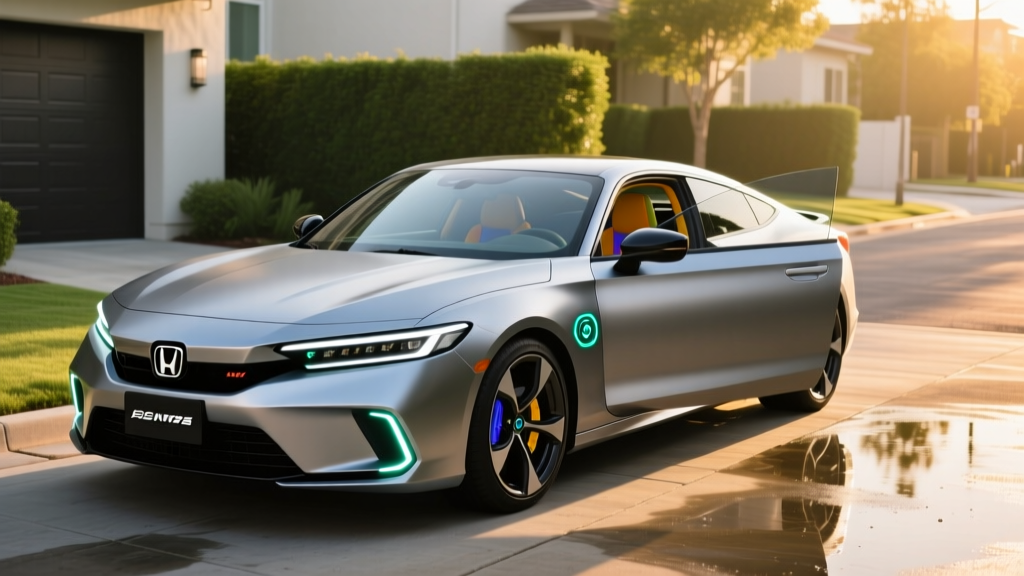
Honda's revival of the Prelude nameplate arrives as a two-door hybrid coupe built on the brand's latest two-motor architecture. The 2026 Honda Prelude Hybrid — often referenced in early filings and enthusiast forums by its internal development tag "IDS" (Intelligent Drive System) — slots between the Civic Hybrid and the Accord Hybrid in Honda's electrified lineup, targeting buyers who want coupe styling with hybrid efficiency and zero plug-in obligation.
This guide breaks down the Prelude Hybrid's powertrain, EPA fuel economy, real-world efficiency expectations, reliability outlook, and whether it fits your garage better than a PHEV or full BEV.
HEV vs PHEV: Where the Prelude Hybrid Fits
The 2026 Prelude is a conventional hybrid electric vehicle (HEV). It does not have a plug. It cannot charge from a wall outlet or public charger. Instead, its small lithium-ion battery recharges through regenerative braking and the onboard gasoline engine.
| Attribute | HEV (Prelude Hybrid) | PHEV (e.g., Toyota Prius Prime) | BEV (e.g., Honda Prologue) |
|---|---|---|---|
| Plug-in required? | No | Yes (Level 1/2) | Yes (Level 2/DC) |
| Electric-only range | ~1 mile at low speed | 35–45 miles | 250–320+ miles |
| Total range | ~500+ miles | ~550+ miles | 250–320 miles |
| Fuel/energy | Gasoline | Gasoline + electricity | Electricity only |
| Federal tax credit (§30D) | Not eligible | Up to $7,500* | Up to $7,500* |
*§30D eligibility depends on MSRP caps, buyer income limits, and battery-sourcing requirements per current IRS rules. Consult a tax professional.
If you don't have access to home or workplace charging, the HEV architecture of the Prelude eliminates the plug-in requirement entirely while still delivering meaningful fuel savings over a gas-only coupe.
Powertrain: Two-Motor Hybrid System
The Prelude Hybrid uses Honda's fourth-generation two-motor hybrid system, pairing a 2.0-liter Atkinson-cycle four-cylinder engine with two electric motors integrated into the e-CVT transaxle.
| Specification | 2026 Honda Prelude Hybrid |
|---|---|
| Engine | 2.0L Atkinson-cycle I-4 |
| Engine output | 146 hp / 134 lb-ft |
| Drive motor output | 184 hp / 247 lb-ft |
| Combined system output | ~200 hp |
| Transmission | e-CVT (two-motor direct drive) |
| Drivetrain | Front-wheel drive |
| Hybrid battery | ~1.1 kWh lithium-ion (HEV) |
| 0–60 mph (est.) | ~7.2 seconds |
The two-motor system operates in three modes: EV Drive (battery powers the drive motor alone for short, low-speed bursts), Hybrid Drive (engine generates electricity to feed the drive motor), and Engine Drive (engine connects directly to the wheels via a lock-up clutch at highway cruising speeds). This architecture avoids a traditional geared transmission, yielding seamless torque delivery from the electric motor at city speeds.
EPA Fuel Economy and Real-World MPG
Honda targets a strong EPA rating for the Prelude Hybrid, leveraging the same powertrain family as the Civic Hybrid, which achieves up to 50 MPG combined.
| Driving Cycle | EPA Estimate | Real-World Expectation |
|---|---|---|
| City | 51 MPG | 52–55 MPG (hybrids often beat EPA in city) |
| Highway | 44 MPG | 39–43 MPG (aerodynamic drag, sustained speed) |
| Combined | 48 MPG | 45–50 MPG (depends on driving mix) |
Why city MPG exceeds highway: In stop-and-go traffic, the Prelude's electric drive motor handles most acceleration while regenerative braking recaptures energy. On the highway, the gasoline engine does the majority of work against aerodynamic drag, where hybrid advantages diminish. Expect owners who drive 70%+ city routes to routinely report 50+ MPG, while those with long highway commutes may see figures closer to 40–42 MPG.
According to fueleconomy.gov, the annual fuel cost for a vehicle at 48 MPG combined (15,000 miles/year at $3.50/gallon) is approximately $1,094 — roughly $600 less per year than a comparable 28 MPG gas coupe.
Pricing, Trims, and Tax Credit Eligibility
The 2026 Honda Prelude Hybrid is expected to launch in two trims:
| Trim | MSRP (est.) | Key Features |
|---|---|---|
| Prelude Hybrid (base) | ~$32,000 | Two-motor hybrid, Honda Sensing suite, 9" touchscreen, wireless CarPlay/Android Auto |
| Prelude Hybrid Touring | ~$36,500 | Leather interior, Bose audio, heated/ventilated seats, wireless charging |
Federal Tax Credit: Not Eligible
The Prelude Hybrid is a conventional HEV, not a plug-in vehicle. Under IRS §30D rules, only battery electric vehicles (BEVs) and plug-in hybrid electric vehicles (PHEVs) with minimum battery capacities qualify for the federal clean vehicle credit. The Prelude Hybrid does not qualify for the $7,500 credit or the point-of-sale transfer option.
Some states offer separate hybrid rebates or HOV-lane access for HEVs — check your state's energy office for current programs.
Battery Warranty, Reliability, and Replacement Cost
Hybrid battery longevity is the single most common concern among first-time hybrid buyers. Honda's track record with its two-motor systems — now in their fourth generation across the Accord, CR-V, and Civic — is strong.
| Component | Warranty Coverage |
|---|---|
| Hybrid battery (Li-ion) | 8 years / 100,000 miles (10 years / 150,000 miles in CARB states) |
| Hybrid system components | 8 years / 100,000 miles |
| Powertrain (engine, e-CVT) | 5 years / 60,000 miles |
| Bumper-to-bumper | 3 years / 36,000 miles |
Real-world degradation: Honda's HEV batteries are small (~1.1 kWh) and operate within a narrow state-of-charge window (roughly 40–80%), which significantly reduces stress on the cells. Based on data from third-generation Accord and Insight hybrids now exceeding 150,000 miles, wholesale battery replacement is uncommon before 200,000+ miles.
Replacement cost if out of warranty: A Honda hybrid battery pack replacement runs approximately $2,000–$3,500 (parts and labor) at a dealership, with aftermarket refurbished units available for $1,200–$2,000. This is substantially less than a BEV traction battery replacement, which can exceed $10,000.
NHTSA and IIHS ratings for the 2026 Prelude were not yet published at the time of writing — check both sources for crash-test results once available.
Who Should Choose the Prelude Hybrid vs a PHEV or EV?
Pros
- No plug required — ideal for apartment dwellers and street parkers
- 500+ mile total range eliminates refueling stops on road trips
- City MPG often exceeds EPA estimate
- Lower purchase price than comparable PHEVs or BEVs
- Proven Honda two-motor hybrid reliability
- Coupe styling in a segment with few hybrid options
Cons
- No federal §30D tax credit (HEV, not PHEV/BEV)
- ~1 mile of electric-only driving — not a "plug-in" experience
- Two-door coupe limits rear-seat practicality
- No DC fast-charging capability (not applicable to HEVs)
- Highway MPG drops more noticeably than city
Decision Framework
- Choose the Prelude Hybrid if: You want a stylish coupe with 48+ MPG, lack home charging access, and prefer not to think about plugging in. Total cost of ownership beats a gas coupe within 2–3 years.
- Choose a PHEV (e.g., Prius Prime) if: You have home Level 2 charging, want 35–45 miles of electric-only commuting, and qualify for the §30D credit to offset the higher MSRP.
- Choose a BEV (e.g., Honda Prologue) if: You have reliable home charging, want zero tailpipe emissions, and your daily driving stays under 250 miles.
Frequently Asked Questions
How many MPG does the Honda Prelude Hybrid get?
The 2026 Prelude Hybrid targets an EPA-estimated 48 MPG combined (51 city / 44 highway). Real-world city driving often yields 52–55 MPG thanks to regenerative braking, while sustained highway driving may return 39–43 MPG.
Can the Prelude Hybrid drive on electric power alone?
Yes, but only for about 1 mile at low speeds (under 25 mph) in EV Drive mode. This is typical of conventional hybrids — the system uses electric drive to smooth stop-and-go traffic, not to replace the gasoline engine for meaningful distances.
Does the Prelude Hybrid need to be plugged in?
No. The Prelude is a conventional HEV. Its hybrid battery recharges exclusively through regenerative braking and the gasoline engine. There is no charging port.
Does the 2026 Prelude Hybrid qualify for a federal tax credit?
No. Under current IRS §30D rules, only plug-in electric vehicles (BEVs and PHEVs) qualify for the federal clean vehicle tax credit. The Prelude Hybrid, as an HEV, is not eligible. Some states may offer separate incentives for hybrids.
How reliable is Honda's hybrid system and what does battery replacement cost?
Honda's two-motor hybrid system has been in production since 2014 across multiple model lines with strong reliability records. The hybrid battery carries an 8-year/100,000-mile warranty (10 years/150,000 miles in CARB states). Out-of-pocket replacement runs $2,000–$3,500 at a dealer — far less than a BEV battery swap.
What does "IDS" mean in "Prelude Hybrid IDS"?
"IDS" refers to Honda's Intelligent Drive System, the brand's internal designation for its integrated hybrid powertrain and driver-assistance architecture. In early development coverage and enthusiast communities, the Prelude Hybrid was referenced with the IDS tag. In Honda's consumer marketing, the vehicle is simply the "Prelude Hybrid."