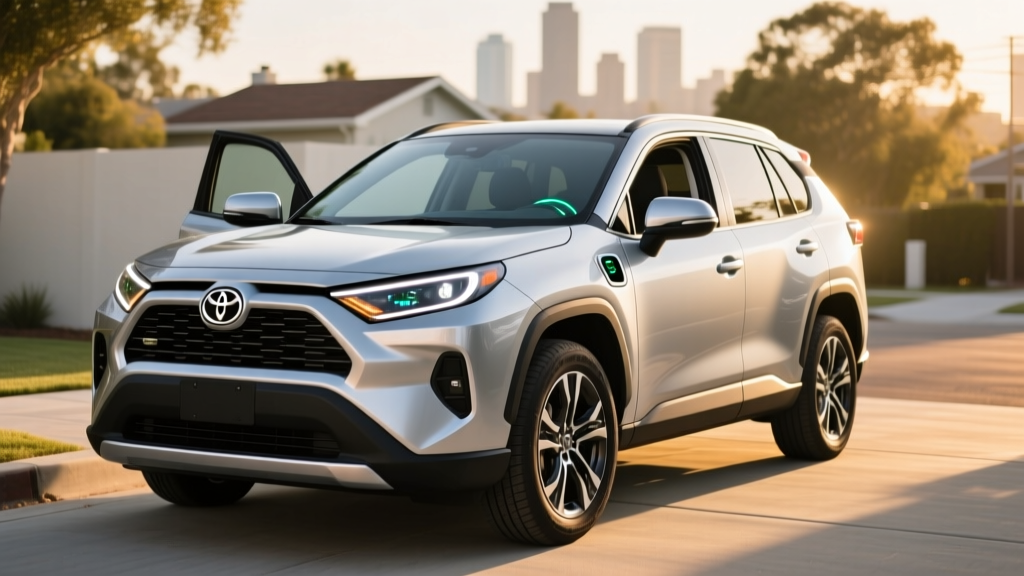
The Toyota RAV4 Hybrid remains one of the most-purchased electrified vehicles in the United States, and the 2026 model year carries forward the proven formula: a 2.5-liter four-cylinder paired with Toyota's fourth-generation hybrid system, standard electronic all-wheel drive, and an EPA-estimated 40 MPG combined. For buyers weighing a hybrid against a full EV or a conventional gas SUV, the RAV4 Hybrid occupies a specific niche — no plug required, no range anxiety, and a purchase price that undercuts most battery-electric competitors by thousands.
This guide breaks down every 2026 Toyota RAV4 Hybrid spec that matters for purchase decisions: real-world fuel economy versus EPA stickers, powertrain output, cargo and towing figures, battery warranty coverage, and federal tax credit eligibility under current IRS §30D rules.
2026 Toyota RAV4 Hybrid: HEV vs. PHEV (Prime) at a Glance
Toyota sells two electrified RAV4 variants. The RAV4 Hybrid is a conventional hybrid electric vehicle (HEV) — it charges its small battery through regenerative braking and the gas engine, and you never plug it in. The RAV4 Prime is a plug-in hybrid (PHEV) with a larger battery, an electric-only driving mode, and a charging port. This article focuses on the HEV; we flag Prime differences where they affect purchase decisions.
| Attribute | RAV4 Hybrid (HEV) | RAV4 Prime (PHEV) |
|---|---|---|
| Plug-in required? | No — self-charging | Yes — Level 1/Level 2 |
| EPA combined MPG | 40 MPG | 38 MPG (hybrid mode) / 94 MPGe (EV mode) |
| Electric-only range | N/A | 42 miles |
| Battery capacity | ~1.6 kWh (NiMH buffer) | 18.1 kWh (lithium-ion) |
| Combined horsepower | 219 hp | 302 hp |
| 0–60 mph | 7.4 sec | 5.7 sec |
| Starting MSRP (2026) | ~$33,575 | ~$44,590 |
| Federal tax credit (§30D) | Not eligible | Up to $7,500 (eligibility varies) |
Fuel Economy: EPA Estimates and Real-World MPG
The 2026 RAV4 Hybrid carries the same EPA ratings as the outgoing model year across all trims equipped with the standard electronic AWD (eAWD) powertrain:
| Driving Cycle | EPA Estimate | Real-World Expectation |
|---|---|---|
| City | 41 MPG | 42–45 MPG (hybrids excel in stop-and-go) |
| Highway | 38 MPG | 34–37 MPG (sustained 70+ mph reduces regen benefit) |
| Combined | 40 MPG | 38–42 MPG depending on driving mix |
Hybrid powertrains inherently favor city driving, where regenerative braking recaptures kinetic energy and the electric motor handles low-speed propulsion without burning fuel. On fueleconomy.gov, owner-reported figures for recent RAV4 Hybrids cluster between 37 and 43 MPG combined — consistent with EPA estimates but heavily dependent on driving profile.
Cold-weather note: Expect a 5–10% fuel economy drop in sub-freezing temperatures. The engine runs more frequently to provide cabin heat and maintain catalyst temperature, reducing electric-motor utilization. This is normal hybrid behavior, not a defect.
Powertrain Specs: 219 hp, eAWD, and Towing
Every 2026 RAV4 Hybrid uses Toyota's 2.5-liter Dynamic Force four-cylinder engine mated to a hybrid transaxle with two motor-generators up front and a separate rear-axle electric motor for all-wheel drive. Total system output is 219 horsepower.
| Specification | Value |
|---|---|
| Engine | 2.5L 4-cylinder Atkinson-cycle |
| Front motor output | 88 kW (118 hp) |
| Rear motor output | 40 kW (54 hp) |
| Net combined horsepower | 219 hp |
| 0–60 mph | 7.4 seconds |
| Drivetrain | Electronic AWD (eAWD) — standard |
| Towing capacity | 1,750 lbs |
| Cargo volume (behind rear seats) | 37.5 cu ft |
| Cargo volume (seats folded) | 69.8 cu ft |
The eAWD system is not a mechanical driveshaft — the rear motor engages on demand for traction, handling balance, and low-speed maneuvering. It's effective in rain and light snow but not designed for serious off-road use. The 1,750-lb towing capacity covers a small utility trailer or a pair of dirt bikes, but it's not rated for boat or camper towing.
Hybrid Battery Warranty and Replacement Cost
Toyota covers the RAV4 Hybrid's traction battery under its Hybrid Battery Warranty for 10 years or 150,000 miles, whichever comes first, from date of first use. This applies nationwide (California-emissions states previously received extended coverage, but Toyota standardized the 10/150k term across all 50 states for recent model years).
What the Warranty Covers
- Battery capacity loss below a functional threshold (typically ~60% state of health)
- Cell or module failure causing a check-engine or hybrid-system warning
- Hybrid control module and inverter assembly
Real-world longevity: Toyota's NiMH and lithium-ion hybrid batteries in the RAV4 platform have demonstrated strong durability. Fleet data and owner reports from 2016–2020 RAV4 Hybrids show most original batteries exceeding 150,000 miles without replacement. The hybrid system's shallow charge-discharge cycles (the battery typically operates between 40–80% state of charge) minimize degradation compared to full EVs that cycle through deeper ranges.
If replacement is needed out of warranty, a new OEM RAV4 Hybrid battery currently costs between $2,500 and $4,000 installed at a dealership, depending on labor rates. Refurbished or reconditioned units are available from $1,500–$2,500. Given the 10-year/150k-mile warranty and the battery's proven track record, this is a low-probability expense for most owners.
2026 RAV4 Hybrid Pricing by Trim
Toyota positions the RAV4 Hybrid across a wide trim range. Prices below are MSRP including destination charge, based on 2026 model-year announcements:
| Trim | MSRP (approx.) | Key Additions |
|---|---|---|
| LE | $33,575 | Base hybrid, Toyota Safety Sense 3.0, 8" touchscreen |
| XLE | $35,075 | Blind-spot monitor, dual-zone climate, Smart Key |
| XLE Premium | $37,275 | SofTex seats, moonroof, 10-way power driver seat |
| Woodland Edition | $37,875 | TRD-tuned suspension, all-terrain tires, roof rails |
| SE | $38,475 | Sport-tuned suspension, 19" wheels, paddle shifters |
| XSE | $39,575 | Sport appearance, SofTex, 9" touchscreen |
| Limited | $42,075 | Leather, JBL audio, panoramic moonroof, 360° camera |
Federal Tax Credit Eligibility
The conventional RAV4 Hybrid (HEV) does not qualify for the federal §30D clean vehicle tax credit. That credit applies only to plug-in electric vehicles (BEVs and PHEVs) meeting battery-sourcing, critical-mineral, MSRP, and buyer-income requirements under current IRS rules.
If federal incentive eligibility is a priority, the RAV4 Prime (PHEV) may qualify for up to $7,500 depending on the buyer's adjusted gross income (capped at $150K single / $300K joint), vehicle MSRP (capped at $80,000 for SUVs), and battery-component/critical-mineral sourcing compliance. Confirm eligibility with a tax professional before purchase, as sourcing requirements tighten annually.
Some states offer separate incentives for conventional hybrids or PHEVs — check your state energy office or DMV for current programs.
RAV4 Hybrid vs. EV vs. Gas: Which Should You Choose?
Choose the RAV4 Hybrid (HEV) If:
- You lack access to home or workplace charging (no plug needed)
- You want 40+ MPG without changing driving habits
- You drive a mix of city and highway with frequent stop-and-go
- You want AWD capability at a sub-$35K starting price
- You plan to keep the vehicle 8–12 years (battery warranty covers the ownership period)
Consider a Full EV (BEV) Instead If:
- You have reliable Level 2 home charging
- Your daily commute is under 250 miles round-trip
- You want to eliminate gasoline purchases entirely
- You qualify for the full $7,500 federal credit on a comparable electric SUV
- You prioritize lowest per-mile energy cost (electricity at $0.14/kWh ≈ $0.04/mile vs. gas at $3.50/gal ≈ $0.09/mile at 40 MPG)
Consider the RAV4 Prime (PHEV) If:
- You can charge at home and want 42 miles of electric-only commuting
- You take longer road trips where EV charging infrastructure is sparse
- You want the 302-hp powertrain and still need a gas backup
- You may qualify for the §30D tax credit, narrowing the price gap with the HEV
Quick Decision Framework
Can you install a Level 2 charger at home? No → RAV4 Hybrid (HEV). Yes → read next question.
Is your daily round-trip under 42 miles? Yes → RAV4 Prime covers most driving on electricity alone, with gas for road trips. No → a full BEV (e.g., Hyundai Ioniq 5, Tesla Model Y) may offer lower running costs if road-trip charging is acceptable.
Is upfront budget the top priority? RAV4 Hybrid LE at ~$33,575 is the lowest entry point with no charging investment required.
Reliability, Safety Ratings, and Ownership Costs
The RAV4 platform has consistently earned top reliability marks. Toyota's hybrid system adds fewer wear components than a conventional powertrain — there is no traditional starter motor, no alternator, and regenerative braking extends pad life significantly (many owners report 80,000+ miles on original brake pads).
For safety, the 2026 RAV4 Hybrid comes standard with Toyota Safety Sense 3.0, which includes:
- Pre-Collision System with Pedestrian Detection
- Lane Departure Alert with Steering Assist
- Full-Speed Range Dynamic Radar Cruise Control
- Lane Tracing Assist
- Road Sign Assist
- Automatic High Beams
This is an SAE Level 2 driver-assistance system — it provides steering and speed support but requires the driver to remain fully engaged with hands on the wheel and eyes on the road at all times. It is not autonomous or "self-driving."
The IIHS and NHTSA historically rate the RAV4 highly; check both sites for the most current 2026 crash-test results as they are published throughout the model year.
5-year estimated ownership cost: At 15,000 miles/year and $3.50/gallon regular unleaded, a RAV4 Hybrid burning fuel at 40 MPG combined spends approximately $6,560 on fuel over five years. A comparable non-hybrid AWD SUV at 28 MPG combined would cost approximately $9,375 — a savings of roughly $2,800 over five years in fuel alone, partially offsetting the hybrid's slightly higher purchase price.
Frequently Asked Questions
How many MPG does the 2026 RAV4 Hybrid get?
The EPA rates it at 41 city / 38 highway / 40 combined MPG. Real-world results typically range from 37–43 MPG combined, with city-heavy drivers often exceeding the EPA city estimate and sustained highway drivers falling slightly below the highway figure.
Does the RAV4 Hybrid need to be plugged in?
No. The conventional RAV4 Hybrid is a self-charging HEV. Its small battery recharges through regenerative braking and the gasoline engine. There is no charging port. If you want plug-in capability with electric-only driving, you need the RAV4 Prime (PHEV).
How long will the hybrid battery last?
Toyota warranties the hybrid battery for 10 years or 150,000 miles. Real-world data from prior RAV4 Hybrid generations shows most batteries lasting well beyond 150,000 miles under normal use. The system's shallow charge cycles (40–80% SoC window) are gentle on battery chemistry.
What does a RAV4 Hybrid battery replacement cost?
A new OEM replacement runs $2,500–$4,000 installed at a dealer. Refurbished units are available for $1,500–$2,500. Given the 10-year warranty and proven longevity, most original owners will never face this cost.
Does the 2026 RAV4 Hybrid qualify for a federal tax credit?
No. The §30D federal clean vehicle credit applies only to plug-in vehicles (BEVs and PHEVs). The conventional RAV4 Hybrid does not have a plug and is ineligible. The RAV4 Prime (PHEV) may qualify for up to $7,500 depending on buyer income, MSRP caps, and battery-sourcing requirements — consult a tax professional for your specific situation.
Is the RAV4 Hybrid AWD system good in snow?
The eAWD system provides competent traction in light to moderate snow and rain. The rear electric motor engages automatically when front-wheel slip is detected. It's not a substitute for dedicated winter tires in severe conditions, but it outperforms front-wheel-drive competitors in low-grip scenarios. For serious off-road or deep-snow use, consider the Woodland Edition's all-terrain tires or a body-on-frame SUV.
How does the RAV4 Hybrid compare to the Honda CR-V Hybrid?
The CR-V Hybrid (EPA 40 city / 35 highway / 37 combined for AWD) is a close competitor but falls slightly behind on highway and combined MPG. The RAV4 Hybrid's eAWD system is standard on all trims; Honda offers AWD as an option on some CR-V Hybrid trims. Cargo volume, tech features, and pricing are closely matched — test-driving both is the best tiebreaker.