Quick Verdict: The PHEV That Makes Plug-In Ownership Easy
The 2026 Toyota Prius Plug-In Hybrid (formerly known as the Prius Prime) continues to occupy a unique space in the electrified vehicle market: it delivers a usable 44 miles of electric-only range for daily commuting while retaining the safety net of a gasoline engine for longer trips. With 220 combined horsepower, a redesigned platform that shed the sluggish driving dynamics of earlier generations, and a starting MSRP near $33,000, it remains one of the most accessible entry points into plug-in ownership.
But the real question for buyers in 2026 isn't whether the Prius PHEV is a good car — it demonstrably is. The question is whether a plug-in hybrid still makes sense for your specific driving pattern, home charging situation, and budget, especially as full EVs push past 300 miles of range and the federal tax credit landscape continues to evolve. This guide breaks down every number that matters.
HEV vs. PHEV: Understanding What You're Actually Buying
Toyota sells two distinct Prius models, and confusing them is the single most common mistake shoppers make:
Prius (Conventional Hybrid / HEV)
- Battery: ~1.0 kWh lithium-ion (not plug-in capable)
- Electric-only driving: Less than 1 mile at low speeds
- Refueling: Gasoline only — regenerative braking recharges the small battery
- EPA combined: 57 MPG
- Starting MSRP: ~$28,350
- Federal tax credit: None (does not meet §30D battery capacity threshold)
Prius Plug-In Hybrid (PHEV)
- Battery: 13.6 kWh usable lithium-ion (NMC chemistry)
- Electric-only range: 44 miles EPA (up to 48 on SE trim with smaller wheels)
- Refueling: Plug in to charge OR use gasoline engine
- EPA combined (gas): 52 MPG / MPGe (electric): 127 MPGe
- Starting MSRP: ~$33,445 (SE trim)
- Federal tax credit: Up to $3,750 under current §30D rules (see eligibility section)
The conventional Prius HEV never needs to be plugged in — it charges its small battery through regenerative braking and engine operation. The Prius PHEV has a substantially larger battery that you can charge via a standard 120V outlet (Level 1) or a 240V Level 2 charger, enabling extended electric-only driving before the gasoline engine engages.
Fuel Economy & Electric Range: The Numbers That Matter
| Metric | EPA Rating | Real-World Expectation |
|---|---|---|
| Electric-only range | 44 miles (XSE) / 48 miles (SE) | 36–42 miles highway; 40–46 miles city (climate-dependent) |
| MPGe (electric mode) | 127 MPGe combined | 110–130 MPGe depending on speed and temperature |
| MPG (gas hybrid mode, combined) | 52 MPG (XSE) / 54 MPG (SE) | 48–56 MPG (hybrids often exceed EPA in stop-and-go city driving) |
| MPG city (gas) | 53 MPG (XSE) / 55 MPG (SE) | 50–58 MPG (regen braking recovers more energy in city traffic) |
| MPG highway (gas) | 51 MPG (XSE) / 53 MPG (SE) | 46–52 MPG (higher sustained speeds reduce hybrid efficiency) |
| Total combined range | ~510 miles (electric + gas) | 450–530 miles depending on conditions |
Real-world range note: The 44-mile EPA electric range assumes moderate temperatures and mixed driving. In winter conditions (below 35°F), expect electric-only range to drop to roughly 32–38 miles due to battery chemistry limitations and cabin heating demand. On sustained highway driving above 70 mph, the electric range similarly compresses to around 36–40 miles. The gasoline engine MPG, however, tends to hold up well in cold weather since engine waste heat warms the cabin without drawing from the traction battery.
How many MPG does the 2026 Prius Plug-In Hybrid get? The answer depends on how you use it. If you charge nightly and drive fewer than 40 miles per day, you may use almost no gasoline at all during the week. On a long road trip where you're running in hybrid mode, the 52 MPG combined figure means you'll stop for gas far less often than a conventional vehicle — roughly every 500 miles with the 11.4-gallon fuel tank.
Powertrain, Performance & Charging Specifications
| Specification | Value |
|---|---|
| Combined system horsepower | 220 hp |
| Engine | 2.0L 4-cylinder Atkinson cycle (150 hp) |
| Front electric motor | 161 hp / 163 lb-ft torque |
| Traction battery capacity | 13.6 kWh usable (NMC lithium-ion) |
| 0–60 mph | 6.6 seconds |
| EV-only top speed | 84 mph |
| Level 1 charging (120V / 12A) | ~11 hours (0–100%) |
| Level 2 charging (240V / 32A) | ~4 hours (0–100%) |
| DC fast charging | Not available |
| Charge port | J1772 (Level 1/2 AC only) |
| Drivetrain | Front-wheel drive (AWD-e available on select trims) |
| Cargo volume (behind rear seats) | 20.3 cu ft |
The 220-horsepower combined output is a significant jump from the previous-generation Prius Prime's 121 hp. The 2.0-liter Atkinson-cycle engine paired with a more powerful front motor delivers genuinely responsive acceleration — the 6.6-second 0–60 time puts it in the same ballpark as many turbocharged compact sedans. It's no longer the car that gets left behind at merge lanes.
For PHEVs, how far can it go on electric only? The 44-mile EPA figure (48 on the lighter SE trim with 17-inch wheels) is competitive within the segment. The Chevrolet Equinox PHEV offers slightly more at around 38–42 miles depending on configuration, while the Hyundai Tucson PHEV delivers roughly 33 miles. For most American commuters — whose average one-way trip is under 16 miles according to FHWA data — the Prius PHEV's electric range covers a full day of round-trip driving without engaging the gasoline engine.
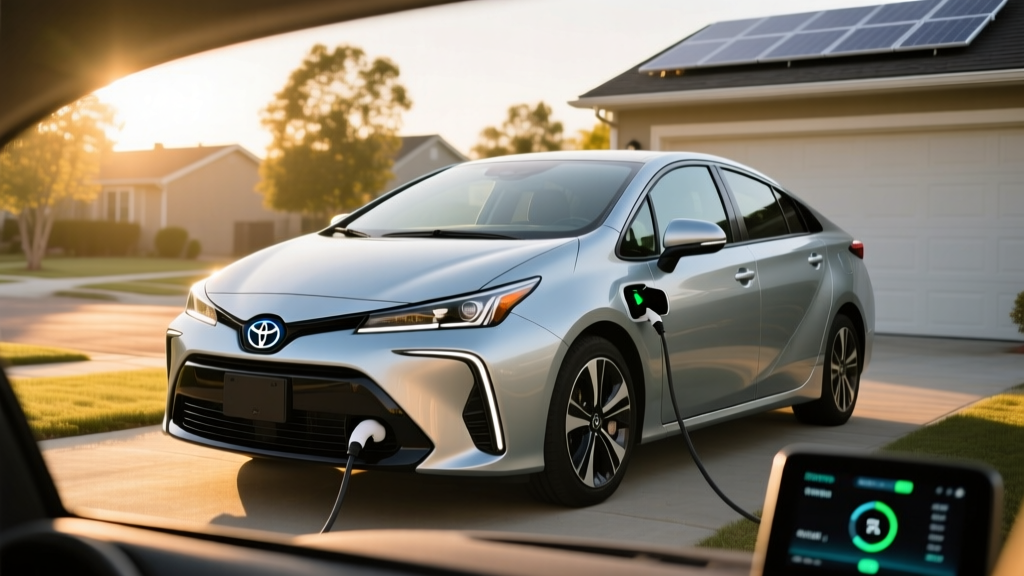
Charging reality check: The Prius PHEV does not support DC fast charging. This is typical for PHEVs with smaller batteries — the 13.6 kWh pack charges fully overnight on a standard 120V household outlet (Level 1), or in about 4 hours on a 240V Level 2 home charger. If you install a Level 2 charger like a ChargePoint Home Flex or Emporia Level 2 EV charger, you can set the car to charge during off-peak utility hours for the lowest electricity cost. At an average residential rate of $0.16/kWh, a full charge costs approximately $2.18 — enough to cover most daily commutes on electricity alone.
Pricing, Trims & Federal Tax Credit Eligibility
| Trim | MSRP (2026) | Key Features |
|---|---|---|
| SE | $33,445 | 48-mi EV range, 17" alloy wheels, Toyota Safety Sense 3.0, 8" touchscreen |
| XSE | $36,745 | 44-mi EV range, 19" alloy wheels, SofTex seats, heated front seats, 12.3" display |
| XSE Premium | $39,995 | Panoramic fixed glass roof, digital rearview mirror, premium JBL audio, parking assist |
The 2026 Toyota Prius Plug-In Hybrid starts at $33,445 including destination charge for the SE trim, climbing to nearly $40,000 for a fully loaded XSE Premium. All trims include Toyota Safety Sense 3.0 (adaptive cruise control, lane-keeping assist, pre-collision system with pedestrian detection, and automatic high beams) as standard equipment.
Does the 2026 Prius PHEV qualify for a federal tax credit?
Under current IRS §30D clean vehicle credit rules, the Prius Plug-In Hybrid may qualify for up to $3,750 — not the full $7,500 that some full EVs receive. The credit amount depends on meeting critical-mineral and battery-component sourcing thresholds that adjust annually. As of the 2026 tax year, the Prius PHEV's battery sourcing satisfies the critical minerals requirement (earning $3,750) but does not fully meet the battery-component manufacturing threshold, which would add the remaining $3,750.
- Buyer income caps: Modified AGI must not exceed $150,000 (single), $225,000 (head of household), or $300,000 (joint filing)
- MSRP cap: Vehicle MSRP must be $55,000 or below for sedans/hatchbacks — all Prius PHEV trims qualify
- Battery capacity: Must be ≥7 kWh — the Prius PHEV's 13.6 kWh pack exceeds this
- Point-of-sale transfer: As of 2024, you can transfer the credit to the dealer at purchase, reducing your out-of-pocket cost immediately rather than waiting to claim it on your tax return
- Assembly: Must be assembled in North America — the Prius PHEV is assembled in Japan, which may disqualify it from the new-vehicle credit but could allow eligibility under the used clean vehicle credit (§25E) if purchasing pre-owned
⚠️ Important tax credit caveat: The 2026 Prius Plug-In Hybrid is assembled at Toyota's Tsutsumi plant in Japan. Under §30D, new clean vehicles must undergo final assembly in North America to qualify for the new-vehicle credit. This means the new Prius PHEV may not qualify for any federal tax credit at the point of sale for 2026. Always verify current eligibility using the DOE's fueleconomy.gov tax credit tool and consult a tax professional before relying on credit availability. If you purchase a qualifying used Prius PHEV from a dealer, the §25E used clean vehicle credit (up to $4,000 or 30% of sale price, whichever is lower) may apply, subject to income caps and the $25,000 maximum sale price for used vehicles.
Reliability, Battery Longevity & Warranty Coverage
Is the 2026 Prius Plug-In Hybrid reliable? Toyota's hybrid powertrains have accumulated more than 25 years of real-world data since the original Prius launched in 1997, and the brand consistently ranks at or near the top of Consumer Reports' reliability surveys and J.D. Power dependability studies. The current-generation Prius platform uses Toyota's fifth-generation hybrid system, which has simplified the powertrain by eliminating the traditional starter motor and accessory belt — fewer mechanical components means fewer failure points.
| Warranty Component | Coverage |
|---|---|
| Hybrid battery (traction) | 10 years / 150,000 miles |
| Hybrid system components | 8 years / 100,000 miles |
| Powertrain (engine, transaxle) | 5 years / 60,000 miles |
| Basic bumper-to-bumper | 3 years / 36,000 miles |
| Corrosion perforation | 5 years / unlimited miles |
The hybrid battery replacement cost is the top concern for hybrid shoppers. If the 13.6 kWh NMC traction battery requires replacement outside of warranty, expect a dealer-installed replacement to cost between $4,500 and $7,000 depending on labor rates and whether a new or remanufactured pack is used. However, real-world data from the broader Toyota hybrid fleet suggests that catastrophic battery failure is uncommon within the first 150,000 miles. More typical is gradual capacity loss — expect the PHEV battery to retain roughly 80–85% of its original capacity after 10 years of normal use, which would reduce the electric-only range from 44 miles to approximately 35–37 miles. Toyota's warranty guarantees the battery will retain at least 70% of its original capacity during the coverage period.
To maximize battery lifespan, avoid routinely charging to 100% and leaving the car parked at full state of charge in extreme heat. The Prius PHEV's battery management system already includes a buffer (the 13.6 kWh figure is usable capacity, not gross), but moderate charging habits — letting the car manage its own charge scheduling rather than overriding it — will slow degradation over the vehicle's lifetime.
Who Should Choose the Prius PHEV vs. a Full EV or Gas Car?
Choose the 2026 Prius Plug-In Hybrid if:
- Your daily round-trip commute is under 45 miles and you can charge at home overnight
- You take regular road trips (200+ miles) where public charging infrastructure is sparse or unreliable
- You live in an apartment or rent where installing a Level 2 charger is possible but DC fast charging access is limited
- You want to reduce gasoline consumption by 60–80% without committing to full EV ownership
- You live in a region with extreme cold where EV range loss is a practical concern
Choose a full battery EV (like the Tesla Model 3, Hyundai Ioniq 6, or Chevrolet Equinox EV) if:
- You have reliable home Level 2 charging and your daily driving rarely exceeds 200 miles
- You want zero tailpipe emissions and the lowest per-mile fuel cost
- You want access to DC fast charging for road trips (150–350 kW capability)
- You qualify for the full $7,500 federal tax credit on an eligible North American–assembled EV
Choose the conventional Prius HEV (no plug) if:
- You cannot charge at home or at work (street parking, no garage access)
- You want maximum MPG simplicity without managing plug-in routines
- Your budget is closer to $28,000–$30,000
- You drive primarily highway miles where the PHEV's electric range provides minimal benefit
The Prius PHEV's strongest use case is the household that wants to electrify daily driving without accepting any range compromise on longer trips. If you can plug in at home — even just a standard 120V outlet — and your weekday driving stays under 40 miles, you'll operate on electricity for most daily miles while the hybrid system handles weekend road trips seamlessly. The gasoline engine starts automatically when the battery depletes, requiring zero behavior change from the driver.
Real-World Ownership Economics: PHEV vs. HEV vs. Gas
Let's model a realistic 5-year ownership scenario assuming 12,000 miles per year (60,000 miles total), $3.40/gallon gasoline, and $0.16/kWh residential electricity:
| Cost Category | Prius PHEV | Prius HEV | Gas Compact (30 MPG) |
|---|---|---|---|
| Fuel / electricity (5 yr) | $3,100 | $4,300 | $6,800 |
| Estimated maintenance (5 yr) | $2,200 | $2,100 | $3,400 |
| Starting MSRP | $33,445 | $28,350 | $25,000 |
| 5-year fuel + maintenance savings vs. gas | $4,900 | $3,800 | — |
The PHEV's fuel cost assumes approximately 70% of miles are driven on electricity (charging nightly at home) and 30% on gasoline (weekend and longer trips). If you charge less frequently, the fuel cost shifts toward the HEV column. The PHEV's higher purchase price is partially offset by fuel savings, though without a federal tax credit (due to Japanese assembly), the payback period versus the conventional HEV stretches to roughly 7–8 years for average drivers.
Pros, Cons & Final Assessment
Pros
- 44–48 miles of real electric-only range covers most commutes
- 52–54 MPG in hybrid mode is excellent for a plug-in
- 220 hp and 6.6-second 0–60 make it genuinely quick
- Charges fully on a standard 120V outlet overnight — no Level 2 required
- Toyota Safety Sense 3.0 standard on all trims
- 10-year / 150,000-mile hybrid battery warranty
- Proven long-term reliability track record
Cons
- No DC fast charging capability
- Assembled in Japan — likely ineligible for the new-vehicle federal tax credit
- Rear seat and cargo space tighter than crossover PHEV alternatives
- XSE Premium trim pushes $40,000, where some full EVs become competitive
- Electric-only range drops to ~32–38 miles in cold weather
- AWD-e availability limited; not offered on all trims
Frequently Asked Questions
How many MPG does the 2026 Toyota Prius Plug-In Hybrid get?
The EPA rates the Prius PHEV at 52 MPG combined (53 city / 51 highway) in the XSE trim, and 54 MPG combined (55 city / 53 highway) in the SE trim, when operating in hybrid mode after the electric range is depleted. In real-world driving, city MPG often exceeds the EPA estimate thanks to regenerative braking, while highway MPG may fall slightly below at sustained speeds over 70 mph.
How far can the 2026 Prius PHEV go on electric only?
The EPA rates the electric-only range at 44 miles for the XSE and XSE Premium trims (19-inch wheels) and 48 miles for the SE trim (17-inch wheels). Real-world range varies with temperature, speed, and terrain: expect 36–42 miles on the highway, 40–46 miles in city driving, and 32–38 miles in winter conditions below 35°F.
Does the 2026 Prius PHEV qualify for the $7,500 federal tax credit?
Most likely not as a new vehicle. Under current IRS §30D rules, the vehicle must be assembled in North America to qualify for the new clean vehicle credit. The Prius PHEV is assembled in Japan. However, if you purchase a used Prius PHEV from a dealer for $25,000 or less, you may qualify for the §25E used clean vehicle credit of up to $4,000, subject to income limits. Always verify with a tax professional and the latest IRS guidance.
Is the Prius PHEV battery reliable and what does replacement cost?
Toyota's hybrid batteries have a strong longevity record, backed by a 10-year / 150,000-mile warranty. Gradual capacity loss of 15–20% over 10 years is typical, which reduces electric range but does not disable the vehicle. Out-of-warranty battery replacement costs approximately $4,500–$7,000 at a dealership. Third-party remanufactured options may reduce this cost.
Can I charge the Prius PHEV at a public DC fast charger?
No. The 2026 Prius PHEV only supports AC charging via a J1772 port — Level 1 (120V) and Level 2 (240V). It does not have a DC fast charging port. This is standard for most PHEVs, whose smaller batteries are designed for overnight home charging rather than rapid public charging.
Hybrid vs. PHEV vs. full EV — which should I choose?
If you have home charging access and drive under 200 miles daily, a full EV offers the lowest operating cost and zero tailpipe emissions. If you can charge at home but regularly drive longer distances or live in an area with limited public charging, the Prius PHEV offers the best of both worlds. If you cannot charge at home at all, the conventional Prius HEV delivers excellent MPG without any plug-in requirement.