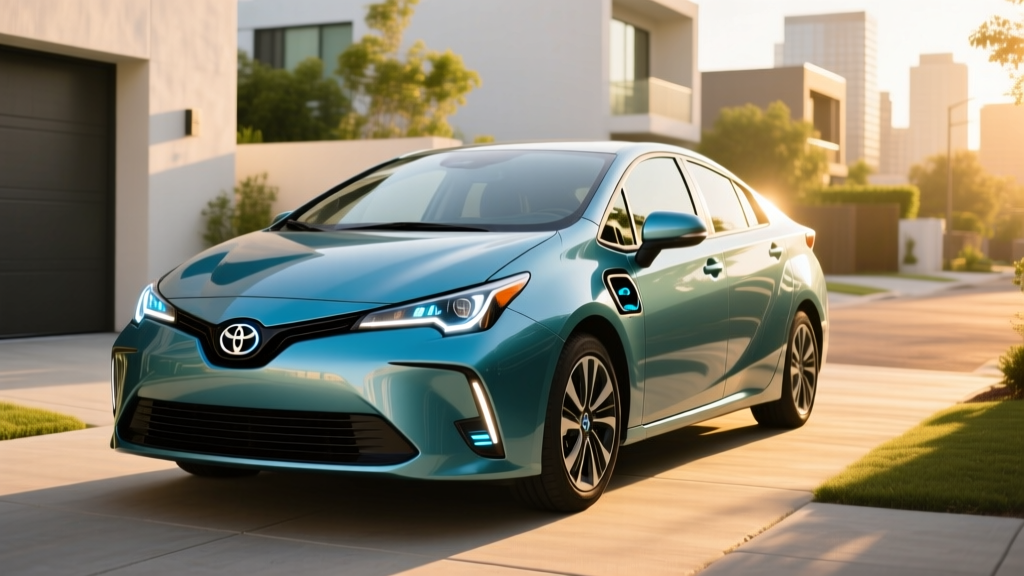
The 2026 Toyota Prius is the benchmark full hybrid in America — a conventional hybrid electric vehicle (HEV) that never needs to be plugged in, yet delivers up to 57 MPG EPA combined. After a complete redesign for the 2023 model year, the current-generation Prius shed its slow-and-boring reputation with 196 combined horsepower and a sleeker fastback profile. For 2026, Toyota has kept the formula largely intact while trimming the lineup to three core trims and adding a standard 12.3-inch infotainment screen across all models.
This review covers the standard Prius HEV — the full hybrid that charges itself through regenerative braking and its gasoline engine. If you're looking for plug-in capability with electric-only driving, that's the Prius Prime (a PHEV), which we address in the comparison section below.
Quick Verdict: Who Is the 2026 Prius Full Hybrid For?
Choose the Prius HEV (full hybrid) if: You want maximum fuel economy without changing your habits — no plugging in, no range anxiety, no home charger needed. Ideal for apartment dwellers, rideshare drivers, and commuters who log 15,000+ miles per year.
Choose the Prius Prime (PHEV) if: You have access to home or workplace charging and want 44 miles of electric-only range for daily commutes, with a gas engine for road trips.
Choose a full EV (like the Hyundai Ioniq 5 or Tesla Model 3) if: You can install a Level 2 home charger, want zero tailpipe emissions, and your daily driving stays under 250 miles.
Fuel Economy: EPA Ratings vs. Real-World MPG
Fuel economy is the Prius's defining metric. Here's what the EPA rates and what you can actually expect:
| Trim / Drivetrain | City MPG | Highway MPG | Combined MPG |
|---|---|---|---|
| LE (FWD) | 57 | 56 | 57 |
| XLE / Limited (FWD) | 52 | 52 | 52 |
| LE / XLE (AWD-e) | 49 | 50 | 49 |
Source: fueleconomy.gov
Real-world MPG reality check: The Prius LE's 57 MPG combined is one of the highest EPA ratings of any non-plug-in vehicle sold in the US. In practice, owners frequently report exceeding the EPA city number — 60+ MPG is common in stop-and-go traffic where regenerative braking recaptures the most energy. Highway driving at 75+ MPH typically drops fuel economy to 48-52 MPG due to aerodynamic drag. In cold weather (below 35°F), expect a 5-10% reduction as the engine runs more frequently to maintain cabin heat and battery temperature.
With a 10.6-gallon fuel tank, the LE trim delivers a theoretical range of 604 miles per tank at combined EPA. Realistically, plan for 520-580 miles between fill-ups in mixed driving — still enough to go nearly two weeks between gas station visits for the average commuter.
Powertrain and Performance Specs
The 2026 Prius uses Toyota's fifth-generation hybrid powertrain, pairing a 2.0-liter four-cylinder engine with two motor-generators through a planetary gearset (eCVT). The result is far more responsive than the previous generation's 1.8-liter setup.
| Specification | 2026 Prius LE / XLE / Limited |
|---|---|
| Engine | 2.0L inline-4 (150 hp, 139 lb-ft) |
| Electric Motor (front) | Permanent-magnet synchronous (111 hp) |
| Combined System Output | 196 hp (FWD) / 196 hp (AWD-e) |
| AWD-e Rear Motor | 41 hp (AWD trims only, auto-disengages above 43 mph) |
| Transmission | eCVT (planetary gearset) |
| 0-60 mph | 7.2 sec (FWD) / 7.0 sec (AWD-e) |
| Hybrid Battery | ~1.0 kWh lithium-ion (sealed, self-charging) |
| Curb Weight | ~3,032 lbs (LE FWD) |
| Base MSRP | $28,550 (LE) / $32,000 (XLE) / $35,700 (Limited) |
The 0-60 time of 7.2 seconds puts the Prius in the same territory as many compact turbo sedans. It's genuinely quick off the line — electric motor torque fills in the low-RPM gap that traditional CVTs struggle with. Merge onto a 70-MPH highway and the Prius pulls confidently, even at altitude where turbocharged engines sometimes lag.
Full Hybrid vs. Plug-In Hybrid: Prius HEV vs. Prius Prime
This is the most common confusion among hybrid shoppers. Both are "hybrids," but they serve different use cases:
| Feature | Prius HEV (Full Hybrid) | Prius Prime (PHEV) |
|---|---|---|
| Plug-in Required? | No — charges via regen + engine | Yes — plug in for EV range |
| Electric-Only Range | ~1 mile (low-speed creep) | 44 miles (EPA) |
| Total Range | ~604 miles | ~480 miles (EV + gas) |
| Battery Capacity | ~1.0 kWh | 13.6 kWh lithium-ion |
| Charging Time (Level 2) | N/A (no plug) | ~4 hours (240V, 3.3 kW) |
| DC Fast Charging | N/A | No |
| Combined MPG (gas mode) | 57 MPG (LE) | 52 MPG (after EV range depleted) |
| MPGe (EV mode) | N/A | 127 MPGe |
| Starting MSRP | $28,550 | $33,475 |
| Federal Tax Credit (§30D) | Not eligible | Up to $3,750 (battery sourcing rules apply) |
Key takeaway: The full hybrid (HEV) is simpler, cheaper, and doesn't require any charging infrastructure. The PHEV trades slightly higher cost for 44 miles of gas-free commuting — but only if you can plug in regularly. Without regular charging, a PHEV is just a heavier, more expensive HEV.
Battery Warranty, Reliability, and Replacement Costs
Hybrid battery longevity remains the top concern for first-time hybrid buyers. Here's what the data shows:
2026 Prius Hybrid Battery Warranty: Toyota covers the hybrid battery for 10 years or 150,000 miles (whichever comes first) in all 50 states. This applies to both the HEV and Prime. The hybrid system components (inverter, motor-generators, control module) are also covered under this warranty.
Source: Toyota Owner's Warranty Guide
Real-world longevity data: Toyota's hybrid batteries have an exceptional track record. Fleet data and owner surveys consistently show Prius hybrid batteries lasting 180,000-250,000+ miles before significant degradation. The small ~1.0 kWh battery in the HEV operates within a narrow state-of-charge window (roughly 40-80%), which dramatically reduces stress on the cells compared to a full EV that cycles 0-100%.
Replacement cost if out of warranty: A new OEM hybrid battery for the current-generation Prius runs approximately $2,500-$3,500 installed at a dealership. Refurbished or aftermarket options are available for $1,500-$2,200. For the Prius Prime (larger 13.6 kWh pack), replacement costs are higher — typically $5,000-$7,000. However, given the 10-year/150,000-mile warranty and documented longevity, most owners will never face this expense.
Toyota's hybrid reliability reputation is backed by decades of data. The Prius consistently earns above-average reliability scores from Consumer Reports and J.D. Power. The eCVT planetary gearset has no belts, clutches, or bands to wear out — it's one of the most durable transmissions in the industry.
Tax Credits and Ownership Economics
Here's where the distinction between full hybrid and plug-in hybrid matters for your wallet:
- Prius HEV (full hybrid): Does NOT qualify for the federal §30D clean vehicle tax credit. The IRS requires a minimum 7 kWh battery capacity and plug-in capability — the HEV's ~1.0 kWh self-charging battery doesn't meet this threshold.
- Prius Prime (PHEV): May qualify for up to $3,750 under §30D, depending on battery critical-mineral sourcing compliance. The full $7,500 credit requires meeting both critical-mineral AND battery-component sourcing requirements, and the Prime currently satisfies only the critical-minerals portion. Income caps apply: $150,000 single / $300,000 joint AGI. MSRP cap: $55,000 for sedans.
- State incentives: Some states offer additional rebates for PHEVs (not HEVs). Check your state's energy office or IRS §30D guidelines for current rules.
Tax credit rules are subject to change. Consult a tax professional for your specific eligibility.
Five-Year Cost Comparison: Prius HEV vs. Gas Sedan vs. Full EV
| Cost Factor (5 yr / 75k mi) | 2026 Prius HEV ($28,550) | 2026 Honda Civic ($25,000) | 2026 Tesla Model 3 ($39,990) |
|---|---|---|---|
| Fuel / Energy | ~$3,950 (gas @ $3.40/gal) | ~$5,670 (gas @ $3.40/gal, 33 MPG) | ~$2,250 (electric @ $0.15/kWh) |
| Maintenance | ~$2,100 | ~$2,800 | ~$1,200 |
| Insurance (avg) | ~$6,500 | ~$6,000 | ~$8,500 |
| Depreciation (est.) | ~$10,000 | ~$10,500 | ~$16,000 |
| Federal Tax Credit | $0 | $0 | Up to $7,500 |
| Est. 5-Year Total Cost | ~$51,100 | ~$49,970 | ~$60,440 |
The Prius HEV's fuel savings over a gas-only compact add up to roughly $1,720 over five years — enough to offset its slightly higher purchase price. The Model 3 wins on fuel and maintenance but costs more upfront and carries higher insurance and depreciation. For buyers without home charging access, the Prius HEV delivers the best no-compromise efficiency.
Pros and Cons
Pros
- 57 MPG combined (LE) — among the highest of any non-plug-in vehicle
- No plugging in required; no charging infrastructure needed
- 196 hp — genuinely quick and confident for highway merging
- 10-year/150,000-mile hybrid battery warranty
- 604-mile total range eliminates refueling stops on most road trips
- Low starting price at $28,550
- Strong resale value and proven long-term reliability
Cons
- No federal tax credit eligibility (HEV battery too small)
- AWD-e trims drop to 49 MPG combined
- Rear seat headroom tight for passengers over 6'2" (fastback roofline)
- Cargo space (20.3 cu ft) trails some compact SUVs
- Limited trim lacks the value proposition of LE/XLE
- Engine noise under hard acceleration (eCVT drone)
Frequently Asked Questions
How many MPG does the 2026 Toyota Prius full hybrid get?
The Prius LE (FWD) achieves an EPA-rated 57 city / 56 highway / 57 combined MPG. The XLE and Limited trims are rated at 52 combined. AWD-e trims drop to 49 combined. In real-world city driving, many owners exceed the EPA city number — 60+ MPG is common in stop-and-go traffic. Highway driving at 75+ MPH typically yields 48-52 MPG.
Does the Prius full hybrid need to be plugged in?
No. The Prius HEV is a conventional (full) hybrid that charges its small lithium-ion battery entirely through regenerative braking and the gasoline engine. You fuel it like any other car — just add gas. There is no plug, no charging cable, and no electric-only driving range beyond low-speed parking-lot creep.
Full hybrid vs. PHEV vs. EV — which should I choose?
Choose a full hybrid (HEV) like the Prius if you can't install a home charger (apartment, street parking) or want zero behavior change with maximum fuel savings. Choose a PHEV like the Prius Prime if you can plug in at home and want 40+ miles of electric commuting with gas backup. Choose a full EV if you have reliable home charging, want the lowest operating costs, and your daily driving stays within the vehicle's range.
Is the Toyota Prius hybrid reliable, and what does battery replacement cost?
The Prius has one of the strongest reliability records in the industry, with hybrid batteries routinely lasting 180,000-250,000+ miles. Toyota covers the hybrid battery for 10 years or 150,000 miles. Out-of-warranty replacement costs approximately $2,500-$3,500 for the HEV battery (OEM). Given the warranty and proven longevity, battery replacement is rarely an ownership concern.
Does the 2026 Prius qualify for any tax credits?
The standard Prius HEV does NOT qualify for the federal §30D clean vehicle credit — its battery is too small and it lacks plug-in capability. The Prius Prime (PHEV) may qualify for up to $3,750 depending on battery sourcing compliance, buyer income caps ($150K single / $300K joint), and the $55,000 MSRP cap for sedans. State-level incentives vary — check your local energy office. Always verify current rules at IRS.gov and consult a tax professional.
What's the difference between a full hybrid and a mild hybrid?
A full hybrid (like the Prius) can drive the wheels using electric motor power alone at low speeds, and its electric motor provides substantial assist to the gas engine. A mild hybrid (like some Ram 1500 or Mercedes models with a 48-volt system) uses a small motor-generator only to assist the engine during acceleration and enable smoother stop-start — it cannot propel the vehicle on electric power alone. Full hybrids deliver significantly greater fuel savings.