2026 Toyota Grand Highlander Hybrid: Pricing, MPG, and Ownership Guide
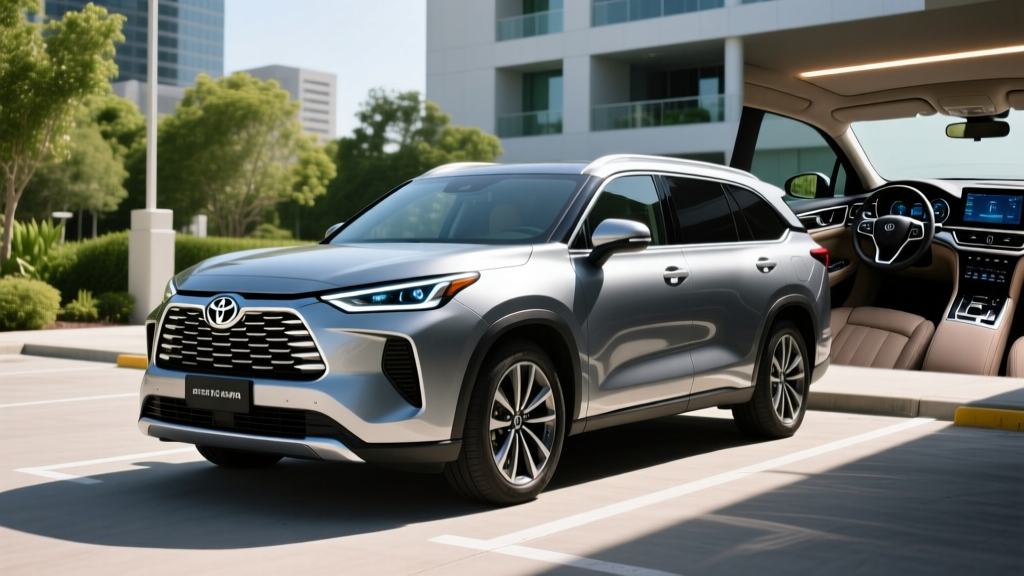
Three-row SUV buyers who want meaningful fuel savings without plugging in keep landing on one nameplate: the Toyota Grand Highlander Hybrid. For the 2026 model year, Toyota continues to offer this midsize hauler exclusively as a conventional hybrid (HEV) — no plug required — with two distinct powertrain options that trade off efficiency for power. Below, we break down every number that matters: the 2026 Toyota Grand Highlander Hybrid MSRP across all trims, EPA fuel economy, real-world MPG expectations, battery warranty details, and whether any tax credits apply.
2026 Toyota Grand Highlander Hybrid MSRP by Trim
Toyota positions the Grand Highlander Hybrid across five trims for 2026. Pricing below reflects manufacturer MSRP before destination charges (typically $1,390–$1,450 depending on region). The LE and XLE trims use the fuel-sipping Hybrid MAX-less powertrain, while the Limited, Nightshade, and Platinum step up to the turbocharged Hybrid MAX system.
| Trim | Powertrain | Drivetrain | MSRP |
|---|---|---|---|
| LE | 2.5L Hybrid (245 hp) | AWD | $46,120 |
| XLE | 2.5L Hybrid (245 hp) | AWD | $49,070 |
| Limited | Hybrid MAX (362 hp) | AWD | $55,855 |
| Nightshade | Hybrid MAX (362 hp) | AWD | $56,590 |
| Platinum | Hybrid MAX (362 hp) | AWD | $59,485 |
The LE hybrid undercuts most three-row hybrid competitors, including the Kia Sorento Hybrid and Mazda CX-90 PHEV, on base price while including all-wheel drive as standard. The Hybrid MAX trims carry a substantial premium — roughly $7,000–$9,000 over the LE — justified by the 362-hp turbo powertrain and upgraded interior features, but they sacrifice about 10 MPG combined in the process.
Pros
- 36 MPG combined (2.5L Hybrid) leads the three-row SUV class
- Standard AWD across all hybrid trims
- Genuine third-row adult space and 97.5 cu ft max cargo
- Toyota Safety Sense 3.0 standard on every trim
- Strong reliability track record; hybrid battery warranty up to 10 years
Cons
- Hybrid MAX trims drop to 27 MPG combined — steep efficiency penalty
- No plug-in hybrid (PHEV) variant available
- Base LE interior materials feel budget-grade at this price
- No DC fast charging capability (not applicable to HEV, but limits future-proofing)
- Hybrid MAX uses a 6-speed automatic, not the smoother eCVT
EPA MPG and Real-World Fuel Economy
Fuel economy splits sharply between the two powertrains. The 2.5-liter four-cylinder hybrid system (LE, XLE) uses Toyota's fourth-generation hybrid synergy drive with an electronically controlled continuously variable transmission (eCVT), while the Hybrid MAX (Limited, Nightshade, Platinum) pairs a 2.4-liter turbocharged four-cylinder with a direct-shift 6-speed automatic and a more powerful electric motor.
| Powertrain | City MPG | Highway MPG | Combined MPG | Est. Total Range |
|---|---|---|---|---|
| 2.5L Hybrid (LE/XLE) | 36 | 35 | 36 | ~630 mi |
| Hybrid MAX (Limited+) | 26 | 27 | 27 | ~475 mi |
Source: fueleconomy.gov — EPA estimates. Actual mileage will vary.
Real-World MPG: What Owners Actually See
The 2.5L hybrid system in the LE and XLE tends to meet or slightly exceed its EPA city rating in stop-and-go driving, where regenerative braking recovers the most energy. On highway-heavy road trips at 75+ mph, expect 31–33 MPG — a slight dip from the 35 MPG highway sticker. Cold weather (below 30°F) typically knocks 2–4 MPG off combined figures due to increased engine runtime for cabin heat and reduced battery efficiency.
The Hybrid MAX system behaves more like a conventional turbocharged SUV: you'll see 24–25 MPG in aggressive city driving and closer to 28–29 MPG on flat highway cruises at moderate speeds. The gap between the two powertrains is roughly 9 MPG combined — significant over 15,000 annual miles.
Annual fuel cost estimate (15,000 mi/yr, $3.50/gal regular unleaded):
- 2.5L Hybrid (36 MPG): ~$1,458/year
- Hybrid MAX (27 MPG): ~$1,944/year
- Gas-only V6 competitor baseline (~22 MPG): ~$2,386/year
The 2.5L hybrid saves roughly $500–$900 per year versus a gas-only three-row SUV, paying back its modest price premium within 2–3 years for most buyers.
Powertrain Specs: Two Very Different Hybrid Systems
Calling both systems "hybrid" undersells how different they are in character and engineering.
| Specification | 2.5L Hybrid | Hybrid MAX (2.4T) |
|---|---|---|
| Engine | 2.5L inline-4 Atkinson-cycle | 2.4L turbo inline-4 |
| Combined Net Horsepower | 245 hp | 362 hp |
| Combined Torque | 175 lb-ft (engine) + electric motor | 332 lb-ft (engine) + electric motor |
| Transmission | eCVT | Direct-shift 6-speed automatic |
| 0–60 mph | ~7.8 sec | ~5.6 sec |
| Towing Capacity | 3,500 lb | 5,000 lb |
| Drivetrain | Electronic AWD (eAWD) | Electronic AWD (eAWD) |
The 2.5L system prioritizes seamless, quiet efficiency. The rear axle is driven by a separate electric motor (no mechanical driveshaft), providing AWD traction without the parasitic loss of a traditional system. It's the powertrain for buyers who value low running costs and relaxed driving.
The Hybrid MAX is Toyota's performance hybrid — similar in philosophy to the system in the Crown and Tacoma i-FORCE MAX. The turbo four and a 48-hp electric motor deliver V6-rivaling acceleration and 5,000 lb of towing capacity. The trade-off is fuel economy that's closer to a conventional V6 than to a hybrid, making it best suited for buyers who want hybrid smoothness and towing capability without prioritizing maximum MPG.
HEV vs. PHEV vs. EV: Which Three-Row SUV Fits You?
The Grand Highlander is offered only as a conventional hybrid (HEV). Toyota does not currently sell a plug-in hybrid (PHEV) or battery-electric (BEV) version. Here's how to evaluate whether the HEV is the right electrification level for your household.
Conventional Hybrid (HEV) — Grand Highlander Hybrid
- No plug required. The battery recharges via regenerative braking and the gasoline engine.
- Best for: Buyers without reliable home charging access, those who take frequent long road trips, and families who need maximum cargo space (no battery pack eating into the floor).
- Limitation: No electric-only driving mode; the gas engine is always part of the equation.
Plug-In Hybrid (PHEV) — Competitor Examples (Kia Sorento PHEV, Jeep Grand Cherokee 4xe)
- Plugs in. Typically 25–40 miles of electric-only range on a full charge, then operates as a conventional hybrid.
- Best for: Households with home Level 2 charging and daily commutes under 35 miles round-trip.
- Limitation: Higher purchase price, smaller cargo space in some models, and you must plug in regularly to capture the benefit.
Battery Electric (BEV) — Examples (Kia EV9, Tesla Model X)
- Fully electric. 250–330 miles of EPA range, zero tailpipe emissions.
- Best for: Households with reliable home charging, predictable daily mileage, and access to DC fast charging for road trips.
- Limitation: Higher upfront cost, charging logistics on long trips, cold-weather range loss of 20–30%.
Choose the Grand Highlander Hybrid (HEV) If:
- You don't have a garage or dedicated parking spot for a charger
- You regularly drive 400+ miles in a day (no charging stops needed)
- You want three-row space with minimal complexity
- Your priority is lower fuel cost, not zero emissions
Look at a PHEV or BEV Instead If:
- You have home Level 2 charging and a short commute (PHEV makes sense)
- You want electric-only daily driving and can manage road-trip charging (BEV)
- You want access to HOV lane privileges or state EV rebates (varies by state)
Tax Credit Eligibility: Does the Grand Highlander Hybrid Qualify?
This is where many buyers get tripped up. The 2026 Toyota Grand Highlander Hybrid does not qualify for the federal §30D Clean Vehicle Credit. Here's why:
Federal §30D Credit Requirements (2026)
- ❌ Vehicle type: The §30D credit requires a plug-in electric vehicle (BEV or PHEV) with a battery capacity of at least 7 kWh. The Grand Highlander Hybrid is a conventional HEV with a small (~1.6 kWh) self-charging battery — it does not meet this threshold.
- ❌ Plug-in capability: Conventional hybrids cannot be plugged in by definition. Only PHEVs and BEVs qualify.
- ✅ MSRP caps (if it were eligible): SUVs must be under $80,000 MSRP — all Grand Highlander trims would clear this bar.
- ✅ Assembly: The Grand Highlander is assembled in Princeton, Indiana — it would meet the North American final assembly requirement.
Bottom line: No federal tax credit applies to any 2026 Grand Highlander Hybrid trim. If a dealer suggests otherwise, they may be confusing it with a different vehicle or referencing outdated rules. For current §30D eligibility details, consult the IRS Clean Vehicle Credit page or speak with a tax professional.
State-level incentives for conventional hybrids are rare but not nonexistent. A handful of states have offered rebates or reduced registration fees for high-efficiency hybrids in past years, but these programs change frequently. Check your state's energy office or DMV for current offerings.
Battery Warranty, Reliability, and Replacement Cost
Hybrid battery longevity is consistently a top concern for buyers, and Toyota has the longest track record in the industry to address it.
2026 Toyota Hybrid Battery Warranty
- Hybrid battery: 10 years / 150,000 miles (whichever comes first)
- Hybrid system components: 8 years / 100,000 miles (inverter, transaxle, control modules)
- Bumper-to-bumper: 3 years / 36,000 miles
- Powertrain (engine/transmission): 5 years / 60,000 miles
The 10-year/150,000-mile hybrid battery warranty has been Toyota's standard since the 2020 model year and applies to all 2026 Grand Highlander Hybrid trims. The battery pack is a nickel-metal hydride (NiMH) unit in the 2.5L hybrid system and a lithium-ion pack in the Hybrid MAX — both are proven chemistries with extensive real-world data.
Real-world reliability data: Toyota's hybrid systems, refined over 25+ years since the original Prius, are among the most dependable powertrains on the road. Independent fleet data and owner surveys consistently show hybrid battery failure rates well below 5% within the warranty period. Many Toyota hybrid batteries exceed 200,000 miles with minimal degradation.
Battery replacement cost: If a hybrid battery does fail outside the warranty window, a replacement from Toyota typically runs $3,000–$4,500 including labor for the 2.5L system. The Hybrid MAX lithium-ion pack may be somewhat higher. Third-party remanufactured batteries are available for $1,500–$2,500 from specialized hybrid repair shops. For context, this is significantly less than a BEV battery replacement ($10,000–$20,000+) because the pack is much smaller.
According to IIHS, the Grand Highlander carries strong safety ratings across all trims, and Toyota Safety Sense 3.0 — including pre-collision braking, lane tracing assist, and full-speed adaptive cruise — is standard equipment, not an expensive add-on.
Who Should Buy the 2026 Grand Highlander Hybrid?
The Grand Highlander Hybrid occupies a specific and well-defined niche: families who need genuine three-row utility, want to cut fuel costs significantly versus a gas-only SUV, and either cannot or prefer not to deal with plug-in charging logistics.
Ideal buyer profile:
- Families with 2–3 children who use the third row regularly (not just for emergencies)
- Commuters driving 15,000–20,000 miles per year who feel fuel costs acutely
- Apartment dwellers or street parkers who lack home charging infrastructure
- Buyers who plan to keep the vehicle 8–10+ years and want the security of Toyota's hybrid warranty
- Towers who need up to 5,000 lb capacity (Hybrid MAX) but don't want a truck-based SUV
Better options elsewhere:
- If you have home charging and a short commute, the Kia Sorento PHEV (32 miles electric-only, ~$52,000 MSRP) lets you drive most weekdays on electricity while keeping gas flexibility for road trips.
- If you want maximum interior space and are ready for full electric, the Kia EV9 (304 miles EPA, ~$55,000 base) offers three rows with zero tailpipe emissions and available §30D credit eligibility.
- If budget is the top priority and you can live with slightly less third-row space, the standard (non-hybrid) Grand Highlander with the turbo-four starts around $40,000.
Frequently Asked Questions
How many MPG does the 2026 Toyota Grand Highlander Hybrid get?
The 2.5L hybrid (LE and XLE trims) achieves an EPA-estimated 36 MPG combined (36 city / 35 highway). The Hybrid MAX (Limited, Nightshade, Platinum) is rated at 27 MPG combined (26 city / 27 highway). In real-world driving, the 2.5L hybrid often meets or slightly exceeds its city rating but may drop to 31–33 MPG on sustained highway trips at higher speeds.
Does the Grand Highlander Hybrid need to be plugged in?
No. The Grand Highlander Hybrid is a conventional hybrid (HEV). Its battery recharges automatically through regenerative braking and the gasoline engine. There is no plug, no charging cable, and no electric-only driving mode. This is fundamentally different from a plug-in hybrid (PHEV), which does require plugging in to access its electric-only range.
Does the 2026 Grand Highlander Hybrid qualify for a federal tax credit?
No. The federal §30D Clean Vehicle Credit is only available for plug-in electric vehicles (BEVs and PHEVs) with battery packs of at least 7 kWh. The Grand Highlander Hybrid's self-charging battery is far smaller and the vehicle cannot be plugged in, so it does not qualify for any federal purchase incentive. Always verify current rules at irs.gov.
Is the Toyota Grand Highlander Hybrid reliable?
Toyota's hybrid powertrains have an industry-leading reliability record built over 25+ years. The hybrid battery is covered by a 10-year / 150,000-mile warranty, and real-world failure rates within that period are very low. The Grand Highlander also earns strong safety ratings from IIHS and NHTSA. For long-term ownership (8–10+ years), it is one of the lowest-risk choices in the three-row SUV segment.
What is the difference between the 2.5L Hybrid and the Hybrid MAX?
The 2.5L hybrid (245 hp, 36 MPG combined) is the efficiency-focused powertrain available on LE and XLE trims. The Hybrid MAX (362 hp, 27 MPG combined) is a turbocharged performance hybrid on Limited, Nightshade, and Platinum trims that adds 1,500 lb of towing capacity and significantly quicker acceleration (5.6 vs. 7.8 seconds 0–60 mph) at the cost of ~9 MPG and a higher MSRP.
How much does it cost to replace the hybrid battery?
Out-of-warranty replacement for the 2.5L hybrid battery typically costs $3,000–$4,500 at a Toyota dealer. Third-party remanufactured options can reduce that to $1,500–$2,500. Given the 10-year / 150,000-mile warranty and Toyota's track record of hybrid batteries lasting 200,000+ miles, most original owners will never face this expense.