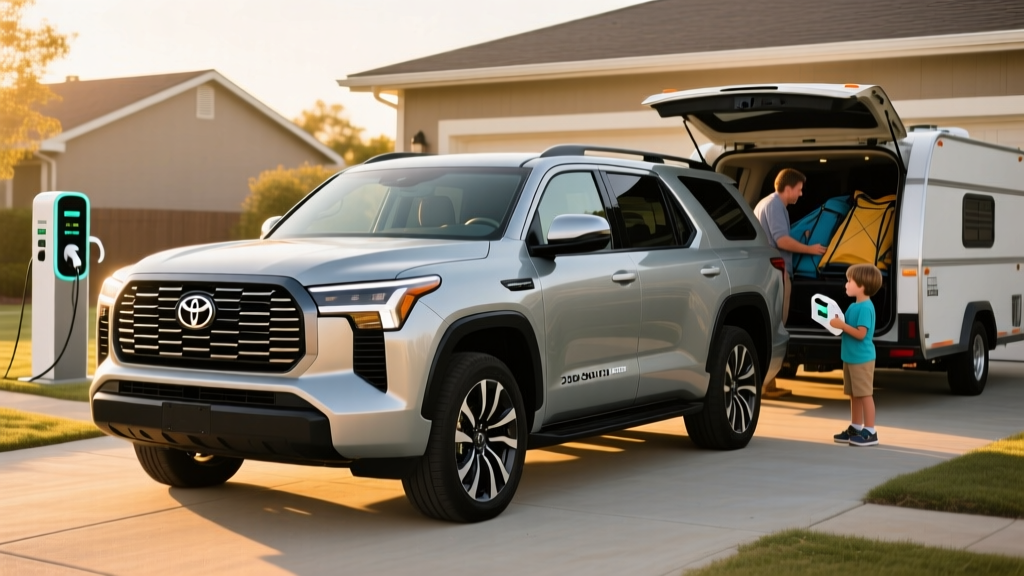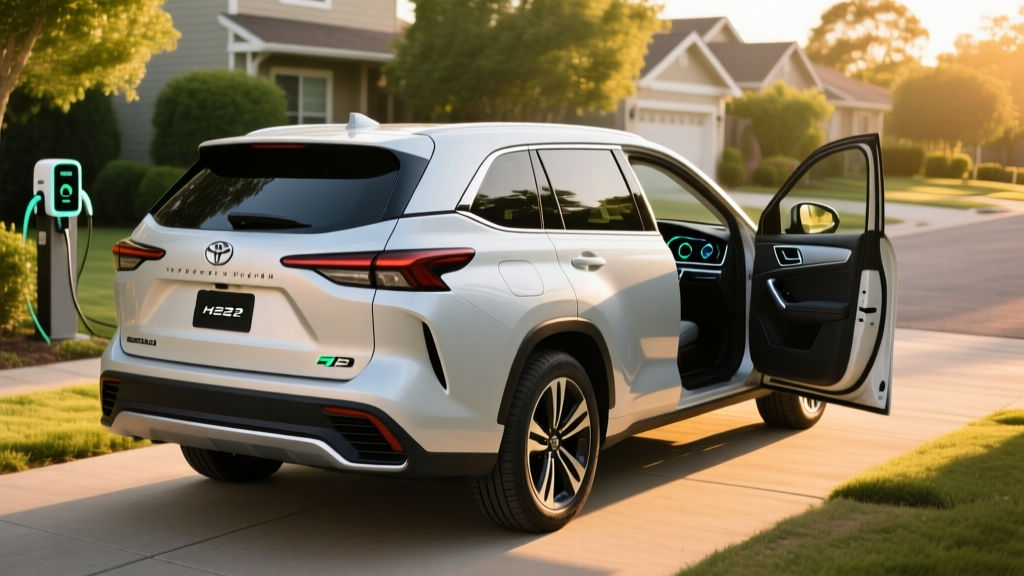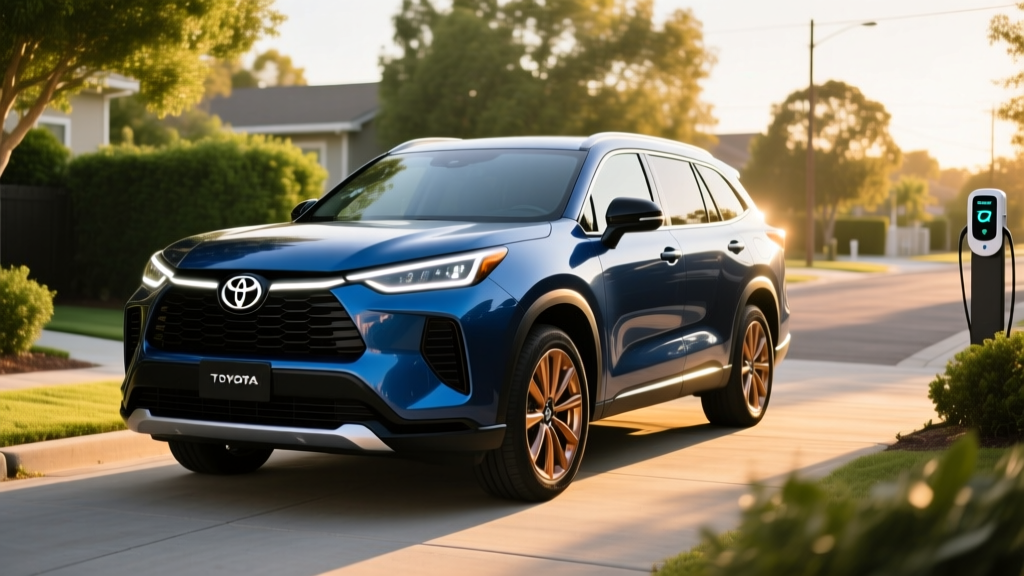
The 2026 Toyota Grand Highlander Hybrid occupies a narrow lane in the three-row SUV market: it offers genuine space for seven or eight passengers while returning fuel economy that embarrasses many compact crossovers. Toyota's fourth-generation hybrid system pairs a 2.5-liter four-cylinder engine with electric motors to achieve EPA ratings up to 36 MPG combined — a figure that holds up remarkably well in real-world driving, particularly in city and suburban use where regenerative braking does its best work.
This guide covers everything buyers need to know about the 2026 Grand Highlander Hybrid lineup, from the standard HEV (which never needs to be plugged in) to the performance-oriented Hybrid MAX variant, along with warranty coverage, ownership economics, and how it stacks up against plug-in hybrids and full EVs in the three-row segment.
HEV vs PHEV: What the Grand Highlander Hybrid Actually Is
The 2026 Grand Highlander Hybrid is a conventional hybrid electric vehicle (HEV). It charges its own battery through regenerative braking and the gasoline engine. You never plug it in. There is no electric-only driving mode beyond very low-speed maneuvering, and the battery is relatively small — roughly 1.6 kWh of usable capacity, designed to assist the engine rather than replace it.
Toyota does not currently offer a plug-in hybrid (PHEV) version of the Grand Highlander. If you want a three-row Toyota with a plug, you would need to look at the Sienna (also HEV-only) or consider competitors like the Chrysler Pacifica PHEV. The distinction matters because conventional hybrids like this one have no range anxiety, no charging logistics, and no dependency on home electrical infrastructure — you simply fuel it like any other vehicle and let the hybrid system optimize efficiency in the background.
HEV vs PHEV vs EV at a Glance
| Factor | Grand Highlander HEV | Typical 3-Row PHEV | Typical 3-Row EV |
|---|---|---|---|
| Plug-in Required? | No | Yes (for EV range) | Yes (always) |
| Electric-Only Range | ~1 mile at low speed | 25–40 miles | 250–350 miles |
| Total Range | ~550+ miles | ~450–550 miles | 250–350 miles |
| Home Charging Needed | No | Recommended (Level 2) | Essential (Level 2) |
| Best Use Case | No home charging, long trips | Short commutes + road trips | Home charging, mostly local |
| Maintenance | Oil changes, standard | Oil changes + battery care | Minimal (no engine) |
Fuel Economy: EPA Ratings and Real-World MPG
The 2026 Grand Highlander Hybrid comes in two distinct powertrain configurations, and the fuel economy difference between them is significant.
| Powertrain | Drivetrain | City MPG | Highway MPG | Combined MPG | Source |
|---|---|---|---|---|---|
| Hybrid (2.5L + 2 motors) | FWD | 37 | 34 | 36 | fueleconomy.gov |
| Hybrid (2.5L + 2 motors) | AWD (AWD-i) | 36 | 32 | 34 | fueleconomy.gov |
| Hybrid MAX (2.4L turbo + motor) | AWD | 26 | 27 | 27 | fueleconomy.gov |
Real-world expectations: The standard Hybrid FWD consistently meets or slightly exceeds its EPA city rating in stop-and-go traffic — hybrids thrive where regenerative braking recaptures energy that would otherwise be lost to brake heat. Expect 37–40 MPG in genuine city driving. Highway fuel economy tends to land closer to 31–33 MPG at sustained 70–75 mph speeds, where aerodynamic drag dominates and the electric motor provides less assistance. Cold weather (below 35°F) typically reduces efficiency by 5–10% as the engine runs longer to provide cabin heat.
The Hybrid MAX sacrifices roughly 9 MPG combined in exchange for substantially more power. Buyers choosing this variant are prioritizing acceleration and towing over efficiency — a reasonable tradeoff if you're regularly hauling a loaded trailer.
Powertrain and Performance Specs
| Specification | Standard Hybrid | Hybrid MAX |
|---|---|---|
| Engine | 2.5L 4-cyl Atkinson cycle | 2.4L turbocharged 4-cyl |
| Electric Motors | 2 (front + rear for AWD) | 1 (integrated in transaxle) |
| Net Combined Horsepower | 245 HP | 362 HP |
| 0–60 mph (est.) | ~7.6 seconds | ~5.8 seconds |
| Drivetrain | FWD or AWD-i (electronic rear) | AWD (standard) |
| Towing Capacity | 3,500 lbs | 5,000 lbs |
| Transmission | eCVT | 6-speed automatic |
| Hybrid Battery Capacity | ~1.6 kWh (NiMH) | ~1.6 kWh (NiMH) |
| Fuel Tank | 17.1 gallons | 17.1 gallons |
| Total Driving Range (est.) | ~580–615 miles | ~460 miles |
The standard Hybrid uses Toyota's proven eCVT power-split device, which seamlessly blends engine and motor power without traditional gear shifts. The AWD-i variant adds a rear-mounted electric motor that activates on demand — there is no mechanical driveshaft connecting the front and rear axles. This system responds faster than conventional AWD but provides less sustained torque to the rear wheels in deep snow or off-road situations.
The Hybrid MAX pairs a turbocharged engine with a single electric motor and a conventional 6-speed automatic transmission. The result is more linear, enthusiastic acceleration and a higher tow rating, at the cost of the standard hybrid's best-in-class efficiency.
Pricing, Trims, and Tax Credit Eligibility
The 2026 Grand Highlander Hybrid lineup spans four trims for the standard Hybrid and two for the Hybrid MAX.
| Trim | Powertrain | MSRP (approx.) |
|---|---|---|
| XLE | Standard Hybrid | $46,500 |
| Limited | Standard Hybrid | $51,000 |
| Nightshade | Standard Hybrid | $52,500 |
| Platinum | Standard Hybrid | $55,500 |
| Limited | Hybrid MAX | $55,000 |
| Platinum | Hybrid MAX | $59,500 |
Federal tax credit: The conventional Grand Highlander Hybrid does not qualify for the federal §30D clean vehicle tax credit (up to $7,500). That credit applies only to plug-in electric vehicles — battery electric vehicles (BEVs) and plug-in hybrids (PHEVs) with at least 7 kWh of battery capacity and meeting IRS battery-sourcing and critical-minerals requirements. Since the Grand Highlander Hybrid is a self-charging HEV with a ~1.6 kWh battery, it falls outside the program entirely.
Some states offer their own incentives for hybrid vehicles, though these are increasingly rare as programs shift toward plug-in vehicles. Check your state's department of revenue or energy office for current programs. Toyota's official Grand Highlander Hybrid page may also list regional incentives.
Battery Warranty, Lifespan, and Replacement Cost
Toyota Hybrid Battery Coverage
- Warranty: 10 years / 150,000 miles (whichever comes first), transferable to subsequent owners
- Coverage threshold: Battery capacity below 60% of original, or failure of any hybrid system component
- Hybrid system warranty: 8 years / 100,000 miles for inverter, motor, and control modules
Toyota's hybrid battery track record is among the strongest in the industry. The Prius, Camry Hybrid, and RAV4 Hybrid have demonstrated that nickel-metal hydride (NiMH) hybrid batteries routinely last 150,000–200,000+ miles with minimal degradation, largely because the battery operates within a narrow state-of-charge window (roughly 40–80%) that avoids the stress of deep cycles.
Replacement cost if out of warranty: A new OEM hybrid battery pack for the Grand Highlander Hybrid is estimated at $3,000–$4,500 installed. Refurbished packs are available for $1,500–$2,500. Given that these batteries routinely outlast the vehicle's ownership cycle, replacement is a low-probability event — but the figure matters for second- or third-owner budgeting.
The Hybrid MAX uses a similar NiMH pack with identical warranty terms. The smaller battery size (compared to PHEVs or BEVs) is actually an advantage here: less capacity to degrade, less expensive to replace, and no thermal management complexity.
Who Should Choose the Grand Highlander Hybrid (and Who Shouldn't)
Pros
- 36 MPG combined in a genuine 7/8-passenger SUV — best-in-class for the segment
- No plug-in charging required; zero infrastructure dependency
- 580+ mile total range eliminates road-trip fuel stops
- Proven Toyota hybrid reliability with 10-year battery warranty
- Hybrid MAX offers 362 HP and 5,000-lb towing for performance buyers
- Standard Toyota Safety Sense 3.0 (adaptive cruise, lane-keeping, AEB)
Cons
- No electric-only driving mode; cannot do zero-emission school runs
- Does not qualify for $7,500 federal EV tax credit
- AWD-i rear motor provides limited low-traction capability vs. mechanical AWD
- Hybrid MAX drops to 27 MPG combined — a steep efficiency penalty
- Starting price ~$46,500 is a premium over the gas-only Grand Highlander
- No DC fast charging (not applicable — this is an HEV, not a PHEV)
Choose the Grand Highlander Hybrid if:
- You lack access to home or workplace charging and cannot install a Level 2 outlet
- Your weekly driving includes a mix of city errands and highway road trips
- You want three-row space without the fuel cost of a body-on-frame SUV
- You plan to keep the vehicle 8–12 years and value long-term reliability data
Consider a PHEV or EV instead if:
- You have a short commute (under 35 miles) and access to Level 2 charging — a PHEV like the Chrysler Pacifica Hybrid or a BEV like the Kia EV9 could eliminate most gasoline use
- You want the $7,500 federal tax credit (requires a qualifying plug-in vehicle)
- You need zero tailpipe emissions for local air-quality or HOV-lane access requirements
Hybrid vs PHEV vs EV: Which Three-Row Vehicle Fits You?
The three-row electrified market has matured enough that the right choice depends less on technology loyalty and more on your specific logistics:
| Your Situation | Best Fit | Why |
|---|---|---|
| No home charging, frequent long trips | Grand Highlander HEV | No plug needed, 580+ mi range, 36 MPG |
| Home Level 2, commute under 35 mi | PHEV (e.g., Pacifica Hybrid) | Electric commute, gas for road trips |
| Home Level 2, mostly local driving | BEV (e.g., Kia EV9, Rivian R1S) | Lowest fuel cost, minimal maintenance |
| Towing 4,000+ lbs regularly | Grand Highlander Hybrid MAX | 5,000-lb capacity, 362 HP |
| Want federal tax credit | Qualifying PHEV or BEV | HEVs excluded from §30D credit |
The honest calculus: if you can charge at home and your daily driving stays under 35 miles, a PHEV will save more fuel than the Grand Highlander Hybrid because most of your miles will be electric. But if charging infrastructure is uncertain — apartment living, street parking, frequent relocation — the HEV's zero-compromise efficiency is the safer play.
Frequently Asked Questions
How many MPG does the 2026 Grand Highlander Hybrid actually get?
The EPA rates the FWD Hybrid at 37 city / 34 highway / 36 combined. In real-world city driving, many owners report 37–40 MPG thanks to aggressive regenerative braking. Highway driving at 70+ mph typically returns 31–33 MPG. The AWD variant drops to 34 combined; the Hybrid MAX drops further to 27 combined.
Does the Grand Highlander Hybrid need to be plugged in?
No. This is a conventional hybrid (HEV), not a plug-in hybrid (PHEV). The battery charges through regenerative braking and the gasoline engine. You fuel it normally at any gas station.
Is there a plug-in hybrid (PHEV) version of the Grand Highlander?
Not for the 2026 model year. Toyota has not announced a Grand Highlander PHEV. If you need a three-row Toyota with plug-in capability, you would need to look outside the current lineup or consider competitors.
How long will the hybrid battery last?
Toyota's hybrid NiMH batteries have demonstrated 150,000–200,000+ mile lifespans across the Prius, Camry, and RAV4 Hybrid platforms. The Grand Highlander uses the same architecture. Toyota warrants the battery for 10 years / 150,000 miles, which covers the vast majority of ownership scenarios.
What does hybrid battery replacement cost?
If replacement is needed outside warranty, expect $3,000–$4,500 for a new OEM pack installed, or $1,500–$2,500 for a refurbished unit. This is a fraction of BEV battery replacement costs ($8,000–$20,000) due to the much smaller battery size (~1.6 kWh vs. 70–100 kWh).
Does the Grand Highlander Hybrid qualify for any tax credit?
It does not qualify for the federal §30D clean vehicle credit (up to $7,500), which requires a plug-in vehicle with at least 7 kWh of battery capacity and meeting IRS sourcing requirements. Some states may offer hybrid-specific rebates — check your state energy office for current programs.
Can the Grand Highlander Hybrid tow?
Yes. The standard Hybrid is rated for 3,500 lbs. The Hybrid MAX increases that to 5,000 lbs — competitive with midsize truck-based SUVs and sufficient for most boat, utility, and small travel trailers.