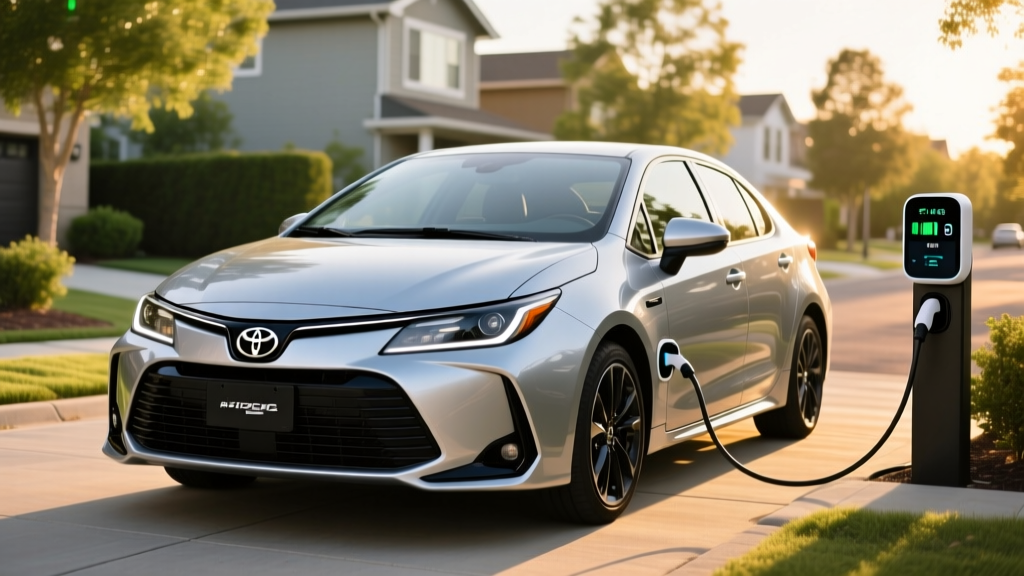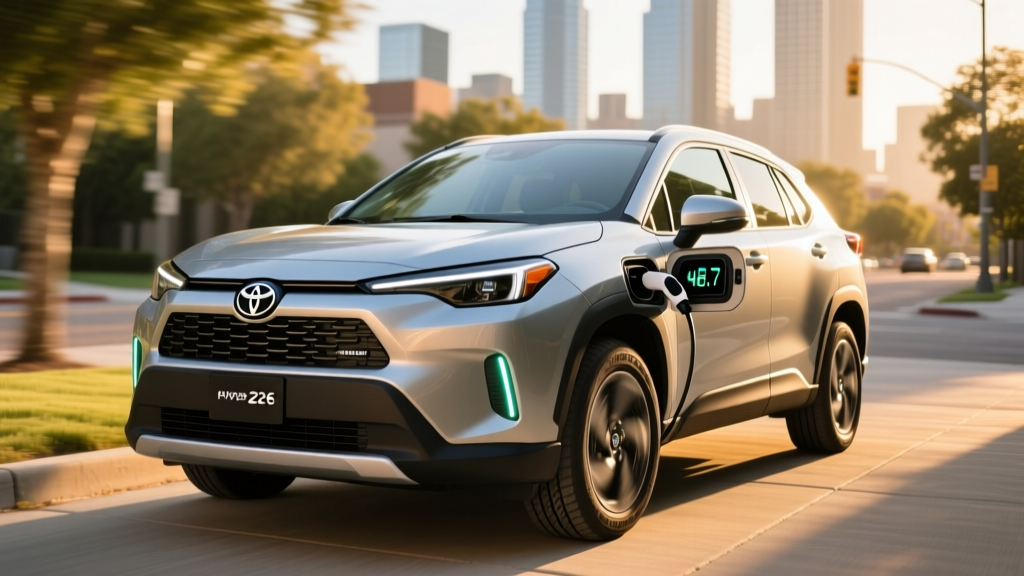
The 2026 Toyota Corolla Cross Hybrid occupies a specific niche: a compact crossover that delivers genuine fuel economy without requiring a plug, a charging routine, or a lifestyle change. For buyers who want electrified efficiency but lack home charging access or face frequent road trips, Toyota's fifth-generation hybrid system in a crossover body is worth a close look.
This guide covers the 2026 Corolla Cross Hybrid's EPA fuel economy, real-world MPG expectations, powertrain specs, pricing across trims, battery warranty details, and how it stacks up against both plug-in hybrids and full EVs in this price range.
HEV vs. PHEV: What the Corolla Cross Hybrid Actually Is
The 2026 Corolla Cross Hybrid is a conventional hybrid (HEV), not a plug-in hybrid (PHEV). This distinction matters for ownership:
- HEV (Corolla Cross Hybrid): You never plug it in. A small battery (roughly 1.0 kWh usable) charges via regenerative braking and the gasoline engine. It enables short electric-only bursts at low speeds but cannot be charged from a wall outlet.
- PHEV (e.g., Toyota RAV4 Prime): A larger battery (18.1 kWh) that you plug in for 30-42 miles of electric-only range before the gas engine engages.
- BEV (e.g., Tesla Model Y): No gas engine at all; 100% electric with 250+ miles of range and mandatory plug-in charging.
Toyota does not currently offer a Corolla Cross PHEV in the US market. If plug-in capability is a priority, the RAV4 Prime remains Toyota's compact-crossover PHEV option, though at a significantly higher starting price.
Fuel Economy: EPA Ratings and Real-World MPG
| Driving Condition | EPA Estimate | Real-World Expectation |
|---|---|---|
| City | 46 MPG | 44–50 MPG (hybrids often beat EPA in stop-and-go) |
| Highway | 38 MPG | 35–40 MPG (sustained 75+ mph reduces hybrid advantage) |
| Combined | 42 MPG | 39–44 MPG depending on driving mix |
The EPA rates the 2026 Corolla Cross Hybrid AWD at 42 MPG combined, with a notable city advantage of 46 MPG. This is where Toyota's hybrid system shines: at low speeds and in traffic, the electric motor handles more of the workload, and regenerative braking recaptures energy that a gas-only car would waste as heat.
Real-world caveat: In our experience with Toyota's fifth-generation hybrid platforms, city-heavy commuters routinely see 44–48 MPG. Highway-dominant drivers averaging 70–80 mph should expect 35–38 MPG. Cold weather (below 30°F) typically drops efficiency by 5–8 MPG as the engine runs more frequently for cabin heat and battery conditioning. These figures assume the standard AWD-i powertrain, which is the only configuration offered on the Hybrid.
Powertrain Specs: Horsepower, Engine, and Motors
| Specification | Detail |
|---|---|
| Engine | 2.0L 4-cylinder Atkinson-cycle |
| Combined System Horsepower | 196 hp |
| Electric Motors | Front motor + rear motor (AWD-i) |
| Drivetrain | Electronic AWD (all Hybrid trims) |
| Transmission | eCVT (electronically controlled) |
| 0–60 mph | ~7.5 seconds |
| Hybrid Battery (usable) | ~1.0 kWh (lithium-ion) |
| Towing Capacity | Not rated for towing |
| Fuel Tank | 10.6 gallons |
| Total Driving Range | ~445 miles (10.6 gal × 42 MPG) |
The 2026 Corolla Cross Hybrid pairs a 2.0-liter Atkinson-cycle four-cylinder with two electric motors — one driving the front axle and a smaller one powering the rear axle for all-wheel drive. Combined output is 196 horsepower, a meaningful step up from the 169 hp in the gas-only Corolla Cross.
The eCVT is not a traditional belt-and-pulley CVT; it uses a planetary gearset to blend engine and motor power. The result is smooth, linear acceleration without the rubber-band feeling some CVTs produce. The 0–60 time of approximately 7.5 seconds is adequate for merging and passing, though not sporty.
The rear electric motor engages automatically when the system detects front-wheel slip or during hard acceleration. Unlike mechanical AWD systems, there is no driveshaft — the rear motor provides torque independently, which also contributes to the hybrid's packaging efficiency and fuel economy.
2026 Pricing by Trim and Tax Credit Eligibility
| Trim | MSRP (est.) | Key Features |
|---|---|---|
| S Hybrid | $30,500 | AWD-i, 8" touchscreen, Toyota Safety Sense 3.0, wireless CarPlay/Android Auto |
| SE Hybrid | $32,000 | Sport-tuned suspension, 18" alloy wheels, SofTex seats, paddle shifters |
| XSE Hybrid | $34,500 | Heated front seats, JBL 9-speaker audio, power liftgate, ambient lighting |
Pricing is estimated based on 2025 carryover trends and may shift at official 2026 model release. Destination charge (~$1,350) not included.
Federal Tax Credit: Not Eligible. Under current IRS §30D rules, the Corolla Cross Hybrid does not qualify for the federal plug-in vehicle tax credit because it is a conventional HEV — it cannot be plugged in. The §30D credit applies only to plug-in electric vehicles (PHEVs and BEVs) with battery capacities of at least 7 kWh.
Some states and local utilities offer rebates for conventional hybrids, but these vary widely. Check your state energy office or utility provider for current programs. Consult a tax professional for personalized eligibility advice. (IRS §30D Clean Vehicle Credit rules)
Battery Warranty, Lifespan, and Replacement Cost
Hybrid Battery Warranty: Toyota covers the Corolla Cross Hybrid battery for 10 years or 150,000 miles (whichever comes first) across all 50 states. This applies to the traction (hybrid) battery, not the standard 12V auxiliary battery.
Hybrid System Warranty: The broader hybrid system components — including the inverter, electric motors, and eCVT — are covered for 8 years or 100,000 miles.
Toyota's hybrid battery longevity record is among the strongest in the industry. The Prius fleet, now spanning over 25 years of real-world data, shows that hybrid batteries commonly last 150,000–200,000+ miles before significant degradation. Unlike full EVs, the Corolla Cross Hybrid's battery is small (~1.0 kWh usable) and never deeply cycled — it typically operates between 40% and 80% state of charge, which dramatically reduces wear.
Replacement cost: If the hybrid battery does fail outside of warranty, a new OEM replacement typically costs between $2,000 and $3,500 including labor. Third-party refurbishment options exist for $1,000–$1,800. However, given the battery's small size and shallow cycling, out-of-warranty failure is uncommon.
The 12V auxiliary battery (which powers accessories and boots the vehicle computer) is a separate maintenance item, typically lasting 3–5 years and costing $150–$250 to replace — no different from a conventional vehicle.
Corolla Cross Hybrid vs. PHEV vs. Full EV: Which Fits You?
Choose the Corolla Cross Hybrid (HEV) if:
- You cannot install a home charger (apartment, street parking, landlord restrictions)
- You take frequent long road trips and don't want to plan around charging stops
- Your budget is under $35,000
- You want AWD for snow/rain without the complexity of a plug-in system
- You want minimal behavior change from a gas car
Choose a PHEV (e.g., RAV4 Prime, Hyundai Tucson PHEV) if:
- You can charge at home and your daily commute is under 35 miles
- You want electric-only driving for errands but gas flexibility for road trips
- You qualify for the §30D federal tax credit (up to $7,500 depending on income, MSRP caps, and battery sourcing)
Choose a full EV (e.g., Hyundai Ioniq 5, Tesla Model Y) if:
- You have reliable home Level 2 charging
- Your daily driving is under 200 miles and road trips are occasional
- You want zero tailpipe emissions and the lowest per-mile fuel cost
- You want to eliminate oil changes and gas-engine maintenance entirely
The Corolla Cross Hybrid's strongest competitive position is against gas-only compact crossovers. Compared to the gas Corolla Cross AWD (EPA 32 MPG combined), the hybrid saves roughly 1.8 gallons per 100 miles. At $3.40/gallon and 12,000 miles driven annually, that's about $730/year in fuel savings — enough to offset the hybrid's price premium over a gas model in roughly 3–4 years, depending on trim.
Reliability, Safety, and Ownership Costs
Toyota's hybrid systems have an established reliability track record. The Corolla Cross platform carries over proven components from the Corolla sedan and Prius lineages. IIHS and NHTSA ratings for the 2026 model year should be checked once published, but the prior-year Corolla Cross earned strong marks across crash-test categories.
Toyota Safety Sense 3.0 comes standard on every trim, including:
- Pre-Collision System with Pedestrian Detection
- Lane Departure Alert with Steering Assist
- Full-Speed Range Dynamic Radar Cruise Control
- Automatic High Beams
- Road Sign Assist
Important SAE Level note: These are Level 1 and Level 2 driver-assistance features. They do not make the vehicle self-driving. The driver must remain fully engaged, hands on the wheel, eyes on the road at all times.
Insurance costs for the Corolla Cross Hybrid are generally comparable to the gas version — insurers do not typically surcharge conventional hybrids the way they sometimes do for EVs. Expect annual premiums in the $1,200–$1,600 range depending on your profile and state.
Pros and Cons at a Glance
Pros
- 42 MPG combined with AWD standard — rare in this segment
- No plug-in required; zero behavior change from gas ownership
- 196 hp is peppy for a compact hybrid crossover
- 10-year/150,000-mile hybrid battery warranty
- ~445 miles of total range per tank
- Standard Toyota Safety Sense 3.0
Cons
- No federal tax credit (HEV, not PHEV/BEV)
- Cargo space (25.5 cu ft behind rear seats) trails some rivals
- Rear-seat legroom is tight for taller passengers
- Not rated for towing
- No PHEV variant available for electric-only commuting
- Base S Hybrid trim has a basic interior feel for the price
Frequently Asked Questions
How many MPG does the 2026 Corolla Cross Hybrid get?
The EPA rates it at 46 city / 38 highway / 42 combined MPG. Real-world results vary: city-heavy drivers often see 44–48 MPG, while sustained highway driving at 75+ mph typically yields 35–38 MPG.
Does the Corolla Cross Hybrid need to be plugged in?
No. It is a conventional hybrid (HEV). The battery charges itself through regenerative braking and the gasoline engine. You fuel it exclusively at a gas station, just like a conventional car.
How far can it go on electric only?
The Corolla Cross Hybrid can travel roughly 0.5–1 mile on electric power alone at very low speeds (under 25 mph). It is not designed for meaningful electric-only driving — that is the role of a PHEV or BEV.
Does the Corolla Cross Hybrid qualify for any tax credit?
It does not qualify for the federal §30D Clean Vehicle Credit, which is limited to plug-in vehicles with at least 7 kWh of battery capacity. Some state or utility hybrid incentives may apply — check your local programs.
Is the hybrid battery reliable and what does replacement cost?
Toyota's hybrid batteries are among the most durable in the industry, commonly lasting 150,000–200,000+ miles. The battery is warrantied for 10 years/150,000 miles. Out-of-warranty replacement runs $2,000–$3,500 for a new OEM unit, or $1,000–$1,800 for a refurbished pack.
Is the Corolla Cross Hybrid AWD?
Yes. Every 2026 Corolla Cross Hybrid trim comes standard with electronic AWD (AWD-i), using a dedicated rear electric motor. There is no FWD-only hybrid option.
How does it compare to the RAV4 Hybrid?
The RAV4 Hybrid is larger, offers more cargo room (37.5 cu ft), and gets a similar 41 MPG combined. It starts around $34,000 — roughly $3,500 more than the Corolla Cross Hybrid. If you need more interior space, the RAV4 is worth the premium. If compact dimensions and a lower price matter more, the Corolla Cross Hybrid is the better fit.