Quick Verdict: A Hybrid Sedan That Nails the Basics
The 2026 Toyota Camry Hybrid remains one of the most pragmatic midsize sedans on the market. Now exclusively offered as a hybrid (Toyota dropped the gas-only four-cylinder after 2024), the Camry pairs a 2.5-liter four-cylinder with Toyota's fifth-generation hybrid system for an EPA-estimated 51 city / 49 highway / 50 combined MPG in front-wheel-drive trims. The 2026 model carries over the redesigned interior introduced with the ninth generation, featuring a 12.3-inch infotainment display on upper trims, wireless Apple CarPlay and Android Auto, and a cabin that prioritizes material quality and ergonomics over flash.
For buyers weighing a hybrid against a plug-in hybrid or full battery-electric vehicle, the Camry Hybrid occupies a clear lane: maximum fuel efficiency with zero lifestyle change. No plug, no range anxiety, no charging logistics — just fill up and drive.
2026 Toyota Camry Hybrid Interior: Materials, Tech, and Space
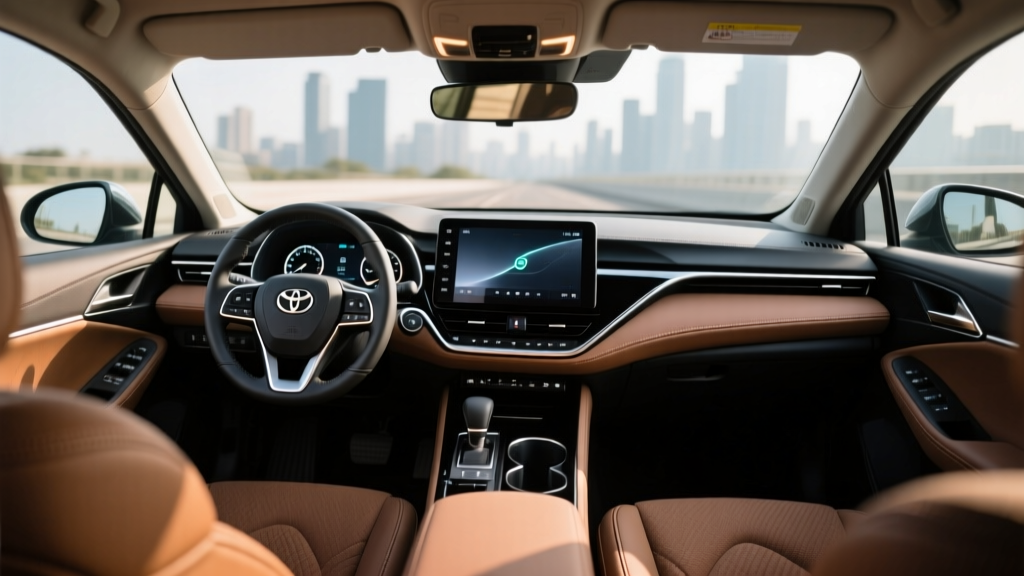
The keyword bringing many shoppers here is the 2026 Toyota Camry Hybrid interior, and it delivers a meaningful step up from the previous generation. Toyota moved the Camry upmarket with soft-touch materials on the dashboard and door panels, available heated and ventilated front seats, and a standard 8-inch or available 12.3-inch touchscreen running Toyota's latest Audio Multimedia system.
Infotainment and Connectivity
- LE / SE trims: 8-inch touchscreen, wireless Apple CarPlay and Android Auto, six speakers
- XLE / XSE trims: 12.3-inch touchscreen, navigation, 9-speaker JBL premium audio (available)
- Standard across trims: Bluetooth, USB-C ports (front and rear), Wi-Fi Connect trial
The interface is responsive and logically laid out. Physical knobs for volume and tuning remain — a deliberate choice that Camry buyers consistently prefer over all-touch setups. A 12.3-inch digital driver information display replaces analog gauges on XLE and XSE trims, showing hybrid energy flow, battery state of charge, and trip efficiency data.
Seating and Cargo
Front seats offer generous cushioning with available eight-way power adjustment and lumbar support on the XLE. Rear legroom measures 38.0 inches — competitive with the Honda Accord Hybrid and Hyundai Sonata Hybrid. The trunk provides 15.1 cubic feet of cargo space. Because the hybrid battery is packaged under the rear seats (not intruding into the trunk), cargo volume matches the previous gas Camry exactly. Rear seats fold 60/40 for longer items.
Cabin Noise and Ride Quality
Toyota added acoustic-laminated front glass and additional sound deadening for the ninth generation. At highway speeds, the Camry Hybrid is noticeably quieter than its predecessor, though the 2.5-liter engine still announces itself under hard acceleration — a characteristic of the e-CVT powertrain rather than a traditional geared transmission.
Powertrain and Performance Specs
The 2026 Camry Hybrid uses Toyota's fifth-generation hybrid synergy drive. Here's the full breakdown:
| Specification | Detail |
|---|---|
| Engine | 2.5L Dynamic Force 4-cylinder (Atkinson cycle) |
| Engine Output | 184 hp / 163 lb-ft torque |
| Electric Motor (FWD) | 100 kW front motor |
| Combined System Output | 225 hp (FWD) / 232 hp (AWD) |
| AWD Motor | 30 kW rear motor (AWD-e trims) |
| Transmission | e-CVT (electronically controlled continuously variable) |
| Hybrid Battery | Lithium-ion, ~1.0 kWh (self-charging HEV — not plug-in) |
| 0-60 mph | ~7.2 seconds (FWD), ~7.0 seconds (AWD) |
| Drivetrain | FWD standard; electronic AWD available |
The 225-horsepower combined output provides confident merging and passing. The AWD-e system engages the rear motor automatically during acceleration from a stop or when front-wheel slip is detected, improving traction without a mechanical driveshaft. Unlike a plug-in hybrid, this system has no electric-only driving mode — the gasoline engine and electric motor work together seamlessly, and the battery recharges through regenerative braking and engine power.
Fuel Economy: EPA Estimates vs. Real-World MPG
Fuel efficiency is the Camry Hybrid's headline act. Per fueleconomy.gov, here are the official EPA estimates:
| Drivetrain | City | Highway | Combined |
|---|---|---|---|
| FWD (LE, XLE) | 51 MPG | 49 MPG | 50 MPG |
| AWD-e (SE, XSE) | 48 MPG | 47 MPG | 47 MPG |
Real-World MPG: What Owners Actually See
Toyota hybrids have a well-documented tendency to exceed their EPA city estimates in real-world driving, thanks to aggressive regenerative braking and frequent electric-motor-only operation at low speeds. In mixed suburban driving with moderate stop-and-go traffic, many owners report 52-55 MPG on FWD trims. Highway fuel economy tends to track closer to the EPA number or slightly below — expect 45-48 MPG at sustained 70-75 mph speeds, as the engine carries more of the load at higher velocities.
In cold weather (below 30°F), expect a temporary 5-10% fuel economy reduction during short trips as the engine runs more frequently to warm the cabin and bring the catalytic converter to operating temperature. This is normal hybrid behavior, not a defect.
HEV vs. PHEV vs. EV: Which Fits Your Situation?
The Camry is offered only as a conventional hybrid (HEV) — it is not a plug-in hybrid and cannot be charged from an outlet. Here's how it compares to the other electrification paths:
| Factor | HEV (Camry Hybrid) | PHEV (e.g., Prius Prime) | BEV (e.g., Tesla Model 3) |
|---|---|---|---|
| Plug-in Required? | No | Yes (for EV range) | Yes |
| Electric-Only Range | 0 miles (EV assist only) | 35-44 miles typical | 250-350+ miles |
| Total Range | ~660 miles | ~500-600 miles | 250-350+ miles |
| Home Charging Needed? | No | Recommended | Essential |
| Federal Tax Credit | Not eligible (§30D) | Up to $7,500* | Up to $7,500* |
| Best For | No home charging; road trips | Short commutes + home outlet | Home Level 2; low daily miles |
*Federal §30D tax credit eligibility depends on MSRP caps, buyer income limits, battery sourcing, and critical mineral requirements. Consult IRS.gov or a tax professional before purchasing.
Pricing, Trims, and Tax Credit Eligibility
The 2026 Camry Hybrid is offered across four trims, with FWD and AWD-e availability varying by trim:
| Trim | Drivetrain | MSRP (incl. destination) |
|---|---|---|
| LE | FWD | $29,990 |
| LE | AWD-e | $31,390 |
| SE | FWD | $31,490 |
| SE | AWD-e | $32,890 |
| XLE | FWD | $34,490 |
| XLE | AWD-e | $35,890 |
| XSE | FWD | $35,090 |
| XSE | AWD-e | $36,490 |
Federal Tax Credit Status
Because the Camry Hybrid is a conventional HEV (not a plug-in vehicle), it does not qualify for the federal §30D Clean Vehicle Credit, which applies only to plug-in electric vehicles and fuel-cell vehicles. There is currently no federal tax credit for conventional hybrids.
Some states offer their own incentives for hybrid purchases, though these vary widely and change frequently. Check your state's energy office or department of revenue for current programs.
Battery Warranty, Reliability, and Replacement Cost
Hybrid battery longevity is consistently the top concern among first-time hybrid buyers. Toyota addresses this with one of the strongest hybrid battery warranties in the industry:
10 years / 150,000 miles (whichever comes first) for the hybrid battery and hybrid system components. This applies to all 50 states. The warranty covers capacity loss below a defined threshold and any hybrid-system-related defect.
Real-World Battery Longevity
Toyota's hybrid batteries have an extensive track record. The Prius, which shares similar hybrid architecture, has demonstrated battery packs lasting 150,000-200,000+ miles with minimal degradation. The Camry Hybrid's lithium-ion pack is smaller and less stressed than a PHEV or BEV battery, since it operates in a narrow state-of-charge window (typically 40-80% SoC) managed by the hybrid control system. This shallow cycling significantly extends cell life.
Battery Replacement Cost
Should the hybrid battery require replacement outside of warranty, expect the following:
- New OEM battery: $2,500 - $3,500 (parts and labor at a Toyota dealer)
- Refurbished/reconditioned battery: $1,500 - $2,200 (independent hybrid specialists)
- Individual module replacement: $300 - $600 (if only one or two cells have failed)
For context, the hybrid battery is far less expensive to replace than a full BEV traction battery ($8,000-$20,000+), because the Camry's pack stores roughly 1 kWh versus 60-85 kWh in a typical EV.
Overall Reliability
Toyota consistently ranks at or near the top of dependability studies. The e-CVT transmission has no conventional clutch packs, torque converter, or gear sets to wear — it's a planetary gearset connecting the engine and two motor-generators. This mechanical simplicity contributes to long-term durability. According to IIHS, the current-generation Camry has earned top safety ratings, and Toyota Safety Sense 3.0 (pre-collision, lane tracing, adaptive cruise, road sign assist) comes standard on every trim.
Pros, Cons, and Who Should Buy the Camry Hybrid
Pros
- 50 MPG combined (FWD) — class-leading for a midsize sedan
- No plug-in required; zero lifestyle change vs. gas car
- 660-mile total range per tank
- 10-year/150,000-mile hybrid battery warranty
- Standard AWD-e availability across trims
- Refined, quiet interior with modern tech
- Competitive pricing from under $30,000
- Standard Toyota Safety Sense 3.0 suite
Cons
- No plug-in/PHEV variant available
- No federal tax credit eligibility
- e-CVT drone under hard acceleration
- AWD-e trims drop to 47 MPG combined
- Rear headroom slightly tight for 6'2"+ passengers
- Base LE infotainment is 8-inch (not 12.3-inch)
- No spare tire — tire inflator kit only
Who Should Choose the Camry Hybrid?
Choose the Camry Hybrid if: You want maximum MPG without changing your fueling habits, you lack access to home or workplace charging, you regularly take long road trips, or you want a proven, low-risk hybrid from the brand with the deepest hybrid track record.
Look at a PHEV (Prius Prime) instead if: You have a garage or driveway with a 120V outlet, your daily commute is under 40 miles round-trip, and you want electric-only driving for most daily trips while retaining a gas engine for longer journeys.
Look at a full BEV (Model 3, Ioniq 6) instead if: You can install a Level 2 home charger, your daily driving is under 250 miles, you want zero tailpipe emissions, and you want to access the $7,500 federal tax credit (subject to eligibility).
Frequently Asked Questions
How many MPG does the 2026 Camry Hybrid get?
The FWD Camry Hybrid achieves an EPA-estimated 51 city / 49 highway / 50 combined MPG. AWD-e trims rate at 48/47/47 MPG. Real-world city driving often yields 52-55 MPG in FWD models due to frequent electric-motor assist at low speeds.
Does the Camry Hybrid need to be plugged in?
No. The 2026 Camry Hybrid is a conventional hybrid (HEV). The battery charges through regenerative braking and the gasoline engine. You fuel it like any other car at a gas station.
How far can the Camry Hybrid go on electric only?
The Camry Hybrid does not have a dedicated electric-only driving mode with meaningful range. The electric motor assists the engine and can propel the car at very low speeds (parking lots, creeping in traffic) for brief distances, but the gasoline engine engages almost immediately during normal driving. For electric-only commuting, you need a PHEV or BEV.
Is the Camry Hybrid reliable and what does a battery replacement cost?
Toyota's hybrid system is among the most proven in the industry, with millions of units on the road. The hybrid battery is warrantied for 10 years/150,000 miles. Out-of-warranty replacement costs $2,500-$3,500 for a new OEM battery — far less than a full EV battery replacement.
Does the 2026 Camry Hybrid qualify for any tax credit?
No. The federal §30D Clean Vehicle Credit applies only to plug-in electric vehicles and fuel-cell vehicles. As a conventional hybrid, the Camry Hybrid is not eligible. Some states may offer separate hybrid incentives — check your state's energy or revenue department for current programs.
What's the difference between the Camry Hybrid and the Prius?
The Camry Hybrid is a midsize sedan with more interior space, a smoother ride, and available AWD-e. The Prius (and Prius Prime PHEV) is a compact liftback with slightly higher MPG (57 combined) and, in the Prime variant, 44 miles of plug-in electric range. The Camry prioritizes comfort and presence; the Prius prioritizes maximum efficiency and cargo versatility.