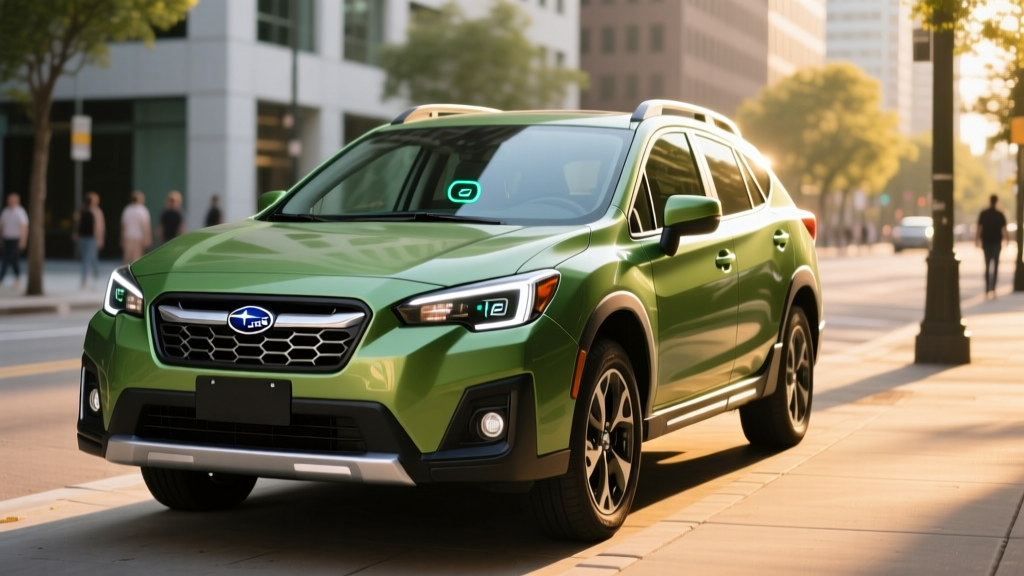
The Subaru Crosstrek has long been the default compact crossover for outdoor-minded buyers who need standard all-wheel drive without paying a luxury premium. For 2026, Subaru expands the lineup with a conventional hybrid variant that pairs its familiar 2.0-liter boxer engine with an electric motor and a compact lithium-ion battery pack. Unlike a plug-in hybrid (PHEV), the 2026 Subaru Hybrid Crosstrek never needs to be plugged in — it recovers energy through regenerative braking and the engine itself, making it a straightforward step up from the gas-only model for buyers who want better fuel economy without changing their habits.
This guide breaks down the Hybrid Crosstrek's EPA ratings, real-world efficiency expectations, powertrain details, pricing, and how it compares to both PHEV rivals and full battery-electric vehicles (BEVs). If you're weighing whether to go hybrid, plug-in, or full electric, the data below will help you decide.
Hybrid vs. Plug-In Hybrid: What the Crosstrek Actually Is
Before diving into specs, it's critical to understand the distinction, because Subaru has offered a Crosstrek Hybrid PHEV in previous model years (discontinued after 2023). The 2026 model is a conventional hybrid (HEV), not a plug-in.
| Feature | 2026 Crosstrek Hybrid (HEV) | PHEV (e.g., prior Crosstrek Hybrid, Toyota RAV4 Prime) |
|---|---|---|
| Plug-in charging required? | No — self-charging via regen and engine | Yes — plug in for electric-only miles |
| Electric-only range | None (motor assists engine only) | 17–42 miles typical |
| Battery size | ~1.1 kWh (small buffer) | 13–18 kWh usable |
| Federal tax credit (§30D) | Not eligible | Up to $7,500 if eligible (sourcing/income rules apply) |
| Home charger needed? | No | Recommended for daily EV driving |
| Complexity | Low — drive like a gas car | Higher — manage charge schedule, EV mode |
The takeaway: the 2026 Hybrid Crosstrek is designed for buyers who want a MPG boost with zero behavioral change. If you want electric-only commuting, you'll need to look at a PHEV or BEV instead.
EPA Fuel Economy and Real-World MPG
The gas-only 2026 Crosstrek with the 2.0-liter engine rates at 27 city / 34 highway / 29 combined MPG according to the EPA. The hybrid powertrain meaningfully improves those figures, particularly in city driving where regenerative braking and electric-motor assist do the most work.
| Powertrain | City MPG | Highway MPG | Combined MPG |
|---|---|---|---|
| 2.0L Gas (Base/Premium/Sport) | 27 | 34 | 29 |
| 2.5L Gas (Sport/Limited) | 26 | 33 | 29 |
| 2026 Hybrid (estimated) | 35 | 37 | 36 |
Real-World MPG Expectations: Conventional hybrids typically exceed their EPA city rating in stop-and-go traffic, where the electric motor handles low-speed propulsion and regen recovers braking energy. Expect 37–40 MPG in urban driving. Highway driving at 70–80 MPH yields closer to 33–35 MPG because the engine carries more of the load. In sub-freezing temperatures, anticipate a 2–4 MPG drop due to colder engine operation, increased cabin heating demand, and reduced battery efficiency.
Over 15,000 miles per year, the hybrid's ~7 MPG combined improvement over the gas model saves roughly 85 gallons of fuel annually — about $260–$310 per year at $3.10–$3.60/gallon depending on your region.
Powertrain: Engine, Motor, and Combined Output
Subaru's 2026 hybrid system pairs the 2.0-liter direct-injection boxer four-cylinder with an integrated electric motor mounted between the engine and the Lineartronic CVT. The motor draws from a compact lithium-ion battery pack (approximately 1.1 kWh total capacity) mounted under the rear cargo floor, preserving the Crosstrek's 20.1 cu ft of cargo space behind the rear seats.
| Specification | Detail |
|---|---|
| Engine | 2.0L DOHC boxer 4-cylinder, direct injection |
| Engine output | 152 hp / 145 lb-ft torque |
| Electric motor | Integrated AC synchronous motor |
| Motor output | ~20 kW (~27 hp) assist |
| Combined system output | ~168 hp (estimated) |
| Transmission | Lineartronic CVT with manual mode |
| Drivetrain | Symmetrical All-Wheel Drive (standard) |
| Battery type | Lithium-ion, ~1.1 kWh |
| Battery location | Under rear cargo floor |
| 0–60 mph (estimated) | ~8.8 seconds |
| Ground clearance | 8.7 inches |
| Towing capacity | 1,500 lbs |
The electric motor's primary role is torque fill at low RPMs (smoothing out the CVT's off-the-line response), enabling engine-off coasting at low speeds, and capturing energy during deceleration. Unlike Toyota's hybrid system, which can propel the vehicle on electric power alone for short distances at low speed, Subaru's system is more engine-centric — the motor assists rather than replaces the gasoline engine.
The standard Symmetrical AWD system remains fully intact. Subaru uses a multi-plate transfer clutch to distribute torque front-to-rear, and the hybrid system does not compromise the Crosstrek's X-Mode traction management or 8.7 inches of ground clearance — key differentiators against front-wheel-drive hybrid crossovers like the Honda HR-V Hybrid or Hyundai Kona Hybrid.
Pricing, Trims, and Tax Credit Eligibility
Subaru positions the Hybrid Crosstrek in the mid-to-upper portion of the lineup. Based on the 2026 pricing structure, expect the hybrid powertrain to be available on Sport and Limited trims.
| Trim | MSRP (est.) | Hybrid Premium Over Gas |
|---|---|---|
| Sport Hybrid | $32,495 | ~$1,800 |
| Limited Hybrid | $35,195 | ~$1,800 |
Federal tax credit: The 2026 Crosstrek Hybrid is a conventional HEV and does not qualify for the IRS §30D New Clean Vehicle Credit. That credit (up to $7,500) applies only to plug-in electric vehicles — BEVs and PHEVs — that meet battery-sourcing, critical-mineral, MSRP cap, and buyer income requirements. Some states offer modest rebates for conventional hybrids (typically $250–$500), but these vary widely. Check your state energy office or the AFDC state incentive database for current local programs.
At a ~$1,800 premium over the equivalent gas model, the hybrid's fuel savings of roughly $285/year yield a payback period of approximately 6.3 years at 15,000 miles/year. If fuel prices rise or your annual mileage is higher, the payback shortens. Buyers who plan to keep the Crosstrek for 8–10 years will see a net savings; those who trade every 3–4 years will not recoup the premium through fuel alone — though the hybrid may command a modest resale-value advantage.
Battery Warranty, Reliability, and Replacement Cost
Hybrid battery longevity is the top concern for buyers new to electrified powertrains. Subaru covers the hybrid battery and related components under its hybrid system warranty:
Subaru Hybrid Battery Warranty: 8 years / 100,000 miles (whichever comes first) in most states. In California Air Resources Board (CARB) states — including CA, CO, CT, ME, MD, MA, NJ, NY, OR, RI, VT, WA — the hybrid battery warranty extends to 10 years / 150,000 miles under PZEV/ULEV emissions warranty requirements.
The ~1.1 kWh lithium-ion pack in the Hybrid Crosstrek is small and lightly stressed compared to a BEV or PHEV battery. It never undergoes deep discharge cycles (the system maintains a narrow state-of-charge window, typically 40–80%), which is the primary factor in long-term lithium-ion longevity. Based on industry data from comparable mild and full hybrid systems, degradation to 70–80% of original capacity at 150,000 miles is typical, and most hybrid batteries outlast the vehicle itself.
If replacement is needed out of warranty, expect a cost of $2,000–$3,500 for the hybrid battery pack (parts and labor) at a Subaru dealer. Third-party hybrid battery refurbishers offer reconditioned units for $1,200–$2,000. For context, this is significantly less than a PHEV or BEV battery replacement, which can run $6,000–$18,000+.
Subaru's reliability reputation, backed by the boxer engine's long production history and the relatively simple addition of a small motor and battery, positions the Hybrid Crosstrek favorably. The hybrid system adds few wear items — there is no additional transmission, no plug-in charging hardware, and the regenerative braking system actually reduces brake pad wear.
Hybrid Crosstrek vs. PHEVs and Full EVs: Which Fits You?
The 2026 Crosstrek Hybrid occupies a specific niche. Here's how to determine if it's the right electrified choice, or if you should look at a PHEV or BEV instead.
Choose the 2026 Crosstrek Hybrid (HEV) if:
- You don't have access to home or workplace charging (apartment, street parking, no garage outlet)
- You want better MPG with zero change to your driving or fueling routine
- You need standard AWD with 8.7" ground clearance for snow, dirt roads, or trailheads
- Your budget is under $36,000 and you want to avoid the PHEV/BEV price premium
- You keep vehicles 7+ years and value long-term fuel savings
Choose a PHEV (e.g., Toyota RAV4 Prime, Subaru's future PHEV) if:
- You have Level 2 home charging and a commute under 35 miles round-trip
- You want electric-only daily driving but gas flexibility for road trips
- You qualify for the §30D federal tax credit (income and sourcing rules apply — see IRS.gov)
Choose a full BEV (e.g., Hyundai Ioniq 5, Tesla Model Y, Subaru Solterra) if:
- You have reliable home Level 2 charging
- Your daily driving is under 250 miles and you're comfortable with DC fast charging on road trips
- You want the lowest per-mile fuel cost (~$0.04–$0.06/mile on home electricity vs. ~$0.12–$0.14/mile for the hybrid on gas)
- You want to eliminate oil changes and minimize drivetrain maintenance
Pros, Cons, and the Bottom Line
Pros
- Standard Symmetrical AWD — no FWD compromise
- ~7 MPG combined improvement over gas model
- No plug-in required; zero behavioral change
- Preserves full cargo space and 8.7" ground clearance
- 8-year/100,000-mile hybrid battery warranty (10/150k in CARB states)
- Reduced brake wear from regenerative braking
Cons
- No electric-only driving capability
- Not eligible for the $7,500 federal §30D tax credit
- ~$1,800 hybrid premium with a 6+ year fuel payback
- Modest motor assist (~27 hp) — not a performance hybrid
- Towing limited to 1,500 lbs (same as gas model)
- CVT drone under hard acceleration remains
The 2026 Subaru Hybrid Crosstrek is not trying to be an EV. It's a pragmatic efficiency upgrade for the buyer who already loves the Crosstrek formula — standard AWD, generous ground clearance, rugged styling — and wants to spend less at the pump without adding a charging cable to their routine. If your lifestyle includes home charging and a short commute, a PHEV or BEV will save you more. But if you park on the street, drive in all weather, and want a simple, proven path to better MPG, the Hybrid Crosstrek delivers exactly what it promises.
Frequently Asked Questions
How many MPG does the 2026 Subaru Hybrid Crosstrek get?
The 2026 Crosstrek Hybrid is estimated to achieve 35 city / 37 highway / 36 combined MPG. Real-world city driving often yields 37–40 MPG thanks to regenerative braking, while sustained highway driving at 75+ MPH may return 33–35 MPG. Cold weather reduces efficiency by 2–4 MPG.
Does the 2026 Crosstrek Hybrid need to be plugged in?
No. The Crosstrek Hybrid is a conventional hybrid (HEV). Its small lithium-ion battery charges through regenerative braking and the gasoline engine. You fuel it exactly like a gas-only car — there is no plug, no charging cable, and no electric-only range.
Does the 2026 Subaru Hybrid Crosstrek qualify for a tax credit?
It does not qualify for the federal §30D New Clean Vehicle Credit, which is reserved for plug-in vehicles (BEVs and PHEVs) meeting battery sourcing, MSRP, and buyer income requirements. Some states offer small hybrid rebates ($250–$500); check your state's energy office for details.
How long will the hybrid battery last, and what does replacement cost?
Subaru warranties the hybrid battery for 8 years/100,000 miles (10 years/150,000 miles in CARB states). The small battery operates in a narrow charge window that minimizes degradation, and most hybrid batteries last the life of the vehicle. Out-of-warranty replacement runs $2,000–$3,500 at a dealer, or $1,200–$2,000 from a third-party refurbisher.
Is the Hybrid Crosstrek better than a full EV like the Subaru Solterra?
They serve different buyers. The Solterra (a BEV co-developed with Toyota) offers ~222 miles of EPA range, zero tailpipe emissions, and fuel costs of ~$0.05/mile on home electricity — but it requires home charging access, costs significantly more (~$44,995 base before credits), and has lower ground clearance (8.3"). The Hybrid Crosstrek is the better pick for buyers without charging access, who need maximum ground clearance, or who regularly exceed 250 miles between stops.
Will Subaru offer a Crosstrek PHEV (plug-in hybrid) again?
Subaru discontinued the previous Crosstrek PHEV after the 2023 model year. As of early 2026, Subaru has not announced a successor PHEV for the Crosstrek, though the brand has committed to offering electrified options across its lineup by the late 2020s. The current 2026 Hybrid Crosstrek is a conventional HEV only.