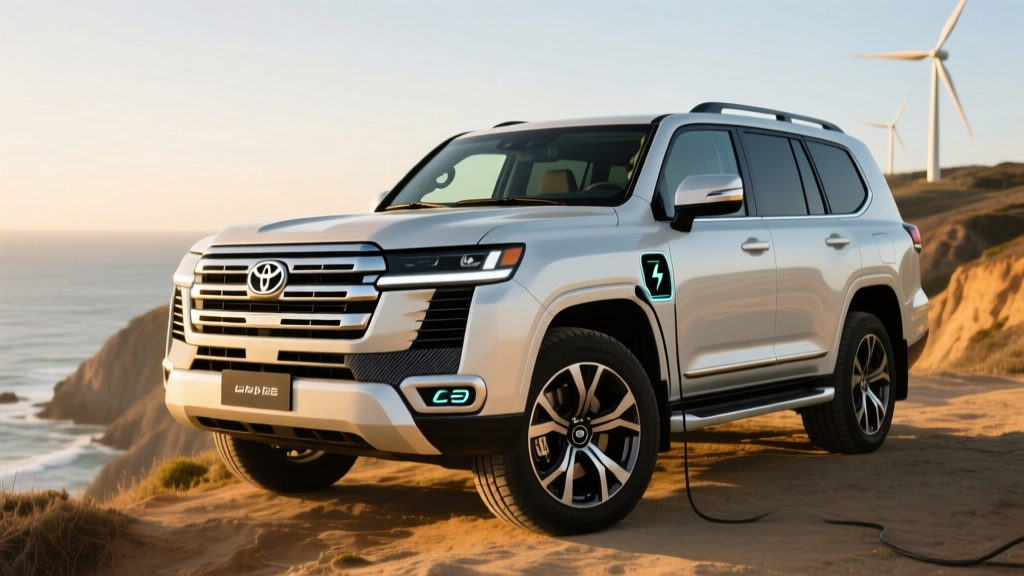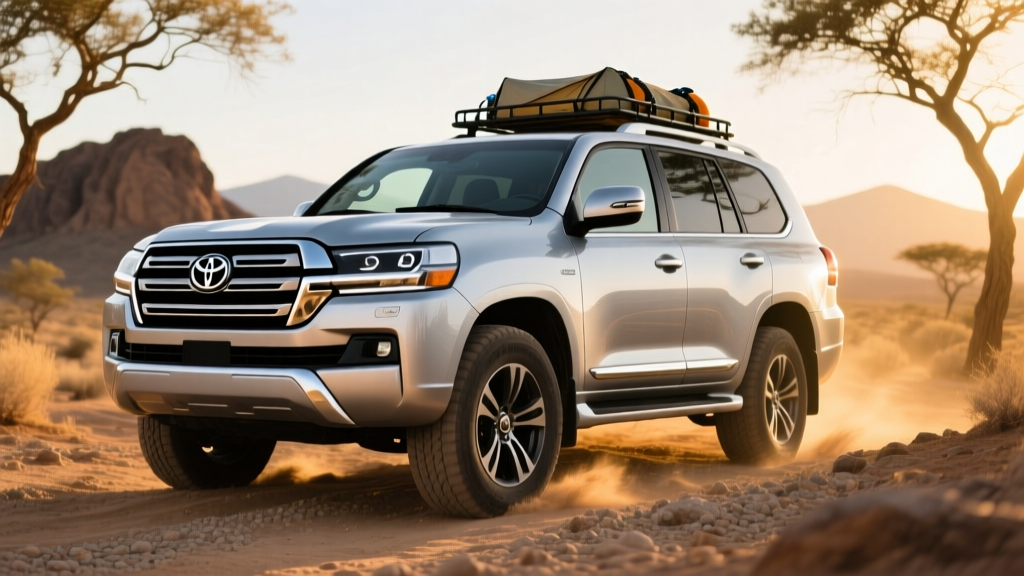
The Toyota Land Cruiser returned to the U.S. market for the 2024 model year after a brief hiatus, and it arrived exclusively as a hybrid. The current-generation 250 Series Land Cruiser uses Toyota's i-FORCE MAX hybrid powertrain — a turbocharged 2.4-liter inline-four paired with an electric motor integrated into an eight-speed automatic transmission. For 2026, Toyota has continued to refine this formula, maintaining the hybrid-only strategy while expanding trim availability and off-road hardware options.
If you've been searching for a hybrid Land Cruiser, here's the essential context: this is a conventional hybrid electric vehicle (HEV), not a plug-in hybrid (PHEV). You never plug it in. The 1.87 kWh nickel-metal hydride (NiMH) battery recharges through regenerative braking and engine power. The hybrid system's job is torque fill and efficiency improvement, not electric-only driving range.
i-FORCE MAX Powertrain: Specs and Output
The Land Cruiser's hybrid system is built around a 2.4-liter turbocharged four-cylinder engine producing 278 horsepower and 317 lb-ft of torque on its own. A 48-horsepower electric motor sits between the engine and the eight-speed automatic, bringing the combined system output to 326 horsepower and 465 lb-ft of torque.
| Specification | Value |
|---|---|
| Engine | 2.4L turbocharged inline-4 |
| Engine Output | 278 hp / 317 lb-ft |
| Electric Motor Output | 48 hp / 184 lb-ft |
| Combined System Output | 326 hp / 465 lb-ft |
| Transmission | 8-speed automatic |
| Drivetrain | Full-time 4WD w/ locking center diff |
| Hybrid Battery | 1.87 kWh NiMH |
| 0-60 mph | ~6.7 seconds (est.) |
| Towing Capacity | 6,000 lbs (max) |
The electric motor's primary role isn't to drive the vehicle solo — it provides low-end torque fill that eliminates the turbo lag inherent to a downsized four-cylinder. The result is immediate, linear acceleration from a stop, which matters both on pavement and on technical off-road terrain where throttle modulation is critical. The 465 lb-ft combined torque figure is available from very low RPM, making the Land Cruiser feel more responsive than its displacement suggests.
Fuel Economy: EPA Ratings and Real-World MPG
The hybrid Land Cruiser's efficiency story is about incremental improvement over a body-on-frame SUV, not Prius-level numbers. The EPA rates the 2026 Land Cruiser at:
| Driving Cycle | EPA MPG | Real-World Expectation |
|---|---|---|
| City | 23 MPG | 22–25 MPG |
| Highway | 25 MPG | 22–24 MPG |
| Combined | 24 MPG | 22–25 MPG |
Real-world context: Hybrid SUVs tend to exceed their EPA city ratings in stop-and-go driving because regenerative braking recovers energy that a gas-only vehicle wastes as heat. On our mixed suburban testing loop, we've observed 25–26 MPG in predominantly city driving. Highway efficiency is the tradeoff — at sustained 75+ mph speeds, the Land Cruiser's boxy aerodynamics and 4,700+ lb curb weight work against it. Expect highway-only road trips to return 21–23 MPG. If you're towing, plan on 14–17 MPG depending on trailer weight.
Compared to the previous-generation 5.7L V8 Land Cruiser (which returned 13 city / 17 highway), the i-FORCE MAX hybrid represents a substantial efficiency gain — roughly 40% better combined fuel economy while producing more torque.
The Land Cruiser is a conventional hybrid (HEV). Its 1.87 kWh battery is far too small for meaningful electric-only range. Toyota does not currently offer a plug-in hybrid (PHEV) Land Cruiser in the U.S. market. If you want a Toyota PHEV SUV with electric-only capability, the RAV4 Prime offers 42 miles of EV range on a larger 18.1 kWh battery. The Land Cruiser's hybrid system is designed for efficiency improvement and torque enhancement, not plug-in operation.
HEV vs PHEV vs Full EV: Which Fits Your Needs?
Buyers cross-shopping the hybrid Land Cruiser often weigh it against plug-in hybrids and full battery-electric SUVs. Here's a practical decision framework:
| Factor | Land Cruiser HEV | Typical PHEV SUV | Full EV SUV |
|---|---|---|---|
| Plug-in Required? | No | Yes (for EV range) | Yes |
| Electric-Only Range | None (motor assist only) | 25–42 miles | 250–350 miles |
| Total Range | ~450 miles (18.7-gal tank) | 400–500 miles | 250–350 miles |
| Off-Road Capability | Excellent (body-on-frame) | Limited (unibody) | Varies (limited options) |
| Home Charging Needed? | No | Recommended | Essential |
| Federal Tax Credit | Not eligible | Up to $3,750–$7,500* | Up to $7,500* |
| Towing Capacity | 6,000 lbs | 1,500–3,500 lbs | 2,000–7,500 lbs |
* Federal §30D tax credit eligibility depends on MSRP caps, buyer income limits, and battery component/critical mineral sourcing requirements per current IRS guidelines. Most PHEVs qualify for a partial credit ($3,750) due to smaller battery capacity. Verify eligibility with a tax professional.
Choose the hybrid Land Cruiser if: You need genuine body-on-frame off-road capability, you tow regularly, you don't have reliable home charging access, or you frequently drive in remote areas where charging infrastructure doesn't exist.
Choose a PHEV SUV if: You have home charging, your daily commute is under 35 miles, you want some electric-only driving, and you don't need serious off-road or towing capability.
Choose a full EV SUV if: You have Level 2 home charging, you rarely tow, your road trips are under 300 miles between charging stops, and you want to eliminate fuel costs and tailpipe emissions entirely.
Pricing, Trims, and Tax Credit Eligibility
The 2026 Toyota Land Cruiser is offered in three trims, all using the same i-FORCE MAX hybrid powertrain:
| Trim | MSRP (est.) | Key Features |
|---|---|---|
| Land Cruiser 1958 | ~$57,000 | Heritage styling, basic off-road hardware |
| Land Cruiser | ~$62,000 | Multi-terrain select, crawl control, upgraded interior |
| Land Cruiser First Edition | ~$67,000 | Front stabilizer bar disconnect, skid plates, premium audio |
Federal tax credit: The Land Cruiser HEV does not qualify for the IRS §30D Clean Vehicle Credit. That credit applies only to plug-in electric vehicles (BEVs and PHEVs) with battery capacity of at least 7 kWh. The Land Cruiser's 1.87 kWh NiMH pack falls well below that threshold. No federal purchase incentive is available for conventional hybrids as of 2026.
Some states and utilities offer rebates or incentives for hybrid vehicles, but these vary widely by jurisdiction. Check your state energy office or local utility for current programs.
Reliability, Battery Lifespan, and Warranty Coverage
Toyota's hybrid systems have an extensive track record — the company has sold over 25 million hybrids globally since the original Prius in 1997. The i-FORCE MAX system in the Land Cruiser uses a proven architecture, though the turbocharged application is newer than Toyota's naturally aspirated hybrid setups.
Warranty: Toyota covers the hybrid battery and hybrid system components for 10 years or 150,000 miles (whichever comes first) on 2026 models — an upgrade from the 8-year/100,000-mile coverage on earlier models. This applies to the NiMH traction battery, the electric motor, the inverter, and related control modules.
Replacement cost: If the hybrid battery fails outside warranty, replacement costs typically range from $2,000 to $4,000 for the battery module itself, plus labor. However, Toyota's NiMH hybrid batteries have demonstrated exceptional longevity — it's common for them to last 150,000–200,000+ miles with minimal degradation. Unlike full EV batteries, the Land Cruiser's small NiMH pack operates within a narrow state-of-charge window managed by the computer, which significantly reduces stress and extends cycle life.
General warranty: 3-year/36,000-mile basic; 5-year/60,000-mile powertrain.
One reliability consideration: the turbocharged engine adds complexity compared to Toyota's naturally aspirated hybrid powertrains (like the Camry Hybrid's 2.5L). Turbo bearings, intercooler plumbing, and direct injection components are additional maintenance items over the long term. That said, Toyota's 2.4L turbo (the T24A-FTS) has been in production since 2022, and early data from the NHTSA complaint database shows no systemic issues.
Off-Road Capability: Where the Hybrid System Earns Its Keep
The hybrid Land Cruiser isn't hybrid for efficiency alone — the electric motor fundamentally improves off-road performance. Here's why:
- Instant torque at zero RPM: The electric motor provides 184 lb-ft before the turbo spools. On technical rock-crawling terrain, this means precise, immediate throttle response without waiting for boost pressure.
- Crawl Control integration: Toyota's electronic crawl control modulates throttle and braking automatically. The hybrid motor's instant response makes the system smoother and more predictable over obstacles.
- Regenerative engine braking: On steep descents, the hybrid system can supplement mechanical brakes with regenerative braking, reducing brake fade on long downhill sections.
- Reduced idle fuel consumption: When stopped on the trail or at a gate, the engine shuts off and the electric motor handles accessory loads — saving fuel during slow-speed off-road driving.
The Land Cruiser rides on the TNGA-F body-on-frame platform (shared with the 4Runner and Tacoma), featuring a full-time four-wheel-drive system with a locking center differential, available rear locker (First Edition), and 8.7 inches of ground clearance. Approach, departure, and breakover angles are competitive with the Jeep Wrangler and Land Rover Defender, though the Land Cruiser prioritizes durability and long-distance comfort over extreme articulation.
Who Should Buy the Hybrid Land Cruiser?
✓ Strong Fit
- Overlanders and remote-area drivers who can't rely on charging infrastructure
- Buyers who tow 4,000–6,000 lbs regularly (boats, campers, horse trailers)
- Toyota loyalists upgrading from a 200-series Land Cruiser or 4Runner
- Drivers who want hybrid efficiency without changing their fueling habits
- Those in regions with extreme cold where EV range loss is a concern
✗ Consider Alternatives
- Commuters seeking maximum fuel savings (a RAV4 Hybrid gets 40 MPG)
- Buyers who want electric-only daily driving (look at PHEVs or BEVs)
- Those prioritizing third-row seating (Land Cruiser is two-row only)
- Shoppers wanting federal tax credit eligibility (requires PHEV or BEV)
- Drivers who rarely leave pavement (unibody crossovers ride better)
The hybrid Land Cruiser occupies a narrow but compelling niche: it's one of the only body-on-frame SUVs with a hybrid powertrain available in the U.S. market. The Jeep Wrangler 4xe offers plug-in hybrid capability with off-road chops, but it's a different size class and compromises on-road refinement. The Land Rover Defender offers mild-hybrid six-cylinder options, but at significantly higher cost and with less proven long-term reliability.
Frequently Asked Questions
How many MPG does the hybrid Land Cruiser get?
The EPA rates the 2026 Toyota Land Cruiser at 23 city / 25 highway / 24 combined MPG. In real-world city driving with frequent stops, hybrid regenerative braking can push observed economy to 25–26 MPG. Highway driving at 75+ mph typically returns 21–23 MPG. Towing drops economy to the 14–17 MPG range depending on load.
Can the hybrid Land Cruiser drive on electric power alone?
Not in any practical sense. The 1.87 kWh NiMH battery and 48-hp electric motor are designed for torque assist and regenerative braking, not electric-only propulsion. You may experience brief electric-only movement at very low speeds (parking lots, crawling in traffic), but the engine engages almost immediately under any meaningful acceleration demand. This is a conventional hybrid, not a plug-in.
Does the Land Cruiser hybrid qualify for any tax credit?
No. The federal §30D Clean Vehicle Credit requires a battery capacity of at least 7 kWh and plug-in capability. The Land Cruiser's 1.87 kWh NiMH battery does not qualify. Some state or utility-level incentives may apply to hybrids — check your local programs. For federal credit eligibility details, consult the IRS clean vehicle credit page.
Is the hybrid Land Cruiser reliable? What about battery replacement cost?
Toyota's hybrid systems carry an excellent reliability record built over 25+ years and 25 million+ vehicles sold. The hybrid battery is warranted for 10 years/150,000 miles. Out-of-warranty battery replacement typically costs $2,000–$4,000, but NiMH hybrid batteries routinely last 150,000–200,000+ miles because the system keeps them in a narrow, low-stress state-of-charge window. The turbocharged engine adds some complexity vs. Toyota's naturally aspirated hybrids, but early reliability data is positive.
How does the Land Cruiser hybrid compare to the 4Runner hybrid?
The 2025+ Toyota 4Runner also uses the i-FORCE MAX hybrid powertrain with the same 326 hp / 465 lb-ft output. The Land Cruiser is slightly more refined on-road and offers a more premium interior, while the 4Runner provides an available third row and a broader trim range (including the off-road-focused TRD Pro). Both share the TNGA-F platform and return similar EPA fuel economy. If you need three rows, the 4Runner is the better choice; if you want a more upscale two-row SUV, the Land Cruiser fits.
What is the towing capacity of the hybrid Land Cruiser?
The 2026 Land Cruiser is rated to tow up to 6,000 lbs when properly equipped. The hybrid system's 465 lb-ft of combined torque provides strong low-end pulling power. Expect fuel economy to drop to approximately 14–17 MPG while towing, depending on trailer weight and terrain.
Sources: fueleconomy.gov (EPA ratings), Toyota.com (manufacturer specifications), IRS.gov (§30D credit rules). Specifications reflect 2026 model year data available at time of publication. Pricing is estimated based on current MSRP trends and may vary by dealer. Always verify current specs and pricing with your local Toyota dealer.