Quick Verdict: The Forester Hybrid Returns for 2026
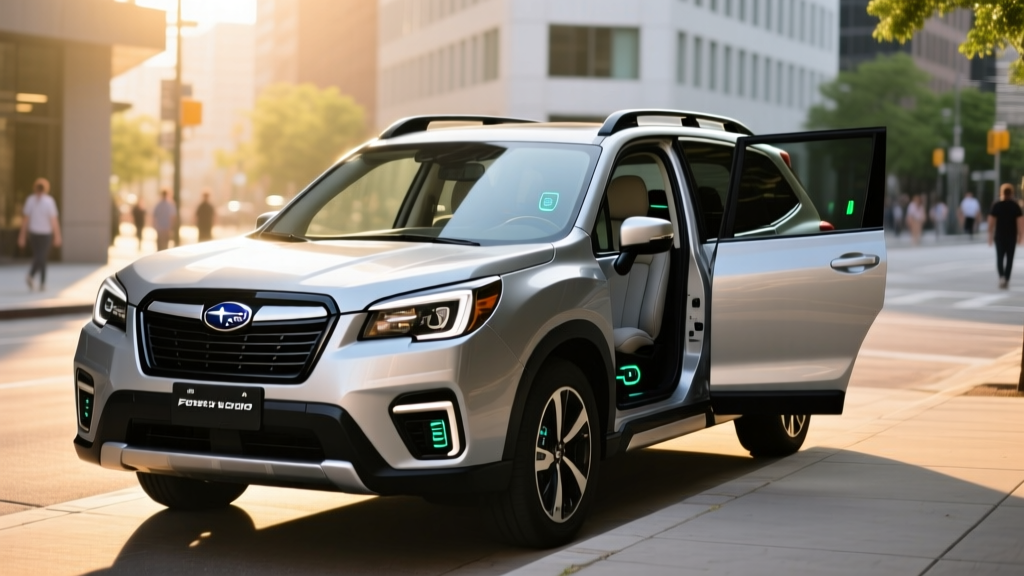
After a brief absence from the U.S. lineup, the Subaru Forester Hybrid is back for the 2026 model year as a conventional hybrid (HEV) — not a plug-in. It pairs Subaru's proven 2.5-liter flat-four engine with a hybrid electric motor and the brand's signature symmetrical all-wheel drive. The result is a compact SUV that delivers meaningfully better fuel economy than its gas-only sibling without requiring any change to your fueling habits. No plugging in, no range calculations, just fill up and go — with fewer stops at the pump.
This guide covers every critical 2026 Subaru Forester Hybrid spec: EPA-estimated MPG, powertrain output, battery warranty, pricing, tax-credit eligibility, and what you can expect in real-world driving.
HEV vs. PHEV: What the Forester Hybrid Actually Is
Before digging into the numbers, it's essential to clarify what the 2026 Forester Hybrid is — and what it isn't.
Conventional Hybrid (HEV) — This Is the Forester
- No plug required. The battery recharges through regenerative braking and the gasoline engine.
- Small battery (typically under 2 kWh) — not designed for extended electric-only driving.
- Electric motor assists the gas engine during acceleration and low-speed maneuvers, reducing fuel consumption.
- No federal EV tax credit under IRS §30D (that credit is reserved for plug-in vehicles with larger batteries).
Plug-In Hybrid (PHEV)
- Must be plugged in to access the full electric-only range (typically 20–40 miles).
- Larger battery (10–20+ kWh) capable of highway-speed electric driving.
- Qualifies for federal tax credits (up to $7,500, subject to battery sourcing, MSRP, and income caps).
- Examples: Toyota RAV4 Prime, Subaru's own Crosstrek PHEV (discontinued after 2023).
Subaru currently does not offer a Forester PHEV in the U.S. market. If you're searching for plug-in capability with Subaru's AWD, the closest option is the Crosstrek, though as of 2026, Subaru has not reintroduced a PHEV variant. The Forester Hybrid is strictly an HEV.
Fuel Economy: EPA Ratings and Real-World MPG
The headline reason to choose the Forester Hybrid over the standard gas model is fuel economy. Here's how the EPA estimates break down, alongside the non-hybrid Forester for comparison.
| Model | City MPG | Highway MPG | Combined MPG |
|---|---|---|---|
| 2026 Forester Hybrid (AWD) | 35 | 34 | 35 |
| 2026 Forester Gas (AWD) | 26 | 33 | 29 |
Source: fueleconomy.gov, EPA estimates. Actual mileage will vary.
Real-World MPG: What to Actually Expect
Subaru's hybrid system, like Toyota's, tends to shine in city driving where regenerative braking and electric-motor assist do the most work. Here's what real-world driving typically yields:
- City driving: Expect 34–37 MPG. Stop-and-go traffic maximizes regen braking and electric assist. Many owners report exceeding the EPA city estimate in moderate-temperature urban commuting.
- Highway driving: Expect 31–34 MPG. At sustained speeds above 65 mph, the gasoline engine does most of the work. The hybrid advantage narrows compared to the gas model.
- Cold weather (below 30°F): Expect a 10–15% drop, landing around 29–32 MPG combined. The engine runs more frequently to maintain cabin heat and battery temperature.
- Mountainous terrain: Uphill segments will drop instantaneous MPG into the low 20s; downhill regen recaptures some of that energy on descents.
Over a 15,000-mile annual driving cycle, the hybrid's 6 MPG combined advantage translates to roughly 74 fewer gallons of fuel per year, or about $230–$260 in savings at $3.30/gallon. Over five years, that's approximately $1,150–$1,300 in fuel savings — meaningful, though it won't fully offset the hybrid's price premium on its own.
Powertrain Specs: Engine, Motor, and Combined Output
| Specification | 2026 Forester Hybrid |
|---|---|
| Engine | 2.5L DOHC 4-cylinder (Boxer) |
| Engine Output | 180 hp / 178 lb-ft torque |
| Electric Motor | AC synchronous motor integrated into transmission |
| Combined System Output | 194 hp |
| Transmission | Lineartronic CVT (continuously variable) |
| Drivetrain | Symmetrical All-Wheel Drive (standard) |
| 0–60 mph (est.) | ~7.8 seconds |
| Towing Capacity | 1,500 lbs |
| Fuel Tank | 13.2 gallons |
| Total Range (est.) | ~462 miles |
The hybrid system uses a series-parallel architecture. At low speeds and light loads, the electric motor can propel the Forester short distances on electric power alone — typically under 1 mile at parking-lot speeds. Under harder acceleration, both the engine and motor work together, which is where the 194 combined horsepower figure comes from. It's not dramatically quicker than the gas-only Forester (rated at 180 hp), but the electric motor's instant torque fills in the CVT's low-end response, making it feel more responsive in city driving.
One trade-off: the hybrid's towing capacity drops to 1,500 lbs, compared to the gas Forester's 1,500 lbs rating — essentially the same, which is modest for the class. If you need to tow a small trailer or pair of dirt bikes, the Forester Hybrid handles it, but it's no hauler.
Battery Warranty, Lifespan, and Replacement Cost
Hybrid Battery Warranty
Subaru covers the Forester Hybrid's battery pack under its hybrid system warranty:
- Duration: 8 years / 100,000 miles (whichever comes first)
- CARB states: 10 years / 150,000 miles in states that follow California Air Resources Board emissions standards
- Coverage: Defects and capacity loss below a defined threshold (typically 60–70% of original capacity)
The Forester Hybrid's battery pack is small — roughly 1.1 kWh of usable capacity — because it's designed for assist, not extended electric driving. Small hybrid batteries experience less thermal stress and fewer deep charge-discharge cycles than large EV or PHEV batteries, which translates to strong longevity.
Based on data from Toyota and Subaru hybrid systems over the past two decades, most hybrid batteries last 150,000–200,000+ miles before significant degradation. Failures within the warranty period are uncommon. When replacement is eventually needed out of warranty, expect to pay:
- OEM replacement battery: $2,500–$3,500 (parts and labor)
- Refurbished/remanufactured battery: $1,500–$2,200
- Individual cell replacement: $500–$1,200 (if only specific modules have degraded — offered by some independent hybrid specialists)
For context, a conventional 12V starter battery replacement runs $150–$250, and the Forester Hybrid still uses one of those alongside the high-voltage hybrid pack.
Pricing, Trims, and Tax Credit Eligibility
The 2026 Forester Hybrid is offered across multiple trims, with pricing starting in the low $30,000s.
| Trim | MSRP (est.) |
|---|---|
| Hybrid Premium | $32,495 |
| Hybrid Limited | $36,495 |
| Hybrid Touring | $39,995 |
Pricing includes destination charge. Verify with your local Subaru dealer for exact figures.
Federal Tax Credit: Does the Forester Hybrid Qualify?
No. The 2026 Subaru Forester Hybrid is a conventional HEV and does not qualify for the IRS §30D Clean Vehicle Credit, which is reserved for plug-in electric vehicles (BEVs and PHEVs) with battery capacities of at least 7 kWh. The Forester Hybrid's ~1.1 kWh battery falls well below that threshold.
Under current IRS rules, only new plug-in vehicles meeting battery-component and critical-mineral sourcing requirements, MSRP caps ($55,000 for SUVs), and buyer income limits qualify for up to $7,500 in federal credits. Since the Forester Hybrid doesn't plug in, none of these provisions apply.
Some states or utilities offer smaller rebates for conventional hybrids — check your state's energy office or local utility for current programs. These are typically $250–$1,000 and vary widely by jurisdiction.
Hybrid vs. PHEV vs. EV: Which Subaru Fits Your Life?
Who Should Choose the Forester Hybrid?
Choose the Forester Hybrid if:
- You want better fuel economy without changing your fueling routine
- You don't have access to home or workplace charging (apartment, street parking, no garage outlet)
- You regularly drive in cold climates where EV range loss is a concern
- You want AWD standard with minimal complexity
- Your annual mileage is moderate (10,000–15,000 miles) and fuel savings are a bonus, not the primary goal
Choose a PHEV instead if:
- You have reliable home Level 2 charging and a commute under 30 miles round-trip
- You want to drive primarily on electricity most days with gas backup for road trips
- You qualify for the §30D federal tax credit and want to offset a higher purchase price
Choose a full EV (BEV) instead if:
- You have home charging and your daily driving is within the EV's range
- You want zero tailpipe emissions and minimal drivetrain maintenance
- You're eligible for the full $7,500 federal credit and your state offers additional EV incentives
- You want the lowest per-mile "fuel" cost (electricity at $0.12/kWh is roughly equivalent to $1.00/gallon gasoline)
The Forester Hybrid occupies a practical middle ground. It won't match a BEV's per-mile energy cost or a PHEV's electric-only commuting, but it asks nothing of you beyond what a gas car requires. For buyers in regions with limited public charging infrastructure — or those who simply don't want to think about charging — it's a compelling efficiency upgrade.
Pros and Cons
Pros
- 35 MPG combined with standard AWD — a strong result for the compact SUV class
- No plug-in requirement; works with existing gas-station infrastructure
- Subaru's symmetrical AWD and 8.7 inches of ground clearance for snow and light trails
- 8-year/100,000-mile hybrid battery warranty (10 years in CARB states)
- Responsive low-speed acceleration from electric motor torque assist
- EyeSight driver-assist suite standard (adaptive cruise, lane centering, pre-collision braking)
Cons
- No federal tax credit eligibility (HEV, not PHEV)
- Highway MPG advantage over the gas model is modest (~1 MPG)
- Small hybrid battery means virtually no electric-only driving range
- 1,500-lb towing capacity is low for the segment
- Price premium of ~$2,000–$3,000 over equivalent gas trims requires several years of fuel savings to recoup
- CVT can drone under hard acceleration (common to all Subaru CVTs)
Frequently Asked Questions
How many MPG does the 2026 Subaru Forester Hybrid get?
The EPA estimates the 2026 Forester Hybrid at 35 MPG city, 34 MPG highway, and 35 MPG combined. In real-world city driving, many owners report 34–37 MPG thanks to regenerative braking. Highway driving typically yields 31–34 MPG, and cold weather can reduce combined figures by 10–15%.
Can the Forester Hybrid drive on electric power only?
Only at very low speeds for very short distances (under ~1 mile at parking-lot speeds). The hybrid battery is approximately 1.1 kWh — far too small for meaningful electric-only driving. This is a conventional hybrid designed to assist the gas engine, not replace it.
Do I need to plug in the Forester Hybrid?
No. The 2026 Forester Hybrid is a conventional HEV. Its battery recharges automatically through regenerative braking and the gasoline engine. There is no plug, no charging port, and no need for home or public charging infrastructure.
Is the Forester Hybrid reliable? What does a battery replacement cost?
Subaru's hybrid system is based on proven technology shared with Toyota (Subaru's partner in hybrid development). Hybrid batteries in this class typically last 150,000–200,000+ miles. The battery is warrantied for 8 years/100,000 miles (10 years/150,000 miles in CARB states). Out-of-warranty OEM replacement costs $2,500–$3,500; refurbished options run $1,500–$2,200.
Does the 2026 Forester Hybrid qualify for a federal tax credit?
No. The IRS §30D Clean Vehicle Credit applies only to plug-in vehicles (BEVs and PHEVs) with battery capacities of at least 7 kWh. The Forester Hybrid's ~1.1 kWh battery does not qualify. Check your state energy office for any local hybrid rebate programs.
How does the Forester Hybrid compare to the Toyota RAV4 Hybrid?
The RAV4 Hybrid is rated at 39–41 MPG combined (depending on trim) with AWD, giving it a 4–6 MPG advantage over the Forester Hybrid. The RAV4 Hybrid also offers a PHEV variant (RAV4 Prime) with 42 miles of electric-only range. The Forester Hybrid counters with standard AWD across all trims, more ground clearance (8.7 vs. 8.1 inches), and Subaru's EyeSight safety suite. If maximum fuel economy is your priority, the RAV4 Hybrid wins. If you value AWD capability, visibility, and Subaru's safety reputation, the Forester Hybrid is the stronger pick.
What's the total driving range on a full tank?
With a 13.2-gallon fuel tank and a 35 MPG combined rating, the Forester Hybrid delivers approximately 462 miles of total range. In real-world mixed driving (32–34 MPG combined), expect 420–445 miles between fill-ups — enough for most road trips with just one fuel stop.