Quick Verdict: A Practical Hybrid SUV With a Cabin That Punches Above Its Weight
The 2026 Subaru Forester Hybrid pairs a familiar 2.5-liter flat-four with an electric motor for a combined 194 horsepower and an EPA-estimated 36 MPG combined. But beyond the powertrain, the cabin is where Subaru has made its most visible gains: a standard 11.6-inch vertical touchscreen, improved soft-touch materials on the dash and door uppers, and a cargo area that barely shrinks compared to the gas-only Forester. For compact-SUV shoppers who want all-weather capability without plugging in, this is one of the most pragmatic hybrid choices in the segment.
This guide covers the 2026 Subaru Forester Hybrid interior in detail, along with the powertrain specs, real-world MPG expectations, battery warranty, and purchase economics you need before signing the paperwork.
2026 Subaru Forester Hybrid Interior: What's Changed
Subaru refreshed the Forester's cabin significantly with the current generation, and the 2026 hybrid model carries forward those improvements with minor trim-level tweaks. Here's what you'll find when you open the door:
Dashboard and Infotainment
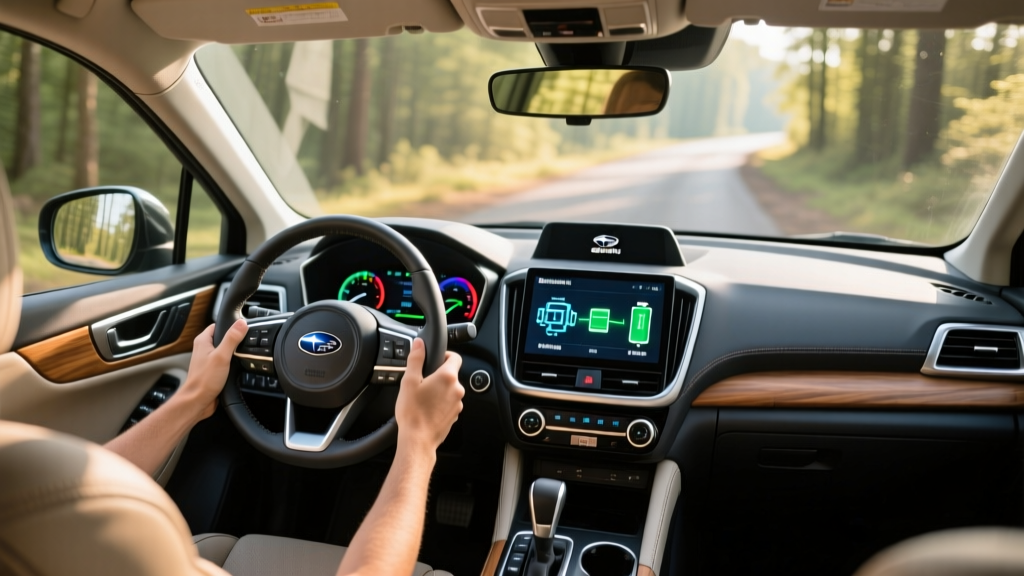
The centerpiece is an 11.6-inch portrait-oriented touchscreen running Subaru's latest Starlink multimedia system. Wireless Apple CarPlay and Android Auto are standard across all hybrid trims. The screen's vertical layout works well for map navigation — you see more of the route ahead — though the touch targets for climate controls embedded at the bottom of the screen take a week of muscle-memory adjustment. Physical knobs for volume and tuning remain, which is a win for gloved winter driving.
Materials and Build Quality
Subaru has upgraded the upper dashboard and front door panels to a soft-touch, stitched-look material on Premium and higher trims. Lower door areas and the center console sides remain hard plastic — typical for the segment, but noticeable if you're comparing against a Mazda CX-50 Hybrid's more upscale trimmings. The Sport Hybrid trim adds contrast stitching and a unique gray/black two-tone cloth upholstery, while the Touring Hybrid offers leather-trimmed seats with copper-tone accent stitching.
Seating and Space
Front seats are supportive on longer drives with adequate lateral bolstering. Rear legroom measures 39.4 inches — enough for adults on road trips, not just kids. The rear seatbacks recline slightly for added comfort. Three-across seating in the back is feasible for shorter trips thanks to a relatively flat floor and wide hip room.
Cargo Capacity
The hybrid battery sits beneath the rear seat, preserving cargo volume. You get approximately 28.9 cubic feet behind the rear seats and up to 74.4 cubic feet with the rear seats folded — only about 1.5 cubic feet less than the gas-only Forester. That's a negligible real-world difference, and the load floor remains flat and low.
Powertrain and Performance Specs
The 2026 Forester Hybrid uses a conventional hybrid (HEV) system — not a plug-in hybrid. That means you never need to plug it in. The battery recharges through regenerative braking and the gasoline engine. Here's the full powertrain breakdown:
| Spec | Value |
|---|---|
| Engine | 2.5L SUBARU BOXER 4-cylinder |
| Electric Motor | Integrated AC synchronous motor |
| Combined Horsepower | 194 hp |
| Transmission | Lineartronic CVT (eCVT hybrid variant) |
| Drivetrain | Symmetrical All-Wheel Drive (standard) |
| Hybrid Battery | ~1.1 kWh lithium-ion (under rear seat) |
| 0-60 mph (est.) | ~7.4 seconds |
| Towing Capacity | 1,500 lbs |
The 194-hp combined output is a meaningful bump over the gas-only Forester's 180 hp, and it's noticeable during highway merging. The eCVT operates smoothly without the rubber-band drone common to older CVTs, though it won't satisfy drivers who prefer the stepped feel of a conventional automatic. Subaru's AWD system now integrates the electric motor to provide torque to the rear axle under acceleration, improving traction in snow and rain without a mechanical rear driveshaft.
Fuel Economy: EPA Estimates vs. Real-World MPG
The 2026 Forester Hybrid's headline number is its efficiency. Here's the official EPA breakdown:
| Driving Cycle | EPA Estimate |
|---|---|
| City | 38 MPG |
| Highway | 34 MPG |
| Combined | 36 MPG |
As with most conventional hybrids, the Forester Hybrid achieves its best efficiency in stop-and-go city driving, where the electric motor handles low-speed propulsion and regenerative braking recaptures energy. Highway driving relies more heavily on the gasoline engine, which is why the highway figure is actually lower than city — a pattern that's counterintuitive if you're used to gas cars.
Real-World Expectations
Based on owner-reported data and testing patterns from similar Subaru hybrid systems, expect real-world combined MPG in the 33–37 MPG range depending on conditions. Drivers who do predominantly city and suburban driving regularly report exceeding the EPA combined estimate, sometimes hitting 39–40 MPG on flat urban routes. Sustained highway travel at 75+ mph, mountain grades, and cold-weather operation (below 30°F) can drop efficiency to 30–32 MPG. Subaru's standard EPA data on fueleconomy.gov confirms these figures for the current model year.
HEV vs. PHEV vs. EV: Which Forester (or Alternative) Fits You?
Subaru does not currently offer a plug-in hybrid (PHEV) version of the 2026 Forester. The Forester Hybrid is strictly a conventional HEV. Here's how to think about the three electrification paths:
| Factor | HEV (Forester Hybrid) | PHEV (e.g., Toyota RAV4 Prime) | BEV (e.g., Hyundai Ioniq 5) |
|---|---|---|---|
| Plug in to charge? | No | Yes (optional) | Yes (required) |
| Electric-only range | ~1 mile at low speed | 35–42 miles typical | 250–320 miles |
| Home charging needed? | No | Recommended (Level 2) | Essential |
| Best for | No garage/outlet access; want simplicity | Home charging + short commutes | Home charging + most daily driving electric |
| Federal tax credit | No §30D credit | Up to $7,500 (if eligible) | Up to $7,500 (if eligible) |
| Fuel cost (annual est.) | ~$1,500 | ~$800–$1,200 | ~$500–$800 |
The Forester Hybrid is the right call if you lack home charging access, live in an apartment, or simply don't want to think about plugging in. It's also the lowest-risk entry into electrification — no range anxiety, no charging-app fumbling, no dependency on public infrastructure. If you do have a garage with a 240V outlet and a commute under 40 miles, a PHEV like the RAV4 Prime will let you drive most days on electricity alone, with the gas engine available for road trips.
Pricing, Trims, and Tax Credit Eligibility
The 2026 Subaru Forester Hybrid is offered across multiple trims. Here's the approximate MSRP breakdown at launch:
| Trim | MSRP (approx.) |
|---|---|
| Sport Hybrid | $35,495 |
| Premium Hybrid | $37,095 |
| Limited Hybrid | $39,595 |
| Touring Hybrid | $42,095 |
All prices include destination. The hybrid premium over the equivalent gas-only Forester trim is roughly $2,000–$2,500. At 36 MPG combined vs. the gas model's ~29 MPG combined, and assuming 12,000 miles/year at $3.50/gallon, you'd recoup the hybrid premium in approximately 4–5 years through fuel savings alone.
Federal Tax Credit Status
The 2026 Forester Hybrid is a conventional HEV, not a plug-in vehicle. It does not qualify for the federal §30D Clean Vehicle Credit (up to $7,500), which applies only to plug-in hybrids and battery-electric vehicles. Some states offer modest hybrid incentives or HOV-lane access — check your state's alternative fuel vehicle laws via the AFDC for details. Always verify current-year rules with a tax professional before relying on any incentive.
Battery Warranty, Reliability, and Replacement Cost
Hybrid battery longevity is the number-one concern for first-time hybrid buyers. Here's what Subaru provides:
Longevity Data
Subaru's hybrid system is derived from the e-BOXER architecture used globally since 2019. The battery pack is relatively small (~1.1 kWh), which means it undergoes shallower charge/discharge cycles than a PHEV or BEV battery — a factor that generally extends cycle life. Toyota and Honda hybrids from the 2010s routinely exceed 200,000 miles on original battery packs, and Subaru's system follows similar engineering principles. Independent failure data for the Forester Hybrid specifically is still maturing given the model's recency, but the architecture is proven.
Replacement Cost
Should the hybrid battery require replacement outside of warranty, expect a dealer-installed cost in the $2,500–$4,000 range based on current Subaru parts pricing and labor rates. This is significantly less than a BEV battery replacement ($8,000–$20,000) because the pack is small and modular. Third-party hybrid battery rebuilders can sometimes reduce this cost further.
For overall vehicle reliability, Subaru has historically scored average to above-average in IIHS safety testing and owner satisfaction surveys. The Forester typically earns top marks in crashworthiness, which matters for family-SUV buyers.
Pros and Cons
Pros
- Standard AWD — no FWD base model to avoid
- 36 MPG combined with no plugging in required
- 194 hp is a real improvement over the 180-hp gas model
- 11.6-inch vertical touchscreen with wireless phone integration
- Cargo space nearly identical to gas Forester
- 8-year/100K-mile battery warranty (10yr/150K in CARB states)
- Strong resale value and Subaru owner loyalty
Cons
- No federal tax credit (HEV, not PHEV/BEV)
- Highway MPG drops to 34 — lower than city
- Towing limited to 1,500 lbs
- No PHEV option for electric-only commuting
- Lower-rear cargo plastic and console sides feel budget-tier
- CVT won't appeal to enthusiasts
- Touch-based climate controls take adjustment
Frequently Asked Questions
How many MPG does the 2026 Subaru Forester Hybrid get?
The EPA rates the 2026 Forester Hybrid at 38 MPG city, 34 MPG highway, and 36 MPG combined. Real-world results typically range from 33–37 MPG combined, with city-heavy drivers sometimes exceeding the EPA estimate and highway-heavy drivers seeing slightly lower numbers.
Does the Forester Hybrid need to be plugged in?
No. The 2026 Forester Hybrid is a conventional hybrid (HEV). Its small battery recharges through regenerative braking and the gasoline engine. You fuel it like any other car — just with fewer stops at the pump.
Is there a plug-in hybrid (PHEV) Forester?
Subaru does not currently offer a PHEV Forester for the U.S. market. If plug-in capability is a priority, consider the Toyota RAV4 Prime (42 miles electric-only) or the Subaru Solterra (all-electric, ~228 miles range) as alternatives within the Subaru/Toyota ecosystem.
Is the hybrid battery reliable and what does replacement cost?
The hybrid battery is warranted for 8 years/100,000 miles (10 years/150,000 in CARB states). Out-of-warranty replacement runs approximately $2,500–$4,000 at a dealer. The small pack size and shallow cycling contribute to long service life, with similar systems from other manufacturers routinely lasting 200,000+ miles.
Does the 2026 Forester Hybrid qualify for a tax credit?
It does not qualify for the federal §30D Clean Vehicle Credit, which applies only to plug-in vehicles (PHEVs and BEVs). Some states may offer smaller incentives for hybrid purchases. Check your state's energy office or the AFDC state laws database for current programs.
How does the Forester Hybrid interior compare to the gas Forester?
The interior layout is shared with the gas Forester, but hybrid trims typically receive upgraded upholstery options, unique color accents (Sport Hybrid gets two-tone cloth, Touring Hybrid gets leather with copper stitching), and the same 11.6-inch Starlink touchscreen. Cargo volume is nearly identical thanks to the under-seat battery placement.
Who should buy the Forester Hybrid over a full EV?
Choose the Forester Hybrid if you lack reliable home charging, frequently drive in extreme cold (where EV range drops 20–30%), tow occasionally, take long road trips through rural areas with sparse charging infrastructure, or simply prefer the fill-up-and-go simplicity of a gas station. The Forester Hybrid eliminates range anxiety entirely while still cutting fuel costs by roughly 20–25% compared to the gas-only Forester.