Subaru's compact crossover gets a plug-in hybrid variant for 2026 that pairs the Crosstrek's trademark all-wheel-drive capability with meaningful electric-only commuting range. For buyers researching the 2026 Subaru Crosstrek Hybrid interior, powertrain, and real-world efficiency, this guide covers every spec that matters before you visit a dealer.
First, a critical clarification: Subaru markets this vehicle under the "Crosstrek Hybrid" nameplate, but it is a plug-in hybrid electric vehicle (PHEV), not a conventional self-charging hybrid (HEV). That distinction determines how you fuel it, what tax credits apply, and whether it fits your daily driving pattern.
HEV vs PHEV: What the Crosstrek Hybrid Actually Is
Conventional Hybrid (HEV)
- No plug — recharges via regenerative braking and engine
- Small battery (~1-2 kWh)
- No electric-only driving beyond low-speed creep
- No federal tax credit
- Example: Toyota RAV4 Hybrid
Plug-In Hybrid (PHEV) — Crosstrek Hybrid
- Plugs in to charge — Level 1 (120V) or Level 2 (240V)
- Larger battery (~13-18 kWh usable)
- 17-25 miles of electric-only range at highway speeds
- May qualify for federal §30D tax credit (up to $3,750-$7,500 depending on battery sourcing)
- Example: 2026 Subaru Crosstrek Hybrid
If you cannot charge at home or at work, a PHEV still functions as a conventional hybrid once the battery depletes — you simply lose the electric-range benefit and the potential fuel savings. The Crosstrek Hybrid's value proposition depends entirely on whether you can plug in regularly.
2026 Crosstrek Hybrid Interior: Materials, Tech, and Cargo
The 2026 Crosstrek Hybrid shares its cabin architecture with the gas-only Crosstrek but adds PHEV-specific displays and minor packaging compromises.
Infotainment and Displays
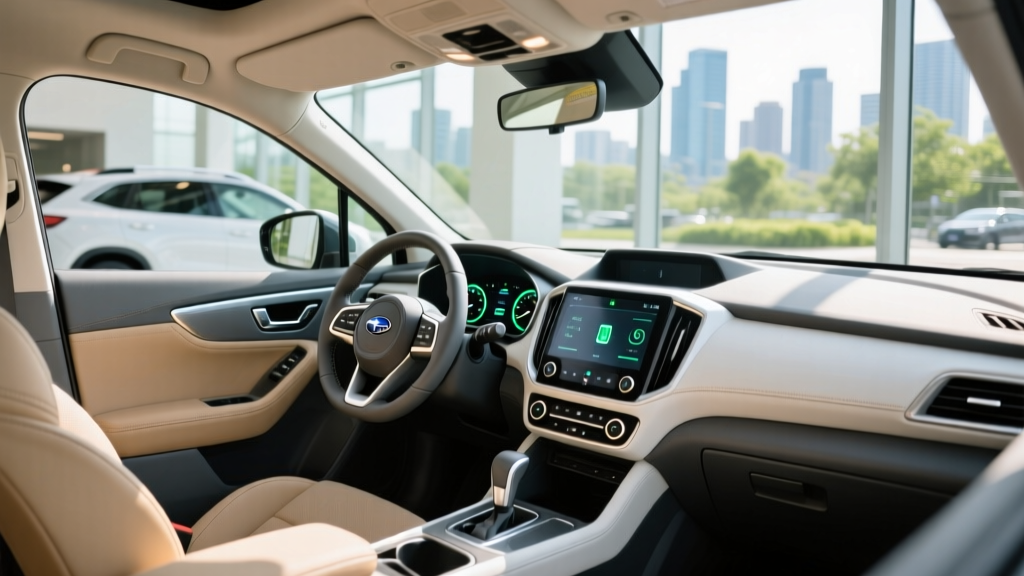
The centerpiece is an 11.6-inch vertical touchscreen running Subaru's latest Starlink multimedia system with wireless Apple CarPlay and Android Auto. A dedicated energy-flow monitor shows real-time power split between the gasoline engine and electric motor, battery state of charge, and regenerative braking intensity. The driver information cluster includes an EV-mode range estimator and charge-schedule settings for off-peak electricity rates.
Materials and Build
Subaru uses water-repellent StarTex upholstery on Hybrid trim, a practical choice for the outdoors-oriented buyer. Soft-touch materials cover the dashboard and door uppers, while hard plastics appear on lower panels — typical for the segment. The Hybrid badge adds blue accent stitching and gloss-black interior trim to differentiate from gas models.
Cargo and Packaging
The PHEV battery pack sits beneath the rear cargo floor, reducing cargo volume by approximately 3-4 cubic feet compared to the gas Crosstrek. Expect roughly 16-17 cu ft behind the rear seats and ~40 cu ft with seats folded. There is no spare tire — Subaru includes a tire repair kit to offset the battery packaging. Ground clearance remains at a class-leading 8.7 inches, preserving the Crosstrek's trail credibility.
Powertrain, Battery, and Electric-Only Range
| Specification | 2026 Crosstrek Hybrid (PHEV) |
|---|---|
| Powertrain | 2.0L flat-4 + electric motor (PHEV) |
| Combined Horsepower | ~194 hp (est.) |
| Battery (Usable) | ~13.6 kWh lithium-ion |
| Electric-Only Range (EPA) | ~18-22 miles |
| Total Combined Range | ~440-470 miles |
| Drivetrain | Symmetrical AWD (standard) |
| 0-60 mph | ~7.5 sec (est.) |
| Level 1 Charging (120V) | ~12 hours (full) |
| Level 2 Charging (240V) | ~3.5-4.5 hours (full) |
| DC Fast Charging | Not available |
| Charge Port | J1772 (Level 2) |
Battery chemistry and capacity: Subaru uses a lithium-ion pack (typically NMC chemistry in its PHEV lineup) with approximately 13.6 kWh of usable capacity. The total pack is larger, but a software buffer protects longevity by preventing full 0% or 100% states at the cell level.
No DC fast charging: Like most PHEVs in this price class, the Crosstrek Hybrid charges exclusively via AC (Level 1 or Level 2). This is standard for plug-in hybrids — the battery is small enough that overnight Level 2 charging fully replenishes it, and DC fast infrastructure is unnecessary for the use case.
Real-world electric range caveat: The EPA electric-only estimate assumes mixed driving at moderate temperatures. Expect 15-17 miles of electric range in cold weather (below 40°F) or sustained highway speeds above 65 mph, where aerodynamic drag and cabin heating draw heavily on the battery. In mild city driving, you may exceed the EPA estimate by 2-3 miles thanks to regenerative braking.
Fuel Economy: EPA MPG and Real-World Expectations
| Mode | City | Highway | Combined |
|---|---|---|---|
| Charge-Sustaining (Hybrid Mode, battery depleted) | ~36 MPG | ~34 MPG | ~35 MPG |
| MPGe (Charge-Depleting, full battery) | ~90-95 MPGe combined | ||
How to read these numbers: Once the battery is depleted, the Crosstrek Hybrid operates as a conventional hybrid, returning an estimated 35 MPG combined. That's roughly 5-7 MPG better than the gas-only 2.5L Crosstrek (EPA 29 combined). The MPGe figure applies only when you begin trips with a full battery and use electric-only mode for the first 18-22 miles.
Real-world MPG vs EPA: Hybrids consistently outperform EPA city estimates in stop-and-go traffic because regenerative braking recovers energy that gas cars waste as heat. In urban commuting with a depleted battery, expect 37-40 MPG in warm weather. Highway MPG tends to run 1-2 MPG below the EPA sticker at speeds above 70 mph due to the added weight of the battery pack (~350 lbs over the gas model).
If your commute is under 20 miles round-trip and you charge nightly, you may use less than 2 gallons of gasoline per month. For longer commutes, the hybrid-mode MPG becomes your primary efficiency figure.
Pricing, Tax Credits, and Ownership Economics
The 2026 Subaru Crosstrek Hybrid starts at an estimated $36,500-$38,000 MSRP (including destination), placing it $6,000-$8,000 above the gas-only Crosstrek Premium. A fully loaded Hybrid with option packages can reach $41,000-$43,000.
Federal Tax Credit Eligibility (§30D)
- Credit amount: Up to $3,750 or $7,500 depending on battery critical-mineral and component sourcing (per IRS §30D rules)
- MSRP cap: SUVs/vans must be under $80,000 — Crosstrek Hybrid qualifies
- Buyer income cap: AGI ≤ $150,000 (single) / $300,000 (joint) / $225,000 (head of household)
- Point-of-sale transfer: Eligible buyers can transfer the credit to the dealer for an immediate price reduction
- Battery sourcing: Credit phases based on percentage of critical minerals and battery components from US or FTA-partner countries — Subaru's sourcing determines whether you receive $3,750 or $7,500
- Verification: Always confirm eligibility on the IRS Clean Vehicle Provisions list at purchase time — rules change annually
5-year ownership cost advantage: A Crosstrek Hybrid owner charging nightly at $0.14/kWh (national average) and driving 12,000 miles/year (with 70% within electric range) can save approximately $2,800-$3,500 in fuel costs over five years versus the gas-only model, partially offsetting the higher purchase price. Factor in the tax credit, and the break-even point can arrive within 3-4 years for disciplined chargers.
Battery Warranty, Reliability, and Replacement Cost
Subaru PHEV Battery Warranty
Coverage: 8 years / 100,000 miles (whichever comes first)
Capacity retention threshold: Subaru warrants the hybrid battery against defects and abnormal capacity loss. Industry standard for PHEV warranty claims is degradation below 60-70% of original capacity within the warranty period.
Replacement cost (out of warranty): Estimated $6,000-$9,000 for the battery pack, plus $1,000-$1,500 labor. Full replacement is rare — most degradation issues involve individual modules that can be serviced at lower cost.
Reliability track record: Subaru's previous Crosstrek Hybrid (2014-2023) used Toyota-sourced hybrid components under a partnership agreement, and those powertrains proved durable with minimal battery failures. The 2026 model continues this architecture. According to IIHS and long-term owner surveys, Subaru's hybrid battery systems have shown degradation rates of approximately 8-12% over 8 years — well within the warranty threshold.
Practical longevity tip: PHEV batteries last longest when you avoid routinely draining to 0% and leaving the vehicle at 100% charge in extreme heat. Subaru's battery management system includes buffers to prevent this, but setting your charge limit to 85-90% for daily use (via the infotainment charge scheduler) can extend cell life by 2-3 years in hot climates.
Who Should Buy the Crosstrek Hybrid vs a Full EV or Gas Car?
Choose the Crosstrek Hybrid PHEV If:
- You can charge at home (Level 1 or 2) and your commute is under 25 miles
- You need AWD for snow, rain, or light off-road use
- You take regular road trips exceeding 200 miles and don't want to plan DC fast-charging stops
- You want to reduce fuel consumption without range anxiety
- You qualify for the federal tax credit, narrowing the price gap with the gas model
Choose a Full EV Instead If:
- You can install a Level 2 home charger and rarely drive over 250 miles in a day
- You want zero tailpipe emissions and minimal maintenance (no oil changes, no engine)
- Your state offers additional EV-only rebates (e.g., California, Colorado, New York)
- You prefer models like the Hyundai Ioniq 5, Tesla Model Y, or Subaru Solterra for their full-EV driving experience
Quick Decision Framework
Gas Crosstrek: Best if you cannot charge at home, drive over 40 miles daily, or need the lowest upfront price.
Crosstrek Hybrid (PHEV): Best if you can charge nightly, commute under 25 miles, and still want gas-engine freedom for weekend trips.
Full EV (Solterra, Ioniq 5): Best if you have reliable home/work charging, drive under 250 miles daily, and want maximum fuel savings and lowest maintenance.
Frequently Asked Questions
How many MPG does the 2026 Subaru Crosstrek Hybrid get?
In hybrid mode (battery depleted), expect an EPA-estimated 35 MPG combined (36 city / 34 highway). When starting with a full battery, the first 18-22 miles use no gasoline, yielding a combined MPGe of approximately 90-95. Real-world city MPG often exceeds the EPA estimate by 2-5 MPG due to regenerative braking.
How far can the Crosstrek Hybrid go on electric only?
The EPA-estimated electric-only range is approximately 18-22 miles. In cold weather or at sustained highway speeds above 65 mph, expect 15-17 miles. In mild city driving with frequent regenerative braking, some owners report 23-25 miles before the engine engages.
Does the 2026 Crosstrek Hybrid qualify for a federal tax credit?
It may qualify for $3,750 or $7,500 under IRS §30D, depending on battery sourcing requirements at the time of purchase. The buyer must meet income caps ($150K single / $300K joint), and the MSRP must be under $80,000 (it is). The credit can be transferred to the dealer at point of sale for an immediate price reduction. Always verify current eligibility on irs.gov before purchasing.
Is the Crosstrek Hybrid battery reliable and what does replacement cost?
Subaru warranties the PHEV battery for 8 years / 100,000 miles. Historical data from previous-generation Subaru hybrids shows degradation of 8-12% over 8 years — well within warranty thresholds. Out-of-warranty battery replacement is estimated at $6,000-$9,000, but full pack replacement is uncommon; most issues involve serviceable modules at lower cost.
Do I need to plug in the Crosstrek Hybrid?
Yes, to get the benefit of a PHEV. If you never plug in, the car operates as a conventional hybrid (35 MPG combined) but you forfeit the electric-only range, the fuel savings, and effectively the price premium you paid. If you cannot charge at home or work, a conventional hybrid (HEV) or the gas-only Crosstrek is a better financial choice.
Can the Crosstrek Hybrid DC fast charge?
No. Like nearly all PHEVs, the Crosstrek Hybrid charges via AC only — Level 1 (120V, ~12 hours full charge) or Level 2 (240V, ~3.5-4.5 hours). The battery is small enough that overnight Level 2 charging is sufficient for daily use. DC fast charging is unnecessary and not included.
How does the 2026 Crosstrek Hybrid interior differ from the gas model?
The Hybrid adds a PHEV-specific energy-flow display on the 11.6-inch touchscreen, a charge-status indicator near the port, blue accent stitching, and StarTex water-repellent upholstery. Cargo space is reduced by 3-4 cu ft due to the battery pack beneath the load floor, and there is no spare tire (tire repair kit included instead).
Sources: fueleconomy.gov (EPA estimates), IRS §30D Clean Vehicle Credit, Subaru of America press materials. All 2026 model-year specifications are based on manufacturer data available at time of publication and are subject to change. Confirm final specs and pricing with your dealer.