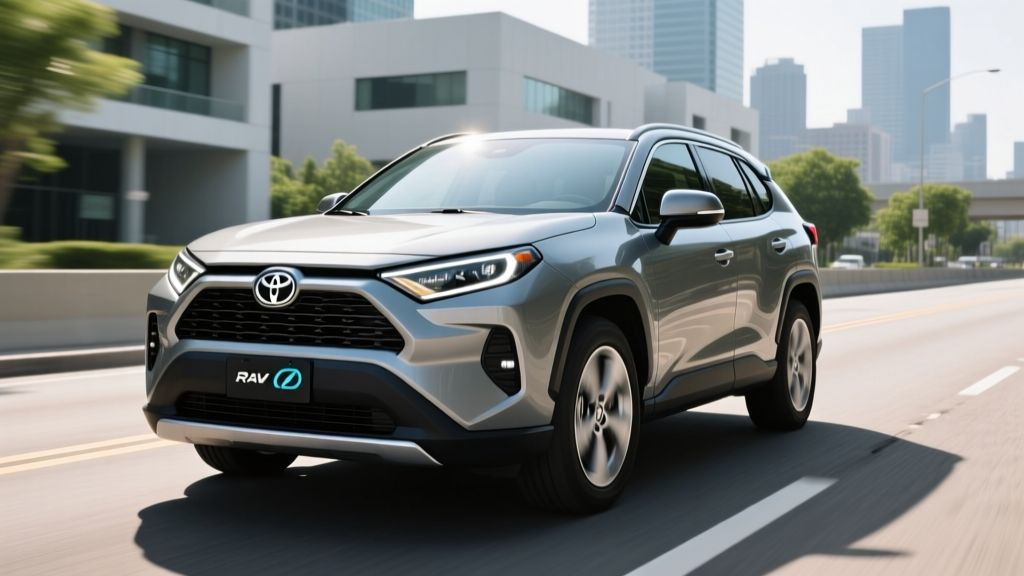
The Toyota RAV4 Hybrid has been the best-selling hybrid SUV in America for years, and the 2026 RAV4 XLE Hybrid continues that streak with a proven powertrain, strong cargo space, and fuel economy that genuinely delivers at the pump. At a starting MSRP near $34,000, it occupies a sweet spot for buyers who want electrified efficiency without plugging in, range-anxiety concerns, or the premium pricing of a full EV.
This review focuses on the XLE trim — the volume seller in the RAV4 Hybrid lineup — and covers everything a research-driven buyer needs: exact EPA MPG figures versus what you'll actually see in daily driving, the powertrain details, battery warranty realities, and how this conventional hybrid (HEV) compares to the plug-in RAV4 Prime and full-electric competitors like the Hyundai Ioniq 5 or Tesla Model Y.
HEV vs. PHEV: What the 2026 RAV4 Hybrid Actually Is
Before diving into specs, it's critical to distinguish what you're buying. The 2026 RAV4 Hybrid is a conventional hybrid electric vehicle (HEV). It pairs a gasoline engine with electric motors and a small battery that recharges through regenerative braking and the engine itself. You never plug it in. You simply fill it with gas and drive.
Toyota also sells the RAV4 Prime, which is a plug-in hybrid electric vehicle (PHEV). The Prime has a much larger battery (18.1 kWh), offers roughly 42 miles of electric-only driving, and can be plugged into a wall outlet or Level 2 charger. We'll compare the two throughout this article, but the XLE Hybrid reviewed here is strictly a self-charging HEV.
| Attribute | RAV4 XLE Hybrid (HEV) | RAV4 Prime (PHEV) |
|---|---|---|
| Plug-in charging required? | No — self-charging | Yes — plug in for EV range |
| Battery capacity | 1.6 kWh (NiMH) | 18.1 kWh (Li-ion) |
| Electric-only range | None (EV assist only) | ~42 miles (EPA) |
| Combined horsepower | 219 hp | 302 hp |
| EPA combined MPG / MPGe | 39 MPG | 94 MPGe (EV mode), 38 MPG (gas) |
| Starting MSRP (2026) | ~$34,025 | ~$44,500 |
| Federal tax credit (§30D) | Not eligible | Up to $7,500 (eligibility varies) |
Powertrain and Performance Specs
The 2026 RAV4 XLE Hybrid uses Toyota's fifth-generation hybrid system, pairing a 2.5-liter Dynamic Force four-cylinder engine with front and rear electric motors for standard electronic all-wheel drive (AWD-i). Combined output is 219 horsepower.
| Engine | 2.5L 4-cylinder Atkinson-cycle |
| Engine horsepower | 176 hp @ 5,700 rpm |
| Front electric motor | Permanent magnet synchronous, 134 hp |
| Rear electric motor | 54 hp (AWD-i) |
| Combined net horsepower | 219 hp |
| Transmission | eCVT (electronically controlled) |
| Drivetrain | Electronic AWD (AWD-i) |
| Hybrid battery | 1.6 kWh Nickel-Metal Hydride (NiMH) |
| 0–60 mph (est.) | ~7.4 seconds |
| Towing capacity | 1,750 lbs |
The eCVT isn't a traditional belt-and-pulley CVT — it's a planetary gearset that blends engine and motor power seamlessly. There are no fixed gear shifts to feel, and acceleration is linear. The rear motor engages automatically when slip is detected, providing confident traction in rain and light snow without the fuel-economy penalty of a mechanical AWD system.
Fuel Economy: EPA Ratings vs. Real-World MPG
This is where the RAV4 XLE Hybrid earns its reputation. The EPA rates it at:
| Driving Cycle | MPG |
|---|---|
| City | 41 MPG |
| Highway | 38 MPG |
| Combined | 39 MPG |
Source: EPA Fuel Economy
For context, the non-hybrid 2026 RAV4 gas model (2.5L, 8-speed automatic, AWD) is rated at 27 MPG combined. That's a 12 MPG improvement with the hybrid — roughly 44% better fuel economy for about $1,500 more at the XLE trim level.
Annual Fuel Cost Estimate
At 15,000 miles per year and $3.40/gallon (national average as of early 2026), the RAV4 XLE Hybrid costs approximately $1,308 per year in fuel. The gas-only RAV4 AWD costs roughly $1,889 — a savings of about $581 annually with the hybrid.
Pricing, Trims, and Tax Credit Eligibility
The 2026 RAV4 Hybrid is offered across several trims. Here's the MSRP breakdown:
| Trim | Starting MSRP |
|---|---|
| LE | $32,925 |
| XLE | $34,025 |
| XLE Premium | $36,125 |
| Woodland Edition | $36,425 |
| SE | $37,225 |
| Limited | $39,725 |
Prices include destination charge. Source: Toyota.com
Federal Tax Credit: Not Eligible
Under current IRS §30D rules, the RAV4 Hybrid (HEV) does not qualify for the federal EV tax credit. The §30D credit applies only to plug-in electric vehicles — battery electric vehicles (BEVs) and plug-in hybrids (PHEVs) with a minimum battery capacity of 7 kWh. Since the RAV4 Hybrid's battery is 1.6 kWh and it cannot be plugged in, it is ineligible regardless of buyer income or MSRP.
However, the RAV4 Prime (PHEV) may qualify for up to $7,500 under §30D, subject to:
- Buyer AGI limits: $150,000 single / $300,000 married filing jointly
- Vehicle MSRP cap: $80,000 for SUVs (RAV4 Prime clears this)
- Battery critical-mineral and component sourcing requirements (check current-year IRS guidance)
- Point-of-sale transfer available at participating dealers
If the tax credit is a deciding factor, the RAV4 Prime's credit can narrow the ~$10,500 price gap between the XLE Hybrid and the Prime — but only if you qualify and can charge at home.
Battery Warranty, Lifespan, and Replacement Cost
Hybrid battery longevity is the single most common concern among first-time hybrid buyers. Here's what Toyota provides:
Toyota's NiMH hybrid batteries have proven exceptionally durable in real-world use. Data from fleet operators and long-term owners shows that RAV4 Hybrid batteries routinely last 150,000–200,000+ miles before significant degradation. The NiMH chemistry is less energy-dense than lithium-ion but is highly tolerant of the shallow charge-discharge cycles that hybrids use (the battery typically cycles between 40% and 80% state of charge, which greatly extends cycle life).
What If the Battery Fails Out of Warranty?
A replacement hybrid battery for the RAV4 Hybrid currently costs between $2,500 and $4,000 installed, depending on whether you use a new OEM unit, a refurbished unit, or an aftermarket option. Independent hybrid-specialty shops can often replace individual battery modules for $500–$1,500 rather than replacing the entire pack. This is dramatically cheaper than a full EV battery replacement ($8,000–$20,000+), reflecting the RAV4 Hybrid's much smaller 1.6 kWh pack.
Driving Experience, Tech, and Cargo
The XLE trim is the RAV4 Hybrid's best value proposition. Standard equipment includes:
- 8-inch touchscreen with wireless Apple CarPlay and Android Auto
- Toyota Safety Sense 3.0 (pre-collision, lane departure, full-speed adaptive cruise, lane tracing)
- Blind-spot monitoring with rear cross-traffic alert
- Dual-zone automatic climate control
- Smart Key with push-button start
- LED headlights and taillights
Cargo volume is 37.6 cubic feet behind the rear seats and 69.8 cubic feet with the rear seats folded — identical to the gas RAV4 because the hybrid battery is packaged under the rear seat, preserving the cargo floor. There's no frunk (front trunk), as the engine bay is fully occupied by the hybrid powertrain.
Toyota Safety Sense 3.0 is a Level 2 driver-assistance system per SAE classification. The lane-tracing and adaptive cruise features work well on highways, but you must keep your hands on the wheel and eyes on the road at all times. This is not a hands-free system like GM's Super Cruise or Ford's BlueCruise.
RAV4 Hybrid vs. PHEV vs. Full EV: Which Fits You?
Choosing between a conventional hybrid, a plug-in hybrid, and a full electric vehicle depends on your driving patterns, charging access, and budget. Here's a practical decision framework:
- You can't charge at home (apartment, street parking, no garage)
- You want maximum simplicity — just add gas, no plugs or apps
- Your budget is under $38,000
- You take frequent road trips and don't want to plan around charging stations
- You want proven long-term reliability with minimal new-technology risk
- You can install a Level 2 home charger
- Your daily commute is under 40 miles round-trip (you'll drive mostly on electricity)
- You qualify for the §30D tax credit, narrowing the price gap
- You want the option of electric-only driving but still want a gas engine for road trips
- You have reliable home Level 2 charging
- Your daily driving is under 250 miles and you're comfortable with public DC fast charging for road trips
- You want the lowest per-mile energy cost and minimal maintenance
- You want the full federal tax credit and your income/sources qualify
Reliability and Long-Term Ownership
Toyota's hybrid powertrains are among the most reliable in the automotive industry. The RAV4 Hybrid uses a planetary eCVT with no friction bands, clutches, or traditional transmission fluid to replace. The regenerative braking system significantly reduces wear on the friction brake pads — many owners report original brake pads lasting 80,000–100,000 miles.
Toyota's standard new-vehicle warranty covers 3 years / 36,000 miles bumper-to-bumper and 5 years / 60,000 miles on the powertrain. The hybrid-specific components (battery, inverter, transaxle) are covered for 10 years / 150,000 miles.
According to IIHS, the RAV4 continues to earn top safety ratings, and Toyota's hybrid system has accumulated billions of real-world miles across the Prius, Camry, Highlander, and RAV4 families since 1997. There is no significant failure-pattern data to suggest the 2026 RAV4 Hybrid deviates from this record.
Pros and Cons
- 41 MPG city — real-world results often match or exceed this
- No plug-in charging needed; zero lifestyle change from a gas car
- Standard AWD with no fuel-economy penalty vs. FWD
- 10-year / 150,000-mile hybrid battery warranty
- Strong cargo space (37.6 cu ft) with battery under rear seat
- Proven reliability track record across Toyota's hybrid lineup
- Competitive pricing at $34,025 for the XLE
- No electric-only driving mode — always uses some gasoline
- No federal tax credit eligibility (HEV exclusion under §30D)
- 1,750-lb towing capacity is limited for an SUV
- Engine noise under hard acceleration (eCVT drone)
- 8-inch infotainment screen is smaller than some competitors
- No DC fast charging capability (not applicable to HEVs, but a limitation vs. PHEV/EV)
Frequently Asked Questions
How many MPG does the 2026 RAV4 XLE Hybrid get?
The EPA rates the 2026 RAV4 XLE Hybrid at 41 MPG city, 38 MPG highway, and 39 MPG combined. In real-world mixed driving, most owners report 37–42 MPG, with city-heavy commutes often exceeding the EPA estimate thanks to the hybrid system's regenerative braking and electric-motor assist at low speeds.
Does the RAV4 Hybrid need to be plugged in?
No. The RAV4 Hybrid is a conventional hybrid (HEV). Its 1.6 kWh battery charges through regenerative braking and the gasoline engine. You never plug it in — you simply refuel with gasoline like any other car.
Is the RAV4 Hybrid reliable, and what does battery replacement cost?
Toyota's hybrid systems have an exceptional reliability record spanning over 25 years. The hybrid battery is warrantied for 10 years / 150,000 miles, and real-world data shows these NiMH packs regularly lasting 150,000–200,000+ miles. Out-of-warranty replacement costs $2,500–$4,000 for a full pack, or $500–$1,500 for individual module replacement at a hybrid specialist.
Does the 2026 RAV4 Hybrid qualify for a federal tax credit?
No. The RAV4 Hybrid is a conventional HEV and does not qualify for the IRS §30D clean vehicle credit, which is limited to plug-in vehicles (BEVs and PHEVs with at least 7 kWh of battery capacity). The plug-in RAV4 Prime may qualify for up to $7,500, subject to income, MSRP, and battery-sourcing requirements.
How does the RAV4 Hybrid compare to the RAV4 Prime PHEV?
The RAV4 Prime offers 42 miles of electric-only range, 302 hp (vs. 219 hp), and potential tax-credit eligibility — but starts at roughly $44,500 (vs. $34,025 for the XLE Hybrid). If you can charge at home and your commute is short, the Prime can operate as an EV most days. If you can't charge at home or prefer a lower purchase price, the XLE Hybrid delivers excellent MPG with zero lifestyle changes.
Should I buy the RAV4 Hybrid or a full EV?
If you have home charging and drive under 250 miles daily, a full EV like the Tesla Model Y or Hyundai Ioniq 5 offers lower per-mile energy costs, zero tailpipe emissions, and less maintenance. If you lack home charging, frequently drive long distances in areas with sparse charging infrastructure, or want the lowest upfront cost, the RAV4 Hybrid is the more practical choice in 2026.