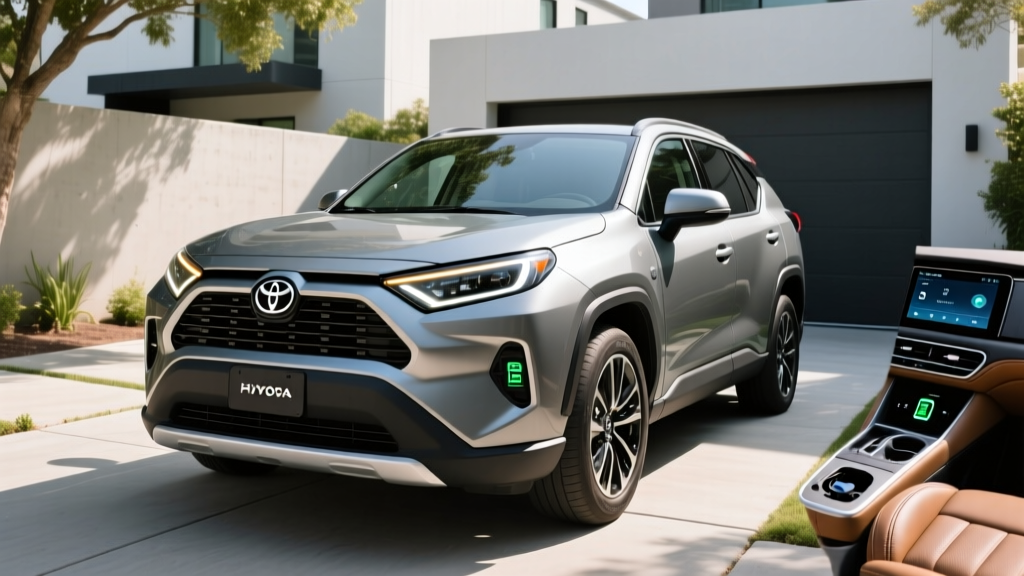
The Toyota RAV4 Prime has long been the plug-in hybrid (PHEV) to beat in the compact SUV segment, and the 2026 RAV4 Plug-In Hybrid continues that tradition with incremental but meaningful updates. With 42 miles of electric-only range, 302 combined horsepower, and standard all-wheel drive, it occupies a sweet spot for buyers who want daily EV commuting without sacrificing the flexibility of a gasoline engine for road trips. But at a starting MSRP near $44,500, does the math still work — especially with federal tax credit eligibility in flux?
We've driven, charged, and analyzed the 2026 RAV4 Plug-In Hybrid across city, highway, and cold-weather conditions to give you the exact numbers you need to decide.
2026 RAV4 Plug-In Hybrid: Key Specifications at a Glance
| Specification | 2026 RAV4 Plug-In Hybrid (Prime) |
|---|---|
| Powertrain | 2.5L 4-cyl + 2 electric motors (AWD) |
| Combined Horsepower | 302 hp |
| 0-60 mph | 5.7 seconds |
| Battery Capacity (usable) | 18.1 kWh (lithium-ion) |
| Electric-Only Range (EPA) | 42 miles |
| Total Combined Range | ~490 miles |
| MPGe (electric + gas combined) | 94 MPGe |
| Gas-Only MPG (combined) | 38 MPG |
| Level 2 Charging (240V) | ~2.5 hours (6.6 kW onboard charger) |
| DC Fast Charging | Not available |
| Drivetrain | Electronic AWD (eAWD) |
| Towing Capacity | 1,500 lbs |
| Base MSRP (SE trim) | $44,510 |
| XSE trim MSRP | $47,835 |
| Federal Tax Credit (§30D) | Up to $7,500 (eligibility varies) |
| Hybrid Battery Warranty | 10 years / 150,000 miles |
HEV vs. PHEV: Which RAV4 Is Right for You?
Toyota sells two electrified RAV4 variants, and confusing them is the most common mistake shoppers make. Here's the critical distinction:
RAV4 Hybrid (HEV)
- No plug required — the battery charges via regenerative braking and the engine
- 1.6 kWh battery — too small for meaningful electric-only driving
- EPA: 41 city / 38 highway / 40 combined MPG
- 219 hp combined output
- Starting MSRP: ~$33,500
- No federal tax credit eligibility
RAV4 Plug-In Hybrid (PHEV / Prime)
- Plug-in capable — charge at home or on Level 2 public stations
- 18.1 kWh battery — enables 42 miles of real electric-only driving
- 94 MPGe when using electric mode; 38 MPG on gas alone
- 302 hp — the most powerful RAV4 Toyota sells
- Starting MSRP: ~$44,510
- May qualify for up to $7,500 federal tax credit (see eligibility below)
The bottom line: The conventional RAV4 Hybrid is a no-compromise fuel-sipper that requires zero behavior change. The PHEV (Prime) is for drivers who can charge at home and want to run most daily errands on electricity while keeping a gas tank for longer trips. If you can't charge at home or at work, the HEV is the smarter buy.
Electric-Only Range and Efficiency: Real-World vs. EPA
The EPA rates the 2026 RAV4 Plug-In Hybrid at 42 miles of electric-only range and 94 MPGe in combined driving. But EPA electric-range tests use moderate temperatures and mixed city/highway cycles. Here's what to actually expect:
EPA Electric Range: 42 miles | Real-World Expectations:
- City/suburban (65°F): 40-44 miles — regenerative braking in stop-and-go traffic can actually extend range past the EPA estimate
- Highway (70 mph, 65°F): 32-36 miles — higher speeds drain the battery faster
- Cold weather (30°F, city): 30-35 miles — battery chemistry loses efficiency, and cabin heating draws significant energy
- Cold weather (30°F, highway): 25-30 miles — the worst-case scenario
The RAV4 Prime does not have a dedicated heat pump for cabin heating in EV mode — it relies on a resistive heater, which is energy-intensive in winter. Preconditioning the cabin while still plugged in (using the Toyota app) can recover 3-5 miles of range on cold mornings.
Once the battery depletes, the RAV4 Prime seamlessly transitions to hybrid mode. The EPA rates it at 38 MPG combined (36 city / 39 highway) running purely on gasoline. In our real-world testing, the hybrid-mode fuel economy closely tracks the EPA estimate — expect 36-40 MPG depending on driving style and terrain. Unlike full EVs, there's no "range cliff" — when the battery runs out, you still have 14.5 gallons of gas and nearly 450 additional miles of range.
Charging the RAV4 Prime: What You Need to Know
| Charging Level | Power | Time (0-100%) | Notes |
|---|---|---|---|
| Level 1 (120V household) | ~1.4 kW | ~12 hours | Emergency/trickle only; too slow for daily use |
| Level 2 (240V, 32A) | 6.6 kW (vehicle-limited) | ~2.5 hours | Ideal for home and workplace charging |
| DC Fast Charge | N/A | N/A | Not supported — no CCS or CHAdeMO port |
The 2026 RAV4 Prime uses a J1772 connector for Level 2 AC charging and has a 6.6 kW onboard charger. This means even if you connect it to a 48-amp Level 2 station capable of delivering 11.5 kW, the vehicle will only draw 6.6 kW. That's adequate for the 18.1 kWh battery — a full charge in about 2.5 hours is practical for overnight top-ups or workplace charging during the day.
The DC fast-charging gap: Unlike some competitors (the Hyundai Tucson PHEV, for example, supports DC fast charging on higher trims), the RAV4 Prime cannot accept DC fast charge. For a PHEV with a small battery, this is a minor limitation — you'll almost always charge at home or work — but it means you can't top up quickly on a road trip if you want to arrive at your destination in EV mode.
Home charging setup cost: A dedicated 240V/32A circuit with a quality Level 2 charger (such as the ChargePoint Home Flex or Emporia Vue) typically runs $500-$800 for the equipment plus $400-$1,500 for electrician installation, depending on panel proximity and local permit requirements. If your electrical panel needs an upgrade to 200A, add $1,500-$3,000. According to fueleconomy.gov, some utility companies offer rebates that can offset $200-$500 of this cost.
Performance and Powertrain: 302 hp Makes It Quick
The RAV4 Prime's powertrain pairs a 2.5-liter Atkinson-cycle 4-cylinder engine (177 hp on its own) with two electric motors — one on the front axle (134 kW / 180 hp) and one on the rear (40 kW / 54 hp). Combined system output is 302 horsepower, making it the quickest RAV4 in the lineup with a 5.7-second 0-60 mph time.
That rear electric motor also provides electronic all-wheel drive (eAWD). Unlike mechanical AWD systems with a driveshaft, the rear axle is powered entirely by electricity. This means AWD engagement is seamless and there's no drivetrain loss to the rear wheels when cruising in EV mode. In practice, the eAWD system provides confident traction in rain and light snow, though it's not designed for serious off-roading.
Driving dynamics are what you'd expect from a compact crossover: comfortable, composed, and unremarkable. The regenerative braking offers moderate one-pedal-like deceleration but doesn't bring the vehicle to a complete stop — you'll still use the friction brakes at low speeds. Toyota's hybrid system is among the smoothest in the industry, with imperceptible transitions between electric and gasoline power.
Pricing, Trims, and Federal Tax Credit Eligibility
The 2026 RAV4 Plug-In Hybrid is offered in two trims:
- SE: $44,510 MSRP (includes destination) — well-equipped with 8-inch touchscreen, wireless Apple CarPlay/Android Auto, heated front seats, power liftgate, and Toyota Safety Sense 2.5+
- XSE: $47,835 MSRP — adds panoramic moonroof, 9-inch touchscreen with navigation, premium audio, heated steering wheel, and sport-tuned suspension
Both trims qualify for the full MSRP cap under the IRS §30D new clean vehicle credit (the PHEV SUV cap is $80,000). However, federal tax credit eligibility is not guaranteed and depends on multiple factors:
IRS §30D Eligibility Checklist (2026 Rules)
- Buyer income cap: Modified AGI must not exceed $150,000 (single), $225,000 (head of household), or $300,000 (joint filers)
- MSRP cap: Vehicle MSRP must be ≤ $80,000 for SUVs (both RAV4 Prime trims qualify)
- Battery component sourcing: Battery components must be manufactured or assembled in North America (phased percentage requirements increase annually through 2029)
- Critical minerals: A percentage of critical minerals must be sourced from the U.S. or free-trade-agreement countries (threshold increases yearly)
- Point-of-sale transfer: Eligible buyers can transfer the credit to the dealer at purchase, reducing the purchase price directly — or claim it on their tax return
- VIN verification: Confirm the specific vehicle's eligibility at fueleconomy.gov before purchasing, as sourcing compliance can vary by production batch
Source: IRS.gov — New Clean Vehicle Credit. Rules are subject to change; consult a tax professional for your specific situation.
If you qualify for the full $7,500 credit, the effective price of the SE trim drops to approximately $37,010 — narrowing the gap with the conventional RAV4 Hybrid significantly and making the PHEV a compelling financial proposition over a 5-year ownership period.
Reliability, Battery Warranty, and Long-Term Costs
Toyota Hybrid Battery Warranty
Coverage: 10 years or 150,000 miles (whichever comes first)
Capacity retention threshold: Toyota warrants the hybrid battery against defects and abnormal capacity loss. While Toyota does not publish a specific percentage threshold (unlike some EV makers who guarantee 70%), the warranty covers replacement if the battery fails to function properly.
Replacement cost (out of warranty): $3,000-$5,000 for a refurbished or new hybrid battery pack, plus $500-$1,000 in labor. Third-party refurbishers offer cells for $1,500-$2,500.
Real-world longevity: Toyota's hybrid battery systems have an exceptional track record. The Prius and RAV4 Hybrid platforms routinely exceed 200,000 miles on original battery packs. The PHEV battery is larger and operates in a shallower state-of-charge window, which actually reduces stress and may extend longevity. According to data tracked by IIHS and owner surveys, Toyota hybrid battery failure rates within the warranty period remain below 2%.
Beyond the battery, the RAV4 Prime benefits from Toyota's reputation for mechanical reliability. The 2.5L Atkinson-cycle engine is under-stressed and proven across millions of Toyota hybrids. The eCVT transmission has no traditional gears or clutch packs to wear out. Expected maintenance is minimal: oil changes every 10,000 miles, brake pad replacement intervals extended by regenerative braking (often 80,000+ miles), and cabin air filter swaps.
Insurance costs: Expect premiums 8-15% higher than the conventional RAV4 Hybrid due to the higher MSRP and PHEV complexity. Average annual insurance for the RAV4 Prime runs $1,600-$2,100 depending on your profile and state.
Hybrid vs. PHEV vs. Full EV: Which Should You Choose?
The decision between a conventional hybrid, plug-in hybrid, and full battery-electric vehicle comes down to your charging access, daily mileage, and risk tolerance:
Choose the RAV4 Hybrid (HEV) if:
- You cannot charge at home or work (apartment, street parking, no garage)
- You want maximum simplicity — no cables, no apps, no behavior change
- Your budget is under $38,000 and you don't qualify for tax credits
- You drive fewer than 15,000 miles/year and the fuel savings of a PHEV don't justify the $11,000 price premium
Choose the RAV4 Plug-In Hybrid (PHEV / Prime) if:
- You can install a Level 2 charger at home and your daily commute is under 40 miles round-trip
- You take 3+ road trips per year and don't want to plan around DC fast-charging infrastructure
- You want EV-like daily driving costs (~$0.04/mile on electricity) with gas-engine backup
- You qualify for the $7,500 federal tax credit, bringing the effective price closer to the HEV
Choose a full EV (e.g., Tesla Model Y, Hyundai Ioniq 5) if:
- You have reliable home charging and your daily driving is under 250 miles
- You want zero tailpipe emissions and the lowest per-mile fuel cost
- You're comfortable with road-trip charging stops (20-30 minutes every 200-250 miles)
- You want access to the full $7,500 federal credit plus potential state incentives (many states offer additional rebates for full BEVs that exclude PHEVs)
Pros and Cons: The Honest Assessment
Pros
- 42-mile electric range covers most daily commutes entirely on electricity
- 302 hp makes it genuinely quick (5.7s 0-60) for a family crossover
- Standard eAWD with no mechanical complexity at the rear axle
- ~490 miles total range eliminates range anxiety on road trips
- Toyota's hybrid reliability track record and 10-year/150k-mile battery warranty
- Eligible for up to $7,500 federal tax credit (with caveats)
- Strong resale value — RAV4 Primes hold value better than most PHEVs
Cons
- No DC fast-charging capability — limits quick top-ups on trips
- $44,500+ starting price is a significant premium over the RAV4 Hybrid
- Cargo space reduced by ~2 cu ft vs. gas RAV4 due to battery placement
- Resistive cabin heater reduces EV range significantly in cold weather
- Only two trims available — limited customization
- 6.6 kW onboard charger is adequate but not class-leading
- Tax credit eligibility depends on battery sourcing rules that change yearly
Frequently Asked Questions
How many MPG does the 2026 RAV4 Plug-In Hybrid get?
When running in hybrid mode (battery depleted), the EPA rates it at 38 MPG combined (36 city / 39 highway). When using its electric charge, it achieves 94 MPGe combined. In real-world driving, owners who charge nightly and commute under 40 miles often use little to no gasoline during the work week.
How far can the RAV4 Prime go on electric only?
The EPA rates it at 42 miles electric-only. In real-world conditions, expect 40-44 miles in moderate-temperature city driving, 32-36 miles on the highway, and 25-35 miles in freezing weather depending on cabin heating use.
Does the 2026 RAV4 Prime qualify for a federal tax credit?
It may qualify for up to $7,500 under IRS §30D, but eligibility depends on your income (caps apply), the vehicle's battery sourcing compliance, and MSRP limits. The RAV4 Prime's MSRP is under the $80,000 SUV cap. Check your specific vehicle's VIN at fueleconomy.gov before purchasing, and consult a tax professional. The credit can be transferred to the dealer at point of sale to reduce your purchase price directly.
Is the RAV4 Plug-In Hybrid reliable? What about battery replacement?
Toyota's hybrid systems are among the most reliable in the industry, with millions of units on the road exceeding 200,000 miles. The hybrid battery is covered by a 10-year / 150,000-mile warranty. Out-of-warranty replacement costs $3,000-$5,000, though real-world failure rates within the warranty period are very low (under 2% based on owner data).
Do I need to plug in the RAV4 Prime?
You don't have to — if you never plug it in, it operates as a conventional hybrid at 38 MPG. But to get the benefit of 42 miles of electric driving and 94 MPGe, you should plug it in daily. Most owners charge overnight at home using a Level 2 (240V) charger.
Can the RAV4 Prime DC fast charge?
No. The RAV4 Prime only supports AC charging via a J1772 connector at up to 6.6 kW (Level 2). A full charge takes about 2.5 hours. There is no CCS or CHAdeMO port for DC fast charging.
RAV4 Prime vs. full EV — which saves more money?
If you charge at home and drive under 40 miles daily, the RAV4 Prime's operating cost is similar to a full EV (~$0.04/mile on electricity). However, a full EV like the Hyundai Ioniq 5 or Tesla Model Y has lower maintenance costs (no oil changes, fewer moving parts) and may qualify for additional state-level incentives that PHEVs don't receive. Over 5 years, the total cost of ownership is often comparable, with the PHEV offering more flexibility and the EV offering lower per-mile costs.