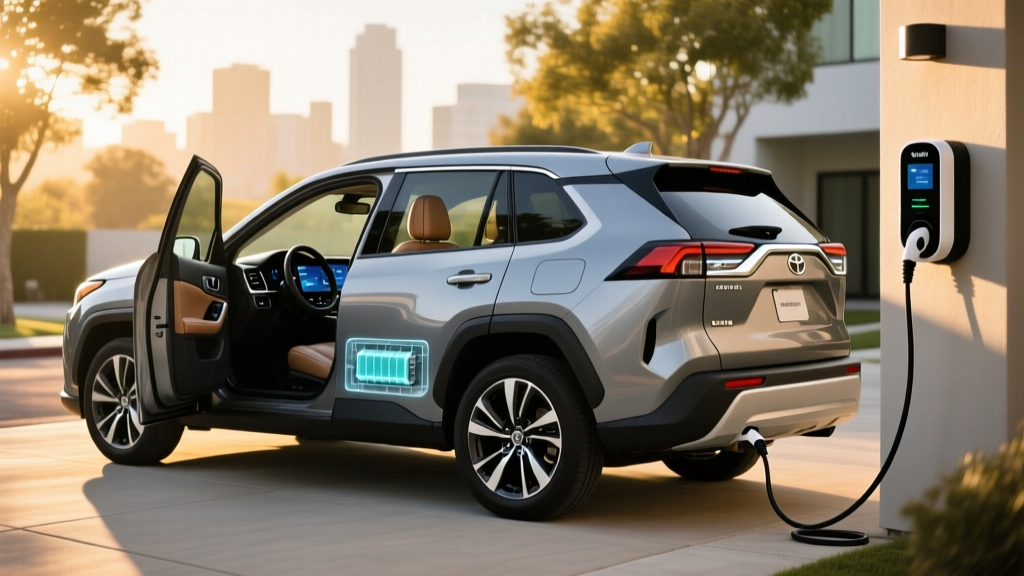
The Toyota RAV4 Hybrid has dominated the compact crossover segment for years, and the top-of-the-line Limited trim continues that streak for 2026. If you've landed on this page searching for the 2026 RAV4 Limited Hybrid, you likely want hard numbers — not marketing gloss. Below, we break down the exact EPA fuel economy, real-world MPG observations, powertrain specs, pricing, battery warranty details, and how this conventional hybrid (HEV) stacks up against the RAV4 Prime plug-in hybrid and full battery-electric alternatives.
Let's get the most important distinction out of the way: the RAV4 Hybrid is a conventional hybrid. It charges its own battery through regenerative braking and the gasoline engine. You never plug it in. If you want electric-only driving, you need the RAV4 Prime (PHEV). We'll compare both below.
2026 RAV4 Limited Hybrid: Quick Spec Overview
| Spec | Value |
|---|---|
| Powertrain | 2.5L 4-cyl + 3 electric motors (AWD-i) |
| Combined Horsepower | 219 hp (net system) |
| EPA MPG (City / Hwy / Combined) | 41 / 38 / 39 MPG |
| Fuel Tank | 14.5 gallons |
| Total Driving Range | ~565 miles (EPA est.) |
| 0-60 mph | 7.4 seconds (est.) |
| Drivetrain | Electronic On-Demand AWD (eAWD) |
| Hybrid Battery | Lithium-ion, ~1.6 kWh (self-charging) |
| Hybrid Battery Warranty | 10 years / 150,000 miles |
| Base MSRP (Limited AWD) | ~$41,500 (est.) |
| Federal Tax Credit | Not eligible (HEV, not PHEV/BEV) |
Fuel Economy: EPA Numbers vs. Real-World MPG
The EPA rates the 2026 RAV4 Hybrid (all AWD trims, including Limited) at 41 MPG city, 38 MPG highway, and 39 MPG combined, per fueleconomy.gov. These figures carry over from the previous model year, as Toyota's fifth-generation hybrid system has proven highly efficient across the lineup.
This is one of the RAV4 Hybrid's strongest selling points: it delivers its best efficiency exactly where most people drive the most — in city and suburban traffic. A comparable gas-only compact SUV might achieve 25-28 MPG combined, meaning the RAV4 Hybrid saves roughly 3-4 gallons per 100 miles driven.
Powertrain: How the Hybrid System Works
The 2026 RAV4 Limited Hybrid pairs a 2.5-liter Dynamic Force four-cylinder engine (176 hp, 163 lb-ft on its own) with Toyota's fifth-generation hybrid system. Two motor-generators sit in the front transaxle, while a third electric motor powers the rear axle for electronic on-demand AWD. Combined net output is 219 horsepower.
The rear motor engages automatically when the system detects front-wheel slip or during hard acceleration, providing AWD traction without a mechanical driveshaft. This setup adds roughly 100 lbs over a FWD-only hybrid but improves traction confidence in rain and light snow.
The hybrid battery pack is a compact lithium-ion unit with approximately 1.6 kWh of capacity. Unlike a plug-in hybrid or full EV, this battery is never charged from an external source. It recovers energy during braking and deceleration, then deploys it for electric-only propulsion at low speeds, torque fill during acceleration, and auxiliary power for accessories. The result is seamless operation — most drivers never notice when the engine cycles on and off.
HEV vs. PHEV: RAV4 Hybrid vs. RAV4 Prime
Toyota offers the RAV4 in two electrified flavors, and buyers frequently confuse them. Here's the clear breakdown:
| Feature | RAV4 Hybrid (HEV) | RAV4 Prime (PHEV) |
|---|---|---|
| Plug-in Required? | No — self-charging | Yes — plug in for EV range |
| Battery Size | ~1.6 kWh | ~18.1 kWh |
| Electric-Only Range | None (EV mode at low speed only) | 42 miles (EPA est.) |
| Combined MPG / MPGe | 39 MPG combined | 94 MPGe (EV+gas) / 38 MPG (gas only) |
| Combined Horsepower | 219 hp | 302 hp |
| 0-60 mph | 7.4 sec | 5.7 sec |
| DC Fast Charge? | N/A | No (Level 2 AC only, ~2.5 hrs) |
| Federal Tax Credit (§30D) | Not eligible | Up to $7,500 (eligibility varies) |
| Starting MSRP (est.) | ~$33,500 (LE) | ~$44,500 (SE) |
The bottom line: If you have access to home or workplace charging and your daily commute is under 40 miles round-trip, the RAV4 Prime lets you drive almost entirely on electricity — effectively operating as an EV on weekdays and a hybrid on road trips. If you can't charge at home or simply want maximum simplicity, the RAV4 Hybrid delivers excellent fuel economy with zero behavior change.
Pricing: 2026 RAV4 Limited Hybrid Trim Cost
The Limited sits at the top of the RAV4 Hybrid trim ladder. For 2026, estimated pricing breaks down as follows:
- RAV4 Hybrid LE (base): ~$33,500
- RAV4 Hybrid XLE: ~$35,500
- RAV4 Hybrid XLE Premium: ~$37,500
- RAV4 Hybrid Woodland Edition: ~$37,000
- RAV4 Hybrid Limited: ~$41,500
The Limited trim adds features like a 12.3-inch digital instrument cluster, SofTex-trimmed heated and ventilated front seats, a 10.5-inch touchscreen with wireless Apple CarPlay and Android Auto, a panoramic moonroof, a JBL premium audio system, and Toyota's full suite of Safety Sense 3.0 driver-assistance features (adaptive cruise, lane-keeping, pre-collision with pedestrian detection, blind-spot monitoring).
Destination charges add approximately $1,350. With popular options like the Advanced Technology Package (head-up display, 360-degree camera, digital rearview mirror), a fully loaded RAV4 Hybrid Limited can approach $45,000.
Battery Warranty, Lifespan, and Replacement Cost
Battery longevity is the number-one concern for hybrid buyers, and Toyota's track record here is among the best in the industry. The RAV4 Hybrid uses a relatively small lithium-ion pack that operates within a narrow state-of-charge window (roughly 40-80%), which significantly reduces degradation compared to full EVs that cycle through wider ranges.
Real-world lifespan data: Toyota hybrid batteries from the Prius and RAV4 Hybrid lineages routinely last 150,000-200,000+ miles before any significant capacity loss. Failure before 100,000 miles is uncommon. When replacement is eventually needed out of warranty, expect to pay approximately $3,000-$5,000 for a new OEM hybrid battery pack, or $1,500-$2,500 for a refurbished unit from authorized recyclers.
For context, that replacement cost is comparable to a major transmission repair on a conventional gas vehicle — and it typically won't be needed until well past the 10-year mark. The hybrid system's simplicity (no traditional starter, alternator, or accessory belt; regenerative braking reduces brake pad wear) actually lowers maintenance costs versus a gas-only vehicle over the long term.
Who Should Choose the RAV4 Hybrid vs. a PHEV or Full EV?
The 2026 RAV4 Limited Hybrid is the right choice if your situation matches these criteria:
Choose the RAV4 Hybrid (HEV) if:
- You lack access to home or workplace Level 2 charging
- You want zero change to your fueling habits
- Your budget is under $42,000 for a loaded compact SUV
- You drive a mix of city and highway and want strong MPG in both
- You plan to keep the vehicle 8-10+ years (warranty coverage)
Choose the RAV4 Prime (PHEV) if:
- You can install a Level 2 charger at home (240V)
- Your daily commute is under 42 miles round-trip
- You want EV-like daily driving with gas backup for road trips
- You qualify for the federal §30D tax credit (up to $7,500)
- You value the 302-hp performance upgrade
Choose a Full EV (e.g., Tesla Model Y, Ioniq 5) if:
- You want zero tailpipe emissions and lowest fuel cost per mile
- You have reliable home charging and nearby DC fast chargers
- You drive under 300 miles between charges most days
- You want the lowest long-term maintenance costs
- You qualify for federal + state EV incentives
For apartment dwellers, street parkers, or anyone without dedicated charging access, the RAV4 Hybrid remains the most practical path to significantly lower fuel consumption. You'll save roughly $600-$900 per year in fuel costs versus a gas-only compact SUV (based on 15,000 miles/year and $3.50/gallon), with a payback period of approximately 3-5 years over a comparably equipped gas model.
Reliability and Safety Ratings
Toyota consistently ranks at or near the top of J.D. Power and Consumer Reports reliability surveys, and the RAV4 Hybrid is a core part of that reputation. The hybrid powertrain has fewer wear items than a conventional drivetrain — no traditional automatic transmission (the eCVT has no clutch packs or bands to wear), regenerative braking extends pad life to 80,000-100,000+ miles, and the engine operates under reduced stress thanks to electric motor assist.
The 2026 RAV4 carries the Insurance Institute for Highway Safety (IIHS) Top Safety Pick+ designation (when equipped with specific headlights), and the National Highway Traffic Safety Administration (NHTSA) awards it a 5-Star Overall Safety Rating. Toyota Safety Sense 3.0 includes pre-collision braking with pedestrian detection, full-speed adaptive cruise control, lane departure alert with steering assist, automatic high beams, and road sign assist.
Frequently Asked Questions
How many MPG does the 2026 RAV4 Limited Hybrid get?
The EPA rates it at 41 MPG city, 38 MPG highway, and 39 MPG combined. In real-world city driving, many owners report 42-44 MPG. Highway driving at 75+ mph typically yields 35-37 MPG.
Does the RAV4 Hybrid need to be plugged in?
No. The RAV4 Hybrid is a conventional hybrid (HEV). It charges its own small battery through regenerative braking and the gasoline engine. You fuel it exactly like a regular car — just with better MPG.
How far can the RAV4 Hybrid go on electric only?
Not far, and not at highway speeds. The hybrid system can propel the RAV4 on electric power alone for roughly 0.5-1 mile at very low speeds (under 25 mph) in stop-and-go traffic. For meaningful electric-only range (42 miles), you need the RAV4 Prime PHEV.
Is the hybrid battery expensive to replace?
Out of warranty, a new OEM hybrid battery costs approximately $3,000-$5,000. However, Toyota's hybrid batteries routinely last 150,000-200,000+ miles, and the factory warranty covers 10 years / 150,000 miles. Most owners will never need a replacement.
Does the 2026 RAV4 Hybrid qualify for a federal tax credit?
No. The IRS §30D Clean Vehicle Credit applies only to plug-in hybrids (PHEVs) and battery-electric vehicles (BEVs). The conventional RAV4 Hybrid is not eligible. The RAV4 Prime PHEV may qualify for up to $7,500, subject to income, MSRP, and battery-sourcing requirements outlined at irs.gov.
How does the RAV4 Hybrid compare to the Honda CR-V Hybrid?
The 2026 Honda CR-V Hybrid (Sport Touring) is rated at 40 MPG combined (43 city / 36 highway), slightly edging the RAV4 in city driving. The RAV4 Hybrid counters with standard AWD across all trims, slightly more cargo volume (37.5 cu ft vs. 36.3 cu ft behind the rear seats), and a longer track record of hybrid reliability. Both are excellent choices; test-driving back-to-back is the best way to decide.