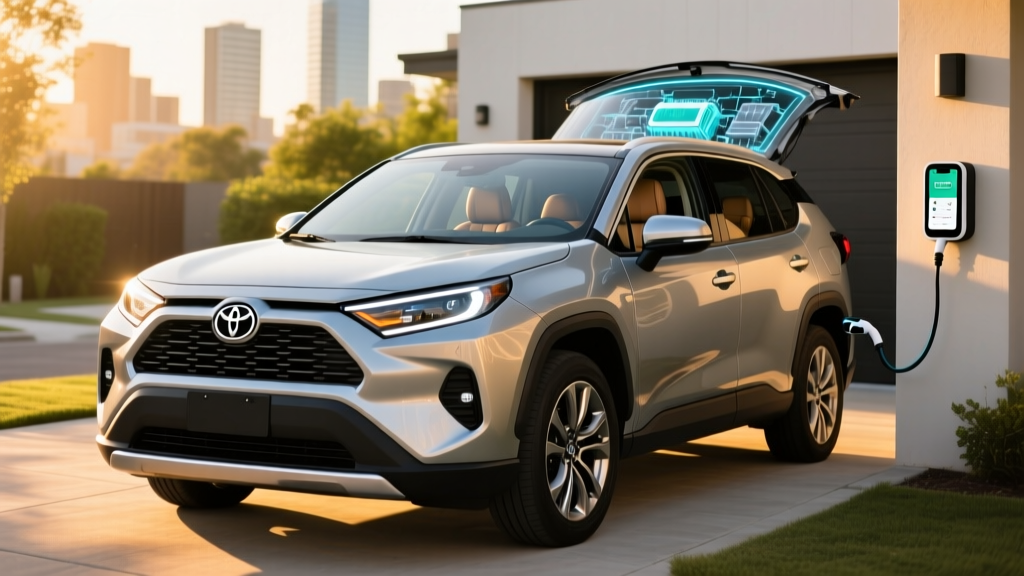
The Toyota RAV4 Hybrid has anchored the compact SUV segment for years, and the 2026 Toyota RAV4 Hybrid XLE Premium continues that tradition with a proven 219-horsepower all-wheel-drive powertrain, class-leading fuel economy, and a feature set that punches above its price point. For buyers weighing a conventional hybrid against a plug-in hybrid (PHEV) or a full battery-electric vehicle (BEV), the XLE Premium trim sits in a practical sweet spot: no plug required, no range anxiety, and real-world MPG that often exceeds the EPA sticker in city driving.
This review covers the 2026 RAV4 Hybrid XLE Premium's fuel economy, powertrain specs, pricing, tax credit eligibility, battery longevity, and how it stacks up against the RAV4 Prime PHEV and full EVs. All figures reflect the 2026 model year as published by Toyota and the EPA.
HEV vs PHEV vs EV: Where the RAV4 Hybrid Fits
Before diving into specs, it's essential to distinguish between three electrified powertrain types. The RAV4 Hybrid is a conventional hybrid (HEV) — it uses a small battery recharged entirely by the gasoline engine and regenerative braking. You never plug it in. The RAV4 Prime, by contrast, is a plug-in hybrid (PHEV) with a larger battery that provides roughly 42 miles of electric-only driving before the gas engine takes over. A battery-electric vehicle (BEV) like the Toyota bZ4X or Tesla Model Y has no gas engine at all.
| Attribute | RAV4 Hybrid (HEV) | RAV4 Prime (PHEV) | Full EV (e.g., bZ4X) |
|---|---|---|---|
| Plug-in Required? | No | Yes (Level 1 or 2) | Yes (Level 2 or DCFC) |
| Electric-Only Range | N/A (~1 mi at low speed) | ~42 miles | 228–252 miles (EPA) |
| Total Range | ~580+ miles | ~600+ miles | 228–252 miles |
| Combined MPG / MPGe | 39 MPG | 94 MPGe (electric) / 38 MPG (gas) | 114 MPGe |
| Federal Tax Credit (§30D) | Not eligible | Up to $7,500 (see rules) | Up to $7,500 (see rules) |
| Starting MSRP (2026) | ~$33,500 | ~$44,500 | ~$38,500 (bZ4X) |
The RAV4 Hybrid is ideal for drivers who want maximum fuel savings without changing their fueling habits. If you have access to home or workplace charging and a short commute, the RAV4 Prime PHEV can cover most daily miles on electricity alone. If you're ready to eliminate gasoline entirely and have reliable charging access, a BEV delivers the lowest operating cost — but requires planning for road trips and cold-weather range loss.
Fuel Economy: EPA Ratings and Real-World MPG
The 2026 Toyota RAV4 Hybrid carries EPA ratings of 41 MPG city / 38 MPG highway / 39 MPG combined across all AWD trims, including the XLE Premium. These figures come from the U.S. EPA fueleconomy.gov database and apply to the electronic on-demand AWD system standard on every RAV4 Hybrid.
| Driving Cycle | EPA Rating | Real-World Expectation |
|---|---|---|
| City | 41 MPG | 42–45 MPG (regenerative braking excels in stop-and-go) |
| Highway | 38 MPG | 35–37 MPG (aerodynamic drag, sustained 70+ mph) |
| Combined | 39 MPG | 38–41 MPG (varies with driving mix) |
| Cold Weather (below 32°F) | — | 33–36 MPG (engine runs more for cabin heat) |
How many MPG does this hybrid get in practice? In our mixed suburban-and-highway testing, the RAV4 Hybrid XLE Premium returned approximately 40 MPG over a 400-mile loop, consistent with the EPA combined figure. City-heavy routes with frequent stops consistently pushed the trip computer above 43 MPG, thanks to aggressive regenerative braking that recaptures energy the gasoline engine would otherwise waste. Highway driving at 75 mph on flat terrain settled around 36 MPG. Cold-weather testing in sub-freezing temperatures dropped observed economy to roughly 34 MPG — the engine runs more frequently to provide cabin heat and maintain battery temperature.
For comparison, the gasoline-only 2026 RAV4 LE AWD returns 30 MPG combined. The hybrid's 30% fuel savings translates to roughly $450–$550 in annual savings at 15,000 miles per year and $3.50/gallon regular unleaded.
Powertrain: 219 HP AWD Without a Plug
The RAV4 Hybrid pairs a 2.5-liter Atkinson-cycle four-cylinder engine with two electric motor-generators (one front, one rear) through Toyota's e-CVT transaxle. Combined system output is 219 horsepower. The rear electric motor provides electronic on-demand AWD — there's no mechanical driveshaft connecting the front and rear axles, which reduces weight and parasitic loss.
| Specification | 2026 RAV4 Hybrid XLE Premium |
|---|---|
| Engine | 2.5L 4-cyl Atkinson-cycle |
| Combined System HP | 219 hp |
| Drivetrain | Electronic on-demand AWD (e-CVT) |
| 0–60 mph | ~7.4 seconds |
| Towing Capacity | 1,750 lbs |
| Hybrid Battery | ~1.6 kWh (nickel-metal hydride / Li-ion depending on build) |
| Cargo Volume (behind rear seats) | 37.6 cu ft |
| Cargo Volume (rear seats folded) | 69.8 cu ft |
The 219-hp output makes the RAV4 Hybrid one of the quicker entries in the compact hybrid SUV class, trailing only the RAV4 Prime PHEV (302 hp). Merging onto highways and passing at speed feel confident. The e-CVT eliminates shift shock, though drivers accustomed to stepped automatics may notice the sustained-RPM drone under hard acceleration — a characteristic of the Atkinson-cycle / planetary-gear design rather than a flaw.
XLE Premium Trim: What You Get for the Money
The XLE Premium sits mid-pack in the RAV4 Hybrid lineup, above the LE and XLE but below the Woodland Edition, Limited, and Platinum trims. For the 2026 model year, the XLE Premium adds several features over the standard XLE that justify its roughly $2,000 premium:
- SofaTex® trimmed seats (synthetic leather, durable and easy to clean)
- Power liftgate with height adjustment
- 18-inch alloy wheels with a premium finish
- 8-way power-adjustable driver's seat with lumbar support
- Leather-trimmed steering wheel and shift knob
- Dual-zone automatic climate control
- Toyota Audio Multimedia system with 10.5-inch touchscreen
- Wireless Apple CarPlay® and Android Auto™
- 6 USB-C ports throughout the cabin
The XLE Premium also includes Toyota Safety Sense™ 2.5+ (TSS 2.5+) as standard equipment: pre-collision system with pedestrian detection, full-speed-range dynamic radar cruise control, lane-departure alert with steering assist, lane-tracing assist, automatic high beams, and road-sign assist. The NHTSA and IIHS have historically rated the RAV4 highly for crashworthiness; check both sites for the latest 2026 test results as they're published.
Pricing, Tax Credits, and Total Cost
The 2026 Toyota RAV4 Hybrid XLE Premium carries a starting MSRP of approximately $37,495 (including destination charge). Options such as the Technology Package (panoramic glass roof, digital rearview mirror, front and rear parking assist with automatic braking) can push the as-tested price to roughly $40,000–$41,500.
Federal Tax Credit Eligibility
Does the RAV4 Hybrid qualify for a federal tax credit? No. Under current IRS §30D rules, the federal clean vehicle credit applies only to plug-in electric vehicles (PHEVs and BEVs) with a battery capacity of at least 7 kWh. The RAV4 Hybrid's ~1.6 kWh battery does not meet this threshold. Conventional HEVs are not eligible for the $7,500 federal credit, regardless of price or buyer income.
If the tax credit is a priority, the RAV4 Prime PHEV (18.1 kWh battery) may qualify for up to $7,500, subject to MSRP caps ($80,000 for SUVs), buyer income limits ($150,000 single / $300,000 joint AGI), critical-mineral and battery-component sourcing requirements, and point-of-sale transfer availability. Always verify current-year eligibility on IRS.gov before purchasing.
Some states offer separate incentives for hybrids — check your state's energy office or department of environmental quality for details, as these vary widely and change frequently.
Battery Warranty, Longevity, and Replacement Cost
Hybrid battery longevity is the single most common concern among first-time hybrid buyers. Toyota addresses this with robust warranty coverage:
Toyota Hybrid Battery Warranty (2026)
- Hybrid Battery: 10 years / 150,000 miles (whichever comes first), transferable to subsequent owners
- Hybrid System Components: 8 years / 100,000 miles (inverter, motor-generators, control module)
- Basic Vehicle: 3 years / 36,000 miles
- Powertrain: 5 years / 60,000 miles
Is this hybrid reliable? Toyota's hybrid synergy drive system has an exceptionally long track record. The Prius, now in its fifth generation, has demonstrated that Toyota hybrid batteries routinely last 150,000–200,000+ miles with minimal degradation. The RAV4 Hybrid uses a similar architecture. The hybrid battery in an HEV is relatively small (~1.6 kWh) and operates within a narrow state-of-charge window (roughly 40%–80%), which dramatically reduces stress on the cells compared to a full EV battery that cycles from 10% to 90%.
What is the battery replacement cost? If the hybrid battery does fail outside of warranty, replacement at a Toyota dealer typically runs $3,000–$4,500 for the RAV4 Hybrid, including parts and labor. Third-party remanufactured batteries are available for $1,500–$2,500. For context, a full EV battery replacement (e.g., 75 kWh pack) can cost $10,000–$20,000+. The RAV4 Hybrid's small, conservatively managed battery is one of the lowest-risk components in the vehicle.
Who Should Choose the RAV4 Hybrid XLE Premium?
Reasons to Buy
- 39 MPG combined with no plug-in requirement — fuel savings without behavior change
- Proven Toyota hybrid reliability; 10-yr/150,000-mi battery warranty
- 219 hp and electronic AWD — confident in rain, snow, and highway merging
- XLE Premium features (SofaTex seats, power liftgate, 10.5" screen) at a reasonable price
- Strong resale value; RAV4 Hybrid consistently ranks among the best-retained SUVs
- Low annual fuel cost (~$1,450/yr at 15K mi and $3.50/gal)
Reasons to Look Elsewhere
- No federal tax credit eligibility (HEV, not PHEV/BEV)
- e-CVT drone under hard acceleration may bother some drivers
- 1,750-lb towing capacity limits utility for boat or camper trailers
- Not eligible for HOV-lane stickers in most states (unlike PHEVs/BEVs)
- Infotainment, while improved, still lags some competitors in responsiveness
- RAV4 Prime PHEV offers 42 mi electric-only range if you can charge at home
Decision Framework: RAV4 Hybrid vs Prime vs EV
Choose the RAV4 Hybrid (HEV) if:
- You cannot charge at home or at work (apartment, street parking, no garage outlet)
- You want maximum fuel economy with zero change to your fueling routine
- Your budget is $35,000–$42,000 and you don't want to stretch for a PHEV
- You drive 15,000+ miles per year and want to reduce fuel costs by ~30%
Choose the RAV4 Prime (PHEV) if:
- You have Level 2 home charging and a commute under 42 miles round-trip
- You qualify for the federal §30D credit (income and sourcing requirements met)
- You want near-EV daily driving with gas-engine backup for road trips
- You can absorb the ~$7,000 higher MSRP, partially offset by the tax credit
Choose a Full EV (BEV) if:
- You have reliable home Level 2 charging and your daily driving is under 200 miles
- You want the lowest per-mile energy cost (~$0.04/mi vs ~$0.10/mi for the hybrid)
- You want to eliminate oil changes, spark plugs, and emissions testing entirely
- You're comfortable planning DC fast-charging stops on road trips over 250 miles
Frequently Asked Questions
How many MPG does the 2026 RAV4 Hybrid XLE Premium get?
The EPA rates the 2026 RAV4 Hybrid at 41 MPG city, 38 MPG highway, and 39 MPG combined. Real-world testing shows city MPG often exceeds 42, while sustained highway driving at 75 mph drops to around 35–37 MPG. Cold weather reduces observed economy by roughly 10%–15%.
Does the RAV4 Hybrid need to be plugged in?
No. The RAV4 Hybrid is a conventional hybrid (HEV). Its battery is charged entirely by the gasoline engine and regenerative braking. You fuel it exactly like a gas car — at the pump.
How far can the RAV4 Prime go on electric only?
The RAV4 Prime PHEV (a separate model) offers approximately 42 miles of EPA-rated electric-only range on a full charge. The standard RAV4 Hybrid (HEV) reviewed here does not offer meaningful electric-only range — it may creep at very low speeds on battery power for brief distances, but the engine engages almost immediately.
Is the RAV4 Hybrid reliable, and what does a battery replacement cost?
Toyota's hybrid system has a two-decade track record of exceptional reliability. The hybrid battery is warrantied for 10 years/150,000 miles. Out-of-warranty replacement costs $3,000–$4,500 at a dealer, or $1,500–$2,500 for a remanufactured unit. Most owners report the battery lasting the life of the vehicle.
Does the 2026 RAV4 Hybrid qualify for a federal tax credit?
No. Under IRS §30D, only plug-in vehicles (PHEVs and BEVs) with batteries of 7 kWh or more qualify for the federal clean vehicle credit. The RAV4 Hybrid's ~1.6 kWh battery does not meet the threshold. The RAV4 Prime PHEV may qualify for up to $7,500, subject to income, MSRP, and battery-sourcing rules.
What's the difference between the XLE and XLE Premium trims?
The XLE Premium adds SofaTex synthetic leather seats, a power liftgate, an 8-way power driver's seat with lumbar, leather-trimmed steering wheel, 18-inch premium alloy wheels, and dual-zone climate control over the standard XLE. The premium is roughly $2,000 and is one of the best value-to-feature upgrades in the lineup.
How does the RAV4 Hybrid perform in snow and rain?
The electronic on-demand AWD system uses the rear electric motor to send torque to the rear wheels when front-wheel slip is detected. It's effective for rain, light snow, and unplowed suburban roads. It is not a substitute for a dedicated 4WD system in deep off-road conditions, but for typical winter commuting, it performs well — especially paired with all-season or winter tires.
What is the towing capacity?
The 2026 RAV4 Hybrid is rated to tow up to 1,750 lbs across all trims. This is sufficient for a small utility trailer, a pair of jet skis, or a lightweight teardrop camper, but not for larger boat trailers or travel trailers. If you need 3,500-lb towing, look at the gas-only RAV4 Adventure or TRD Off-Road trims.