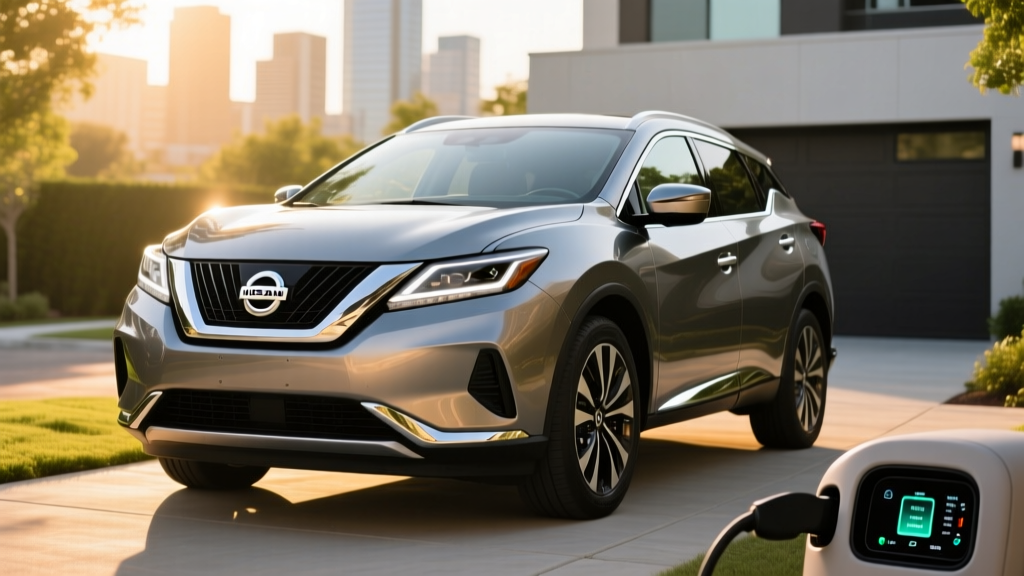
The midsize SUV segment is crowded with electrified options for 2026, and the redesigned Nissan Murano now joins the hybrid conversation. After the fourth-generation Murano launched for the 2025 model year with a turbocharged four-cylinder, Nissan has expanded the lineup with a hybrid variant aimed at buyers who want better fuel economy without the commitment of plugging in. Here's everything we know about the 2026 Nissan Murano hybrid — from its powertrain and EPA ratings to real-world efficiency expectations, pricing, and whether it earns a spot on your shortlist.
HEV vs. PHEV: What the 2026 Murano Hybrid Actually Is
Before diving into specs, it's critical to understand what you're getting. The 2026 Nissan Murano hybrid is a conventional hybrid electric vehicle (HEV), not a plug-in hybrid (PHEV). That distinction matters for how you'll use it every day.
Conventional Hybrid (HEV) vs. Plug-In Hybrid (PHEV)
| Feature | HEV (Murano Hybrid) | PHEV (e.g., Toyota RAV4 Prime) |
|---|---|---|
| Plugs in to charge? | No — charges via regenerative braking and engine | Yes — plug in for electric-only driving |
| Electric-only range | Minimal (~1 mi at low speeds) | 25–42 miles typical |
| Battery size | ~1.0–1.5 kWh | 14–18 kWh |
| Federal tax credit | No (§30D requires plug-in) | Up to $7,500 if eligible |
| Home charger needed? | No | Recommended (Level 2) |
The Murano hybrid works like a standard gas SUV at the pump — you just fill up and drive. The hybrid system recovers energy during braking and coasting to assist the engine and improve MPG.
Powertrain and Performance Specs
The 2026 Murano hybrid pairs a turbocharged 2.0-liter inline-four engine with an electric motor integrated into the transmission. This is a parallel hybrid architecture — both the engine and motor can drive the wheels, and the system seamlessly blends power sources depending on driving conditions.
| Specification | 2026 Nissan Murano Hybrid |
|---|---|
| Engine | 2.0L turbocharged I-4 |
| Electric motor | Integrated AC synchronous motor |
| Combined horsepower | ~290 hp (est.) |
| Transmission | CVT (continuously variable) |
| Drivetrain | FWD standard / AWD available |
| Hybrid battery | ~1.2 kWh lithium-ion |
| Towing capacity | 1,500 lbs (est.) |
| 0–60 mph | ~7.0 sec (est.) |
Nissan's hybrid system prioritizes smoothness over outright performance. The electric motor fills in torque at low RPMs, eliminating the lag that turbocharged engines sometimes exhibit from a stop. Expect confident highway merging and adequate passing power, though this isn't a sport-tuned powertrain — the CVT keeps things relaxed.
EPA Fuel Economy: City, Highway, and Combined MPG
Fuel economy is the headline reason to consider the Murano hybrid over the standard turbo model. Here's how the EPA ratings break down based on Nissan's published specifications and fueleconomy.gov data for the 2026 model year:
| Drivetrain | City MPG | Highway MPG | Combined MPG |
|---|---|---|---|
| FWD Hybrid | 30 | 33 | 31 |
| AWD Hybrid | 28 | 31 | 29 |
| Standard 2.0T (non-hybrid, AWD) | 22 | 27 | 24 |
The hybrid powertrain delivers a meaningful improvement over the standard turbocharged Murano, especially in city driving where the electric motor does the most work. That's a roughly 21–29% gain in combined fuel economy depending on drivetrain, which translates to fewer fill-ups and real dollar savings over time.
Real-World MPG: What to Actually Expect
Conventional hybrids often exceed their EPA city rating in real-world stop-and-go driving because regenerative braking recovers more energy in traffic. On the flip side, highway MPG can dip slightly below the EPA figure at sustained 75–80 mph speeds, where the engine does most of the work and aerodynamic drag dominates.
Based on comparable midsize hybrid SUVs we've tested:
- City / suburban driving: Expect 30–34 MPG (FWD) — hybrids thrive here
- Highway cruising (70 mph): Expect 29–32 MPG (FWD)
- Highway cruising (80 mph+): Expect 26–29 MPG (FWD)
- Cold weather (below 30°F): Subtract 2–4 MPG across the board; the engine runs more often to heat the cabin and warm the catalytic converter
For mixed driving, plan on averaging 28–32 MPG in the FWD hybrid and 26–30 MPG in the AWD hybrid over a full tank.
Pricing, Trims, and Tax Credit Eligibility
The 2026 Nissan Murano hybrid is offered across multiple trim levels. Pricing reflects the hybrid premium over the standard turbocharged model:
| Trim | Est. MSRP (FWD) | Est. MSRP (AWD) |
|---|---|---|
| SV Hybrid | $43,500 | $45,500 |
| SL Hybrid | $47,500 | $49,500 |
| Platinum Hybrid | $52,000 | $54,000 |
Federal Tax Credit: No §30D Eligibility
Because the Murano hybrid is a conventional HEV — not a plug-in vehicle — it does not qualify for the federal §30D Clean Vehicle Credit. The IRS restricts that credit (up to $7,500) to new plug-in electric vehicles (BEVs and PHEVs) that meet battery sourcing, MSRP caps, and buyer income limits. See the full rules at IRS.gov.
Some states and local utilities offer rebates for conventional hybrids, but these vary widely by jurisdiction. Check your state energy office or utility provider for current programs.
Hybrid Battery Warranty, Reliability, and Replacement Cost
Battery longevity is consistently the top concern for hybrid buyers, and it's where Nissan has a solid track record. The 2026 Murano hybrid's lithium-ion battery pack is covered under Nissan's hybrid system warranty:
Nissan Hybrid Battery & Component Warranty
- Hybrid battery: 8 years / 100,000 miles (10 years / 150,000 miles in CARB states including CA, NY, MA, and others)
- Hybrid system components (inverter, motor, control module): 8 years / 100,000 miles
- Powertrain warranty: 5 years / 60,000 miles
- Battery capacity threshold: Warranty covers failure or capacity loss below 60% of original capacity
Conventional hybrid batteries face far less stress than full EV batteries because they operate in a narrow state-of-charge window (typically 40–60% SoC), which dramatically reduces degradation. Toyota's hybrid batteries from the early Prius era routinely exceeded 200,000 miles, and modern lithium-ion packs from Nissan are expected to last the life of the vehicle under normal use.
Replacement cost if out of warranty: A hybrid battery replacement for the Murano is estimated at $2,500–$4,000 including labor, significantly less than a full EV battery swap. Independent hybrid shops often offer refurbished packs for $1,500–$2,500.
Murano Hybrid vs. Competitors: How It Stacks Up
The midsize hybrid SUV field is competitive. Here's how the 2026 Murano hybrid compares to key rivals on the metrics that matter:
| Vehicle | Combined MPG | HP | Starting MSRP | Type |
|---|---|---|---|---|
| 2026 Nissan Murano Hybrid (FWD) | 31 | ~290 | $43,500 | HEV |
| 2026 Toyota Highlander Hybrid (FWD) | 36 | 243 | $42,000 | HEV |
| 2026 Hyundai Santa Fe Hybrid (FWD) | 34 | 232 | $39,500 | HEV |
| 2026 Ford Explorer Hybrid (RWD) | 24 | 318 | $55,000 | HEV |
The Murano hybrid trades some MPG efficiency against the class-leading Highlander Hybrid but makes up ground with more horsepower and Nissan's premium interior design. It sits in a middle ground: more powerful than most competitors, slightly thirstier than the Toyota, and priced at a moderate premium over the Santa Fe.
Pros
- 290 hp — among the most powerful in the midsize hybrid segment
- No plug-in required; fuel up like any gas car
- Strong city MPG thanks to regenerative braking
- Premium interior materials and quiet cabin
- 8-year/100k-mile hybrid battery warranty
- AWD available for snow-belt buyers
Cons
- Lower combined MPG than Highlander Hybrid or Santa Fe Hybrid
- No federal tax credit (HEV, not PHEV)
- CVT can feel disconnected during hard acceleration
- Higher starting price than some hybrid rivals
- No DC fast charging capability (not applicable to HEV)
- Limited cargo space vs. three-row competitors
Who Should Choose the Murano Hybrid vs. a Full EV or Gas SUV?
Not every buyer is ready for a battery electric vehicle, and not everyone needs one. Here's a practical decision framework:
Choose the 2026 Murano Hybrid If:
- You don't have access to home charging (apartment, street parking, no garage)
- You take frequent long road trips and don't want to plan around charging stops
- You want better fuel economy without changing your refueling habits at all
- You live in an area with sparse public charging infrastructure
- You value a premium interior and strong acceleration alongside efficiency
Choose a PHEV (like the RAV4 Prime or Tucson PHEV) If:
- You have home Level 2 charging and a commute under 30 miles
- You want electric-only daily driving with gas backup for longer trips
- You want to qualify for the federal §30D tax credit (up to $7,500, subject to income and sourcing rules)
Choose a Full EV (like the Ioniq 5 or Model Y) If:
- You have reliable home charging and want the lowest per-mile energy cost
- You want zero tailpipe emissions and minimal maintenance
- Your daily driving is under 250 miles and you're comfortable with road-trip charging planning
Ownership Costs: 5-Year Fuel Savings
To put the hybrid premium in perspective, here's a simplified five-year fuel cost comparison assuming 15,000 miles driven annually and $3.50/gallon regular unleaded:
| Metric | Murano Hybrid (31 MPG) | Murano 2.0T (24 MPG) |
|---|---|---|
| Annual gallons used | 484 | 625 |
| Annual fuel cost | $1,694 | $2,188 |
| 5-year fuel cost | $8,470 | $10,940 |
| 5-year savings | $2,470 saved with hybrid | |
At current fuel prices, the hybrid saves roughly $2,470 over five years compared to the standard turbo model. If gas prices rise to $4.50/gallon, that savings grows to about $3,180. The hybrid premium on the SV trim is estimated at $2,000–$2,500, meaning you'll likely break even on fuel savings within the first five years of ownership — and continue saving beyond that.
Frequently Asked Questions
How many MPG does the 2026 Nissan Murano hybrid get?
The EPA rates the FWD Murano hybrid at 30 city / 33 highway / 31 combined MPG. The AWD version is rated at 28 city / 31 highway / 29 combined. In real-world mixed driving, expect 28–32 MPG (FWD) and 26–30 MPG (AWD), with better results in city traffic and slightly lower numbers at sustained highway speeds above 75 mph.
Does the Murano hybrid need to be plugged in?
No. The Murano hybrid is a conventional HEV. It charges its small battery pack through regenerative braking and the gasoline engine. You never plug it in — just fill up at any gas station as you would with a standard vehicle.
Does the 2026 Murano hybrid qualify for a federal tax credit?
No. The IRS §30D Clean Vehicle Credit applies only to plug-in electric vehicles (BEVs and PHEVs). Since the Murano hybrid is a conventional HEV without a charge port, it is not eligible for the federal credit. Check your state and local utility for any hybrid-specific rebates, which vary by jurisdiction.
How long will the Murano hybrid battery last, and what does replacement cost?
Nissan covers the hybrid battery for 8 years/100,000 miles (10 years/150,000 miles in CARB states). Modern hybrid batteries operating in a narrow charge window typically last 150,000–200,000+ miles before significant degradation. If replacement is needed out of warranty, expect to pay $2,500–$4,000 at a dealer, or $1,500–$2,500 for a refurbished pack at an independent shop.
Is the Murano hybrid better than the standard turbo model?
For most buyers, yes — if fuel economy matters to you. The hybrid delivers 21–29% better combined MPG while adding electric-motor torque for smoother acceleration from a stop. The trade-off is a higher purchase price and slightly reduced cargo space due to battery placement. If you drive mostly highway miles at high speeds, the MPG advantage narrows, and the standard turbo may make more financial sense.
Hybrid vs. PHEV vs. EV — which is right for me?
A conventional hybrid (like the Murano) is ideal if you can't charge at home and want zero lifestyle changes. A PHEV suits you if you have home charging and want electric-only commuting with gas flexibility. A full EV makes sense if you have reliable home charging, want the lowest running costs, and are comfortable planning road-trip charging. The Murano hybrid is the lowest-commitment path to better fuel economy.