Quick Verdict: The 2026 Outlander PHEV in a Nutshell
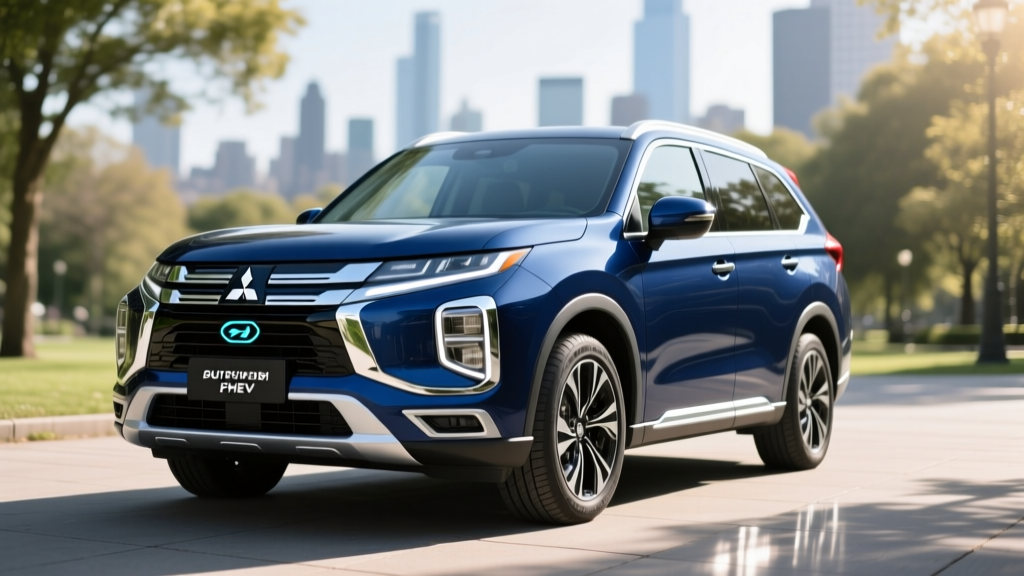
The 2026 Mitsubishi Outlander Hybrid — officially the Outlander PHEV — is a three-row plug-in hybrid SUV that bridges the gap between daily electric commuting and gas-powered road trips. With an EPA-rated 38 miles of electric-only range and a total combined range exceeding 400 miles, it targets buyers who want EV-like daily driving without committing to a full battery-electric vehicle. The trade-off? Real-world highway fuel economy falls short of the EPA sticker, and DC fast charging is limited to CHAdeMO — a connector standard that's increasingly rare at new public charging stations.
If you can charge at home and your commute fits within ~35 miles round-trip, the Outlander PHEV can run almost entirely on electricity most days. If you're looking for a conventional hybrid (HEV) that never needs plugging in, this isn't it — the Outlander is sold exclusively as a plug-in hybrid in the U.S. market.
| Spec | 2026 Outlander PHEV |
|---|---|
| Powertrain | 2.4L 4-cyl + dual electric motors (front/rear) |
| Combined Horsepower | 248 hp |
| Battery Capacity | 20.0 kWh (usable) |
| EPA Electric-Only Range | 38 miles |
| EPA Combined Range (gas + electric) | ~430 miles |
| EPA MPGe (electric mode) | 64 MPGe |
| EPA MPG (gas-only, combined) | 25 MPG (24 city / 27 highway) |
| DC Fast Charge (10-80%) | ~38 min at CHAdeMO (max ~22 kW) |
| Level 2 Charge (0-100%) | ~6.5 hours (240V, 15A) |
| Drivetrain | S-AWC (twin-motor AWD standard) |
| Seating | 7 passengers (3 rows) |
| Cargo (behind 3rd row) | 11.7 cu ft |
| Base MSRP | ~$41,495 (ES trim, incl. destination) |
| Battery Warranty | 10 years / 100,000 miles |
HEV vs. PHEV: What the Outlander Actually Is
Before we go further, let's clear up a common point of confusion. Mitsubishi sells the Outlander in two forms globally, but in the United States, the electrified version is exclusively a plug-in hybrid electric vehicle (PHEV). There is no conventional hybrid (HEV) Outlander available for the 2026 model year in the U.S.
| Feature | Conventional Hybrid (HEV) | Plug-In Hybrid (PHEV) — Outlander |
|---|---|---|
| Plug in to charge? | No — charges via regen & engine | Yes — plug in for max electric range |
| Electric-only range | 0-1 mile at low speed | 38 miles EPA |
| Battery size | ~1-2 kWh | 20.0 kWh usable |
| Federal tax credit | No | Up to $3,750 (see eligibility below) |
| Best for | No home charging access | Home charging + short commute |
The Outlander PHEV's 20.0 kWh battery is large enough to cover most daily commutes on electricity alone. When the battery depletes, the 2.4-liter gasoline engine kicks in seamlessly, and the vehicle operates like a conventional hybrid, using regenerative braking and engine-generated electricity to maintain efficiency.
Fuel Economy: EPA Ratings vs. Real-World MPG
According to fueleconomy.gov, the 2026 Outlander PHEV posts the following EPA estimates:
| Mode | City | Highway | Combined |
|---|---|---|---|
| Electric-only (MPGe) | — | — | 64 MPGe |
| Gas-only (MPG, charge-depleted) | 24 | 27 | 25 |
Real-World MPG: What to Actually Expect
PHEV fuel economy is notoriously dependent on how often you charge. Here's how the Outlander PHEV performs in practice:
- City driving, charged battery: Most owners report using zero gasoline on commutes under 35 miles. You'll see triple-digit MPGe in the trip computer.
- Highway driving, charge-depleted: Expect 22-24 MPG at 70-75 mph. The boxy three-row shape and ~4,800 lb curb weight work against highway efficiency. This is 2-3 MPG below the EPA highway sticker — a pattern common to most PHEVs once the battery buffer is exhausted.
- Mixed driving, never plugged in: If you treat it as a conventional hybrid and never charge, expect a sustained 23-25 MPG combined. You're carrying 20 kWh of battery weight without using its electric advantage.
Real-world range note: The EPA's 38-mile electric estimate assumes moderate temperatures and mixed driving. In winter conditions (below 32°F), expect electric-only range to drop to 28-32 miles due to battery chemistry losses and cabin heating demand. In summer with light city driving, some owners report 40-42 miles before the engine engages.
Powertrain and Performance
The Outlander PHEV uses Mitsubishi's twin-motor S-AWC (Super All-Wheel Control) system, which pairs a 2.4-liter Atkinson-cycle four-cylinder engine with two electric motors — one on each axle. The result is 248 combined system horsepower and standard all-wheel drive across all trims.
- Front motor: 114 hp / 188 lb-ft torque
- Rear motor: 134 hp / 144 lb-ft torque
- Gas engine: 126 hp / 147 lb-ft torque
- Combined system output: 248 hp
- 0-60 mph: ~7.1 seconds (adequate for a three-row SUV, not quick)
- Towing capacity: 1,500 lbs (limited — not a truck replacement)
The dual-motor layout provides genuinely useful AWD traction in rain and light snow, with the rear motor enabling torque-vectoring feel in corners. Acceleration from a stop is brisk thanks to instant electric torque, but highway passing power tapers once you're above 50 mph and the engine is doing the heavy lifting.
Charging: Speeds, Connectors, and the CHAdeMO Problem
Charging capability is where the Outlander PHEV reveals its age. Here's what you need to know:
| Level | Power | Time (0-100% or 10-80%) | Notes |
|---|---|---|---|
| Level 1 (120V household) | ~1.4 kW | ~14-15 hours (0-100%) | Emergency/trickle only |
| Level 2 (240V home/public) | ~3.6 kW | ~6.5 hours (0-100%) | Standard home charging solution |
| DC Fast (CHAdeMO) | ~22 kW peak | ~38 min (10-80%) | CHAdeMO only — no CCS or NACS |
The CHAdeMO issue: Mitsubishi has stuck with the CHAdeMO DC fast-charging connector while the broader industry has moved to CCS and now NACS (Tesla's standard). As of 2026, CHAdeMO stations are increasingly scarce — Electrify America and most new networks have standardized on CCS/NACS. You'll still find CHAdeMO at some older stations and certain regional networks, but availability is shrinking. For most PHEV owners, this matters less than it would for a full EV: a 20 kWh battery charges fully overnight on Level 2, making DC fast charging a convenience rather than a necessity.
Home charging setup: A standard 240V Level 2 home charger (even a basic 16A unit) will fully replenish the battery overnight. Installation typically costs $500-$1,500 depending on your electrical panel's proximity to the charging location. No panel upgrade is usually needed for PHEV-level charging speeds.
Pricing, Trims, and Tax Credit Eligibility
The 2026 Outlander PHEV lineup starts at approximately $41,495 (ES trim, including destination) and tops out near $52,000 for the fully loaded SEL Platinum Edition. Key trims include:
- ES: ~$41,495 — base, well-equipped with 8-inch display, heated front seats, S-AWC AWD
- SE: ~$44,495 — adds panoramic sunroof, power liftgate, 9-inch display
- SEL: ~$47,995 — leather, Bose audio, head-up display, advanced safety suite
- SEL Platinum Edition: ~$52,000 — two-tone paint, premium interior, all options
Does the Outlander PHEV Qualify for the Federal Tax Credit?
Under IRS §30D rules for 2026, the Outlander PHEV may qualify for a partial federal tax credit of up to $3,750, depending on battery component and critical-mineral sourcing compliance. The credit is subject to several constraints:
- MSRP cap: SUVs must be under $80,000 — all Outlander PHEV trims qualify
- Buyer income cap: $150,000 single / $225,000 head of household / $300,000 joint (modified AGI)
- Battery sourcing: The $3,750 critical-minerals component and $3,750 battery-components component are evaluated separately; the Outlander PHEV typically qualifies for one half ($3,750) but may not meet both thresholds — verify current-year status at IRS.gov
- Point-of-sale transfer: Available — you can transfer the credit to the dealer at purchase to reduce the sale price
Important: Tax credit eligibility rules change frequently based on battery sourcing requirements that tighten annually. Always confirm current eligibility on the official IRS page or consult a tax professional before making a purchase decision. Some states also offer additional PHEV incentives — check your state's energy office for details.
Reliability, Battery Warranty, and Long-Term Costs
The Outlander PHEV benefits from Mitsubishi's extensive experience with plug-in hybrid technology — this platform has been in production since 2012 globally. The current-generation powertrain is well-proven, and major reliability concerns are uncommon based on historical data.
Battery & Powertrain Warranty Coverage:
- Drive battery: 10 years / 100,000 miles (capacity retention threshold: ~70%)
- Powertrain: 10 years / 100,000 miles
- Basic vehicle: 5 years / 60,000 miles
- Roadside assistance: 5 years / unlimited miles
Mitsubishi's 10-year/100,000-mile battery warranty is among the best in the PHEV segment, matching Hyundai and Kia. The warranty guarantees the battery will retain a minimum percentage of original capacity (typically 70%) — if it degrades below that threshold within the warranty period, Mitsubishi will repair or replace it.
Battery Replacement Cost
If the drive battery needs replacement out of warranty, expect a cost in the range of $8,000-$12,000 (parts and labor). However, PHEV batteries experience less stress than full EV batteries because they operate in a narrower state-of-charge window — the vehicle's software maintains a buffer, never fully draining or fully charging the pack. This significantly extends cycle life, and most PHEV batteries outlast the vehicle itself.
Maintenance Costs
PHEVs still have an internal combustion engine, so you'll continue to pay for oil changes, spark plugs, and transmission fluid. However, regenerative braking extends brake pad life considerably — many owners report original brake pads lasting 80,000+ miles. Overall maintenance costs fall between a conventional gas vehicle and a full EV.
Who Should Choose the Outlander PHEV?
Choose the 2026 Outlander PHEV if:
- You have home charging (Level 1 or 2) and a commute under ~35 miles round-trip
- You need three rows of seating but don't want a full-size SUV
- You take road trips where charging infrastructure is uncertain
- You want AWD standard without the efficiency penalty of a gas-only AWD SUV
- You want to reduce fuel consumption significantly without full EV commitment
Look elsewhere if:
- You can't charge at home — without plugging in, you're paying for battery weight you're not using
- You need serious towing capacity (1,500 lb limit is restrictive)
- You want a full EV experience — consider the Hyundai Ioniq 5, Tesla Model Y, or Kia EV9
- Third-row cargo space is critical — 11.7 cu ft behind the third row is tight
- You rely on DC fast charging — the CHAdeMO connector is a growing liability
Pros
- 38-mile electric range covers most daily commutes
- Standard twin-motor AWD across all trims
- 10-year/100,000-mile battery warranty
- Three-row seating in a midsize footprint
- Partial federal tax credit eligibility (~$3,750)
- Proven PHEV powertrain with over a decade of refinement
Cons
- CHAdeMO-only DC fast charging (shrinking network)
- Gas-only highway MPG drops to 22-24 in practice
- Towing limited to 1,500 lbs
- Tight third-row cargo space (11.7 cu ft)
- 0-60 in ~7.1 seconds — adequate, not quick
- No conventional HEV option in the U.S.
Frequently Asked Questions
How many MPG does the 2026 Mitsubishi Outlander Hybrid get?
The Outlander PHEV is rated at 25 MPG combined (24 city / 27 highway) when running on gasoline after the battery is depleted. When charged, it achieves 64 MPGe combined in electric mode. Real-world highway MPG on gas alone tends to be 22-24 MPG at sustained speeds above 70 mph.
How far can the Outlander PHEV go on electric only?
The EPA rates the Outlander PHEV at 38 miles of electric-only range. In real-world conditions, expect 28-32 miles in cold weather and up to 40-42 miles in mild city driving. Total combined range (electric + gas) exceeds 430 miles.
Is the Outlander a hybrid or a plug-in hybrid?
In the U.S., the electrified Outlander is exclusively a plug-in hybrid (PHEV). It must be plugged in to achieve its rated electric range, though it will still function as a conventional hybrid if you never plug it in — just with lower fuel economy and wasted battery potential.
Hybrid vs. PHEV vs. EV — which is right for me?
A conventional hybrid (HEV) is best if you can't charge at home and want better MPG with zero behavior change. A PHEV like the Outlander is ideal if you can charge at home and want electric commuting with gas backup for road trips. A full EV (BEV) makes sense if you have reliable home charging, want zero tailpipe emissions, and your driving fits within ~250-300 miles between charges. PHEVs are the pragmatic middle ground for households transitioning to electric.
Is the Outlander PHEV reliable, and what does a battery replacement cost?
The Outlander PHEV platform has been in production since 2012 and is well-proven. Mitsubishi backs the drive battery with a 10-year/100,000-mile warranty. Out-of-warranty battery replacement is estimated at $8,000-$12,000, though most PHEV batteries last the life of the vehicle due to conservative charge management.
Does the 2026 Outlander PHEV qualify for a tax credit?
It may qualify for a partial federal tax credit of up to $3,750 under IRS §30D, subject to battery sourcing requirements, buyer income limits ($150K single / $300K joint), and the $80,000 SUV MSRP cap (all trims qualify). The credit can be transferred to the dealer at point of sale. Verify current eligibility at IRS.gov before purchasing.
Can I charge the Outlander PHEV at a Tesla Supercharger?
No. The Outlander PHEV uses a CHAdeMO connector for DC fast charging and a J1772 connector for Level 2 AC charging. Tesla Superchargers use the NACS connector, and there is no official adapter available for CHAdeMO-to-NACS conversion as of 2026. You can use any J1772-compatible Level 2 public charger for AC charging.
How long does it take to charge the Outlander PHEV at home?
On a standard 240V Level 2 home charger, a full 0-100% charge takes approximately 6.5 hours. Overnight charging is the practical norm — plug in when you get home and the battery will be full by morning. On a standard 120V outlet (Level 1), expect 14-15 hours, which is only practical as a trickle-charge supplement.
Sources: fueleconomy.gov (EPA ratings), IRS.gov (§30D tax credit rules), Mitsubishi Motors North America official specifications.