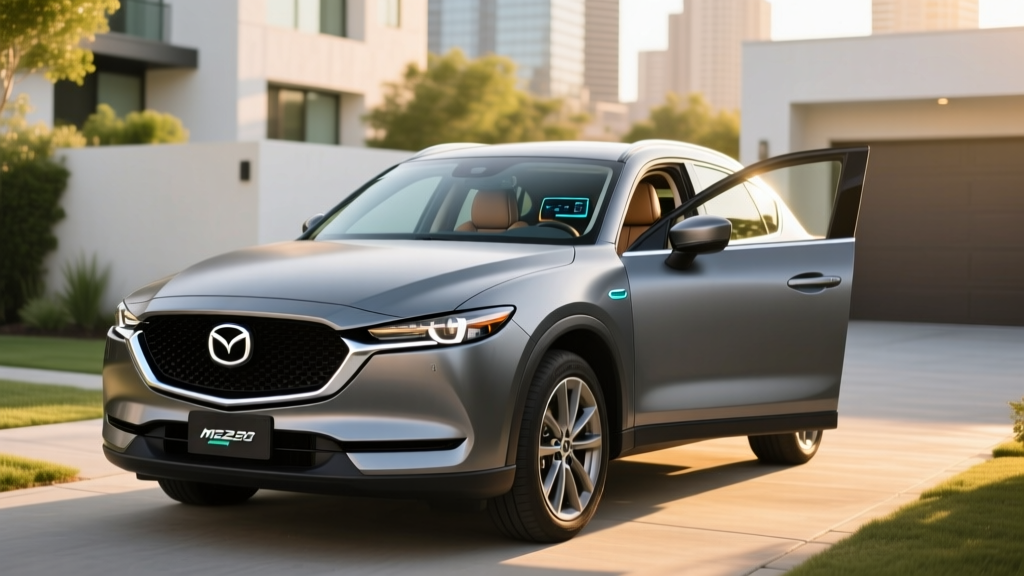
The compact SUV segment has no shortage of hybrid contenders, and the 2026 Mazda CX-5 Hybrid enters a battlefield dominated by the Toyota RAV4 Hybrid and Honda CR-V Hybrid. But Mazda has carved out a distinct lane: premium interior materials, sharper driving dynamics, and now a proven Toyota-sourced hybrid powertrain that promises serious fuel economy without sacrificing the brand's upscale feel. If you've been waiting for Mazda to electrify its best-selling SUV, the 2026 CX-5 Hybrid is the answer — but how does it stack up on paper and at the pump?
Hybrid vs. Plug-In Hybrid: What the CX-5 Actually Is
Before we dig into specs, it's critical to clarify what the 2026 CX-5 Hybrid is — and what it isn't. This is a conventional hybrid electric vehicle (HEV), not a plug-in hybrid (PHEV). That distinction matters for your wallet, your daily routine, and your tax situation.
Conventional Hybrid (HEV)
- No plug — charges via regenerative braking and the gas engine
- Small battery (~1.6 kWh) assists the engine
- No electric-only driving range to speak of
- No federal tax credit eligibility
- Fuel savings come from improved MPG, not electric miles
Plug-In Hybrid (PHEV)
- Plugs in to charge a larger battery (15-20+ kWh)
- 25-40 miles of electric-only range
- Eligible for up to $7,500 federal tax credit (§30D)
- More expensive upfront
- Requires home charging access for full benefit
Mazda has not announced a CX-5 PHEV variant for 2026. If you need plug-in capability, you'll want to look at the Toyota RAV4 Prime (42 miles electric-only) or the Hyundai Tucson PHEV (33 miles). The CX-5 Hybrid is designed for buyers who want better fuel economy without changing their refueling habits.
Fuel Economy: EPA Ratings and Real-World MPG
The 2026 CX-5 Hybrid uses the same 2.5-liter four-cylinder hybrid system found in the Toyota Camry Hybrid and RAV4 Hybrid — a proven, reliable architecture. Here's what the EPA estimates:
| Metric | Value |
|---|---|
| City MPG | 40 |
| Highway MPG | 38 |
| Combined MPG | 39 |
| Fuel Tank Capacity | 14.5 gal |
| Total Range (est.) | ~565 miles |
Compared to the outgoing gas-only CX-5 (26 MPG combined with the turbo engine, 28 MPG with the base 2.5L), the hybrid represents a 39-50% improvement in fuel economy. At $3.50/gallon and 12,000 miles per year, that translates to roughly $550-$700 in annual fuel savings over the non-hybrid CX-5.
Powertrain and Performance Specs
The hybrid system pairs a 2.5-liter Atkinson-cycle four-cylinder engine with two electric motor-generators and an electronically controlled continuously variable transmission (eCVT). Total system output is competitive with the segment:
| Specification | Value |
|---|---|
| Engine | 2.5L 4-cyl Atkinson-cycle |
| Combined Horsepower | 219 hp |
| Engine HP (standalone) | 176 hp |
| Electric Motor Output | ~134 hp (MG2 front motor) |
| Transmission | eCVT |
| Drivetrain | FWD (AWD optional) |
| 0-60 mph (est.) | ~7.2 seconds |
| Hybrid Battery Capacity | ~1.6 kWh (NiMH) |
| Towing Capacity | 1,500 lbs (est.) |
| Curb Weight | ~3,650 lbs |
The 219-hp combined output puts the CX-5 Hybrid slightly ahead of the RAV4 Hybrid (219 hp) and well above the Honda CR-V Hybrid (204 hp). The eCVT is smooth and unobtrusive — there are no simulated gear shifts or rubber-band sensations that plagued older CVTs. Mazda has tuned the throttle response to feel linear, and the transition between electric-only low-speed creep and engine engagement is nearly imperceptible.
AWD models use a separate rear-mounted electric motor (similar to Toyota's E-Four system) rather than a mechanical driveshaft. This provides on-demand rear traction without the efficiency penalty of a traditional AWD system. Expect AWD to reduce combined MPG by roughly 1-2 MPG.
Pricing, Trims, and Tax Credit Eligibility
Mazda has positioned the CX-5 Hybrid aggressively against its Japanese rivals. Here's the projected trim and pricing structure for 2026:
| Trim Level | FWD MSRP | AWD MSRP |
|---|---|---|
| Select | $33,990 | $35,390 |
| Preferred | $35,790 | $37,190 |
| Premium | $38,490 | $39,890 |
| Premium Plus | — | $42,390 |
All prices include destination charge. Pricing is based on Mazda's announced 2026 model-year MSRP.
Battery Warranty, Reliability, and Replacement Cost
This is the question every hybrid buyer asks: how long will the battery last, and what happens when it fails?
The Toyota-sourced hybrid system in the CX-5 has an exceptional reliability track record. Toyota has sold millions of vehicles with this architecture since the 1997 Prius, and real-world data shows hybrid battery packs routinely lasting 150,000-200,000+ miles before significant degradation. The NiMH chemistry used here is less energy-dense than lithium-ion but is extremely tolerant of the shallow charge-discharge cycles that hybrids use — the battery never fully charges or fully depletes, which dramatically extends cycle life.
If the battery does eventually need replacement out of warranty, expect a cost of $2,000-$3,500 for a refurbished or aftermarket pack, or $3,500-$5,000 for a new OEM unit installed at a dealership. Independent hybrid specialists in major metro areas often offer replacement at the lower end of that range. Given the proven longevity of this system, most original owners will never face this expense.
How the CX-5 Hybrid Compares to Its Rivals
The compact hybrid SUV segment is crowded. Here's how the CX-5 Hybrid stacks up against the two benchmarks:
| Spec | Mazda CX-5 Hybrid | Toyota RAV4 Hybrid | Honda CR-V Hybrid |
|---|---|---|---|
| Combined MPG | 39 | 39 | 37 |
| Combined HP | 219 | 219 | 204 |
| Starting MSRP (AWD) | $35,390 | $35,425 | $36,350 |
| Cargo (behind 2nd row) | ~30 cu ft | 37.6 cu ft | 36.3 cu ft |
| Hybrid Battery Warranty | 8 yr / 100k mi | 10 yr / 150k mi | 8 yr / 100k mi |
| Interior Quality | Premium | Mainstream | Mainstream+ |
The numbers tell a clear story: the CX-5 Hybrid matches the RAV4 on efficiency and power while offering a more upscale interior. Where it loses is cargo space — the CX-5 has always been one of the smaller compact SUVs, and the hybrid battery packaging slightly reduces under-floor storage. If maximum utility is your priority, the RAV4 Hybrid wins. If you value cabin materials, ride refinement, and driving engagement, the CX-5 Hybrid has no equal in this price range.
Who Should Buy the CX-5 Hybrid — and Who Shouldn't
✓ Choose the CX-5 Hybrid If:
- You want a premium-feeling SUV without luxury-brand pricing
- Your commute is mostly city/suburban (where hybrids shine)
- You don't have home charging access for a PHEV or EV
- You want 39 MPG without any change to your refueling routine
- You value quiet, composed ride quality over maximum cargo space
✗ Look Elsewhere If:
- You need maximum cargo room (RAV4 Hybrid has 7+ cu ft more)
- You want electric-only driving for short commutes (consider a PHEV)
- You're chasing the $7,500 federal tax credit (only BEVs/PHEVs qualify)
- You regularly tow more than 1,500 lbs
- You prefer a turbocharged engine's punch over hybrid smoothness
Hybrid vs. PHEV vs. Full EV: Which Powertrain Fits You?
The CX-5 Hybrid sits at one end of the electrification spectrum. Here's a quick decision framework:
- Conventional Hybrid (HEV) — like this CX-5: Best for apartment dwellers, those without garage access, or anyone who doesn't want to think about charging. You save 30-50% on fuel vs. a gas car. No behavior change needed.
- Plug-In Hybrid (PHEV) — like the RAV4 Prime: Best for homeowners with a garage/driveway who commute under 35 miles daily. You drive on electricity most days and use gas for road trips. Eligible for the federal tax credit. Higher upfront cost ($5,000-$8,000 more than an HEV).
- Full EV (BEV) — like the Tesla Model Y or Hyundai Ioniq 5: Best for homeowners who can install a Level 2 charger and want zero tailpipe emissions, minimal maintenance, and the lowest per-mile fuel cost. Requires a lifestyle adjustment around charging but offers the best long-term economics in most scenarios.
Frequently Asked Questions
How many MPG does the 2026 CX-5 Hybrid get?
The EPA estimates 40 MPG city, 38 MPG highway, and 39 MPG combined. In real-world city driving with frequent stops, owners often see 40-42 MPG thanks to regenerative braking. Highway driving at sustained speeds above 70 MPH typically yields 35-37 MPG. AWD models lose approximately 1-2 MPG across the board.
Does the CX-5 Hybrid need to be plugged in?
No. The CX-5 Hybrid is a conventional (self-charging) hybrid. The small battery charges through regenerative braking and the gasoline engine. You simply fill up at a gas station as you would with any other car.
Is the CX-5 Hybrid reliable?
The hybrid powertrain is sourced from Toyota, which has produced tens of millions of hybrid vehicles since 1997. The system has an exceptional reliability record, with battery packs commonly lasting 150,000-200,000+ miles. Mazda backs the hybrid battery with an 8-year/100,000-mile warranty (10 years/150,000 miles in CARB states).
What does a CX-5 Hybrid battery replacement cost?
If replacement is needed out of warranty, expect $2,000-$3,500 for a refurbished pack from an independent hybrid specialist or $3,500-$5,000 for a new OEM battery at a Mazda dealership. Given the Toyota hybrid system's proven longevity, most owners will never face this cost.
Does the 2026 CX-5 Hybrid qualify for any tax credit?
No. The federal §30D clean vehicle credit applies only to plug-in vehicles (BEVs and PHEVs) with a battery capacity of at least 7 kWh. The CX-5 Hybrid's ~1.6 kWh battery does not meet this threshold. Some states may offer minor incentives for hybrid purchases — check your local programs.
How does the CX-5 Hybrid compare to the gas-only CX-5?
The hybrid delivers approximately 39 MPG combined vs. 26-28 MPG for the gas models — a roughly 40-50% improvement. The hybrid also produces more combined horsepower (219 hp vs. 187 hp for the base 2.5L) while being more fuel-efficient. The trade-off is slightly less cargo space and a higher starting price (roughly $3,500-$4,000 more than the equivalent gas trim), which fuel savings typically recoup within 4-6 years at current gas prices.
Is there a CX-5 PHEV or EV version coming?
As of this writing, Mazda has not announced a CX-5 PHEV or fully electric variant for the 2026 model year. The brand's larger CX-70 and CX-90 offer mild-hybrid and PHEV options. For a Mazda EV, the closest current option is the MX-30, though it has limited availability and range.
Sources: fueleconomy.gov, Mazda USA, IRS Clean Vehicle Credits.