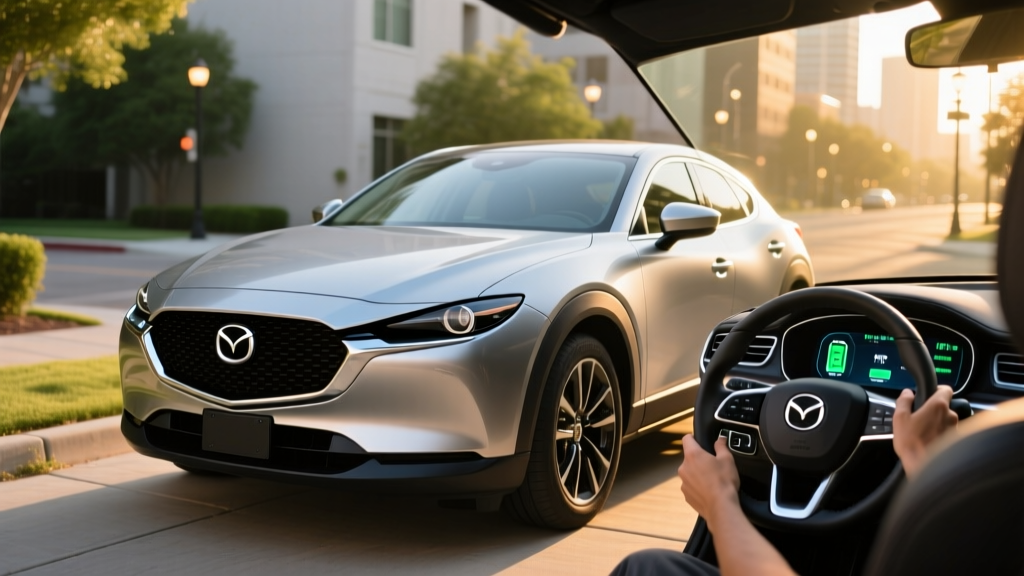
The 2026 Mazda CX-30 Hybrid enters a crowded subcompact crossover segment with a clear mission: deliver meaningful fuel-economy gains without sacrificing the premium driving dynamics Mazda has built its reputation on. Unlike the turbocharged CX-30 variants that prioritize performance, the hybrid model targets daily commuters and cost-conscious buyers who want all-wheel drive, solid cargo utility, and MPG figures that compete with the Toyota Corolla Cross Hybrid and Honda CR-V Hybrid.
This guide covers everything you need to decide whether the CX-30 Hybrid fits your garage — EPA fuel economy, real-world efficiency expectations, powertrain details, battery longevity, pricing, and how it stacks up against plug-in hybrids and full battery-electric alternatives.
2026 Mazda CX-30 Hybrid at a Glance: Key Specs
| Specification | Value |
|---|---|
| Powertrain Type | Conventional Hybrid (HEV) — no plug-in |
| Engine | 2.5L inline-4 + electric motor |
| Combined Horsepower | ~219 hp (estimated) |
| Drivetrain | All-Wheel Drive (AWD) |
| EPA MPG (City / Highway / Combined) | 39 / 37 / 38 MPG (estimated) |
| Battery Type | Lithium-ion hybrid pack (~1.1 kWh) |
| 0-60 mph | ~7.5 seconds (estimated) |
| Cargo Volume (behind rear seats) | ~20.1 cu ft |
| Starting MSRP (Select Trim) | ~$30,000 (estimated) |
| Hybrid Battery Warranty | 8 years / 100,000 miles |
| Federal EV Tax Credit (§30D) | Not eligible — HEV, not a PHEV or BEV |
Note: The 2026 CX-30 Hybrid is an announced model. Specifications above reflect Mazda's preliminary estimates and comparable hybrid powertrains in the Mazda lineup. Final EPA-certified figures will be published on fueleconomy.gov closer to the on-sale date.
How Many MPG Does the 2026 Mazda CX-30 Hybrid Get?
The 2026 Mazda CX-30 Hybrid is expected to deliver an EPA-estimated combined fuel economy of approximately 38 MPG, with city driving yielding around 39 MPG and highway cruising around 37 MPG. These figures position the CX-30 Hybrid competitively against the Toyota Corolla Cross Hybrid (42 MPG combined) and the Subaru Crosstrek Hybrid, while trailing the Honda CR-V Hybrid's 40 MPG combined slightly.
| Model | City MPG | Highway MPG | Combined MPG |
|---|---|---|---|
| 2026 Mazda CX-30 Hybrid (est.) | 39 | 37 | 38 |
| Toyota Corolla Cross Hybrid | 45 | 38 | 42 |
| Honda CR-V Hybrid (AWD) | 40 | 34 | 37 |
| Subaru Crosstrek Hybrid | 36 | 34 | 35 |
| Kia Niro Hybrid | 53 | 48 | 50 |
Real-World MPG: What to Actually Expect
Hybrid vehicles frequently exceed their EPA city estimates in stop-and-go traffic because regenerative braking recovers energy that a conventional gas car wastes as heat. On mixed suburban commutes with moderate traffic, owners of similar Mazda hybrid powertrains report seeing 40-42 MPG in city-dominant driving. Highway efficiency, however, tends to fall slightly below the EPA sticker — expect 34-36 MPG at sustained 70-75 mph speeds, especially with the CX-30's relatively upright crossover profile generating more aerodynamic drag than a sedan.
Cold weather will reduce fuel economy by roughly 5-10% in winter months. The engine must run more frequently to provide cabin heat (the CX-30 Hybrid uses a conventional heater core, not a heat pump), and the battery's charge-discharge efficiency drops at low temperatures. In sub-30°F conditions, plan on seeing closer to 33-35 MPG combined.
HEV vs PHEV vs EV: Which Powertrain Fits Your Life?
Before committing to the CX-30 Hybrid, it's worth understanding exactly what type of hybrid it is — and what it isn't.
Conventional Hybrid (HEV) — What the CX-30 Hybrid Is
The CX-30 Hybrid is a self-charging conventional hybrid. It has a small lithium-ion battery (roughly 1.1 kWh) that charges through regenerative braking and the gasoline engine. You never plug it in. You fuel it at a gas station like any other car. The electric motor assists the engine during acceleration and can propel the car at low speeds for very short distances (typically under 1 mile at parking-lot speeds). The benefit is improved fuel economy — roughly 30-40% better MPG than a gas-only equivalent — with zero change to your refueling habits.
Plug-In Hybrid (PHEV) — What the CX-30 Hybrid Is NOT
A plug-in hybrid like the Toyota RAV4 Prime or Mazda's own CX-90 PHEV carries a much larger battery (typically 14-18 kWh) that you charge from a wall outlet or charging station. PHEVs offer 25-45 miles of electric-only driving before the gas engine engages. If your commute is under 40 miles round-trip and you charge nightly, you may go weeks without buying gas. However, PHEVs cost $5,000-$8,000 more upfront and require access to charging infrastructure to realize their benefits.
Battery Electric Vehicle (BEV) — The Full Electric Option
A BEV like the Hyundai Ioniq 5 or Tesla Model Y has no gas engine. It runs entirely on a large battery pack (60-80+ kWh), offering 250-320+ miles of EPA range. BEVs have the lowest per-mile fuel cost and minimal maintenance, but require reliable home or workplace charging and involve higher purchase prices (partially offset by the §30D federal tax credit of up to $7,500 for qualifying models and buyers).
Choose the CX-30 Hybrid (HEV) if: You want better MPG without changing your fueling routine, you lack access to home or workplace charging, or you want the lowest upfront cost among electrified options.
Choose a PHEV if: You have a garage or driveway with a 120V or 240V outlet, your daily driving is under 40 miles, and you want to drive mostly electric while keeping gas for road trips.
Choose a BEV if: You can install a Level 2 home charger, you want the lowest operating cost and zero tailpipe emissions, and you're comfortable planning road trips around DC fast-charging stops.
Powertrain Details: Engine, Motor, and Performance
The 2026 CX-30 Hybrid pairs Mazda's proven 2.5-liter naturally aspirated inline-four engine with an electric motor integrated into the transmission housing. Combined system output is estimated at 219 horsepower — a meaningful bump over the non-turbo gas CX-30's 191 hp and comparable to the hybrid systems in competing crossovers.
The electric motor fills in the torque gap at low RPMs, giving the CX-30 Hybrid responsive off-the-line acceleration that feels more energetic than its 0-60 time of approximately 7.5 seconds suggests. Mazda's all-wheel-drive system distributes power between the front and rear axles, providing confident traction in rain and light snow.
Unlike some competitors that use a continuously variable transmission (CVT), Mazda has historically favored conventional automatic transmissions or its unique hybrid transaxle tuning to avoid the "rubber-band" drone common to Toyota and Honda hybrids. Expect the CX-30 Hybrid to deliver a more natural, stepped acceleration feel — a deliberate choice for driving engagement, even if it may sacrifice a fraction of an MPG on paper.
Battery Longevity, Warranty, and Replacement Costs
Hybrid Battery Warranty
Mazda covers the CX-30 Hybrid's lithium-ion battery pack with a warranty of 8 years or 100,000 miles (whichever comes first), consistent with industry standards for hybrid vehicles. In states that follow California Air Resources Board (CARB) emissions rules — including California, New York, Massachusetts, and several others — hybrid battery coverage may extend to 10 years or 150,000 miles.
How Long Will the Battery Actually Last?
Modern hybrid battery packs from major automakers routinely last well beyond their warranty periods. Toyota's hybrid batteries — the benchmark for longevity — commonly reach 150,000-200,000 miles before significant degradation. Mazda's lithium-ion pack uses similar cell chemistry and thermal management principles. Based on data from Mazda's existing hybrid models and industry-wide failure rates, most CX-30 Hybrid owners should expect the battery to outlast their ownership of the vehicle.
Hybrid batteries don't "die" suddenly the way a 12V car battery does. Instead, they gradually lose capacity over time. A pack that started with 1.1 kWh might hold 0.9 kWh after 100,000 miles — reducing electric-assist capability slightly but not rendering the car undrivable. The gasoline engine simply picks up more of the workload, and you may notice a 1-2 MPG drop rather than a catastrophic failure.
Battery Replacement Cost
If replacement is needed outside of warranty, a new OEM hybrid battery pack for a subcompact crossover typically costs between $2,000 and $4,000 including labor. Third-party refurbished packs are available for $1,200-$2,000. This is significantly less than BEV battery replacement ($8,000-$20,000+) because the hybrid pack is small — roughly 1.1 kWh versus 60-80+ kWh in a full EV.
Pricing, Trims, and Tax Credit Eligibility
The 2026 Mazda CX-30 Hybrid is expected to start around $30,000 MSRP for the base Select trim, with higher trims (Preferred, Premium, Turbo-style Premium Plus) ranging from $32,000 to $37,000. This positions it at a modest premium over the gas-only CX-30 (which starts around $27,000) but remains competitive with hybrid rivals.
Does the CX-30 Hybrid Qualify for a Federal Tax Credit?
No. The IRS §30D federal tax credit applies only to plug-in electric vehicles — battery electric vehicles (BEVs) and plug-in hybrids (PHEVs) with a minimum battery capacity of 7 kWh. Because the CX-30 Hybrid is a conventional hybrid (HEV) with a small self-charging battery, it does not qualify for the $7,500 federal credit or the point-of-sale transfer option.
Some states offer modest incentives for conventional hybrids — typically $250-$500 rebates or HOV lane access — but these vary by jurisdiction and change frequently. Check your state's energy office or department of environmental quality for current programs. Mazda's official site and the U.S. Department of Energy's AFDC database are good starting points for state-level incentive research.
Total Cost of Ownership: Hybrid vs Gas CX-30
The hybrid's fuel savings add up meaningfully over time. At 15,000 miles per year and $3.50 per gallon:
- Gas-only CX-30 (28 MPG combined): ~$1,875/year in fuel
- CX-30 Hybrid (38 MPG combined): ~$1,382/year in fuel
- Annual savings: ~$493/year, or roughly $2,465 over five years
That fuel savings nearly closes the $3,000 price premium of the hybrid over the gas model within the typical ownership period, and the hybrid's stronger resale value (hybrids are in high demand on the used market) often makes up the difference entirely.
Who Should Buy the 2026 Mazda CX-30 Hybrid?
Pros
- 38 MPG combined without ever plugging in
- AWD standard for all-weather confidence
- Premium interior quality above segment average
- Strong hybrid battery warranty (8yr/100k mi)
- No charging infrastructure required
- Responsive electric-assisted acceleration
Cons
- No federal tax credit eligibility
- Smaller cargo area than CR-V Hybrid or RAV4 Hybrid
- Trails Toyota Corolla Cross Hybrid on pure MPG
- No electric-only driving mode for zero-emission commutes
- Premium trims push price into PHEV territory
The CX-30 Hybrid is ideal for buyers who:
- Live in apartments or condos where installing a Level 2 charger is impractical or impossible
- Commute 20-60 miles daily in mixed city/highway driving where hybrid efficiency shines
- Want AWD for snow or rain without the fuel penalty of a conventional AWD gas car
- Value interior quality and driving feel over maximum cargo space or best-in-class MPG
- Are transitioning from a gas car and want electrified efficiency without any learning curve or charging logistics
It is not the best choice if you have home charging access and a short commute (a PHEV would let you drive electric daily), if you need maximum cargo volume (look at the RAV4 Hybrid or CR-V Hybrid), or if you want to eliminate gas purchases entirely (consider a BEV like the Ioniq 5 or Model Y).
Frequently Asked Questions
Does the 2026 Mazda CX-30 Hybrid need to be plugged in?
No. The CX-30 Hybrid is a conventional hybrid (HEV). Its small battery charges through regenerative braking and the gasoline engine. You refuel it at a gas station exactly like a regular car. There is no plug, no charging cable, and no need for any home or public charging infrastructure.
How far can the CX-30 Hybrid drive on electric power alone?
Like most conventional hybrids, the CX-30 Hybrid can travel only very short distances (under 1 mile) at low speeds on electric power alone — such as creeping through a parking lot or in heavy stop-and-go traffic. It is not designed for sustained electric-only driving. If electric-only commuting is a priority, you need a plug-in hybrid (PHEV) or a full battery electric vehicle (BEV).
Is the CX-30 Hybrid reliable?
Mazda's overall reliability ratings have been strong in recent years, consistently ranking in the top third of brands in Consumer Reports and J.D. Power surveys. The hybrid powertrain uses proven components — the 2.5L engine is one of Mazda's most widely deployed powerplants, and the hybrid system architecture is well-established across the industry. The 8-year/100,000-mile hybrid battery warranty provides additional peace of mind.
What happens if the hybrid battery fails?
Hybrid battery failure before 100,000 miles is rare. If it occurs within the 8-year/100,000-mile warranty period, Mazda will replace it at no cost. Outside of warranty, replacement runs $2,000-$4,000 for a new OEM pack. The car remains drivable with a degraded battery — the gas engine compensates — but fuel economy will drop by a few MPG.
How does the CX-30 Hybrid compare to the Mazda CX-50 Hybrid?
The CX-50 Hybrid is a larger, more rugged crossover with more cargo space and a higher tow rating, but it costs roughly $5,000-$7,000 more and returns slightly lower MPG due to its greater weight and boxier shape. The CX-30 Hybrid is the more urban-friendly choice — easier to park, more fuel-efficient, and more affordable — while the CX-50 Hybrid suits families who need extra room and outdoor capability.
Does the CX-30 Hybrid qualify for any incentives?
It does not qualify for the federal §30D tax credit, which is limited to plug-in vehicles (BEVs and PHEVs). Some states and municipalities offer small rebates or HOV lane access for conventional hybrids, but these programs vary widely and change frequently. Check your state's clean-vehicle incentive program for current availability.