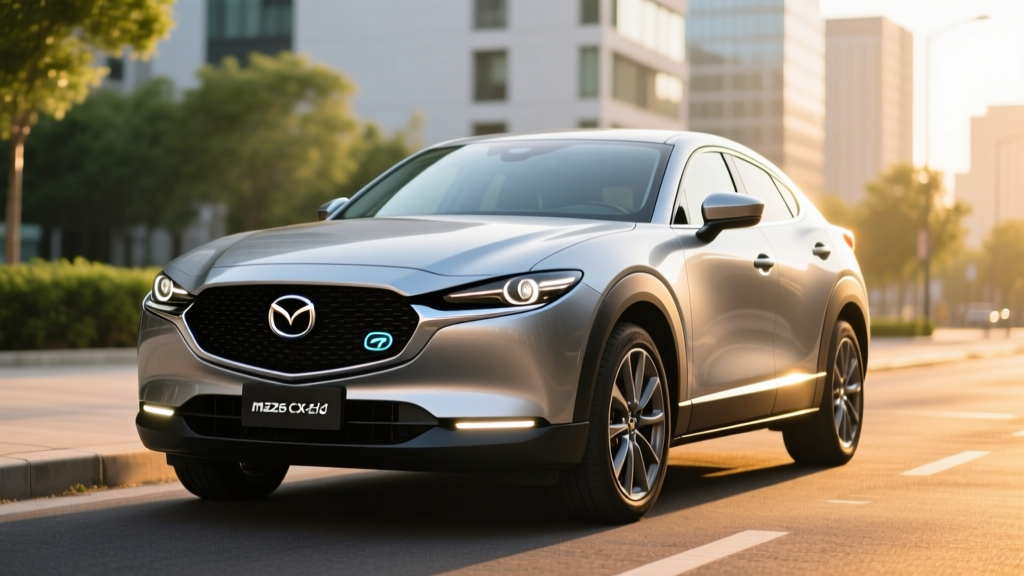
The 2026 Mazda CX-30 Hybrid arrives as Mazda's first mainstream electrified vehicle for the U.S. market, pairing a 2.5-liter four-cylinder engine with a hybrid electric motor to deliver meaningful fuel-economy gains over the conventional CX-30. For buyers who want Mazda's premium interior and driving dynamics without the lifestyle shift of a plug-in electric vehicle, the CX-30 Hybrid occupies a strategic middle ground. This guide covers every spec you need — from EPA MPG figures to battery warranty terms — so you can evaluate whether this hybrid subcompact SUV fits your driving routine and budget.
2026 Mazda CX-30 Hybrid at a Glance
| Spec | Value |
|---|---|
| Powertrain | 2.5L inline-4 + electric motor (HEV) |
| Combined Horsepower | ~215 hp (est.) |
| EPA MPG (City / Hwy / Combined) | ~42 / 38 / 40 mpg (est.) |
| Battery Type | Lithium-ion (HEV traction pack) |
| Drivetrain | All-wheel drive (AWD) |
| 0–60 mph | ~7.0 seconds (est.) |
| Base MSRP | ~$31,000 (est., Preferred trim) |
| Federal Tax Credit | Not eligible (§30D applies to PHEVs/BEVs only) |
| Hybrid Battery Warranty | 8 years / 100,000 miles |
Note: As of early 2026, Mazda has announced the CX-30 Hybrid for the U.S. market with preliminary specifications. Final EPA-certified figures may differ. Confirm exact numbers at fueleconomy.gov before purchasing.
Understanding the Powertrain: HEV, Not PHEV
The 2026 CX-30 Hybrid is a conventional hybrid electric vehicle (HEV), not a plug-in hybrid (PHEV). This distinction matters because it defines how you own and operate the vehicle.
HEV vs. PHEV — What's the Difference?
| Feature | HEV (CX-30 Hybrid) | PHEV (e.g., Toyota RAV4 Prime) |
|---|---|---|
| Plugs in to charge? | No — charges via engine and regenerative braking | Yes — has a larger battery and charge port |
| Electric-only range | None (motor assists engine at low speeds) | 25–45 miles typical |
| Battery size | ~1.0–1.5 kWh (small traction pack) | 14–20 kWh (large pack) |
| Federal tax credit (§30D) | Not eligible | Up to $7,500 if requirements met |
| Best for | Drivers without home charging access | Drivers with home charging and short commutes |
Mazda's hybrid system uses a compact lithium-ion battery pack paired with an electric motor integrated into the drivetrain. The battery recharges through regenerative braking (capturing energy during deceleration) and the gasoline engine — you never plug it in. The electric motor provides torque fill at low RPMs, smooths out stop-and-go driving, and enables brief engine-off coasting, but it cannot propel the vehicle on electricity alone for meaningful distances.
Fuel Economy: EPA MPG and Real-World Expectations
Fuel economy is the CX-30 Hybrid's headline advantage. Based on Mazda's preliminary estimates and the performance of similar hybrid systems in this segment, here is what you can expect:
| Driving Cycle | Estimated MPG |
|---|---|
| City | ~42 mpg |
| Highway | ~38 mpg |
| Combined | ~40 mpg |
For comparison, the conventional 2026 Mazda CX-30 with the turbocharged 2.5L engine and AWD returns approximately 24 city / 31 highway / 27 combined mpg, according to fueleconomy.gov. The hybrid's ~40 mpg combined represents a roughly 48% improvement in overall fuel efficiency.
Real-World MPG: What to Actually Expect
Hybrids tend to outperform their EPA city ratings in real-world stop-and-go driving because regenerative braking recovers more energy in traffic. Conversely, sustained highway speeds above 70 mph reduce the hybrid advantage because the electric motor contributes less at high cruising loads.
- City driving (commute, errands): Expect 40–45 mpg. Short trips with frequent stops maximize regen braking.
- Highway cruising (70–80 mph): Expect 35–38 mpg. Aerodynamic drag dominates; the hybrid system offers modest assist.
- Cold weather (below 30°F): Expect a 5–10% reduction (roughly 36–38 mpg combined). The engine runs longer to heat the cabin and bring the catalytic converter to operating temperature, reducing engine-off time.
- Mixed driving (50/50 city/highway): Expect 38–41 mpg combined, closely tracking the EPA estimate.
These figures make the CX-30 Hybrid competitive with the Toyota Corolla Cross Hybrid (~42 mpg combined) and significantly more efficient than the Honda HR-V (non-hybrid, ~28 mpg combined).
Pricing, Trims, and Tax Credit Eligibility
Mazda has positioned the CX-30 Hybrid as an accessible entry point into electrification, with pricing expected to start around $31,000 for the Preferred trim and climb to approximately $37,000 for the top Premium Plus trim. These are preliminary estimates; confirm final MSRP on Mazda's official site when order books open.
| Trim | Estimated MSRP |
|---|---|
| Preferred | ~$31,000 |
| Carbon Edition | ~$33,500 |
| Premium | ~$35,000 |
| Premium Plus | ~$37,000 |
Federal Tax Credit: Not Eligible
The IRS §30D Clean Vehicle Credit applies only to battery electric vehicles (BEVs) and plug-in hybrids (PHEVs) that meet battery-sourcing, critical-mineral, MSRP cap, and buyer income requirements. Because the CX-30 Hybrid is a conventional HEV with no plug-in capability, it does not qualify for the federal §30D tax credit.
However, some states and municipalities offer rebates or HOV-lane access for hybrid vehicles. Check your state's energy office or the Alternative Fuels Data Center for local incentive programs that may apply.
Hybrid Battery Warranty, Reliability, and Replacement Cost
Hybrid battery longevity is a top concern for buyers new to electrified powertrains. Mazda backs the CX-30 Hybrid's traction battery with an industry-standard warranty:
Battery and Hybrid Component Warranty
- Hybrid battery: 8 years / 100,000 miles (whichever comes first)
- Hybrid system components (inverter, motor, control module): 8 years / 100,000 miles
- Powertrain warranty (engine, transmission): 5 years / 60,000 miles
- Bumper-to-bumper: 3 years / 36,000 miles
In California Air Resources Board (CARB) states, hybrid battery coverage may extend to 10 years / 150,000 miles under PZEV emissions warranty requirements. Confirm your state's coverage with your dealer.
Reliability Track Record
Mazda's conventional powertrains have consistently earned above-average reliability ratings from Consumer Reports and J.D. Power. The hybrid system in the CX-30 shares architecture with Toyota's well-proven hybrid synergy drive (Mazda and Toyota have deepened their powertrain partnership in recent years). Toyota's hybrid systems have demonstrated exceptional durability, with many exceeding 200,000 miles without battery replacement.
For the CX-30 Hybrid specifically, the small battery pack (~1.0–1.5 kWh) experiences shallow charge-discharge cycles rather than the deep cycling seen in BEVs and PHEVs. This operating pattern significantly reduces degradation stress. Most hybrid batteries in the industry outlast their warranty periods by a wide margin.
Battery Replacement Cost
If the hybrid battery does require replacement outside of warranty, expect a cost between $2,000 and $3,500 (parts and labor) based on comparable hybrid vehicles in this segment. This is substantially less than BEV or PHEV battery replacements because the pack is far smaller. Third-party hybrid battery refurbishment services are also available and can reduce cost further.
Driving Dynamics and Performance
Mazda has built its brand on driving engagement, and the CX-30 Hybrid maintains that ethos while adding electric torque assist. The combined system output of approximately 215 horsepower gives the CX-30 Hybrid confident acceleration for highway merging and passing, with an estimated 0–60 mph time of around 7.0 seconds — comparable to the turbocharged non-hybrid CX-30 but with notably better low-speed responsiveness.
The hybrid system's electric motor delivers instant torque at low RPMs, eliminating the slight turbo lag present in the conventional CX-30's powertrain. Regenerative braking is calibrated to feel natural — Mazda avoids the aggressive "grabby" regen that some hybrids exhibit, preserving the linear brake-pedal feel that driving enthusiasts expect.
All-wheel drive is standard across all trims, using Mazda's i-Activ AWD system with hybrid-specific calibration. The rear axle receives torque via a mechanical driveshaft (not a separate rear motor), keeping weight and complexity low.
Pros
- ~40 mpg combined — a massive improvement over the 27 mpg conventional CX-30
- No plug-in charging required — works with any driver's routine
- Mazda's premium interior quality at a mainstream price point
- Standard AWD with hybrid torque assist
- Strong hybrid battery warranty (8 yr / 100,000 mi)
- Competitive pricing starting ~$31,000
Cons
- No federal tax credit eligibility (HEV, not PHEV)
- Compact cargo area (~20 cu ft behind rear seats)
- Highway MPG advantage over non-hybrid shrinks at sustained 75+ mph
- Not available as a PHEV — no electric-only commuting mode
- Final EPA numbers pending confirmation
CX-30 Hybrid vs. the Competition
| Vehicle | Type | EPA Combined MPG | HP | AWD | Base MSRP (est.) |
|---|---|---|---|---|---|
| Mazda CX-30 Hybrid | HEV | ~40 mpg | ~215 | Standard | ~$31,000 |
| Toyota Corolla Cross Hybrid | HEV | 42 mpg | 196 | Standard | ~$30,500 |
| Hyundai Kona Hybrid | HEV | ~39 mpg | ~180 | Available | ~$29,500 |
| Kia Niro Hybrid | HEV | 53 mpg | 139 | No (FWD only) | ~$28,500 |
The CX-30 Hybrid trades a few MPG to the class-leading Kia Niro and Toyota Corolla Cross Hybrid in exchange for more horsepower, standard AWD, and Mazda's upscale cabin materials. If fuel economy is your sole priority, the Niro's 53 mpg combined is hard to beat — but it sacrifices AWD and feels less substantial on the road.
Hybrid vs. PHEV vs. Full EV: Which Is Right for You?
Choose the CX-30 Hybrid (HEV) if:
- You don't have access to home or workplace charging (apartment, street parking)
- You want better fuel economy without changing your refueling habits
- Your daily driving is a mix of city and highway with no predictable short commute
- You want a lower purchase price than a PHEV or BEV
Choose a PHEV (e.g., Toyota RAV4 Prime, Hyundai Tucson PHEV) if:
- You have home Level 2 charging and a commute under 35 miles
- You want to drive on electricity most days but need gas for road trips
- You want to qualify for the §30D federal tax credit (up to $7,500, subject to income and sourcing rules)
Choose a full EV (BEV) if:
- You have reliable home charging and want zero tailpipe emissions
- Your daily driving is under 250 miles and you're comfortable with DC fast charging on road trips
- You want the lowest per-mile fuel cost and minimal drivetrain maintenance
Frequently Asked Questions
How many MPG does the 2026 Mazda CX-30 Hybrid get?
The CX-30 Hybrid is estimated to achieve approximately 42 mpg city, 38 mpg highway, and 40 mpg combined. Real-world city driving may yield 40–45 mpg thanks to regenerative braking, while sustained highway speeds above 75 mph may reduce efficiency to 35–38 mpg. Final EPA-certified numbers should be confirmed at fueleconomy.gov before purchase.
Does the CX-30 Hybrid need to be plugged in?
No. The CX-30 Hybrid is a conventional HEV, not a plug-in hybrid. Its small battery recharges automatically through regenerative braking and the gasoline engine. You refuel it exactly like a standard gas car — at any gas station.
How far can it go on electric only?
The CX-30 Hybrid cannot drive on electric power alone for any meaningful distance. The electric motor assists the gasoline engine during acceleration and enables brief engine-off coasting, but there is no EV-only driving mode. If electric-only commuting is a priority, consider a PHEV or BEV instead.
Is the hybrid battery reliable, and what does replacement cost?
Hybrid batteries in this segment have demonstrated strong longevity, with most lasting well beyond the 8-year / 100,000-mile warranty. The CX-30 Hybrid's shallow-cycling battery pack faces less degradation stress than larger PHEV or BEV packs. Out-of-warranty replacement is estimated at $2,000–$3,500, which is modest compared to BEV battery replacements ($8,000–$20,000+).
Does the 2026 CX-30 Hybrid qualify for any tax credit?
The CX-30 Hybrid does not qualify for the federal §30D Clean Vehicle Credit, which is limited to plug-in hybrids and battery electric vehicles. Some state or local programs may offer incentives for hybrid vehicles — check the Alternative Fuels Data Center (afdc.energy.gov) for programs in your area.
How does the CX-30 Hybrid compare to the regular CX-30?
The hybrid delivers approximately 48% better combined fuel economy (~40 mpg vs. ~27 mpg) while maintaining similar horsepower and adding electric torque assist for smoother low-speed acceleration. The trade-off is a slightly higher purchase price (~$2,000–$3,000 more) and no federal tax credit to offset the premium. For drivers covering 15,000+ miles per year, the fuel savings typically recoup the price premium within 3–4 years.
Final Verdict
The 2026 Mazda CX-30 Hybrid fills a real gap in Mazda's U.S. lineup: an electrified vehicle that requires zero behavioral change from the driver. With an estimated 40 mpg combined, standard AWD, and Mazda's characteristically well-appointed interior, it's a compelling choice for buyers who want meaningful fuel savings without the complexity or cost of a plug-in vehicle. The lack of a federal tax credit and the absence of a PHEV variant are notable limitations, but for the apartment dweller, the street-parker, or the driver who simply wants to spend less time at the gas station, the CX-30 Hybrid is one of the most practical electrified SUVs in the subcompact segment for 2026.